3D Scanning for Irish Heritage: Digitising Our Past with Precision
Ireland's rich tapestry of history, from ancient monastic sites to intricate Viking artefacts, is a source of immense national pride. However, time, environmental factors, and even human interaction constantly threaten these invaluable relics. How can we ensure these treasures endure for future generations, not just in memory but in tangible, accessible forms? The answer lies in the revolutionary power of 3D scanning, a technology that is rapidly transforming how we approach heritage preservation in Ireland.
At PrintIn3D.ie, we're passionate about bringing ideas to life, and that includes helping to safeguard Ireland's incredible past. Our advanced 3D scanning services offer a non-invasive, highly accurate method to capture the intricate details of historical objects and sites, creating digital archives that can last forever. Beyond digital preservation, these scans can be transformed into physical replicas using high-quality 3d printer filaments, making our history more accessible for study, exhibition, and education than ever before. Join us as we explore how 3D scanning is precisely digitising our past and shaping the future of Irish heritage.
- The Power of 3D Scanning in Heritage Preservation
- How 3D Scanning Works: A Glimpse Behind the Tech
- Beyond Digital: Bringing Heritage to Life with 3D Printing
- PrintIn3D.ie: Your Partner in Irish Heritage Digitisation
- Applications: Preserving Ireland's Treasures
- The Future of Irish Heritage: Digital, Accessible, and Sustainable
- Frequently Asked Questions About 3D Scanning & Heritage
The Power of 3D Scanning in Heritage Preservation
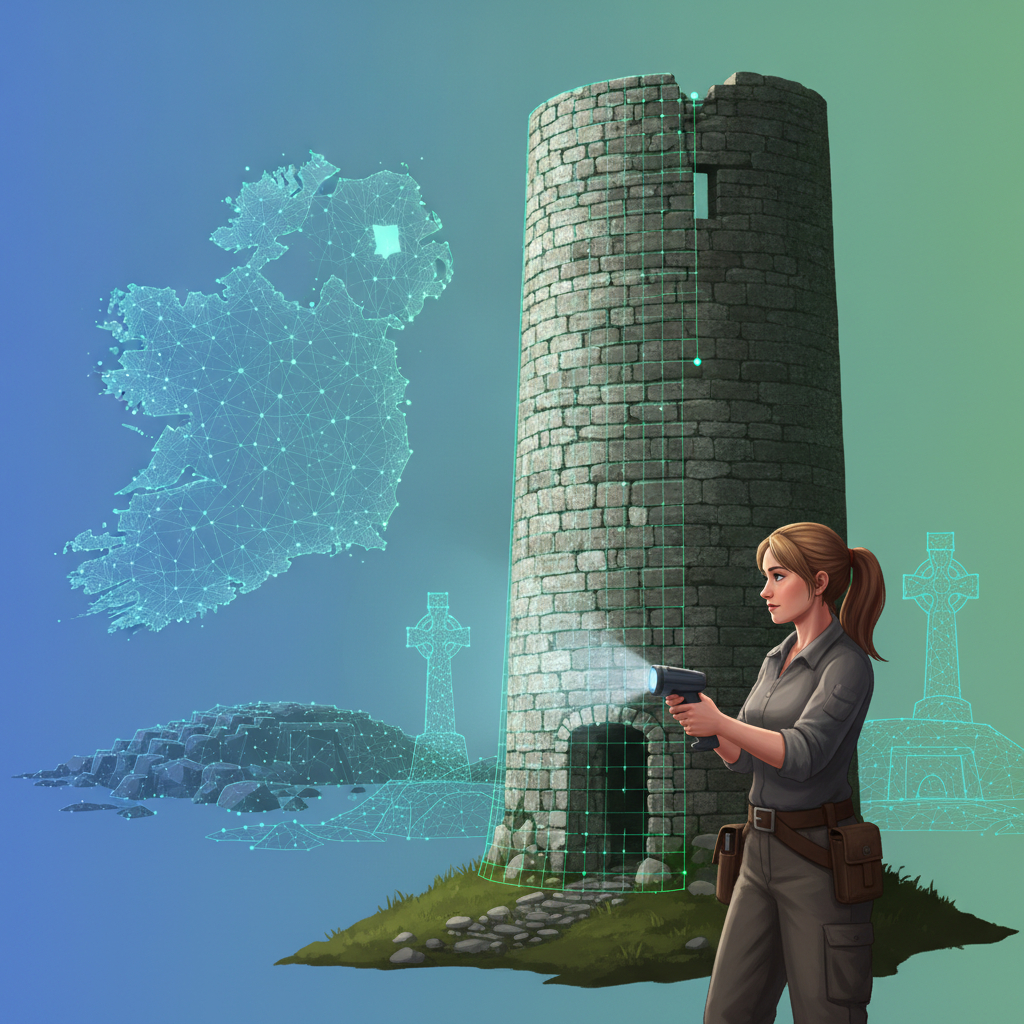
Imagine being able to meticulously capture every crack, inscription, and texture of a 2,000-year-old Celtic cross without ever touching it. This is the magic of 3D scanning. By creating a precise digital replica, we gain an unparalleled ability to study, preserve, and share our cultural inheritance.
Preserving Fragile Artefacts Digitally
Many of Ireland's most precious artefacts are incredibly delicate. Exposure to light, humidity, or even the slightest physical contact can cause irreversible damage. Traditional documentation methods, like photography or hand-drawn sketches, offer limited data and can miss crucial details. 3D scanning, however, provides a comprehensive, non-contact solution. It captures the exact geometry, surface details, and even colour information of an object, creating a "digital twin" that can be examined endlessly without risk to the original. This is vital for items housed in museums or archaeological finds that are too fragile to be moved or frequently handled. For any institution seeking a 3d printing service Dublin or beyond, the process often begins with digital capture.
Documenting Archaeological Sites with Precision
Archaeological digs are a race against time. Once a site is excavated, it begins to degrade. 3D scanning offers an incredible advantage here, allowing archaeologists to capture entire sites or specific features with unprecedented speed and accuracy before they are re-covered or altered. From ancient settlements to burial mounds, the resulting 3D models provide an enduring record, enabling future research, virtual reconstructions, and even public tours without disturbing the physical location. This capability is revolutionising how we approach archaeological survey and documentation across 3d printing Ireland.
Creating Immersive Educational Experiences
Digital 3D models aren't just for researchers; they're powerful educational tools. Imagine school children in Mayo or students in Dublin being able to virtually explore the interior of a Neolithic passage tomb or manipulate a detailed 3D model of an ancient Viking sword on a screen. These immersive experiences bring history to life in a way textbooks simply cannot, fostering a deeper understanding and appreciation for Ireland's past. Museums and heritage centres can utilise these models for interactive displays, virtual reality experiences, and online exhibits, making Irish heritage accessible to a global audience.
How 3D Scanning Works: A Glimpse Behind the Tech
At its core, 3D scanning involves capturing the physical shape of an object or environment and converting it into a digital, three-dimensional model. There are various technologies, but generally, they work by emitting light (laser or structured light) and measuring its distortion as it reflects off a surface. This data is then translated into a "point cloud" – millions of tiny points representing the object's geometry – which is then processed to create a mesh model.
From Physical Object to Digital Model
The process begins with our skilled technicians deploying state-of-the-art 3D scanners. For smaller, intricate artefacts, we might use high-resolution structured light scanners that project patterns onto the object and capture how those patterns deform. For larger objects or even entire rooms, handheld laser scanners offer flexibility and speed. The scanner captures thousands, sometimes millions, of data points per second. This raw data is then meticulously processed using specialised software, cleaned of any noise, and stitched together to form a complete, accurate 3D model. This digital model can then be stored, analysed, or even prepared for 3D printing.
The Role of Data Accuracy and Detail
In heritage preservation, accuracy is paramount. Every tiny detail – a faint carving, a tool mark, a unique patina – tells a story. Our 3D scanning services are designed to capture these details with exceptional precision, often down to sub-millimetre levels. This means the digital model is a true representation of the original, preserving all its nuances. This level of detail is crucial for academic study, conservation planning, and creating authentic physical reproductions. It’s why our expertise is sought after by businesses and individuals looking for high-quality 3d product design services Ireland, extending naturally to heritage applications.
Beyond Digital: Bringing Heritage to Life with 3D Printing
The power of 3D scanning doesn't end with a digital file. These precise models can be transformed into physical objects through 3D printing, opening up incredible new possibilities for heritage interpretation and accessibility. From educational replicas to tactile experiences, 3D printing breathes new life into our past.
The Critical Role of 3D Printer Filaments
Once a historical artefact or site feature has been meticulously 3D scanned and processed into a digital model, the next exciting step is often to bring it back into the physical world. This is where 3d printer filaments become absolutely crucial. The choice of filament directly impacts the strength, appearance, and tactile feel of the printed replica. For heritage applications, considerations might include durability for handling, paintability for accurate colour representation, or specific material properties to mimic the original artefact's texture. At PrintIn3D.ie, we offer a wide range of high-quality filaments, including popular choices like PLA and PETG, and can advise on the best material for your specific heritage project, whether you're looking to buy abs filament Ireland or need a robust, weather-resistant material.
Replicating Artefacts for Study and Display
Imagine a museum wanting to display a priceless, fragile artefact. A 3D printed replica allows them to do so safely, protecting the original while still offering visitors a close-up, sometimes even touchable, experience. Researchers can also use these replicas for hands-on study without risking damage to the primary source. This capability is invaluable for institutions across 3d printing Dublin and beyond, providing a practical solution for exhibiting and learning.
Accessible Heritage: Tactile Models for All
One of the most profound impacts of 3D printing in heritage is the ability to create tactile models for visually impaired individuals. By printing accurate, scaled-down, or even life-size replicas of statues, architectural features, or tools, we can make heritage sites and museum collections accessible to everyone, promoting inclusivity and a deeper connection to our history. This aligns with PrintIn3D.ie's commitment to making 3D technology accessible and hassle-free for all.
PrintIn3D.ie: Your Partner in Irish Heritage Digitisation
As a 'Rising Star' at the Irish Print Awards 2026 and a finalist in three categories, PrintIn3D.ie is at the forefront of 3D technology in Ireland. We offer expert services tailored to the unique needs of heritage preservation, combining precision 3D scanning with high-quality 3D printing.
Expert 3D Scanning Services for Ireland
Whether you have a small, intricate object or a larger architectural feature, our team provides professional 3D scanning services. We understand the delicate nature of historical items and approach every project with the utmost care and precision. Our award-winning service ensures high-resolution digital captures, forming the foundation for accurate preservation and replication. We offer flexible options, including shipping objects to us, dropping them off, or on-site scanning for larger, immovable pieces, particularly useful for projects in and around Dublin.
Custom 3D Printing from Your Scans
Once your heritage item is digitally captured, our custom 3d printing services Ireland can transform that digital model into a tangible replica. We work with a variety of materials and finishes to meet your specific requirements, whether it's for museum display, educational purposes, or a personal collection. Our fast turnaround times mean your projects move quickly from concept to reality, supported by our friendly WhatsApp support every step of the way. We also understand the sensitive nature of some heritage projects and are happy to discuss Non-Disclosure Agreements (NDAs).
Supporting Your Projects with Quality 3D Printer Filaments
For those managing their own 3D printing projects for heritage or any other purpose, PrintIn3D.ie is also a leading 3d printer filament shop Ireland. We stock high-quality filaments from trusted brands like Bambu Lab and SUNLU, offering same-day dispatch for orders placed before 4 PM. Whether you need a bulk filament supplier Ireland for ongoing projects or just a single spool, we ensure fast delivery and the materials you need to bring your creations to life. We can help you find the best filament for 3d printing your specific heritage models.
Applications: Preserving Ireland's Treasures (Illustrative Examples)
While specific client projects are often confidential, we can illustrate the immense potential of 3D scanning and printing for Irish heritage through examples of how these technologies could be applied.
Conserving Ancient Ogham Stones in Kerry
Imagine the Ogham stones of Kerry, ancient monuments with unique inscriptions. 3D scanning could capture every weathered mark and surface detail, creating a permanent digital record that would protect them against erosion and time. Researchers could then study these digital models remotely, and 3D printed replicas could allow visitors to safely touch and feel the ancient script without damaging the originals.
Documenting Medieval Castles in Dublin
Dublin's rich medieval history is dotted with castles and fortifications. A 3d design and prototyping company like PrintIn3D.ie could conduct 3D scans of intricate architectural details – a carved fireplace, a unique archway – that are slowly deteriorating. These scans could be used for conservation planning, precise restoration work, or to create scaled-down models for museum exhibits, showcasing the architectural brilliance of the past.
Replicating Viking Artefacts for Museums
Viking artefacts discovered in Irish soil are incredibly precious. Instead of keeping them behind glass, 3D scanning allows for the creation of perfect replicas. These could be used in interactive museum displays, allowing visitors to handle a "Viking sword" or "brooch" safely. This also opens up opportunities for accessible learning and even the creation of educational resources that could one day lead to unique etsy 3d printed products Ireland inspired by history.
The Future of Irish Heritage: Digital, Accessible, and Sustainable
The convergence of 3D scanning and 3D printing offers a transformative path for the future of Irish heritage. It's a future where our past is not just preserved, but actively reinterpreted and made accessible to everyone, everywhere. From detailed digital archives that safeguard against loss to tangible replicas that bring history into our hands, these technologies are empowering guardians of heritage across the island.
PrintIn3D.ie is proud to be at the forefront of this digital revolution, offering comprehensive solutions for heritage organisations, educational institutions, and individuals passionate about preserving Ireland's legacy. We are more than just a 3d printing service Ireland; we are a partner dedicated to precision, quality, and exceptional customer care, offering a hassle-free way to digitise and realise your vision for historical preservation.
Frequently Asked Questions About 3D Scanning & Heritage
How much does 3D scanning for heritage cost in Ireland?
The cost of 3D scanning for heritage projects in Ireland varies depending on several factors, including the size and complexity of the object or site, the required level of detail, and whether on-site scanning is necessary. While providing a precise figure without specifics is difficult, PrintIn3D.ie offers competitive rates and transparent pricing. For an accurate estimate, we encourage you to contact us directly for an online 3d printing quote Ireland, detailing your project requirements. We strive to make our services, including industrial 3d printing services and specialised scanning, as accessible as possible.
Can PrintIn3D.ie scan large historical sites or buildings?
Yes, PrintIn3D.ie offers flexible 3D scanning solutions suitable for a range of sizes, from small, intricate artefacts to larger architectural features and even sections of historical sites. Our advanced scanning equipment and expert technicians can handle complex environments, ensuring high-accuracy data capture. For very large, immovable objects or sites, we can arrange for on-site scanning services, particularly convenient for projects in and around Dublin.
Which filament is best for 3D printing heritage reproductions?
The "best filament for 3D printing" heritage reproductions depends heavily on the specific application. For general display models or educational replicas, PLA (Polylactic Acid) is often an excellent choice due to its ease of printing, wide range of colours, and biodegradability. For more durable models that might be handled frequently or require a tougher finish, PETG or even buy abs filament Ireland might be suitable. If the replica needs to withstand outdoor conditions, materials like PETG are often preferred. We also offer advice on which filament is best for beginners or specific project needs through our friendly WhatsApp support.
What if I only have a sketch or an old photograph of an artefact I want to reproduce?
Even without a physical object to scan, PrintIn3D.ie can help bring your historical concepts to life. Our comprehensive 3d design services can convert your sketches, old photographs, or detailed descriptions into print-ready 3D models. This includes our expert 3d product design services Ireland, enabling us to help you with how to get a 3d model made from scratch, often leading to rapid prototyping service Ireland for new designs or reconstructed historical elements. This is a perfect solution for conceptual reconstructions or missing pieces of historical puzzles.
Do you offer specific 3D printing services for institutions in Dublin?
Absolutely! PrintIn3D.ie provides a full range of 3d printing service Dublin and across Ireland. We are proud to be an award-winning service recognized in Dublin and frequently serve clients within the city and surrounding areas. Our fast turnaround times, high-quality output, and dedicated support make us an ideal choice for museums, universities, historical societies, and businesses in Dublin looking for reliable 3D printing and scanning solutions for heritage and other projects.