3D Scanning for Irish Heritage: Preserving Our Past with Precision
Ireland, a land steeped in history and rich cultural heritage, boasts an incredible array of ancient sites, historic buildings, and priceless artifacts. Preserving these treasures for future generations is not just a duty; it's a passion. In the digital age, a revolutionary technology is making this task more precise, efficient, and accessible than ever before: 3D scanning for heritage & restoration Ireland. At PrintIn3D.ie, we're proud to be at the forefront of this innovation, offering state-of-the-art 3D scanning services that help safeguard Ireland's past with unparalleled accuracy.
Imagine capturing every intricate detail of an ancient Ogham stone, a weathered castle ruin, or a delicate museum piece with millimetre-perfect precision. This is the power of 3D scanning. It creates a digital twin, a perfect copy that can be studied, restored, replicated, and shared without ever risking damage to the original. Whether you're a museum curator, an archaeologist, a heritage site manager, or an individual passionate about preserving local history, 3D scanning offers a transformative approach to conservation.
- What is 3D Scanning and Why is it Essential for Heritage?
- The Power of Precision: How 3D Scanning Benefits Heritage Projects in Ireland
- Real-World Applications: Where 3D Scanning Shines in Irish Heritage
- Beyond Preservation: Restoration and Replication with 3D Printing
- Choosing Your Heritage Partner: Why PrintIn3D.ie?
- Frequently Asked Questions About 3D Scanning for Heritage
What is 3D Scanning and Why is it Essential for Heritage?
At its core, 3D scanning is a non-contact, non-destructive technology that captures the physical shape of an object or environment and converts it into a precise digital 3D model. Think of it as taking millions of measurements and photographs simultaneously, creating a dense cloud of data points that define every curve, contour, and texture. This data is then processed to create a versatile digital model, often a mesh or CAD file.
For heritage and restoration projects, this technology is nothing short of a game-changer. Traditional methods of documenting historical items – hand measurements, sketches, and 2D photography – are time-consuming, prone to error, and simply cannot capture the true three-dimensional complexity of an object. 3D scanning provides an objective, comprehensive, and highly accurate digital record, a crucial first step in any serious preservation effort.
The Process: From Physical to Digital
Our expert team at PrintIn3D.ie utilises advanced 3D scanning equipment, suitable for a wide range of objects and environments. Depending on the size, material, and required accuracy, we might employ structured light scanners for intricate details or handheld laser scanners for larger structures. The process typically involves:
- Data Capture: The scanner projects light patterns or laser lines onto the object and captures how these patterns distort across its surface.
- Point Cloud Generation: This raw data forms a "point cloud" – millions of individual points, each with XYZ coordinates, that map the object's surface in three dimensions.
- Mesh Generation: Sophisticated software connects these points to create a continuous mesh, effectively wrapping a digital skin around the object.
- Texturing & Colour (Optional): For even greater realism, high-resolution photographs can be mapped onto the 3D model, capturing colour and texture details.
- Clean-up & Export: The final model is refined, cleaned of any noise, and exported in various formats suitable for archival, analysis, 3D design, or 3D printing.
This digital model then becomes a powerful tool for archivists, conservators, educators, and the public, opening up new avenues for understanding and interacting with our shared past.
The Power of Precision: How 3D Scanning Benefits Heritage Projects in Ireland
The benefits of integrating 3D scanning into heritage and restoration are vast and far-reaching, particularly for the unique challenges and opportunities presented by Ireland's diverse historical landscape.
Accurate Documentation and Archiving
One of the primary advantages of 3D scanning is its ability to create an exact, high-resolution digital archive. This is invaluable for:
- Vulnerable Artifacts: For fragile objects susceptible to decay, theft, or natural disaster, a 3D scan provides an immutable record. If the original is lost or damaged, a digital replica remains, ensuring its form is never truly forgotten.
- Archaeological Excavations: Documenting finds in situ on an archaeological dig can be challenging. 3D scanning captures the exact spatial relationships of artifacts before they are moved, preserving critical contextual information that traditional methods might miss.
- Condition Monitoring: Regular 3D scans of statues, buildings, or historical sites allow conservators to track subtle changes over time, identifying erosion, structural shifts, or deterioration long before they become critical. This data aids in proactive conservation planning.
Enhanced Research and Analysis
With a precise 3D model, researchers can study objects in unprecedented detail. They can:
- Take Virtual Measurements: Non-invasive measurements can be taken from the digital model, allowing for in-depth analysis of dimensions, volumes, and surface areas without touching the original.
- Cross-Sectional Views: Digital models can be virtually "sliced" to reveal internal structures or to analyse construction methods that would otherwise require destructive physical examination.
- Comparative Studies: Researchers can compare multiple 3D models of similar objects or sites, identifying patterns, influences, and evolution over time.
Improved Accessibility and Engagement
3D digital models unlock new ways for the public to engage with heritage, fostering a deeper connection to history:
- Virtual Exhibitions: Museums can create stunning online exhibitions, allowing people worldwide to explore high-fidelity 3D models of artifacts from the comfort of their homes. This is particularly valuable for rare or delicate items that cannot be regularly displayed.
- Educational Tools: Students can interact with 3D models, rotating them, zooming in on details, and even virtually "disassembling" complex objects, making learning more immersive and engaging.
- Augmented Reality (AR) and Virtual Reality (VR): Imagine walking through a reconstructed ancient Irish settlement in VR, or seeing a digital replica of a Viking helmet appear in your living room via AR. 3D models make these experiences possible, bringing history to life.
Real-World Applications: Where 3D Scanning Shines in Irish Heritage
Ireland's unique heritage offers countless opportunities for 3D scanning to make a profound impact. From the megalithic tombs of Newgrange to the medieval castles and the countless historical artifacts housed in our national collections, the potential is immense.
Archaeological Sites and Monuments
Irish archaeological sites, often exposed to the elements, benefit greatly from digital preservation. A 3D scan can capture the current state of a dolmen, a ringfort, or even an underwater wreck, creating a baseline for future monitoring. This is crucial for protecting sites from erosion, development, or climate change. It also allows for detailed virtual reconstructions, helping us visualise how these sites once appeared.
Historical Artifacts and Museum Collections
From ancient bog bodies to intricate Celtic metalwork, Irish museums house a treasure trove of artifacts. 3D scanning allows for the detailed documentation of these items, creating digital backups and facilitating non-contact study. For particularly fragile items, a 3D model can be used to create physical replicas for handling by visitors or for exhibition in remote locations, protecting the original from wear and tear.
Architectural Heritage and Built Environment
Ireland's historic buildings – from Georgian townhouses in Dublin to rural cottages and ancient churches – are constantly undergoing change. 3D scanning can capture the precise dimensions and intricate architectural details of these structures, invaluable for restoration planning, condition assessment, and documenting alterations over time. This data is also critical for urban planning and ensuring new developments harmonise with existing heritage.
Grave Markers and Ecclesiastical Heritage
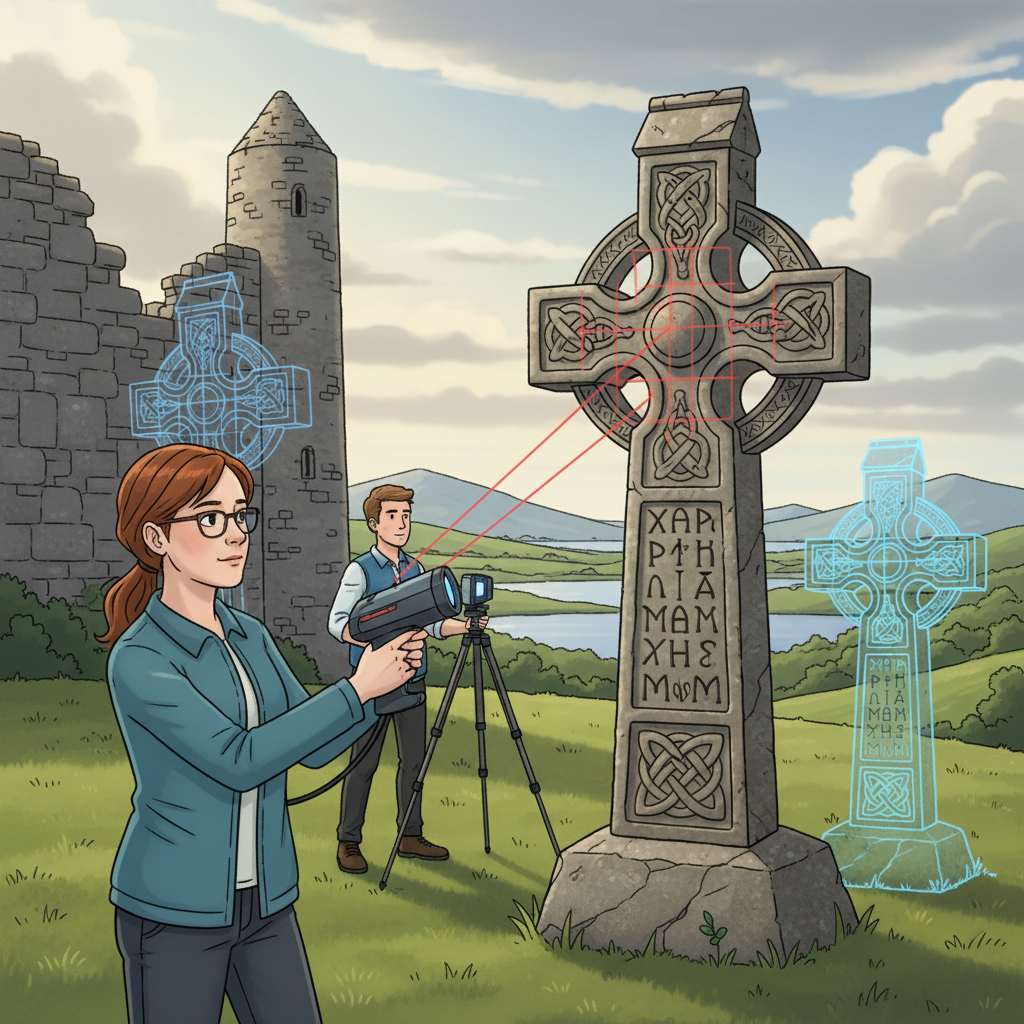
Weathered gravestones, ancient crosses, and monastic ruins present a specific challenge. Often, inscriptions and carvings are eroding rapidly. 3D scanning can capture these fading details with remarkable clarity, preserving the information before it's lost forever. This is a powerful tool for genealogists, historians, and local communities seeking to connect with their ancestors and local heritage.
Beyond Preservation: Restoration and Replication with 3D Printing
The journey doesn't have to end with a digital model. Once an object is accurately 3D scanned, that data becomes a powerful blueprint for physical restoration and replication using 3D printing. This is where the synergy between 3D scanning and custom 3D printing truly shines in the heritage sector.
Creating 3D Printed Replacement Parts Service for Restoration
Imagine a broken vase from the 18th century or a missing finial from a historical piece of furniture. Traditionally, finding or fabricating a matching part would be a monumental, often impossible, task. With 3D scanning and 3D design, the existing parts can be scanned, digitally repaired or mirrored, and then precisely 3D printed in a suitable material. This offers an incredible 3d printed replacement parts service for delicate or unique heritage items. It ensures that restoration efforts are accurate, sympathetic to the original, and often more cost-effective than traditional artisanal methods.
Our capabilities extend to helping clients with how to get a 3d model made from concept sketches, old photographs, or even fragmented pieces, transforming them into print-ready files for meticulous restoration work.
Replicas for Education and Accessibility
High-fidelity 3D printed replicas are invaluable for:
- Handling Collections: Allowing visitors, especially those with visual impairments, to touch and feel replicas of artifacts that would otherwise be off-limits.
- Traveling Exhibitions: Enabling museums to send "copies" of their prized possessions on tour, reaching wider audiences without risking the original.
- Educational Outreach: Providing schools and community groups with tangible representations of history for hands-on learning.
- Commemorative Objects: Creating accurate replicas for display in historical societies or for use in community projects.
The digital workflow, from 3d scanning for product development (which in this context includes developing heritage restoration components) to professional cad design for manufacturing, ensures accuracy and consistency. Whether it's recreating a lost piece of architecture or developing a new way to display an ancient relic, PrintIn3D.ie provides comprehensive 3d product design services Ireland can rely on.
Choosing Your Heritage Partner: Why PrintIn3D.ie?
When it comes to preserving Ireland's precious heritage, you need a partner who understands the importance of precision, reliability, and careful handling. At PrintIn3D.ie, we are not just a service provider; we are your dedicated 3D Scanning for Heritage & Restoration Ireland partner, committed to helping you bring your preservation goals to life.
Award-Winning Expertise and Reliability
We're incredibly proud to have been recognised with the Silver Rising Star award at the Irish Print Awards 2026, and as a finalist in three categories. This acknowledges our commitment to quality, innovation, and customer satisfaction. When you partner with us, you're choosing a service that's not just good, but award-winning.
Comprehensive and Hassle-Free Service
We understand that heritage projects can be complex. That's why we offer a hassle-free experience from start to finish. Our 3D scanning service offers flexibility: you can ship objects to us, drop them off at our Dublin location, or for larger, immovable objects, we can arrange on-site scanning. We cover services across Ireland and the entire EU/EEA.
- Expert Guidance: Our friendly team provides WhatsApp support, guiding you through the process, whether you're new to 3D scanning or a seasoned professional.
- Fast Turnaround: We work efficiently to deliver your digital models promptly, understanding the timelines often associated with heritage projects.
- Confidentiality Assured: We offer Non-Disclosure Agreements (NDAs) to protect sensitive information and ensure the utmost discretion for your valuable projects.
Beyond Scanning: A Full 3D Solution
Our expertise doesn't stop at scanning. As a leading 3d design and prototyping company, we can take your scanned data and transform it. If you need 3d design services to repair, modify, or create new elements based on your scans, our team is ready to assist. We can help you with how to get a 3d model made from an existing scan, ensuring it's ready for any application, be it digital archive or physical replica.
And when it comes to the next step, our custom 3D printing services can bring those digital designs to life. From creating accurate 3d printed replacement parts service components to developing educational replicas, we provide a complete end-to-end solution. You can even get an online 3d printing quote Ireland-wide, making planning your restoration budget straightforward.
For those who manage their own 3D printers, we also offer a wide range of 3D printer filaments like PLA, PETG, and flexible TPU from brands like Bambu Lab and SUNLU. We provide same day filament delivery Ireland for orders placed before 4 PM, with typical delivery in 2 working days, and are your reliable 3d printer filament shop Ireland. So, whether you need to buy pla filament Ireland, buy petg filament ireland, buy abs filament ireland, or buy flexible tpu filament ireland, we've got you covered.
While topics like "which filament is best for beginners" or "best filament for 3d printing" might seem unrelated to heritage, understanding material properties is vital for selecting the right filament for durable and appropriate restoration pieces.
Choose PrintIn3D.ie for unparalleled precision, award-winning service, and a truly dedicated partner in preserving Ireland's invaluable heritage. We make the seemingly complex world of 3D technology accessible and effective, ensuring our past has a vibrant future.
Frequently Asked Questions About 3D Scanning for Heritage
How much does 3D scanning for heritage projects typically cost in Ireland?
The cost of 3D scanning varies significantly depending on the size and complexity of the object or site, the required level of detail, the scanning method employed (e.g., structured light, laser, photogrammetry), and whether on-site scanning or post-processing (like texturing or CAD conversion) is needed. For an accurate estimate, it's always best to contact PrintIn3D.ie directly with details of your specific project to get an online 3d printing quote Ireland for any subsequent printing, and a detailed quote for the scanning services.
What types of objects can be 3D scanned for heritage preservation?
Almost any physical object, from the smallest artifact to large architectural structures and even entire archaeological sites, can be 3D scanned. This includes pottery, tools, sculptures, textiles, bones, documents (for their physical form), sections of buildings, monuments, and geological features. The key considerations are the object's size, reflective properties, and accessibility. Our team at PrintIn3D.ie can advise on the best approach for your specific heritage item or site.
Is 3D scanning safe for fragile or delicate historical items?
Yes, 3D scanning is a non-contact and non-destructive process, making it exceptionally safe for even the most fragile or delicate historical items. Unlike traditional methods that might involve direct contact or moulds, 3D scanners capture data using light or lasers, meaning there is no physical interaction with the object itself. This makes it an ideal solution for invaluable artifacts where preservation is paramount.
Can 3D scans be used to create physical replicas for museums or public display?
Absolutely! One of the most compelling applications of 3D scanning in heritage is its direct link to 3D printing. Once an accurate 3D digital model is created through scanning, it can be prepared for 3D printing. This allows for the creation of precise, durable physical replicas in various materials, which can be used for interactive museum displays, educational programs, accessible handling collections, or even as 3d printed replacement parts service components for restoration projects, all without risking damage to the original artifact.
What is the turnaround time for a 3D scanning project for heritage in Ireland?
Turnaround times for 3D scanning projects can vary widely based on the scale of the project, the complexity of the objects, and the amount of post-processing required (e.g., mesh clean-up, CAD modelling, texturing). A small, simple artifact might be scanned and processed in a few days, while a large architectural scan or an intricate archaeological site could take several weeks. At PrintIn3D.ie, we pride ourselves on fast turnaround times and will provide a clear project timeline when you request a quote for your specific 3D Scanning for Heritage & Restoration Ireland project.
In Ireland, the legacy of our ancestors is all around us, waiting to be explored, understood, and preserved. With advanced technology like 3D Scanning for Heritage & Restoration Ireland, we have an unprecedented opportunity to safeguard these irreplaceable treasures. At PrintIn3D.ie, we are dedicated to providing the expertise, precision, and friendly support needed to bring your heritage projects to life in the digital realm and beyond.
Don't let history fade. Partner with the award-winning team at PrintIn3D.ie to digitally preserve, study, and share Ireland's rich cultural heritage. Contact us today for a consultation and let's discuss how our 3D scanning and design services can help secure the future of our past.