Choosing Filament: PLA vs. PETG for 3D Prints in Luxembourg
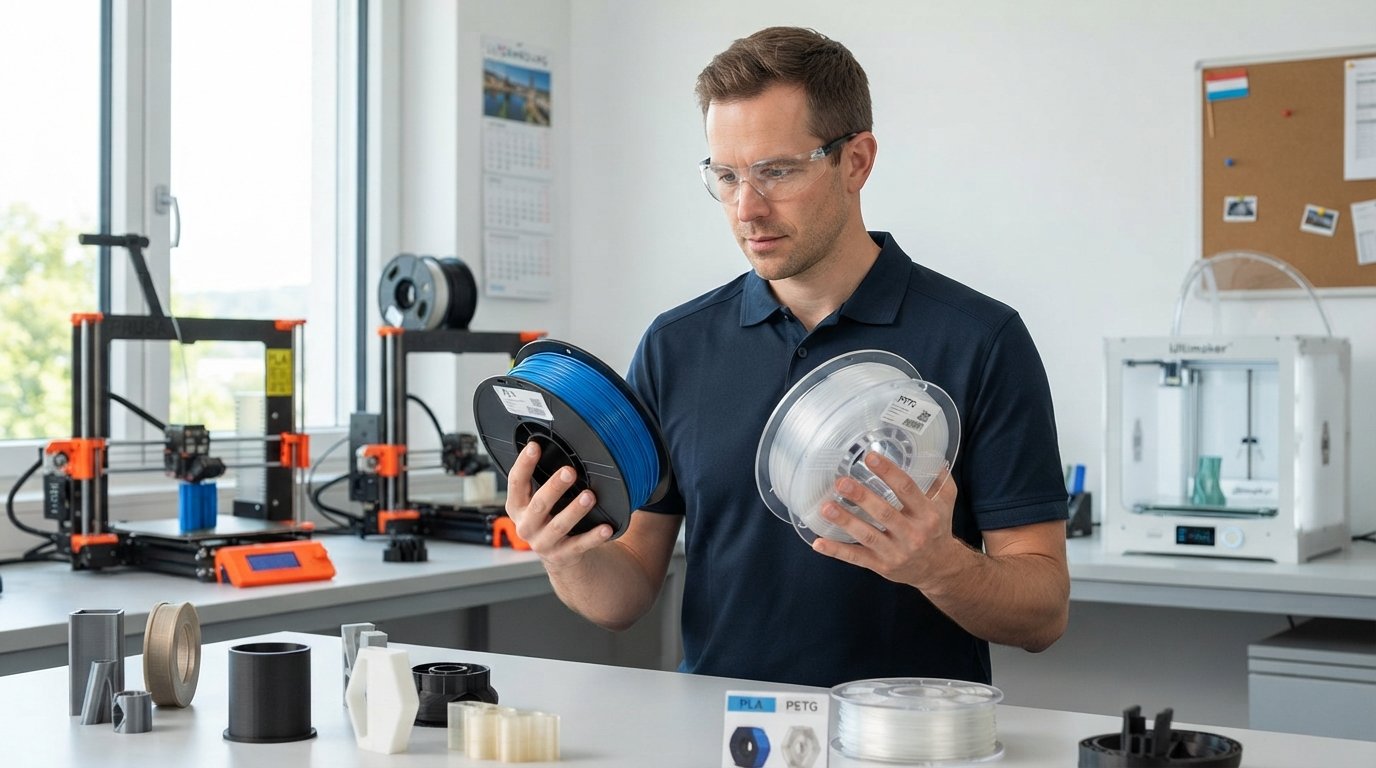
Embarking on a 3D printing journey, or perhaps refining your existing skills, often leads to a crucial question: which filament is right for my project? Among the vast array of options, PLA (Polylactic Acid) and PETG (Polyethylene Terephthalate Glycol-modified) stand out as two of the most popular and versatile choices for FDM (Fused Deposition Modeling) 3D printing. Understanding their unique properties is key to achieving successful prints, whether you're creating prototypes, functional parts, or artistic models. For those in Luxembourg, considering an achat filament pla luxembourg or exploring custom 3D printing services, this guide will illuminate the path.
At PrintIn3D, we're dedicated to being your 3D printing partner, offering not only high-quality filaments like PLA and PETG but also comprehensive custom 3D printing, design, and scanning services across the EU/EEA, including the Grand-Duché de Luxembourg. We aim to simplify your 3D printing experience, making it hassle-free whether you own a printer or prefer to utilise our award-winning services.
- Introduction to PLA & PETG
- Understanding PLA Filament
- Understanding PETG Filament
- PLA vs. PETG: A Detailed Comparison
- Choosing the Right Filament for Your Project
- Beyond PLA and PETG: Other Filament Options
- PrintIn3D: Your 3D Printing & Filament Partner in Luxembourg
- Frequently Asked Questions
- Conclusion
Understanding the Basics: PLA Filament
PLA, or Polylactic Acid, is arguably the most popular 3D printer filament, especially for beginners. It's a thermoplastic made from renewable resources like corn starch, sugarcane, or tapioca roots, making it biodegradable and an environmentally friendlier option compared to many other plastics. Its ease of use and consistent results have cemented its place as a go-to material for a wide range of applications.
Key Characteristics of PLA
- Ease of Printing: PLA is renowned for its low printing temperature, minimal warping, and lack of strong odours during printing. It adheres well to print beds, often without the need for an enclosed printer, making it very forgiving for new users.
- Strength and Rigidity: While generally considered rigid, PLA is also quite brittle. This means it can break rather than bend under stress, which is a consideration for parts requiring high impact resistance.
- Aesthetics: PLA prints often have a smooth, glossy finish and come in an incredibly diverse range of colours, including opaque, translucent, metallic, and even colour-changing variants.
- Post-Processing: PLA parts can be sanded, painted, and glued relatively easily. However, their lower heat resistance can make certain post-processing techniques, like heat-shaping, challenging.
- Biodegradability: As a bioplastic, PLA can degrade under industrial composting conditions, making it a more sustainable choice for many users.
Common Applications for PLA
Due to its properties, PLA is ideal for:
- Prototypes: Quick and easy iteration of design concepts.
- Artistic Models & Figurines: Its excellent detail retention and finish make it perfect for aesthetic prints.
- Educational Projects: Safe and easy to use in learning environments.
- Low-Stress Functional Parts: Gears, containers, or mounts that aren't subjected to high temperatures or significant impact.
- Home Decor: Vases, planters (with proper sealing), and decorative items.
Understanding the Basics: PETG Filament
PETG, or Polyethylene Terephthalate Glycol-modified, offers a compelling bridge between the ease of PLA and the strength of more industrial filaments like ABS. It shares many properties with PET (the plastic used in water bottles) but is modified with glycol to make it clearer, less brittle, and easier to 3D print. It's gaining significant traction among hobbyists and professionals looking for a more robust material than PLA.
Key Characteristics of PETG
- Durability & Strength: PETG boasts impressive strength, good impact resistance, and flexibility, making it less brittle than PLA. It's often used for parts that need to withstand physical stress.
- Temperature & Chemical Resistance: Unlike PLA, PETG has a higher glass transition temperature, meaning it can tolerate higher temperatures before deforming. It also offers good resistance to many chemicals.
- Adhesion: PETG has excellent layer adhesion, resulting in very strong, durable prints. However, this can sometimes make it sticky during printing, leading to stringing or oozing if not properly dialled in.
- Transparency: While available in various colours, clear PETG is particularly popular for parts requiring translucency or transparency, similar to glass.
- Food Safe (with caveats): Virgin PETG is often considered food-safe, though the 3D printing process itself (micro-gaps, nozzles) can introduce contaminants.
Common Applications for PETG
PETG's balanced properties make it suitable for:
- Functional Prototypes: Parts that need to be tested for durability and performance.
- Mechanical Parts: Gears, living hinges, protective components, or enclosures.
- Outdoor Applications: Items that need to withstand sunlight, moisture, and temperature fluctuations.
- Water-Resistant Objects: Vases (naturally watertight), liquid containers, or garden accessories.
- Protective Gear: Phone cases, drone parts, or safety components.
For those searching for robust materials, you can find high-quality filament petg luxembourg prix options available from suppliers like PrintIn3D, ensuring your durable projects come to life.
PLA vs. PETG: A Detailed Comparison
To help you make an informed decision, let's break down the key differences between PLA and PETG across several important categories:
1. Ease of Printing
- PLA: The undisputed champion for ease of use. Prints at lower temperatures (190-220°C), minimal to no warping, and doesn't require a heated bed for small prints (though recommended). Very little odour.
- PETG: Slightly more challenging than PLA. Requires higher temperatures (220-250°C for the nozzle, 70-90°C for the bed). Prone to stringing and oozing due to its sticky nature. Less warping than ABS, but more than PLA.
2. Mechanical Properties (Strength, Durability, Flexibility)
- PLA: High tensile strength, but brittle. It will snap rather than bend. Less impact resistance.
- PETG: Excellent tensile strength, higher impact resistance, and good flexibility. It can bend significantly before breaking, making it ideal for parts under stress.
3. Temperature Resistance
- PLA: Low heat deflection temperature (around 50-60°C). Prints can deform in hot environments (e.g., a car on a sunny day).
- PETG: Significantly higher heat deflection temperature (around 80°C), making it suitable for applications where moderate heat is a factor.
4. Chemical Resistance
- PLA: Generally resistant to alcohols and oils, but less so to strong solvents.
- PETG: Good resistance to water, many acids, alkalis, and solvents.
5. Post-Processing
- PLA: Easy to sand, paint, and glue. Difficult to smooth with solvents without special techniques.
- PETG: Can be more challenging to sand due to its ductility and tendency to gum up sandpaper. Accepts paint and glue well. Can be smoothed with certain solvents, but less commonly done than with ABS.
6. Odour and Fumes
- PLA: Produces a sweet, mild odour during printing, considered non-toxic.
- PETG: Very low odour during printing, minimal fumes.
7. Aesthetics
- PLA: Often produces glossy, smooth prints with excellent detail.
- PETG: Can produce glossy or slightly more matte finishes. Clear PETG offers impressive transparency. Can sometimes have visible layer lines if stringing is an issue.
If you're looking for an offre d'impression 3d luxembourg that provides clarity on material choices, PrintIn3D is here to help you navigate these options.
Choosing the Right Filament for Your Project
Making the right choice between PLA and PETG largely depends on the specific requirements of your 3D print. Here’s a breakdown to guide your decision-making, particularly for projects within the Grand-Duché de Luxembourg:
When to Choose PLA:
- Beginner-Friendly Projects: If you're new to 3D printing or need a hassle-free experience, PLA is your best bet.
- Aesthetic Prints: For highly detailed models, artistic creations, display pieces, or prints where visual appeal is paramount.
- Prototyping & Iteration: When you need to quickly test designs without extreme functional requirements.
- Educational & Hobby Projects: Safe and straightforward for home use or learning environments.
- Indoor Use: For items that won't be exposed to high temperatures or direct sunlight.
If your project calls for this easy-to-use material, finding achat filament pla luxembourg is straightforward with PrintIn3D, offering brands like SUNLU and Bambu Lab.
When to Choose PETG:
- Functional Parts Requiring Durability: For components that need to withstand impact, bending, or regular use.
- Outdoor & High-Temperature Applications: Items that will be exposed to sunlight, moisture, or moderate heat.
- Mechanical Components: Gears, clamps, protective housings, or parts requiring good layer adhesion for strength.
- Water-Tight or Chemical-Resistant Needs: For containers or parts that interact with liquids or mild chemicals.
- Semi-Flexible Items: Where a degree of flexibility is preferred over brittleness.
For more industrial or robust applications, exploring impression 3d industriel luxembourg services or purchasing quality filament 3d prix luxembourg for PETG from PrintIn3D will provide the strength you need.
Beyond PLA and PETG: Other Filament Options
While PLA and PETG cover a vast spectrum of 3D printing needs, the world of 3D printer filaments is much broader. PrintIn3D focuses on high-quality FDM printing with PLA and PETG, but it's useful to know about other materials for specific applications, which might prompt a search for filament 3d composites luxembourg or filament abs luxembourg acheter:
- ABS (Acrylonitrile Butadiene Styrene): Known for its strength, toughness, and higher temperature resistance than PETG. However, it's more challenging to print, prone to warping, and emits strong fumes, often requiring an enclosed printer. Good for engineering prototypes and end-use parts.
- TPU (Thermoplastic Polyurethane): A flexible filament, perfect for phone cases, gaskets, and wearables. Can be tricky to print due to its elasticity.
- Nylon: Extremely strong, durable, and resistant to abrasion. Often used for functional parts like gears and bearings. Requires specific printing conditions.
- Exotic Filaments: These include wood-filled, metal-filled, carbon fibre, or glow-in-the-dark filaments, offering unique aesthetic or mechanical properties.
- Resin Printing: While FDM printing uses filaments, SLA/DLP 3D printing uses liquid resins. For those looking into highly detailed, smooth surface finishes, searches for impression 3d résine luxembourg might be relevant. It's a different technology altogether, not typically offered by filament-based services like ours.
PrintIn3D specialises in providing robust FDM 3D printing solutions with PLA and PETG, materials that cater to the majority of custom 3D printing and prototyping demands. For specific needs that go beyond these, you might seek out specialised providers, but for most custom projects, our materials offer an excellent balance of performance and cost-effectiveness.
PrintIn3D: Your 3D Printing & Filament Partner in Luxembourg
Whether you're an individual maker, a designer with a concept, or an entreprise impression 3d luxembourg looking for a reliable partner, PrintIn3D offers a comprehensive suite of services designed to bring your 3D ideas to life. Our dedication to quality and customer satisfaction is recognised, having won the Silver Rising Star award at the Irish Print Awards 2026, and being a finalist in three categories – a testament to our commitment to excellence for clients across Ireland and the entire EU/EEA, including Luxembourg.
Custom 3D Printing Services in Luxembourg
Don't own a 3D printer, or require specialised equipment for your project? PrintIn3D offers high-quality custom 3D printing services. Simply upload your 3D file, choose your material (PLA or PETG), and we'll handle the rest. This is a perfect solution for those who want to 3d print bedrijf huren luxemburg without the upfront investment, or for anyone needing an impression 3d sur mesure luxembourg for a unique part.
We pride ourselves on fast turnaround times, ensuring your project progresses without delay. Our rapid prototyping services cater to the need for usinage rapide 3d luxembourg, getting your ideas from concept to physical object efficiently.
3D Design and Scanning Expertise
Have an idea but no 3D model? Our expert team can transform your sketches, concepts, or even existing physical objects into print-ready 3D models. Our création modèle 3d luxembourg service helps you bypass the technical complexities of 3D design. If you need to replicate an existing object, our scan 3d professionnel luxembourg service captures its dimensions and details accurately, converting it into a digital file ready for printing or modification.
Quality Filament Sales with Fast Delivery to Luxembourg
For those who own a 3D printer in Luxembourg, we offer a curated selection of premium 3D printer filaments, including PLA and PETG from trusted brands like Bambu Lab and SUNLU. We understand the importance of reliable supplies, which is why we offer same-day dispatch for filament orders placed before 4 PM. Typical delivery to Europe, including Luxembourg, is 5-7 working days, meaning your projects stay on track. You can easily buy 3d filament luxembourg from our online store, and even inquire about 3d printer filament bulk buy luxembourg options for larger needs.
We also keep a keen eye on the coût impression 3d luxembourg for both our services and our filament sales, ensuring you get excellent value without compromising on quality.
Why Choose PrintIn3D?
- Award-Winning Service: Recognised for excellence at the Irish Print Awards 2026.
- Risk-Free Guarantee: Enjoy our 30-Day Risk-Free Return policy, covering original and return shipping.
- Expert Support: Friendly WhatsApp support and a 'First-Time Buyer’s Guide' for all your questions.
- Confidentiality: Non-Disclosure Agreements (NDAs) available for sensitive projects.
- EU-Wide Reach: Serving customers throughout the EU/EEA, bringing our expertise directly to Luxembourg.
Frequently Asked Questions
Is PLA or PETG better for outdoor use in Luxembourg?
For outdoor applications in Luxembourg, PETG is generally superior to PLA. PETG offers higher resistance to UV radiation, moisture, and temperature fluctuations, making it more durable and less prone to degradation or deformation compared to PLA, which can become brittle or warp in direct sunlight and heat.
Can PrintIn3D help me design a custom 3D model from a sketch in Luxembourg?
Absolutely! PrintIn3D provides comprehensive 3d design service luxembourg. You can send us your sketches, concepts, or even detailed drawings, and our expert designers will work with you to convert your ideas into a print-ready 3D model. We ensure your vision is accurately translated into a digital format for successful 3D printing.
How long does it take to receive filament orders in Luxembourg from PrintIn3D?
For filament orders placed before 4 PM, PrintIn3D offers same-day dispatch. For delivery to European locations, including Luxembourg, the typical delivery time is 5-7 working days. We strive for efficient delivery so you can continue your 3D printing projects with minimal delay after your achat filament pla luxembourg or PETG.
Does PrintIn3D offer services for businesses in Luxembourg, such as rapid prototyping?
Yes, PrintIn3D is an ideal partner for businesses across the Grand-Duché de Luxembourg. We offer rapid prototyping services that leverage our fast turnaround times and expertise in materials like PLA and PETG, supporting your needs for quick design iteration and functional testing. Our custom 3D printing and 3D design services can cater to a wide range of industrial and commercial requirements, effectively serving as your dedicated entreprise impression 3d luxembourg.
Conclusion
Choosing between PLA and PETG doesn't have to be a daunting task. By understanding the distinct properties and ideal applications of each filament, you can make an informed decision that ensures the success and durability of your 3D prints. PLA remains the go-to for ease of use and aesthetic projects, while PETG offers enhanced strength, durability, and temperature resistance for functional parts.
Whether you're searching for an achat filament pla luxembourg, require a robust filament petg luxembourg prix, or need professional 3D printing, design, or scanning services, PrintIn3D is your reliable partner. We are committed to providing top-tier service, quality products from brands like Bambu Lab and SUNLU, and expert support to the 3D printing community across the entire EU/EEA, including Luxembourg. Let us help you bring your 3D dreams to life with ease and confidence.
Ready to get started? Explore our filament selection or get an instant quote for your custom 3D printing project today!