Optimise Production: 3D Printed Jigs & Fixtures for Irish Businesses
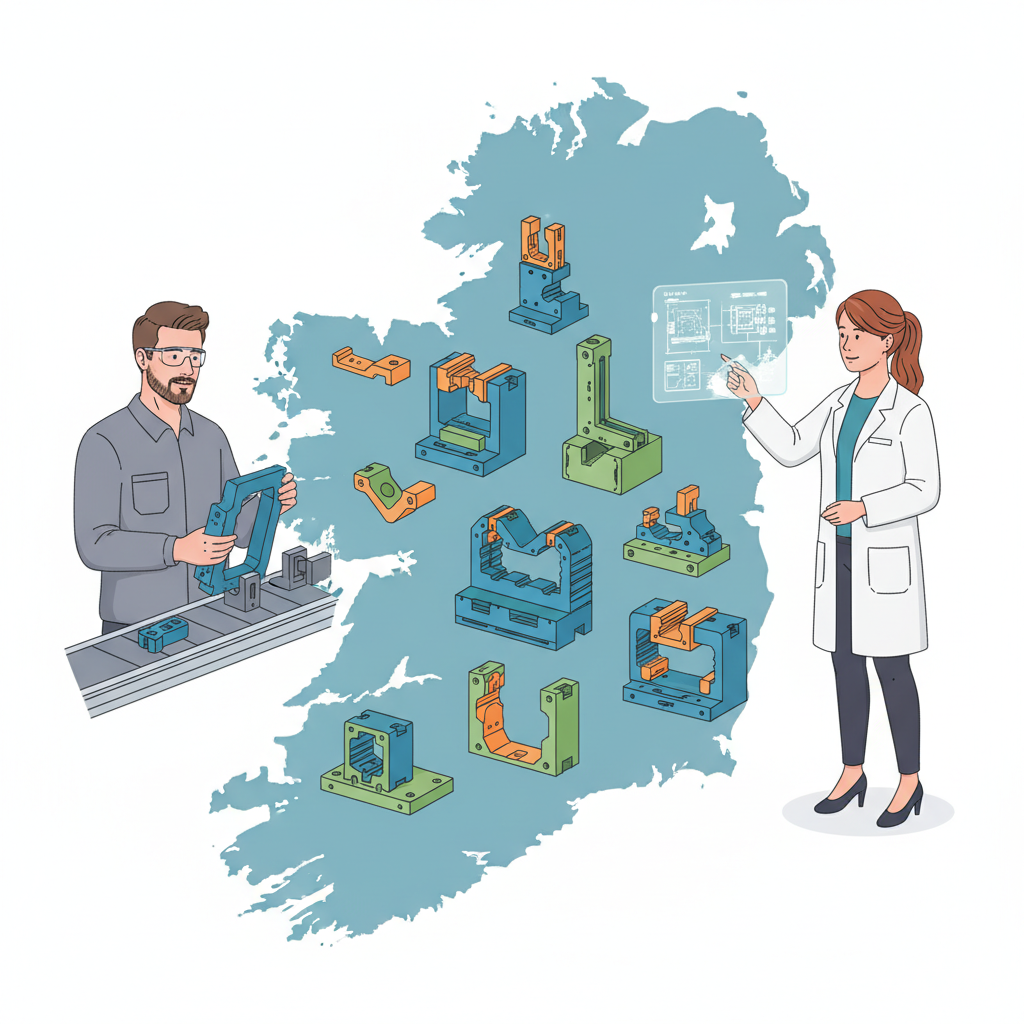
In the dynamic world of manufacturing and production, efficiency, precision, and cost-effectiveness are paramount. Irish businesses, like their counterparts worldwide, are constantly seeking innovative solutions to streamline their operations. One such powerful innovation making significant waves is the use of custom 3D printed parts for jigs and fixtures. These essential tools, once expensive and time-consuming to produce, are now more accessible and adaptable than ever, thanks to advanced 3D printing technology. At PrintIn3D.ie, we're proud to be your award-winning partner, helping businesses across Ireland harness the power of 3D printing to create bespoke solutions that optimise production workflows and enhance quality.
Ready to see how `custom 3d printed parts ireland` can revolutionise your operations? Let's dive in.
- The Critical Role of Jigs & Fixtures in Manufacturing
- How 3D Printing is Revolutionising Jigs & Fixtures
- Practical Applications for Irish Industries
- The Tangible Benefits for Irish Businesses
- Getting Started with Custom 3D Printed Jigs & Fixtures
- Frequently Asked Questions
The Critical Role of Jigs & Fixtures in Manufacturing
Jigs and fixtures are the unsung heroes of manufacturing. They are custom-made tools designed to hold, support, and locate a workpiece during manufacturing operations, or to guide a cutting tool to a specific position. Their primary purpose is to ensure accuracy, repeatability, and interchangeability of parts, while also enhancing safety and efficiency on the production floor.
What are Jigs and Fixtures?
- Jigs: A jig is a device that holds the workpiece and guides the tool (e.g., a drill jig guides a drill bit to specific locations on a part). They are about guiding the process.
- Fixtures: A fixture holds the workpiece in a fixed position during an operation (e.g., a milling fixture secures a part during machining). They are about holding the part steady.
Traditional Challenges in Creating Jigs & Fixtures
Historically, designing and manufacturing jigs and fixtures has been a costly and time-consuming process. They were typically made from metals like steel or aluminium through conventional machining methods. This involved:
- High Costs: Expensive materials and skilled labour for machining.
- Long Lead Times: Design, material sourcing, and machining could take weeks or even months.
- Design Constraints: Complex geometries were difficult and costly to produce, often limiting design optimisation.
- Weight: Metal jigs and fixtures could be heavy, impacting ergonomics and increasing setup times.
- Limited Iteration: Making design changes was costly, leading to fewer prototypes and potentially suboptimal solutions.
These challenges often meant that jigs and fixtures were only feasible for high-volume production runs, leaving smaller businesses or those with bespoke products at a disadvantage. However, `3d printing ireland` is changing this paradigm entirely.
How 3D Printing is Revolutionising Jigs & Fixtures
The advent of 3D printing, also known as additive manufacturing, has transformed the way businesses approach the creation of jigs and fixtures. It offers unprecedented flexibility, speed, and cost-effectiveness, making `custom 3d printed parts ireland` an accessible solution for businesses of all sizes.
Speed and Agility: Rapid Prototyping and Iteration
One of the most significant advantages of 3D printing is its ability to produce parts quickly. From a digital design, a physical jig or fixture can be printed in a matter of hours or days, rather than weeks. This enables rapid prototyping, allowing engineers to test multiple designs, identify flaws, and make improvements with unparalleled speed. The ability to iterate quickly means businesses can fine-tune their tools for optimal performance, ensuring the best possible outcome for their production lines.
Cost-Effectiveness: Reduced Material Waste & No Tooling Costs
3D printing builds parts layer by layer, which inherently reduces material waste compared to subtractive manufacturing (machining away material). Furthermore, it eliminates the need for expensive tooling or moulds, which are major cost drivers in traditional manufacturing. For businesses seeking `affordable 3d printing near me`, this translates into substantial cost savings, particularly for low to medium-volume production and one-off custom solutions.
Customisation and Complexity: Tailored Designs for Any Need
The geometric freedom offered by 3D printing is a game-changer. Complex internal structures, organic shapes, and intricate details that would be impossible or prohibitively expensive to machine are readily achievable with 3D printing. This allows for the creation of perfectly ergonomic jigs and fixtures tailored precisely to a specific part or process, improving fit, function, and operator comfort. Whether you need a simple guide or a sophisticated workholding device, `3d design and prototyping company` like PrintIn3D.ie can bring your vision to life.
Material Versatility: Tailoring to Specific Requirements
While often associated with plastics, 3D printing can utilise a wide range of materials, each with unique properties suitable for jigs and fixtures. For many applications, robust plastics like PETG filament or reinforced PLA offer excellent strength, durability, and chemical resistance. At PrintIn3D.ie, we offer `3d printer filaments` from top brands like Bambu Lab and SUNLU, including PLA and PETG, ensuring you get the `best filament for 3d printing` your specific jig or fixture.
- PLA (Polylactic Acid): Excellent for general-purpose jigs, prototypes, and fixtures where high temperature resistance isn't critical. Easy to print and environmentally friendly.
- PETG (Polyethylene Terephthalate Glycol): A popular choice for its strength, durability, chemical resistance, and higher temperature resistance than PLA. It's often the `buy petg filament ireland` choice for more demanding applications.
- Reinforced Filaments: Materials infused with carbon fibre or glass fibre offer even greater stiffness and strength, suitable for high-stress applications.
Reduced Weight: Improving Ergonomics and Handling
By leveraging advanced design techniques and lighter materials, 3D printed jigs and fixtures can be significantly lighter than their metal counterparts. This improves ergonomics for operators, reduces fatigue, and can speed up changeovers and handling, contributing to overall workplace safety and efficiency.
Practical Applications for Irish Industries
The versatility of `custom 3d printed parts ireland` for jigs and fixtures means they can be applied across a multitude of industries and for various tasks. Here are some common applications relevant to Irish businesses:
Assembly Jigs
Precision is key in assembly. 3D printed assembly jigs ensure that components are correctly aligned and positioned before joining. This is invaluable in sectors ranging from electronics manufacturing to medical device assembly, guaranteeing consistent quality and reducing errors. Imagine an Irish med-tech firm needing to assemble a new device; a 3D printed jig ensures every component slots perfectly, every time.
Drilling & Machining Fixtures
When drilling holes or performing light machining operations, fixtures are essential for guiding tools accurately and holding parts securely. 3D printed drill guides, tapping jigs, and light-duty machining fixtures can be custom-designed for unique parts, eliminating the need for expensive, dedicated tooling and offering a perfect fit for complex geometries. This is particularly beneficial for `industrial 3d printing services` where bespoke parts are common.
Inspection & Measurement Tools
Quality control is non-negotiable. Custom 3D printed gauges, Go/No-Go fixtures, and inspection nests allow for rapid and precise checks of manufactured parts. These bespoke tools ensure that components meet exact specifications, helping Irish manufacturers maintain high standards and compliance. For instance, a food packaging company might use a custom 3D printed gauge to quickly verify the dimensions of new packaging components.
Workholding Devices
Securing parts during various stages of production – whether for gluing, painting, or marking – is crucial. 3D printed workholding devices can be tailored to the exact contours of a component, providing stable and non-marring support. This is especially useful for delicate or unusually shaped parts that conventional clamps might damage.
Ergonomic Aids & Tool Organisers
Beyond direct manufacturing tasks, 3D printing can create custom ergonomic aids to improve worker comfort and reduce repetitive strain injuries. Custom tool organisers and shadow boards also help keep workplaces tidy and efficient, reducing time spent searching for tools and improving workflow. These small but impactful improvements contribute to a safer and more productive environment.
The Tangible Benefits for Irish Businesses
Embracing `3d printing service dublin` for jigs and fixtures offers a competitive edge, delivering measurable benefits that impact the bottom line for Irish enterprises.
Enhanced Productivity and Efficiency
By automating positioning, guiding tools, and reducing setup times, 3D printed jigs and fixtures significantly boost operational efficiency. Less time is spent on manual adjustments, allowing production lines to run smoother and faster.
Improved Quality Control
The precision and repeatability offered by custom-designed jigs lead directly to higher quality products. By ensuring consistent part alignment and accurate operations, the risk of defects and rework is drastically reduced, leading to fewer scrap parts and better customer satisfaction.
Reduced Costs
As discussed, 3D printing slashes the costs associated with traditional manufacturing of jigs and fixtures. This includes material costs, labour for machining, and the elimination of expensive tooling. For `custom prototype manufacturing ireland`, this means innovation becomes more affordable.
Faster Time-to-Market for New Products
The ability to rapidly design, prototype, and implement custom jigs and fixtures means new product lines can be brought to market much faster. This agility allows Irish businesses to respond quicker to market demands and gain a competitive advantage.
Local Sourcing Advantage
Partnering with a local `3d printing dublin` expert like PrintIn3D.ie means fast turnaround times and convenient communication. As an award-winning Irish company, we understand the local market and can provide responsive, high-quality `industrial 3d printing services` right here in Ireland. We even offer same-day dispatch for filament orders placed before 4 PM, with typical delivery times of 2 working days for Ireland.
Innovation and Customisation
3D printing empowers businesses to innovate without compromise. Solutions can be precisely tailored to unique challenges, leading to highly effective and specialised tools that might not be feasible with traditional methods. Need `how to get a 3d model made` for a specific application? Our `professional cad design for manufacturing` team is ready to assist.
Getting Started with Custom 3D Printed Jigs & Fixtures in Ireland
Embarking on your journey to optimise production with `custom 3d printed parts ireland` is straightforward when you partner with experts. PrintIn3D.ie makes the process hassle-free from concept to creation.
1. Identify Your Needs
Start by identifying bottlenecks, inefficiencies, or quality issues in your current production process. Where could a custom jig or fixture save time, improve accuracy, or enhance safety? Perhaps you need a `3d printed replacement parts service` to fix an existing tool or a completely new design.
2. Design Considerations
Consider the environment the jig or fixture will operate in (temperature, chemicals, stress levels) to help determine the best material. Think about the required precision and any ergonomic needs. If you have a physical object you need a jig for, our `3d scanning for product development` service can create a precise digital model to build upon.
3. Partner with an Expert: PrintIn3D.ie
This is where we come in. Whether you have a ready-to-print 3D model, a sketch, or just an idea, our team can help. We offer comprehensive 3D design services to convert your concepts into print-ready models, ensuring optimal functionality and printability. Our expertise in `3d design` and advanced `3d printing` technology means you get high-quality, durable solutions.
For those ready to proceed, our `online 3d printing quote ireland` system makes it easy to upload your files and get a quick, transparent quote. We understand the importance of discretion, which is why Non-Disclosure Agreements (NDAs) are available for your proprietary designs.
4. Review and Refine
With 3D printing, iteration is fast and affordable. We can quickly produce prototypes for testing, allowing you to review, refine, and perfect your custom jig or fixture before full production. This iterative process ensures the final product meets your exact requirements and delivers maximum value.
Frequently Asked Questions
What materials are best for 3D printed jigs and fixtures?
The `best filament for 3d printing` jigs and fixtures depends on their specific application. For general use, PLA is cost-effective and easy to print. For stronger, more durable, and heat/chemical resistant applications, PETG is an excellent choice and widely used. For even higher strength and stiffness, composites like carbon fibre or glass fibre reinforced filaments are available. We can advise you on the optimal material for your project.
How much does `custom 3d printed parts ireland` cost?
The cost of `how much does 3d printing cost ireland` for custom parts, including jigs and fixtures, varies based on factors such as size, complexity, material type, and print time. However, 3D printing is often significantly more cost-effective than traditional manufacturing methods for bespoke tools and lower volumes. You can get an accurate estimate quickly through our online 3D printing quote Ireland service by uploading your design.
Can PrintIn3D.ie help with the design of my jigs?
Absolutely! We are a full-service `3d design and prototyping company`. If you have a concept, sketch, or even a physical part you need a jig for, our experienced team provides `professional cad design for manufacturing` services. We can convert your ideas into print-ready 3D models, ensuring your custom jig or fixture is perfectly suited for its intended purpose. Our `3d design` expertise is here to bring your vision to life.
How long does it take to get `custom 3d printed parts ireland`?
One of the key advantages of `3d printing` is speed. Lead times for `custom 3d printed parts ireland` are significantly shorter than traditional manufacturing, often just a few days from design finalisation to dispatch. We pride ourselves on fast turnaround times and efficient service, ensuring you get your parts when you need them to keep your production running smoothly.
Why choose 3D printing over traditional manufacturing for jigs and fixtures?
3D printing offers several compelling advantages: significantly lower costs for bespoke and low-volume tools, faster lead times for rapid iteration and deployment, unparalleled design freedom for complex and ergonomic solutions, and reduced material waste. It empowers businesses to create highly customised, efficient tools that traditional methods simply can't match in terms of speed, flexibility, or affordability.
At PrintIn3D.ie, we're dedicated to being your `3d printing` partner, offering hassle-free solutions and friendly WhatsApp support. As an award-winning service (Silver Rising Star, Irish Print Awards 2026), we stand by the quality of our `custom 3d printed parts ireland` with a 30-Day Risk-Free Return policy, including shipping.
Ready to unlock the full potential of your production line with `custom 3d printed parts ireland`? Whether you're in Dublin or anywhere across Ireland and the EU/EEA, PrintIn3D.ie is here to help. Upload your 3D model for an instant quote, or contact our team to discuss your specific needs today. Let's build a more efficient future, together.