PLA vs. PETG: Best 3D Printer Filament for Your Project
Diving into the world of 3D printing can be incredibly exciting, opening up a universe of possibilities for creating everything from intricate models to robust functional parts. But before you can bring your ideas to life, one of the most crucial decisions you’ll face is selecting the right material for your project. For most hobbyists, makers, and even businesses, this often comes down to a direct comparison: PLA vs. PETG. Both are incredibly popular, readily available, and versatile, yet they offer distinct characteristics that make them suitable for different applications. If you're looking for the best filament for 3d printing for your specific needs here in Ireland, understanding these differences is key.
At PrintIn3D.ie, your trusted 3D printing partner in Ireland, we understand that choosing the right material can feel daunting. Whether you're planning a delicate aesthetic piece or a durable component, we're here to help you navigate the options. We offer a wide range of high-quality 3d printer filaments, including both PLA and PETG from leading brands like Bambu Lab and SUNLU, with fast delivery across Ireland.
Let's explore the unique strengths and weaknesses of PLA and PETG, helping you make an informed decision for your next project.
- PLA: The User-Friendly Favourite
- PETG: The Robust All-Rounder
- PLA vs. PETG: A Direct Comparison
- Choosing the Right Filament for Your Project in Ireland
- Where to Find Your Filaments & Expert 3D Printing Services in Ireland
- Frequently Asked Questions (FAQ)
- Conclusion
PLA: The User-Friendly Favourite
Polylactic Acid, or PLA, is perhaps the most widely used 3D printer filament today, especially among beginners and those focused on aesthetic prints. It's an excellent starting point for anyone new to the world of additive manufacturing, offering a forgiving printing experience and consistently good results.
What is PLA?
PLA is a biodegradable thermoplastic derived from renewable resources like corn starch, tapioca roots, or sugarcane. This makes it a more environmentally friendly option compared to many other plastics, as it can decompose under industrial composting conditions.
Advantages of PLA Filament
- Ease of Printing: PLA is renowned for being incredibly easy to print. It typically requires lower printing temperatures than other filaments, leading to fewer issues like warping or poor layer adhesion. It also doesn't demand a heated print bed, although using one often improves adhesion.
- Minimal Warping: One of the biggest headaches in 3D printing is warping, where corners lift from the print bed. PLA exhibits very low thermal expansion, significantly reducing the likelihood of this issue.
- No Strong Fumes: Unlike some other filaments, PLA produces very little odour during printing, and what little there is, is often described as slightly sweet. This makes it suitable for use in home or office environments without special ventilation.
- Excellent Detail and Surface Finish: PLA allows for highly detailed prints with a smooth, often glossy, finish. It's excellent for capturing fine features and producing visually appealing objects.
- Wide Colour Range: You'll find PLA available in an astonishing array of colours, including opaque, translucent, metallic, glitter, and even glow-in-the-dark variations, making it ideal for decorative projects.
- Biodegradable: As mentioned, its plant-based origin means it can biodegrade in specific industrial composting facilities, offering a more sustainable choice.
Disadvantages of PLA Filament
- Brittleness: While good for static display, PLA can be quite brittle and prone to breaking under stress or impact. It's not the best choice for parts that need to withstand significant force.
- Low Heat Resistance: PLA has a relatively low glass transition temperature (around 60°C). This means prints can deform or soften when exposed to heat, such as direct sunlight in a car or even hot water.
- UV Degradation: Prolonged exposure to UV light (sunlight) can cause PLA to degrade over time, losing its structural integrity and potentially becoming discoloured. This makes it less suitable for long-term outdoor applications.
- Limited Chemical Resistance: PLA is not particularly resistant to a wide range of chemicals, which can limit its use in certain industrial or scientific applications.
Best Use Cases for PLA in Ireland
Considering its properties, PLA is perfect for:
- Prototypes and Conceptual Models: Its ease of printing and detail makes it ideal for quickly iterating designs and visualising concepts.
- Aesthetic Prints and Decorations: Statues, miniatures, cosplay props, vases, and intricate artistic pieces shine with PLA. If you're looking for custom 3d printed gifts ireland, PLA is often the go-to material for its finish and colour options.
- Educational Models: Great for schools and learning environments due to its ease of use and safety.
- Non-Functional Parts: Anything that won't experience significant mechanical stress, impact, or high temperatures.
- Short-Term Use Items: Event props or temporary fixtures.
At PrintIn3D.ie, we stock premium SUNLU PLA filament, offering a fantastic balance of quality and affordability for your projects. If you're looking to buy pla filament ireland, we've got you covered with reliable delivery straight to your door.
PETG: The Robust All-Rounder
PETG (Polyethylene Terephthalate Glycol-modified) is often seen as the bridge between PLA and stronger, more industrial filaments like ABS. It combines many of the best properties of both, offering an impressive balance of strength, durability, and printability.
What is PETG?
PETG is a modified version of PET (the plastic used in water bottles). The 'G' stands for glycol-modified, which prevents crystallisation, making it clearer, less brittle, and easier to thermoform than PET. This modification also makes it excellent for 3D printing.
Advantages of PETG Filament
- Strength and Durability: PETG is significantly stronger and more durable than PLA. It offers excellent impact resistance and is less brittle, making it suitable for functional parts that need to withstand some abuse.
- Flexibility: While not as flexible as TPU, PETG has a degree of flexibility that allows it to bend rather than break, adding to its robustness.
- Good Layer Adhesion: PETG is known for very strong layer adhesion, which contributes to the overall strength of a printed part. This is crucial for functional components.
- Temperature Resistance: With a glass transition temperature around 80-85°C, PETG handles higher temperatures much better than PLA, making it suitable for parts that might be exposed to moderate heat.
- Chemical Resistance: PETG exhibits good resistance to many chemicals, oils, and greases, broadening its application potential for functional parts.
- Water Resistance: It's inherently water-resistant, which is beneficial for outdoor use or items that might get wet.
- Food-Safe (Certain Grades): While not all PETG is food-safe, specific grades can be used for food contact applications, provided proper printing hygiene is maintained. This makes it a popular choice for containers or kitchen tools.
- UV Resistance: PETG stands up much better to UV exposure than PLA, making it a viable option for outdoor parts.
Disadvantages of PETG Filament
- Stringing and Oozing: PETG can be prone to stringing and oozing due to its sticky nature and higher printing temperatures. This requires careful calibration of retraction settings.
- More Challenging to Print than PLA: While easier than ABS, PETG requires higher print temperatures (hotend and bed) and more fine-tuning of settings to achieve optimal results compared to PLA.
- Moisture Absorption: PETG is hygroscopic, meaning it absorbs moisture from the air. Wet filament can lead to bubbles, stringing, and poor print quality, so proper storage in a dry environment is essential.
- Adhesion Issues (Too Strong): Sometimes, PETG can adhere *too* strongly to certain print surfaces, potentially damaging the bed when removing parts. Using an interface like blue painter's tape or specific bed adhesives can help.
Best Use Cases for PETG in Ireland
PETG's balanced properties make it excellent for:
- Functional Parts and Prototypes: Gears, brackets, clamps, enclosures, and mechanical components that need to be durable.
- Outdoor Applications: Garden fixtures, drone parts, or signage where weather resistance is important.
- Protective Casings and Housings: For electronics or other sensitive components.
- Automotive Parts: Interior components or under-hood parts that need to withstand moderate heat.
- Containers and Vases: Its strength and water resistance make it good for functional containers.
- Jigs and Fixtures: Tools for workshops that require durability.
- Medical Applications: With appropriate certification, its chemical resistance and non-toxicity make it suitable for certain medical models or tools.
If you're looking to buy bambu lab filament ireland, our selection includes high-quality Bambu Lab PETG, renowned for its performance and reliability for those demanding projects. For those needing robust, custom 3d printed parts ireland, PETG is often the material of choice.
PLA vs. PETG: A Direct Comparison
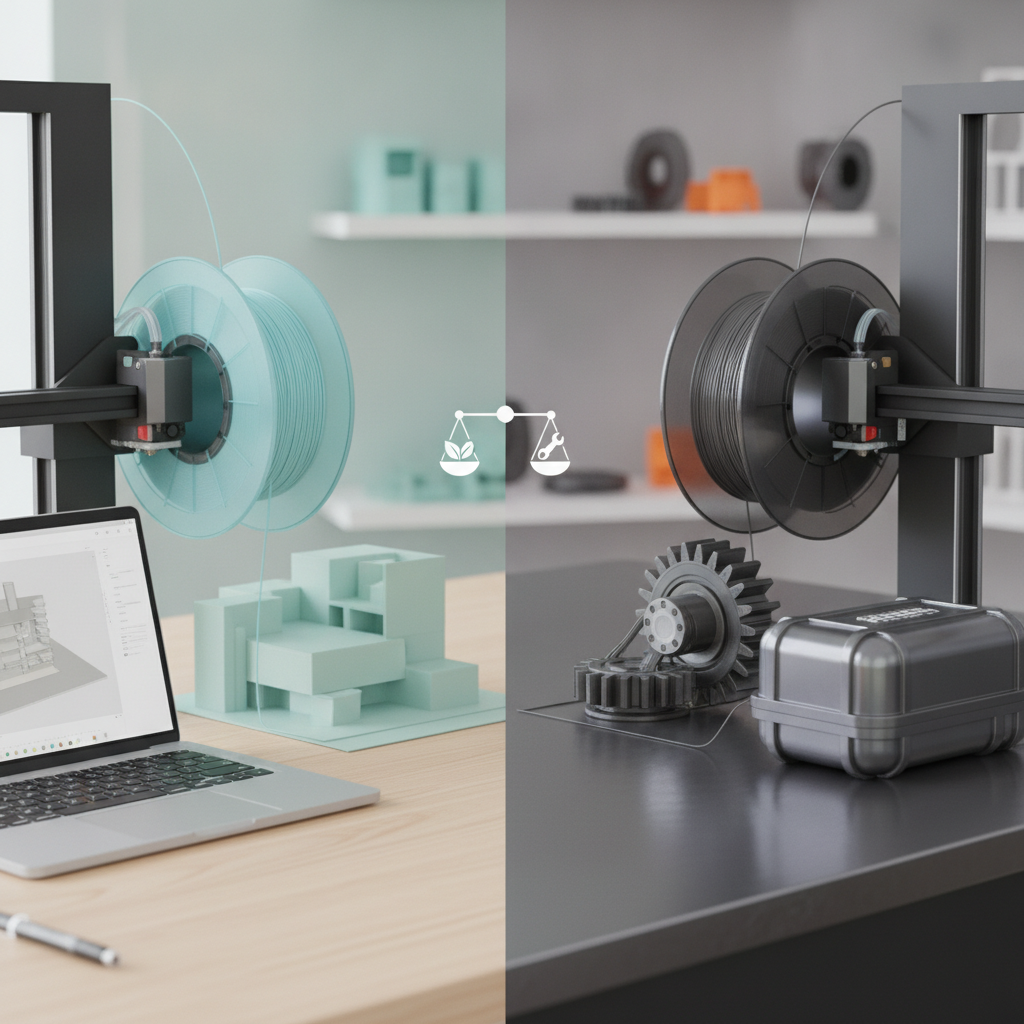
To help you visualise the key differences, here's a side-by-side comparison of PLA and PETG:
| Feature | PLA (Polylactic Acid) | PETG (Polyethylene Terephthalate Glycol-modified) |
|---|---|---|
| Ease of Printing | Very Easy; low temps, low warping. | Moderate; higher temps, can string/ooze, requires fine-tuning. |
| Strength & Durability | Moderate; brittle, low impact resistance. | High; strong, good impact resistance, less brittle. |
| Temperature Resistance | Low (softens ~60°C). | Moderate (softens ~80-85°C). |
| Flexibility | Rigid; tends to snap. | Good; has some flex, more ductile. |
| Chemical Resistance | Low. | Good; resistant to many chemicals, oils. |
| UV Resistance | Poor; degrades over time outdoors. | Good; suitable for outdoor use. |
| Surface Finish | Often glossy, excellent detail. | Often slightly less glossy than PLA, can be clear/translucent. |
| Fumes/Odour | Minimal to none, slightly sweet. | Minimal, sometimes a mild plastic smell. |
| Biodegradable | Yes (under industrial composting). | No. |
| Post-Processing | Easier to sand, paint, glue. | More challenging to sand due to toughness; good for dyeing. |
Choosing the Right Filament for Your Project in Ireland
When deciding between PLA and PETG, consider these crucial questions about your project:
1. What is the Purpose of Your Print?
- Aesthetic/Display: If your print is primarily for visual appeal, a decorative item, or a model that won't experience stress, PLA is often the better choice due to its excellent detail, wide colour range, and ease of use. This is perfect for custom 3d printed gifts ireland or display pieces.
- Functional/Mechanical: For parts that need to withstand force, temperature, or be used outdoors, PETG is the clear winner. Think brackets, enclosures, protective covers, or components for machinery. This aligns well with needs for industrial 3d printing services or robust prototypes.
2. What Environmental Conditions Will the Print Face?
- Indoor, Room Temperature: PLA is perfectly fine for most indoor applications.
- Outdoor, High Temperatures, or Direct Sunlight: PETG's superior UV and heat resistance make it far more suitable for anything intended for outdoor use or in environments where temperatures might exceed 60°C.
3. What Mechanical Properties are Required?
- Rigidity & Detail: PLA provides stiff, detailed prints, but can be brittle.
- Strength, Impact Resistance & Flexibility: PETG offers a balance of strength, impact resistance, and a slight degree of flexibility, making it less prone to snapping under stress.
4. How Important is Post-Processing?
- If you plan to sand, paint, or glue your print extensively, PLA is generally easier to work with. PETG's toughness can make sanding more laborious.
5. What is Your 3D Printing Experience Level?
- If you're new to 3D printing or prefer a straightforward, hassle-free experience, PLA is ideal.
- If you're comfortable with adjusting settings and troubleshooting minor issues like stringing, PETG offers a significant step up in material properties.
Remember, if you're not an experienced 3D printer owner yourself or prefer to avoid the hassle, PrintIn3D.ie offers a comprehensive 3d printing service dublin and across Ireland. We can handle everything from converting a simple sketch or concept into a print-ready model (our 3d product design services ireland and professional cad design for manufacturing) to producing your final parts. Whether you have a cad file to 3d print service requirement or just an idea, we can guide you to the right material and print it perfectly.
Where to Find Your Filaments & Expert 3D Printing Services in Ireland
Once you've made your choice, the next step is to acquire high-quality filament. As a leading 3d printer filament shop ireland, PrintIn3D.ie is your go-to source. We pride ourselves on being a reliable bulk filament supplier ireland, stocking top brands like Bambu Lab and SUNLU. You can buy pla filament ireland or buy bambu lab filament ireland (including PETG) directly from our website with confidence.
Our commitment to our customers extends beyond just selling filament:
- Fast Delivery: We offer same-day dispatch for filament orders placed before 4 PM, with typical delivery times of 2 working days for Ireland, ensuring you get your materials quickly.
- Award-Winning Service: Recognised as a Silver Rising Star at the Irish Print Awards 2026, we're dedicated to excellence in every aspect of our business.
- Hassle-Free 3D Printing: Don't own a printer? No problem! Our custom 3d printing ireland service means you can bring your ideas to life without needing to buy, set up, or maintain your own equipment. Upload your file, and we'll do the rest.
- Expert Support: Our friendly WhatsApp support is always ready to assist you, whether you have questions about filament, design, or printing. We can help guide you through how to get a 3d model made from scratch or existing files.
- Risk-Free Guarantee: We stand by our products and services with a 30-Day Risk-Free Return policy, including original and return shipping.
- Confidentiality: For businesses or sensitive projects, we offer Non-Disclosure Agreements (NDAs) to protect your intellectual property, especially important for 3d design and prototyping company services.
Whether you need to buy abs filament ireland (though not the focus here, we can also advise on other materials), source PLA or PETG, or require a comprehensive 3d design and prototyping company to turn your vision into a reality, PrintIn3D.ie is here to help.
Frequently Asked Questions (FAQ)
Can I print PLA and PETG on the same 3D printer?
Yes, absolutely! Most FDM (Fused Deposition Modeling) 3D printers are capable of printing both PLA and PETG. The key differences are the printing temperatures required (PETG needs higher hotend and bed temperatures than PLA) and calibration settings like retraction. You'll need to adjust your slicer profile when switching between the two materials, but the hardware itself is typically compatible.
Is one filament better for outdoor use?
For outdoor use, PETG is significantly better than PLA. PETG offers superior UV resistance, meaning it won't degrade as quickly when exposed to sunlight, and it has a higher temperature resistance, making it less likely to deform in hot weather. PLA will become brittle and discolour over time in outdoor conditions, making it unsuitable for long-term exterior applications.
What is the best filament for 3D printing for beginners?
For beginners, PLA (Polylactic Acid) is almost universally recommended as the best filament for 3d printing. It is the easiest to print, requiring lower temperatures, exhibiting minimal warping, and producing no strong fumes. This makes the learning curve much smoother and helps new users achieve successful prints quickly. Once comfortable with PLA, PETG is a natural next step for exploring more functional materials.
How much does 3D printing cost Ireland for different materials?
The cost of 3D printing in Ireland, or anywhere, varies depending on several factors: the material chosen (PLA is often slightly cheaper per kg than PETG, though both are affordable), the complexity and size of the part, the print time, and whether you're printing it yourself or using a service. When using a service like PrintIn3D.ie, the cost also includes the expertise, machine time, and post-processing. Generally, more specialised or engineering-grade filaments will cost more than common ones like PLA and PETG. For a precise quote on how much does 3d printing cost ireland for your specific project, it's best to upload your 3D model to our custom printing service for an instant calculation.
Is PETG food safe?
The raw PETG polymer itself is generally considered food-safe (it's the same material as many plastic bottles). However, for a 3D printed object to be truly "food safe," several factors beyond just the filament come into play. The printing process can create microscopic pores where bacteria can grow. Also, additives in the filament (colourants, etc.) might not be food-safe. Furthermore, brass nozzles, often used in 3D printers, can contain lead. Therefore, while PETG is a better candidate than PLA, it's generally recommended to use specific food-safe certified filaments, stainless steel nozzles, and apply a food-safe sealant for any items intended for prolonged food contact. For single-use or very infrequent contact, it might be acceptable, but always err on the side of caution.
Conclusion
Choosing between PLA and PETG doesn't have to be a daunting task. By understanding the unique properties, advantages, and disadvantages of each filament, you can make an informed decision that perfectly matches the requirements of your 3D printing project. Whether you prioritise ease of use and aesthetics with PLA, or demand strength, durability, and resilience with PETG, both materials offer incredible potential to bring your ideas to life.
At PrintIn3D.ie, we're passionate about making 3d printing ireland accessible and hassle-free for everyone. We're proud to be your go-to 3d printer filament shop ireland, offering high-quality PLA and PETG from trusted brands like SUNLU and Bambu Lab, delivered quickly to your doorstep. If you don't own a printer, our award-winning custom 3D printing, 3D design, and 3D scanning services are here to support you every step of the way. From conceptualisation to the final printed part, we're your partner in innovation.
Ready to start your next project? Explore our range of filaments or get an instant quote for your custom 3D print today!
Get an instant quote for your custom 3D print!
Browse our 3D Printer Filaments!