PLA vs. PETG: Choosing the Right 3D Printer Filament
Embarking on a 3D printing journey, or perhaps looking to refine your material choices, often leads to a crucial question: which filament is best for my project? Among the myriad options available, two stand out as perennial favourites: PLA and PETG. Both have carved out significant niches in the 3D printing world, each boasting unique properties that make them ideal for different applications. For creators and businesses across Germany and the wider EU, understanding the nuances between these materials is key to achieving optimal results.
At PrintIn3D.ie, your trusted 3D printing partner, we understand this dilemma. Whether you're crafting intricate prototypes, durable functional parts, or decorative pieces, selecting the right PLA vs. PETG filament can make all the difference. This comprehensive guide will delve into the characteristics, advantages, disadvantages, and ideal use cases for both PLA and PETG, helping you make an informed decision for your next project, ensuring your 3D dreams come to life with precision and quality.
- Understanding 3D Printer Filaments: The Foundation of Your Creations
- PLA Filament: The Friendly All-Rounder
- PETG Filament: The Robust Workhorse
- PLA vs. PETG: A Direct Comparison
- Making the Right Choice for Your Project in Germany
- Where to Buy High-Quality Filaments in Ireland and the EU
- Beyond Filaments: Your Full 3D Printing Partner for Germany and the EU
- Frequently Asked Questions (FAQ)
- Conclusion
Understanding 3D Printer Filaments: The Foundation of Your Creations
At the heart of every Fused Deposition Modeling (FDM) 3D print lies the filament – a thermoplastic string that is heated and extruded layer by layer to build your desired object. The choice of filament is paramount, as it dictates the physical properties, aesthetic qualities, and ultimately, the success of your print. Different materials offer varying degrees of strength, flexibility, temperature resistance, and ease of printing, directly impacting the functionality and appearance of your finished product.
For individuals and businesses in Germany, just like anywhere else in the EU, understanding these foundational aspects is crucial. Whether you're a hobbyist prototyping a new gadget or a company manufacturing custom prototype manufacturing ireland, the material you select is the first and most critical step. PrintIn3D.ie offers a wide range of high-quality filaments, including leading brands like Bambu Lab and SUNLU, ensuring you have access to the best materials for your specific needs.
PLA Filament: The Friendly All-Rounder
When it comes to accessibility and ease of use, PLA (Polylactic Acid) filament often reigns supreme. It's the go-to choice for beginners and experienced users alike, thanks to its forgiving nature and excellent print quality. But what exactly is PLA, and why is it so popular?
What is PLA?
PLA is a biodegradable thermoplastic derived from renewable resources like corn starch, tapioca roots, or sugarcane. Its eco-friendly origins make it a popular choice for those mindful of environmental impact. It's known for its relatively low printing temperatures and minimal warping, making it incredibly easy to work with on almost any FDM 3D printer.
Advantages of PLA Filament
- Ease of Use: PLA is renowned for being the easiest filament to print. It requires lower extrusion temperatures and usually doesn't need a heated print bed (though one is recommended for better adhesion). This makes it perfect for those new to 3D printing.
- Excellent Aesthetics: PLA prints often boast a smooth, glossy finish, and it's available in an incredibly vast array of colours, including opaque, translucent, metallic, and even glow-in-the-dark options.
- Minimal Warping: Due to its low thermal expansion, PLA experiences very little warping or shrinking during cooling, leading to more accurate prints, especially for larger objects.
- Low Odour: Unlike some other filaments that emit strong, unpleasant fumes during printing, PLA has a slightly sweet, unobtrusive smell, making it suitable for printing in various environments.
- Biodegradable: Its plant-based origins mean PLA is compostable under industrial conditions, offering a more environmentally conscious choice compared to petroleum-based plastics.
- Affordability: Generally, PLA is one of the more cost-effective filament options, helping to keep how much does 3d printing cost ireland manageable for both hobbyists and businesses. If you want to buy pla filament ireland, PrintIn3D.ie has competitive pricing.
Disadvantages of PLA Filament
- Lower Temperature Resistance: PLA has a relatively low glass transition temperature (around 60°C). This means parts can deform or soften when exposed to heat, such as direct sunlight or hot liquids.
- Brittle: While strong enough for many applications, PLA can be more brittle than other plastics, meaning it might snap under sudden impact or stress rather than flexing. This limits its use for highly functional parts requiring durability.
- UV Degradation: Prolonged exposure to UV light (like direct sunlight) can cause PLA to become brittle and degrade over time, making it less suitable for long-term outdoor applications.
- Limited Chemical Resistance: PLA is not particularly resistant to many common solvents, which can limit its use in certain industrial or chemical environments.
Ideal German Anwendungsfälle (Use Cases) for PLA
Given its characteristics, PLA is perfectly suited for a wide range of projects for individuals and businesses in Germany:
- Prototyping: For rapid iteration and proof-of-concept models, PLA’s ease of printing and cost-effectiveness make it ideal. Think of custom prototype manufacturing ireland for product design validation.
- Decorative Items: From intricate figurines and cosplay props to art pieces and household decorations, PLA's excellent aesthetic qualities shine.
- Educational Projects: Its forgiving nature makes PLA a great material for schools, universities, and educational workshops exploring 3D printing technology.
- Architectural Models: Creating detailed scale models of buildings or urban landscapes benefits from PLA's precision and minimal warping.
- Low-Stress Functional Parts: Organisers, containers, jigs for light use, and desk accessories that don't face high temperatures or impact are great candidates for PLA.
- Gift Items and Toys: Safe, colourful, and easy to print, PLA is fantastic for personalised gifts and child-safe toys (with appropriate design and supervision).
PETG Filament: The Robust Workhorse
When your project demands more strength, durability, and resilience than PLA can offer, PETG (Polyethylene Terephthalate Glycol-modified) steps in as a formidable contender. It strikes an excellent balance between the ease of printing of PLA and the strength of more technical materials.
What is PETG?
PETG is a modified version of PET (Polyethylene Terephthalate), the plastic commonly used in water bottles. The "G" stands for glycol-modified, which prevents crystallisation, making it clearer and less brittle than standard PET. This modification also makes it easier to 3D print.
Advantages of PETG Filament
- Durability and Strength: PETG is significantly stronger and more impact-resistant than PLA. It exhibits good tensile strength and can withstand more physical stress, making it excellent for robust functional parts and 3d printed replacement parts service.
- Temperature Resistance: With a higher glass transition temperature (around 80°C), PETG parts are less prone to deforming under heat exposure, making them suitable for environments where PLA would fail.
- Flexibility: While not as flexible as TPU, PETG has a degree of flexibility that allows it to absorb impact rather than shatter, contributing to its durability. If you want to buy petg filament ireland, PrintIn3D.ie offers high-quality options.
- Good Layer Adhesion: PETG often boasts excellent layer adhesion, resulting in strong, cohesive parts that are less likely to delaminate.
- Chemical Resistance: It offers better resistance to a variety of chemicals compared to PLA, expanding its application in specific industrial or household settings.
- Food-Safe (certain grades): Many PETG filaments are considered food-safe, making them suitable for containers or components that come into contact with food (always check manufacturer specifications and consider post-processing for hygiene).
- UV Resistance: PETG generally holds up better to UV exposure than PLA, making it a better choice for outdoor applications.
Disadvantages of PETG Filament
- More Challenging to Print: While easier than ABS, PETG can be trickier than PLA. It requires higher printing temperatures, can be prone to stringing and oozing (creating fine "hairs" on prints), and requires more careful calibration.
- Hygroscopic: PETG readily absorbs moisture from the air. Wet filament can lead to poor print quality, bubbles, and weaker parts. Proper storage (in dry environments or with a filament dryer) is crucial.
- Adhesion Issues: PETG can sometimes stick *too* well to certain build surfaces, potentially damaging the print bed when removing parts. Using an interface like painter's tape or a PEI sheet with a release agent is often recommended.
- Less Aesthetic Finish: While it can produce good results, PETG prints often have a slightly less glossy or refined surface finish compared to PLA, and stringing can be an ongoing challenge to mitigate.
Ideal German Anwendungsfälle (Use Cases) for PETG
For applications demanding robust performance, PETG is the superior choice for German businesses and individuals:
- Functional Parts and Mechanical Components: Gears, brackets, clamps, and other parts that require strength, impact resistance, and a degree of flexibility are excellent for PETG. This is perfect for 3d product design services ireland that require prototypes of functional components.
- Tooling, Jigs, and Fixtures: In manufacturing or workshop environments, PETG can create durable tools and aids for various processes.
- Outdoor Applications: Its UV and temperature resistance make PETG suitable for outdoor garden accessories, drone parts, or weather-exposed enclosures.
- Containers and Protective Casings: For objects needing impact protection or storage, PETG provides the necessary durability.
- Automotive Parts (Non-critical): Custom interior car accessories or replacement trim pieces can benefit from PETG's resilience and temperature resistance.
- Medical Prototypes and Devices (Non-implantable): Given its chemical resistance and certain food-safe grades, PETG can be used for prototypes or components that require sterilisation or contact with certain substances.
- Reverse Engineering: When a durable and precise replica is needed from a 3d scan to cad conversion or a reverse engineering 3d scan service, PETG is an excellent choice.
PLA vs. PETG: A Direct Comparison
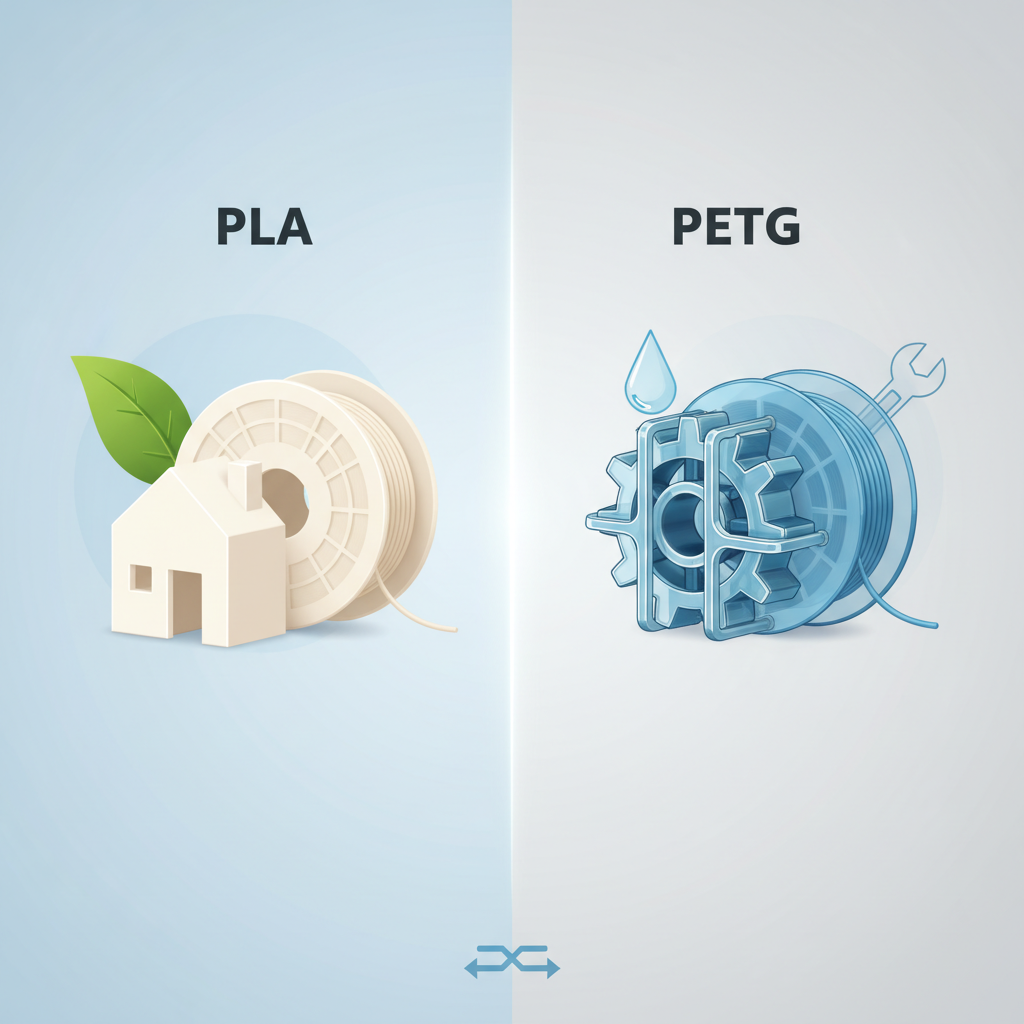
To further simplify your decision, here's a direct comparison of key attributes:
| Feature | PLA (Polylactic Acid) | PETG (Polyethylene Terephthalate Glycol-modified) | |||
|---|---|---|---|---|---|
| Ease of Printing | Very Easy (low temp, minimal warping) | Moderately Easy (higher temp, prone to stringing) | |||
| Strength & Durability | Good (but brittle, prone to snapping) | Excellent (strong, impact-resistant, flexible) | |||
| Temperature Resistance | Low (softens around 60°C) | High (resists deformation up to 80°C) | |||
| UV/Weather Resistance | Poor (degrades in sunlight) | Good (more suitable for outdoor use) | |||
| Surface Finish | Smooth, often glossy, wide colour range | Slightly less refined, can be prone to stringing | |||
| Adhesion to Bed | Good (with or without heated bed) | Very strong (can stick too well, use interface) | |||
| Odour during Printing | Low, slightly sweet | Low to moderate, slightly plastic-like | |||
| Hygroscopic | Low | High (absorbs moisture, requires dry storage) | Biodegradability | Yes (under industrial conditions) | No |
| Typical Applications | Prototyping, decorative items, educational models | Functional parts, jigs, outdoor items, casings |
Making the Right Choice for Your Project in Germany
Deciding between PLA vs. PETG filament ultimately boils down to the specific requirements of your project. Here are the key considerations:
- What is the part's intended function? If it's purely aesthetic, a display model, or a low-stress prototype, PLA is often sufficient. For functional components that need to withstand force, heat, or outdoor elements, PETG is the clear winner. This is crucial for professional cad design for manufacturing.
- What environment will the part be exposed to? For indoor use away from direct heat or sunlight, PLA is fine. For outdoor applications, high-temperature environments (like inside a car on a sunny day), or if chemical resistance is needed, choose PETG.
- What are your aesthetic requirements? If a smooth, glossy finish and a vast colour palette are crucial, PLA usually delivers. While PETG can look good, it often requires more effort to achieve a pristine finish due to stringing.
- What is your 3D printing experience level and printer's capabilities? Beginners will find PLA much more forgiving. PETG requires a bit more fine-tuning, higher temperatures (usually requiring an all-metal hotend), and often an enclosure to manage fumes and temperature fluctuations, though it can be printed on most standard FDM printers with a heated bed.
- What is your budget and timeline? While PLA is generally cheaper, the cost difference isn't always significant enough to compromise on material suitability for critical applications. For bulk filament supplier ireland needs, PrintIn3D.ie offers competitive rates for both materials.
Where to Buy High-Quality Filaments in Ireland and the EU
Once you've decided between PLA and PETG, the next step is sourcing high-quality filament. At PrintIn3D.ie, we pride ourselves on being a reliable 3d printer filament shop ireland and for the wider EU/EEA, including Germany. We stock premium filaments from trusted brands like Bambu Lab and SUNLU, offering a selection of PLA, PETG, and even buy flexible tpu filament ireland for projects requiring high flexibility.
We understand that fast and reliable delivery is crucial. That's why we offer same-day dispatch for all filament orders placed before 4 PM, with typical delivery times of 5-7 working days for our European customers, including those in Germany. Our commitment to quality ensures that whether you buy pla filament ireland or buy petg filament ireland from us, you're getting a product that will help you achieve excellent print results. Our friendly WhatsApp support is always on hand to assist with any questions you might have about our products or your order.
Beyond Filaments: Your Full 3D Printing Partner for Germany and the EU
PrintIn3D.ie is more than just a filament supplier. We are your comprehensive 3D printing partner, offering a range of services designed to bring your ideas to life without the need for you to own a 3D printer. For businesses and individuals in Germany and across the EU, we provide a hassle-free solution for all your 3D needs:
- Custom 3D Printing Service: Have a CAD file ready? Simply upload it to our platform, and we'll handle the cad file to 3d print service, delivering high-quality custom 3d printed parts ireland directly to your doorstep. We also cater to industrial 3d printing services.
- 3D Design Services: If you have an idea, sketch, or concept but no 3D model, our expert team can convert your vision into a print-ready design. Learn how to get a 3d model made by our specialists, offering 3d product design services ireland and professional cad design for manufacturing.
- 3D Scanning Service: Need to replicate a physical object? Our 3d scanning service ireland can capture the precise geometry of your item, providing solutions for 3d scanning for product development, 3d scan to cad conversion, and even reverse engineering 3d scan service.
As a Silver Rising Star award winner at the Irish Print Awards 2026 and a finalist in three categories, PrintIn3D.ie is recognised for its commitment to excellence. We stand by our services with a 30-Day Risk-Free Return policy, including original and return shipping, ensuring your complete satisfaction. Our emphasis on customer care, fast turnaround times, and friendly WhatsApp support truly sets us apart as your reliable 3D printing partner.
Frequently Asked Questions (FAQ)
Can I use PLA and PETG interchangeably?
While both are common FDM filaments, PLA and PETG are not directly interchangeable if the application demands specific material properties. PLA is easier to print and great for aesthetics and low-stress parts. PETG offers superior strength, temperature resistance, and durability for functional components. Always choose the filament that best suits the end-use requirements of your printed object.
Which filament is better for outdoor use?
For outdoor use, PETG is generally superior to PLA. PLA degrades and becomes brittle when exposed to UV light and softens at relatively low temperatures, making it unsuitable for prolonged outdoor exposure. PETG offers better UV resistance, higher temperature resistance, and greater durability against environmental elements, making it a better choice for parts that will be outdoors.
How do I store my 3D printer filament?
Proper filament storage is crucial for maintaining print quality, especially for hygroscopic materials like PETG. Filaments should be stored in a cool, dry environment, ideally in airtight containers or bags with desiccant packs (silica gel). This prevents moisture absorption, which can lead to printing issues like stringing, bubbles, and weaker prints. For best results, use a dedicated filament dryer, particularly for PETG, before printing if it has been exposed to humidity.
Does PrintIn3D.ie ship filaments to Germany?
Yes, absolutely! PrintIn3D.ie provides fast and reliable shipping of 3D printer filaments to Germany and across the entire EU/EEA. We offer same-day dispatch for filament orders placed before 4 PM (Irish time), with typical delivery times to Europe (including Germany) being 5-7 working days. We aim to ensure makers and businesses in Germany have quick access to high-quality PLA, PETG, and other filaments.
What if I need a custom 3D printed part or design service?
PrintIn3D.ie is your comprehensive solution for more than just filament supply. If you require a custom 3D printed part from your own design, you can use our custom 3d printing service. If you have an idea but no 3D model, our expert team offers 3d product design services ireland to transform your concept into a print-ready CAD file. We even offer 3d scanning service ireland for physical objects. Simply reach out to us, and our friendly WhatsApp support will guide you through the process.
Conclusion
The choice between PLA and PETG filament is a fundamental decision that significantly impacts the outcome of your 3D printing projects. PLA, with its ease of use and aesthetic appeal, remains the perfect starting point for beginners and ideal for decorative or low-stress applications. PETG, on the other hand, stands out for its strength, durability, and temperature resistance, making it the preferred material for functional parts and applications that demand robustness.
For anyone in Germany looking to excel in 3D printing, understanding the distinct advantages and disadvantages of each material is empowering. Whether you're purchasing filaments to bring your own designs to life or utilising our custom 3d printing service, PrintIn3D.ie is here to support you every step of the way. We supply premium filaments, offer expert design and scanning services, and ensure a hassle-free experience with our award-winning service and reliable delivery across the EU. Choose wisely, print brilliantly, and let your 3D ideas flourish with PrintIn3D.ie.
Ready to select the perfect filament for your next project or need a custom 3D print? Visit PrintIn3D.ie today to explore our extensive range of high-quality filaments and services, or contact our friendly team for expert advice!