Preserving Ireland's Past: 3D Scanning for Heritage
Ireland, a land steeped in history and rich cultural heritage, holds a treasure trove of ancient artifacts, majestic monuments, and intricate historical sites. Preserving these irreplaceable pieces of our past for future generations is a monumental task. Traditionally, this has involved meticulous documentation, physical restoration, and careful archiving. However, a new frontier in preservation has emerged, offering unprecedented accuracy and accessibility: 3D scanning technology. At PrintIn3D.ie, we're at the forefront of this revolution, transforming the way Ireland's history is protected and shared. We don't just offer custom 3D printing and design; our expertise extends to advanced 3D scanning services, perfectly suited for the intricate needs of heritage preservation and even for specific applications like 3d scanning for product development from historical data.
- The Digital Revolution in Heritage Preservation: Why 3D Scanning Matters for Ireland
- How 3D Scanning Works: From Ancient Relic to Digital Asset
- Applications of 3D Scanning in Irish Heritage
- PrintIn3D.ie: Your Partner in Preserving Ireland's Past
- Overcoming Challenges in Heritage 3D Scanning
- Frequently Asked Questions
The Digital Revolution in Heritage Preservation: Why 3D Scanning Matters for Ireland
Imagine being able to explore a detailed digital replica of a Neolithic tomb, hold a perfect copy of an ancient Celtic brooch, or study the erosion patterns on a historic building without ever touching the original. This is the power of 3D scanning – a non-invasive, highly accurate method of capturing the exact form and texture of an object or site and converting it into a digital 3D model. For Ireland, with its vulnerable coastal heritage, numerous archaeological digs, and vast collection of museum artifacts, this technology is nothing short of a game-changer.
Our commitment at PrintIn3D.ie to cutting-edge technology means we can offer unparalleled service to cultural institutions, archaeologists, historians, and even individuals looking to preserve personal heirlooms. This technology allows for the creation of incredibly detailed digital assets, which can then be used for a multitude of applications, including education, research, conservation, and even for inspiration in `3d product design services ireland` that draw on historical forms and structures.
Safeguarding Irreplaceable Artifacts
Many of Ireland's historical artifacts are fragile, susceptible to environmental damage, or simply too valuable to handle frequently. Traditional methods of documentation, like photography or hand-drawn sketches, offer only a limited perspective. 3D scanning captures every curve, texture, and detail, creating a permanent, high-fidelity digital record. Should an artifact be damaged, lost, or degrade over time, its precise digital twin ensures that its form and essence are preserved forever. This digital archive becomes a vital backup, an insurance policy for our past.
Furthermore, the digital models can be stored securely, shared globally for research, and even used to create exact physical replicas through our custom 3D printing services Ireland, enabling closer study or exhibition without risking the original.
Accessibility and Engagement: Bringing History to Everyone
One of the most exciting aspects of 3D scanning is its ability to democratise access to history. Imagine a school child in Donegal exploring a virtual model of the Book of Kells, or a researcher in Australia studying the intricate carvings of a megalithic passage tomb in Newgrange, all from their computer screen. 3D digital models can be integrated into virtual reality (VR) experiences, augmented reality (AR) apps, and interactive online platforms, bringing Ireland's heritage to life in engaging new ways.
This enhanced accessibility isn't just for academics; it's for everyone. It breaks down geographical barriers and allows people of all ages and abilities to interact with historical objects and sites that might otherwise be out of reach. For PrintIn3D.ie, supporting this engagement is central to our mission, allowing us to help you bring your `3d design` visions to a wider audience, whether they're historical artifacts or modern concepts.
Educational Opportunities with 3D Models
For educators, 3D models of historical artifacts and sites are invaluable tools. They allow students to manipulate, scale, and examine objects from every angle, fostering a deeper understanding and appreciation of history. Teachers can use these models to create interactive lessons, develop virtual field trips, or even set challenges for students to how to get a 3d model made by analysing historical objects for reverse engineering exercises.
PrintIn3D.ie understands the power of these tools. We provide the expertise to convert physical objects into digital learning assets, helping to inspire the next generation of historians, archaeologists, and designers across Ireland. By making history tangible and interactive, 3D scanning transforms learning from passive observation to active discovery.
How 3D Scanning Works: From Ancient Relic to Digital Asset
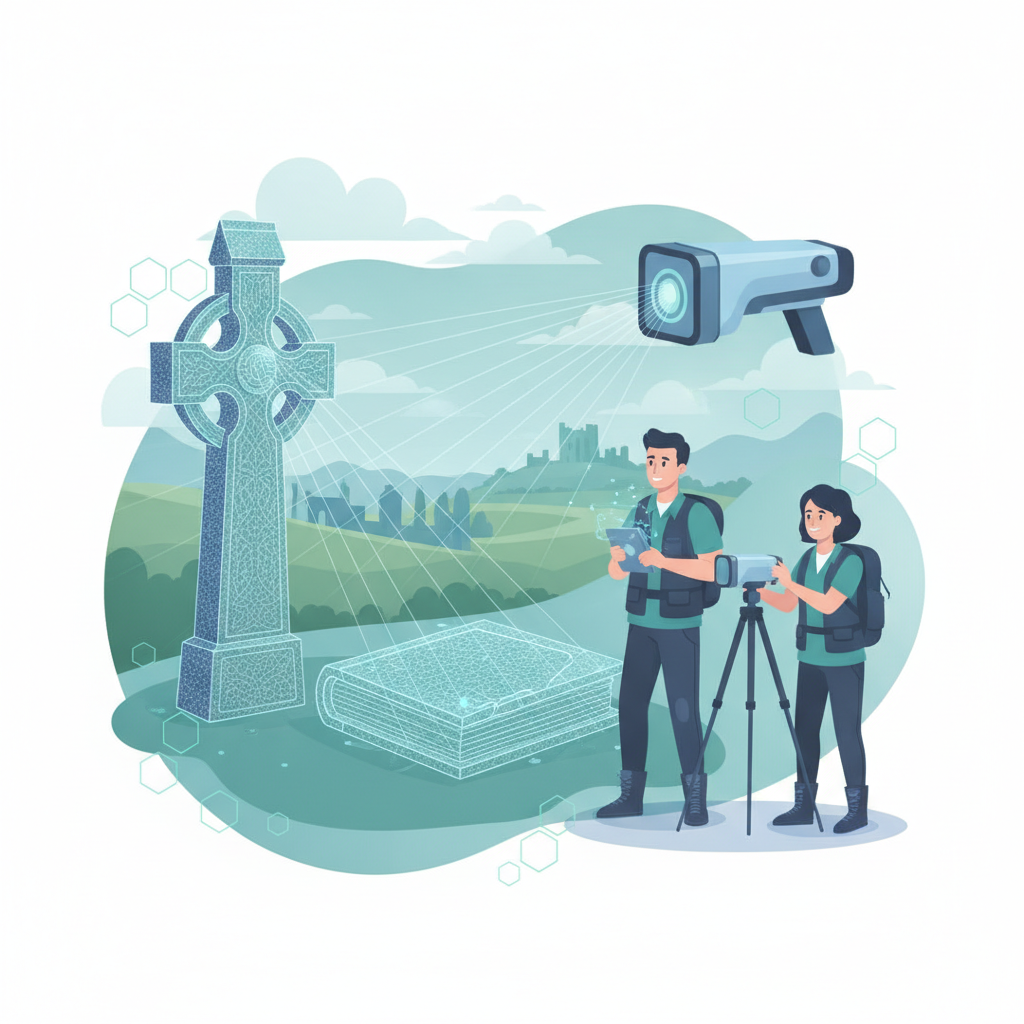
At its core, 3D scanning involves precisely measuring the shape and often the colour of an object, typically using light or lasers, to create a detailed point cloud. This point cloud is then processed into a digital mesh – a complete 3D model that accurately represents the original object. Our advanced scanning equipment ensures incredible detail, even for the most complex and delicate artifacts.
Whether you need a full 3D scan of an archaeological find or require precise `reverse engineering 3d scan service` for a damaged historical component, our team can help. We offer flexible options, including shipping objects to us, dropping them off at our Dublin location, or even on-site scanning for larger or immovable heritage structures, extending our reach across Ireland and the entire EU/EEA.
The Process: Capturing Every Detail
The journey from a physical artifact to a digital 3D model begins with careful assessment. We evaluate the object's size, material, fragility, and surface characteristics to determine the most appropriate scanning method. Our technicians then employ high-precision scanners that emit light or laser lines onto the object's surface. Sensors capture the reflected data, calculating millions of measurement points to form a dense point cloud.
This process is entirely non-contact and non-destructive, making it ideal for even the most delicate and precious heritage items. The result is a highly accurate digital representation, complete with texture and colour information, ready for further processing and development.
From Scan to CAD: The Power of `3d scan to cad conversion`
Once the raw scan data is captured, the next crucial step is often `3d scan to cad conversion`. This process transforms the intricate mesh data into a clean, editable Computer-Aided Design (CAD) model. For heritage applications, this is vital for several reasons. CAD models are parametric, meaning they can be easily modified, scaled, and analysed with engineering precision. This is particularly useful for:
- Creating accurate architectural plans of historical buildings.
- Analysing wear and tear on ancient tools or weapons.
- Designing precise `3d printed replacement parts service` for restoration projects.
- Developing detailed schematics for scholarly publications.
Our expert team at PrintIn3D.ie excels in this complex conversion, turning raw scan data into usable, intelligent CAD files that unlock further possibilities for research, restoration, and indeed, `3d scanning for product development` derived from historical insights.
Creating Tangible Replicas: `Custom 3D Printed Parts Ireland`
Beyond digital preservation, 3D scanning opens the door to physical replication. Once an object has been scanned and a digital model created (often after `3d scan to cad conversion`), that model can then be brought to life using our custom 3D printing services Ireland. This allows for the production of exact replicas in various materials, from durable plastics to highly detailed resins. These `custom 3d printed parts ireland` have numerous applications in heritage:
- Museum Displays: Allowing visitors to safely touch and examine replicas, enhancing the interactive experience.
- Educational Tools: Providing robust, affordable models for classrooms and workshops.
- Conservation: Creating exact fittings or missing components for restoration projects.
- Research: Offering researchers hands-on access to detailed copies without risking the original.
Whether it's an intricate ancient brooch or a component of a historical machine, PrintIn3D.ie can transform digital models into tangible realities, offering `industrial 3d printing services` to meet the specific needs of heritage projects.
Applications of 3D Scanning in Irish Heritage
The versatility of 3D scanning means its applications in heritage preservation are vast and constantly expanding. For Ireland, with its rich tapestry of history, from prehistoric sites to modern cultural landmarks, the potential is enormous.
Documenting Archaeological Sites and Monuments
Ireland's landscape is dotted with countless archaeological sites, many still hidden beneath the soil. 3D scanning provides archaeologists with an unparalleled tool for documenting these discoveries. From capturing the precise layout of a newly excavated settlement to creating highly detailed models of individual artefacts found on site, 3D data offers a level of accuracy and completeness previously unattainable. This is particularly crucial for fragile sites or those vulnerable to erosion, ensuring a permanent record before they might be lost.
Furthermore, digital models of entire sites can be used for virtual reconstructions, allowing historians to visualise how ancient structures once appeared, offering valuable insights into past societies. This detailed documentation, supported by services like `3d scanning for product development` (in this case, "product" being a comprehensive digital site record), safeguards our understanding for generations.
Restoring Damaged Artifacts: The Role of `3d printed replacement parts service`
Time, environmental factors, and past mishandling can take their toll on historical objects, leaving them incomplete or damaged. In these scenarios, 3D scanning, combined with 3D printing, offers groundbreaking solutions for restoration. By scanning the intact parts of an object, or even similar objects, conservators can accurately recreate missing components. Our `3d printed replacement parts service` allows for the precise fabrication of these pieces, ensuring a perfect fit and restoring the artifact to its original integrity with minimal intervention.
This approach is less invasive than traditional methods and allows for the use of materials chosen specifically for their compatibility and stability, ensuring the longevity of the restored piece. From ancient pottery to antique machinery, PrintIn3D.ie stands ready to assist with these delicate and important restoration projects across Ireland.
Virtual Exhibitions and Tourism
The COVID-19 pandemic highlighted the importance of digital access to cultural institutions. 3D scanning enables museums, galleries, and heritage sites to create immersive virtual exhibitions. Visitors can explore detailed 3D models of artifacts, "walk through" historical buildings, and even participate in interactive narratives, all from the comfort of their homes. This expands the reach of Irish heritage far beyond physical borders, attracting global audiences and offering a new dimension to tourism.
Imagine a virtual tour of the Rock of Cashel, where every intricate carving and architectural detail is rendered in stunning 3D. This not only promotes Irish tourism but also acts as a vital educational resource, showcasing the richness of our history to the world.
Research and Scholarly Study
For scholars and researchers, 3D digital models are a treasure trove of data. They allow for non-contact, highly detailed metrological analysis, identifying wear patterns, tool marks, and construction techniques with unprecedented accuracy. Researchers can share these models easily, facilitating collaborative studies across institutions and countries without the need to transport fragile originals.
The ability to precisely measure and analyse objects in a digital environment opens up new avenues for understanding ancient technologies, artistic practices, and cultural exchanges. This data is critical for generating new knowledge and contributing to the global academic community's understanding of human history.
PrintIn3D.ie: Your Partner in Preserving Ireland's Past
At PrintIn3D.ie, we are proud to be an award-winning service, recognised with the Silver Rising Star award at the Irish Print Awards 2026 and as a finalist in three categories. This dedication to excellence underpins everything we do, especially when it comes to the delicate and critical work of heritage preservation. We understand the unique challenges and responsibilities involved in working with historical artifacts and sites.
Our commitment to quality, combined with friendly WhatsApp support and a 30-Day Risk-Free Return policy (for applicable products), ensures that you receive not just a service, but a partnership you can trust. Furthermore, we offer Non-Disclosure Agreements (NDAs) to protect sensitive information and unique historical findings, providing complete peace of mind.
Expert `3d scanning for product development` and Heritage
While `3d scanning for product development` is a common industrial application, our expertise seamlessly translates to the unique requirements of heritage projects. We apply the same precision, attention to detail, and advanced technology to ensure that every historical object or site is captured with the highest fidelity. Whether you're looking to create an educational "product" from an ancient tool, develop a digital archive "product" for a historical collection, or simply understand how to digitise a treasured heirloom, our team is equipped to guide you.
We work with various institutions and individuals across Ireland, understanding the diverse needs from small museum pieces to large architectural elements. Our 3D scanning services are designed to be flexible and comprehensive, ensuring your specific heritage preservation goals are met.
Hassle-Free Solutions for Cultural Institutions and Individuals
We know that navigating new technologies can seem daunting. That's why PrintIn3D.ie is dedicated to providing a hassle-free experience. For cultural institutions, archaeologists, or individuals, we simplify the process of bringing your 3D ideas to life, without the need for you to own a 3D printer or understand complex software. Simply tell us about your heritage project, and we'll provide the expert advice and services needed.
Our fast turnaround times and friendly support mean that your projects can move forward efficiently, helping you to meet deadlines for exhibitions, research, or conservation efforts. We are your dedicated `3d printing service dublin` and across Ireland, ready to serve your heritage needs.
Award-Winning Service You Can Trust
Our recognition at the Irish Print Awards in 2026 highlights our commitment to innovation and customer satisfaction. When you partner with PrintIn3D.ie, you're choosing a service that is not only cutting-edge but also reliable and deeply invested in your success. This trust is paramount when dealing with irreplaceable heritage assets. We strive to be more than just a service provider; we aim to be a long-term partner in your efforts to preserve and celebrate Ireland's rich history.
Beyond scanning, our capabilities extend to offering high-quality 3D printer filaments from brands like Bambu Lab and SUNLU, including `buy petg filament ireland` and buy bambu lab filament ireland. While perhaps not directly related to the scanning of ancient relics, this demonstrates our comprehensive expertise in the 3D printing ecosystem, allowing us to produce high-quality replicas from your scanned data, and even act as a `bulk filament supplier ireland` for larger institutional needs.
Overcoming Challenges in Heritage 3D Scanning
While 3D scanning offers immense benefits, heritage projects often present unique challenges. At PrintIn3D.ie, our experience and advanced technology allow us to navigate these complexities with confidence.
Handling Delicate Objects
Many heritage artifacts are extremely fragile, requiring the utmost care during handling. Our non-contact scanning methods ensure that the objects are not touched during the data capture process, eliminating any risk of damage. For objects that need to be moved, our team adheres to strict protocols, working in consultation with conservators and curators to ensure their safety. This meticulous approach is vital for safeguarding our precious national treasures.
Scale and Environment
From tiny ancient coins to sprawling archaeological sites, heritage objects vary enormously in scale. Our diverse range of scanning equipment allows us to tackle projects of all sizes, ensuring high-resolution data capture whether it's a small museum piece or a large historical building. For outdoor sites, environmental factors like lighting and weather can be a challenge, but our experienced technicians are adept at adapting to these conditions to ensure optimal results. This flexibility makes us a leading `online 3d printing quote ireland` provider for diverse scanning needs.
Data Management and Archiving
The digital files generated by 3D scanning are often very large and require robust data management and secure archiving solutions. PrintIn3D.ie understands the importance of long-term preservation of these digital assets. We can advise on best practices for storing and managing your 3D data, ensuring its accessibility and integrity for future generations of researchers and enthusiasts. This comprehensive support highlights our role as a trusted partner in digital heritage preservation.
The convergence of advanced technology and a deep respect for history is transforming heritage preservation in Ireland. At PrintIn3D.ie, we are proud to offer our expert 3D scanning services to safeguard, celebrate, and make accessible Ireland's incredible past. Whether for meticulous documentation, creating educational tools, or developing accurate `3d printed replacement parts service` for restoration, our award-winning team is here to help.
From ancient artifacts to historic buildings, `3d scanning for product development` in the heritage sector ensures that Ireland's stories continue to be told, explored, and appreciated for centuries to come. Let us help you bring your vision for preserving history to life.
Frequently Asked Questions
What types of heritage items can PrintIn3D.ie 3D scan?
We can 3D scan a wide variety of heritage items, from small, intricate artifacts like jewellery, tools, and pottery fragments to larger objects such as sculptures, architectural elements, and even entire archaeological sites (depending on size and access). Our non-contact scanning methods are ideal for delicate and fragile pieces, ensuring no damage during the process. We encourage you to contact us with details of your specific item for a tailored assessment.
How accurate are the 3D scans for heritage preservation?
Our 3D scanning technology offers incredibly high accuracy, capturing details down to sub-millimetre levels. This precision is crucial for heritage preservation, as it allows for exact documentation, detailed analysis, and the creation of highly accurate replicas or `3d printed replacement parts service`. The fidelity of our scans ensures that the digital models are true representations of the original artifacts, preserving every nuance for future study and appreciation.
Can the 3D digital models be used for virtual reality or online exhibitions?
Absolutely! One of the key benefits of 3D scanning for heritage is its ability to create immersive digital experiences. The 3D models we produce are fully compatible with various virtual reality (VR), augmented reality (AR), and online platform applications. This allows for the creation of engaging virtual tours, interactive museum exhibits, and accessible online resources, bringing Ireland's history to a global audience. We can help prepare your scanned data for these exciting applications.
What if my heritage object is too large or too fragile to transport?
PrintIn3D.ie understands that many heritage items are either too large, too fragile, or too important to be moved from their location. For such cases, we offer on-site 3D scanning services across Ireland and the EU/EEA. Our expert technicians can travel to your location with our portable scanning equipment to capture the necessary data, ensuring the object remains safe and undisturbed. We also offer options for dropping off items at our Dublin location or shipping them to us if transport is feasible.
Do you offer Non-Disclosure Agreements (NDAs) for sensitive heritage projects?
Yes, confidentiality is paramount, especially when dealing with sensitive archaeological finds or unique historical artifacts. PrintIn3D.ie offers Non-Disclosure Agreements (NDAs) to protect your project information and the intellectual property derived from the scanned heritage items. We are committed to maintaining the highest level of discretion and security for all our clients and their valuable assets.