Bring Your Product Idea to Life with Custom 3D Printing in Ireland
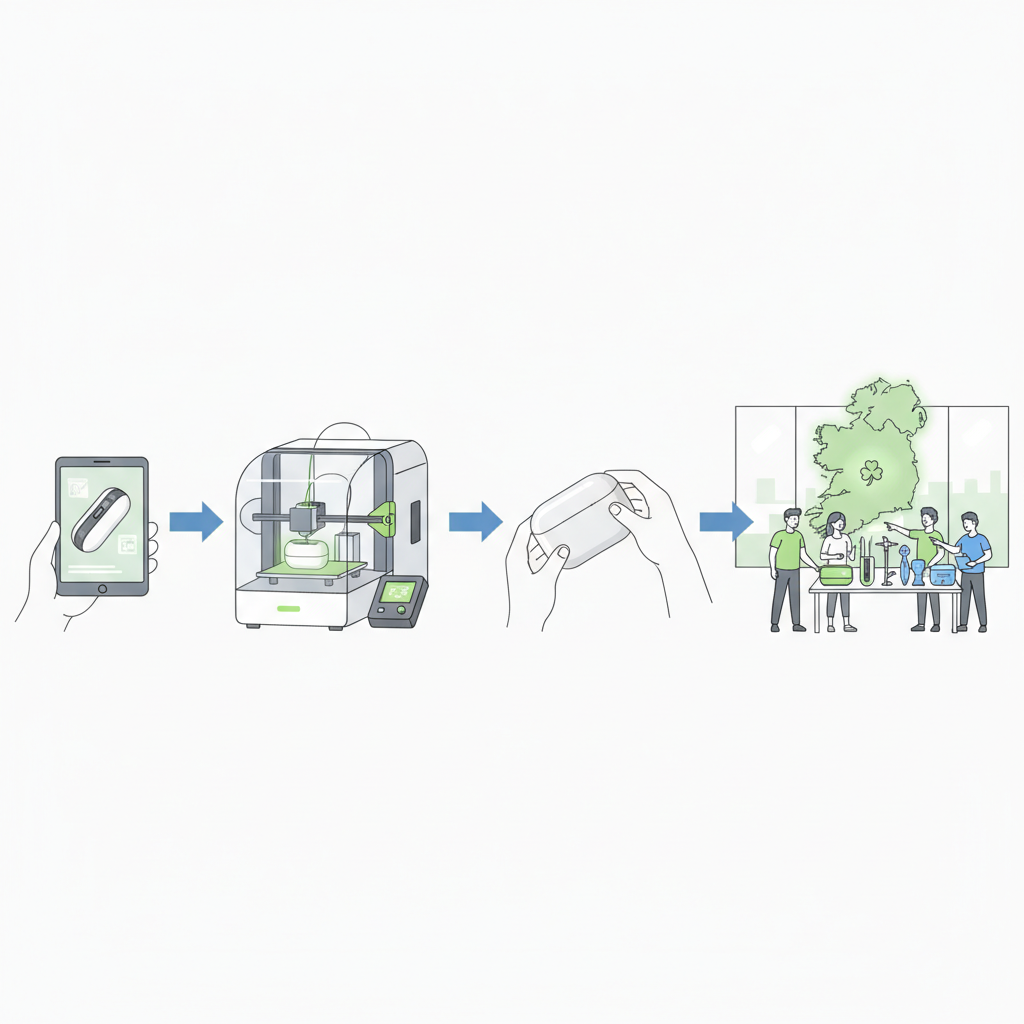
Do you have a brilliant product idea swirling in your head, a concept that could solve a problem, delight customers, or simply bring your creative vision to life? Perhaps you've sketched it out on a napkin, dreamt about it, or even built a rough mock-up. The exciting news is that transforming that abstract idea into a tangible, physical product is more accessible than ever, especially here in Ireland, even if you don't own a 3D printer. This comprehensive guide from PrintIn3D.ie will walk you through every essential step of bringing your product idea to life using custom 3D printing services, no matter your experience level.
In this guide, you will learn the entire process, from initial conceptualisation and 3D model development to selecting the right materials, preparing your files, and partnering with a professional 3D printing service in Ireland. We'll demystify the technical jargon, highlight common pitfalls to avoid, and empower you to confidently navigate the world of additive manufacturing. Whether you're an aspiring entrepreneur looking to prototype a new gadget, a designer needing custom 3d printed parts ireland, or a hobbyist bringing a unique creation to fruition, understanding this journey is crucial. We'll show you how to leverage expert services like PrintIn3D.ie to handle the technical complexities, allowing you to focus on innovation and design. Get ready to turn your dreams into reality, effortlessly!
Here at PrintIn3D.ie, we've helped countless individuals and businesses across Ireland transform their ideas into functional products. We understand the challenges and excitement of product development, and we're committed to being your reliable partner every step of the way, ensuring a smooth and hassle-free experience from concept to completion. Let's get started on your journey to tangible innovation!
Who This Is For
- Entrepreneurs and Start-ups with product ideas
- Designers needing prototypes or custom components
- Engineers requiring functional custom 3d printed parts ireland
- Hobbyists and inventors without access to a 3D printer
- Small businesses looking for industrial 3d printing services or affordable 3d printing near me
- Anyone who wants to create etsy 3d printed products ireland but lacks the equipment
Step 1: Conceptualise and Refine Your Product Idea
Every great product begins with a clear idea. Before you even think about 3D printing, it's crucial to thoroughly conceptualise and define what your product is, what problem it solves, and how it will function. This initial phase involves more than just a vague notion; it requires detailed thought about its purpose, aesthetics, and user interaction. A well-defined concept will save you significant time and resources down the line.
Start by outlining the core features and benefits of your product. Consider its size, shape, moving parts (if any), and how it will interact with other objects or users. Think about the environment it will operate in and any specific requirements for strength, flexibility, or temperature resistance. The more details you can iron out at this stage, the easier the subsequent design and printing processes will be. Don't be afraid to sketch multiple iterations or create simple physical models using craft materials to get a better feel for your design.
- Define the problem: What specific issue does your product address?
- Outline functionality: How will your product work? What are its primary features?
- Consider aesthetics: What should it look like? What colours or textures are important?
- Sketch and brainstorm: Draw your idea from different angles. Annotate with dimensions and material thoughts.
- Identify key dimensions: Get a rough idea of the overall size and critical measurements.
- Think about assembly: If it's a multi-part product, how will the pieces fit together?
Step 2: Develop a 3D Model from Your Concept
Once you have a solid concept, the next critical step is to translate it into a digital 3D model. This digital blueprint is what a 3D printer uses to build your physical product layer by layer. For many, this is the most daunting part of the process, but there are several pathways available, catering to different skill levels and budgets. This is where how to get a 3d model made becomes a key consideration.
Choosing the right method for creating your 3D model depends on the complexity of your design and your own technical expertise. If you're creating custom 3d printed parts ireland for manufacturing, a precise CAD model is usually essential. For organic or artistic shapes, sculpting software might be more appropriate. Don't worry if you're not a CAD expert; professional help is readily available.
- Do It Yourself (DIY) with CAD Software:
- For those with some technical aptitude, free and paid CAD (Computer-Aided Design) software can be used. Options include Fusion 360 (free for hobbyists/startups), TinkerCAD (browser-based, beginner-friendly), SketchUp, and Onshape.
- This approach gives you maximum control over your design but requires a learning curve.
- Ideal for precise, functional parts.
- Hire a Professional 3D Designer:
- This is often the best option for complex designs, intricate mechanisms, or if you lack CAD skills. A professional cad design for manufacturing service can take your sketches, drawings, or even verbal descriptions and turn them into print-ready 3D files (e.g., STL, OBJ).
- Expert designers understand the nuances of 3D printing, ensuring your model is optimised for successful fabrication.
- PrintIn3D.ie offers comprehensive 3D design services, taking your concept from an idea to a polished, printable file.
- Utilise 3D Scanning:
- If you have an existing physical object that you want to replicate, modify, or integrate into a new design, 3d scanning for product development is an excellent solution.
- A 3D scanner captures the geometry of an object and creates a digital 3D model. This is incredibly useful for reverse engineering, preserving historical artifacts, or creating custom fittings for existing items.
- Services like PrintIn3D.ie provide professional 3D scanning, ensuring high-fidelity digital representations of your physical objects.
Step 3: Choose the Right 3D Printer Filaments for Your Product
The material you choose for your 3D printed product is just as important as the design itself. Different 3d printer filaments possess unique properties regarding strength, flexibility, temperature resistance, finish, and cost. Understanding these differences is crucial for ensuring your final product performs as intended. This step is where your conceptualisation from Step 1 truly pays off, guiding your material selection.
At PrintIn3D.ie, we stock a wide range of high-quality 3d printer filaments from trusted brands like Bambu Lab and SUNLU. Whether you need something rigid and durable, flexible and shock-absorbent, or simply aesthetically pleasing, there's a filament suited to your needs. Thinking about the end-use environment for your custom 3d printed parts ireland will help narrow down the options.
- PLA (Polylactic Acid):
- Pros: Easy to print, wide range of colours, biodegradable, good for aesthetic parts and prototypes.
- Cons: Lower temperature resistance, brittle under stress, not ideal for outdoor use.
- Ideal for: Prototypes, decorative items, figures, low-stress functional parts, etsy 3d printed products ireland.
- PETG (Polyethylene Terephthalate Glycol):
- Pros: Stronger and more flexible than PLA, good layer adhesion, better temperature and UV resistance, food-safe options available.
- Cons: Can be stringy during printing, requires slightly higher print temperatures.
- Ideal for: Functional prototypes, mechanical parts, outdoor components, enclosures, durable items.
- ABS (Acrylonitrile Butadiene Styrene):
- Pros: High strength, good temperature resistance, durable, often used in consumer products.
- Cons: Requires an enclosed printer, prone to warping, emits fumes during printing.
- Ideal for: End-use parts, automotive components, functional prototypes requiring high durability.
- TPU (Thermoplastic Polyurethane):
- Pros: Highly flexible, elastic, excellent impact resistance, rubber-like properties.
- Cons: Difficult to print (slow speeds required), can be stringy.
- Ideal for: Gaskets, phone cases, wearable items, flexible connectors, dampeners.
- Speciality Filaments:
- Wood, metal, carbon fibre, or glow-in-the-dark infused filaments offer unique aesthetic or functional properties.
- Consider these for niche applications or enhanced visual appeal.
Step 4: Prepare Your 3D Model for Printing
Even with a perfectly designed 3D model and the ideal filament chosen, proper file preparation is crucial for a successful print. This step involves optimising your digital model for the 3D printing process, ensuring it's robust, printable, and accurately represents your vision. This is where your digital design becomes ready for the physical world, and a well-prepared file can save you from common printing issues.
When you use a custom 3D printing service like PrintIn3D.ie, much of this technical preparation is handled by our experts. However, understanding the basics helps you design more effectively and communicate your needs clearly. We'll ensure your model is watertight, correctly scaled, and optimally oriented for the best possible print quality and structural integrity.
- Check for Model Errors:
- Ensure your 3D model is "manifold" or "watertight" – meaning it has no holes, inversed normals, or intersecting geometry. These errors can cause the printer to fail or produce incomplete parts.
- Use software like Meshmixer, Netfabb, or online services to check and repair common mesh issues.
- Scale and Orientation:
- Verify that your model is scaled correctly to its real-world dimensions (e.g., in millimetres).
- Consider the optimal orientation for printing. Orienting a part to minimise supports, maximise strength in critical directions, or improve surface finish can significantly impact the final result.
- Wall Thickness:
- Ensure all walls and features are thick enough to be printed. Very thin walls can break easily or not print at all. Minimum recommended thickness varies by material and printer, but generally aim for at least 0.8mm-1.5mm.
- Tolerances for Assembled Parts:
- If your product has multiple parts that need to fit together, design with appropriate tolerances. A gap of 0.2mm-0.4mm is often a good starting point for FDM (Fused Deposition Modelling) prints to allow for easy assembly without being too loose.
- Support Structures:
- Overhangs and bridges in your design will likely require support structures during printing to prevent them from collapsing. While slicing software generates these automatically, consider designing your part to minimise the need for extensive supports, as they require post-processing removal.
- File Format:
- The most common file formats for 3D printing are STL (.stl) and OBJ (.obj). Ensure your model is exported in one of these formats. PrintIn3D.ie also accepts other formats, and our team can assist with conversions.
Step 5: Select a Custom 3D Printing Service in Ireland
This is where your vision truly begins to materialise. Instead of investing in your own printer, managing maintenance, and learning the intricacies of slicing software, partnering with a professional custom 3D printing service in Ireland offers a hassle-free and efficient path to bringing your product idea to life. Services like PrintIn3D.ie eliminate the barriers to entry, providing expert knowledge and industrial-grade equipment.
When choosing a service, consider factors like material availability, print quality, turnaround time, and customer support. At PrintIn3D.ie, we pride ourselves on being an award-winning service, recognised as a 'Rising Star' at the Irish Print Awards 2026. We offer everything from custom 3d printing dublin to custom 3d printing cork and beyond, ensuring affordable 3d printing near me is a reality for everyone in Ireland. We understand that your product is important, and we offer fast turnaround times, sometimes as quickly as 8 hours, alongside friendly WhatsApp support and a 30-day risk-free return policy.
- Research Local & Online Services:
- Look for services specifically in Ireland that offer the types of 3d printing you need (e.g., FDM for functional prototypes, SLA for high detail).
- PrintIn3D.ie is your premier Irish partner, offering a full suite of services including custom 3D printing, 3D design, and 3D scanning.
- Request a Quote:
- Submit your 3D model (or concept if you need design help) to the service for a detailed quote. This will typically include material cost, print time, and any post-processing.
- Our online platform makes it easy to get 3d print estimates quickly.
- Discuss Materials and Finishes:
- Confirm the availability of your chosen 3d printer filaments and discuss any specific finish requirements (e.g., sanding, painting, vapour smoothing).
- Our team can guide you on the best options for your project.
- Review Lead Times:
- Understand the expected turnaround time for your print, especially if you have a deadline for a prototype or an event showcasing etsy 3d printed products ireland.
- PrintIn3D.ie offers competitive lead times, with same-day dispatch for filament orders placed before 4 PM, and prompt delivery for custom prints across Ireland and the EU/EEA.
- Consider Confidentiality:
- If your product idea is proprietary, ensure the service offers Non-Disclosure Agreements (NDAs) to protect your intellectual property. PrintIn3D.ie understands the importance of confidentiality and offers NDAs for your peace of mind.
Step 6: Review Prototypes and Iterate
The first 3D print of your product idea is rarely the final version. This stage is all about evaluation, testing, and refinement. Think of your initial print as a prototype – a tangible representation that allows you to identify strengths, weaknesses, and areas for improvement. This iterative process is a cornerstone of effective product development and a major advantage of using 3d printing.
Once you receive your 3D printed prototype from PrintIn3D.ie, put it through its paces. Does it fit correctly? Does it function as intended? Does it feel good in the hand? Are there any unexpected aesthetic issues? Gather feedback from potential users, colleagues, or mentors. The goal is to learn as much as possible from this physical model to inform the next design revision. Don't be discouraged by imperfections; they are valuable learning opportunities that will lead to a superior final product.
- Thoroughly Inspect the Print:
- Check for dimensional accuracy using callipers or a ruler.
- Examine surface finish, layer lines, and any imperfections.
- Assess the overall aesthetic appeal.
- Test Functionality:
- If your product has moving parts, test their articulation and fit.
- Apply intended loads or stresses to gauge strength and durability based on the chosen 3d printer filaments.
- Ensure any internal components or assemblies fit as designed.
- Gather Feedback:
- Show your prototype to others and actively solicit their opinions.
- Note down all feedback, both positive and negative.
- Identify Areas for Improvement:
- Based on your inspection and feedback, list all design changes needed. This could involve adjusting dimensions, strengthening weak points, improving ergonomics, or refining aesthetics.
- Revise the 3D Model:
- Go back to your 3D design software (or work with your designer) to implement the identified changes.
- Sometimes, this might involve significant redesign; other times, it's minor tweaks.
- Repeat (Iterate):
- Order a new prototype with the revised model. Repeat the inspection, testing, and feedback cycle.
- This iterative process continues until you are satisfied with the product's performance and appearance.
Step 7: Scale Up to Production (Small Batch or On-Demand)
Once your prototype is perfected and you're confident in your design, the final stage is moving towards production. One of the significant advantages of custom 3D printing, especially for businesses in Ireland, is its flexibility in scaling. Whether you need a small batch of custom 3d printed parts ireland for a limited release, a series of functional components for ongoing projects, or wish to stock etsy 3d printed products ireland, 3D printing offers a cost-effective and agile solution without the massive upfront investment of traditional manufacturing.
PrintIn3D.ie is perfectly positioned to support your production needs. We offer industrial 3d printing services, capable of producing high-quality, consistent parts in quantities that suit your demand. Our efficient processes, combined with access to a wide range of 3d printer filaments as a bulk filament supplier ireland, mean you can transition from prototyping to market quickly and without hassle. This on-demand manufacturing approach reduces inventory risks and allows for continuous improvement even after launch.
- Define Production Quantity:
- Determine how many units you need. 3d printing excels for low-to-medium volume production or when customisation is key.
- For very high volumes (thousands), traditional methods might eventually become more cost-effective, but 3D printing offers an excellent bridge.
- Optimise for Manufacturing:
- Even if your prototype is perfect, consider if there are any further optimisations for batch production, such as nesting parts efficiently on the print bed or minor design tweaks that simplify post-processing.
- Your custom 3D printing service can advise on these aspects.
- Quality Control:
- Establish clear quality control parameters to ensure each printed part meets your specifications.
- PrintIn3D.ie maintains rigorous quality checks throughout the printing process.
- Packaging and Shipping:
- Plan how your finished products will be packaged and shipped, especially if you're selling etsy 3d printed products ireland.
- Leverage PrintIn3D.ie's fast and reliable delivery service across Ireland and the EU/EEA.
- Ongoing Support and Reorders:
- Work with a service that can easily handle reorders and future iterations.
- With PrintIn3D.ie, your designs are safely stored (with NDA protection), making reordering and modifications simple.
Common Mistakes to Avoid When Bringing Your Product Idea to Life
Embarking on the journey of product development with 3D printing is exciting, but like any venture, it comes with potential pitfalls. Being aware of these common mistakes can help you navigate the process more smoothly, saving you time, money, and frustration. At PrintIn3D.ie, we've seen it all, and we're here to help you avoid these stumbles on your path to creating custom 3d printed parts ireland.
- Skipping the Conceptualisation Phase: Rushing straight to design without a clear idea of your product's purpose, functionality, and audience can lead to endless revisions and a product that misses its mark.
- Ignoring Material Properties: Assuming all plastics are the same. Not considering the specific environmental conditions or mechanical stresses your product will face can lead to premature failure. Always match your 3d printer filaments to your product's requirements.
- Poor 3D Model Preparation: Submitting a 3D model with errors (e.g., non-manifold geometry, too-thin walls) can result in failed prints, reduced quality, or unexpected costs for file repair. If you need how to get a 3d model made professionally, ensure it's print-ready.
- Underestimating the Value of Iteration: Expecting the first prototype to be perfect. Product development is an iterative process. Embrace testing, feedback, and multiple revisions to refine your design.
- Overlooking Print Orientation: The way a part is oriented on the print bed significantly impacts its strength, surface finish, and the need for support structures. A professional service will optimise this for you.
- Not Considering Post-Processing: Some 3D printed parts require sanding, painting, or assembly. Factor this into your design and budget, especially if aiming for a polished, market-ready finish for etsy 3d printed products ireland.
- Choosing the Wrong Service Provider: Opting for the cheapest option without considering expertise, equipment, material range, and customer support. A reliable partner like PrintIn3D.ie offers consistent quality and valuable guidance. For complex 3d scanning for product development, expertise is paramount.
- Ignoring Intellectual Property: Not securing your design with an NDA when working with third parties, particularly if your idea is novel.
- Scalability Blindness: Designing a prototype that is difficult or expensive to produce in larger quantities if future scaling is a goal. Consider the feasibility of industrial 3d printing services from the outset.
FAQ
What is the typical cost for custom 3D printing in Ireland?
The cost of custom 3D printing varies widely depending on several factors: the size and complexity of your 3D model, the type of 3d printer filament chosen (e.g., PLA, PETG, specialty materials), the required print resolution, and any additional services like 3D design or post-processing. Small, simple prototypes in standard materials can be very affordable 3d printing near me, starting from just a few euros. Larger, more intricate parts or those requiring engineering-grade materials will naturally cost more. At PrintIn3D.ie, we offer instant online quotes for your 3D models, providing transparent pricing upfront so you can budget effectively for your custom 3d printed parts ireland.
How long does it take to get a 3D model made if I only have a sketch?
The time it takes to create a 3D model from a sketch depends on the complexity of your idea and the level of detail required. A simple, basic model might be completed in a few hours, while a highly intricate or mechanical design requiring precise professional cad design for manufacturing could take several days or even weeks. This also depends on the clarity of your sketches and your responsiveness during the design process. PrintIn3D.ie offers dedicated 3D design services to efficiently transform your concepts into print-ready files, keeping you updated at every stage. We streamline the process of how to get a 3d model made.
Can I get prototypes quickly for my business in Ireland?
Absolutely! One of the biggest advantages of 3d printing is its speed for rapid prototyping. PrintIn3D.ie understands the urgency often associated with business development and offers express services for custom 3D printing. We can achieve fast turnaround times for many projects, sometimes as quickly as 8 hours, depending on the print volume and complexity. Our local Irish presence ensures swift delivery, helping you iterate on your designs faster and bring your product to market sooner. We're committed to being your responsive partner for fast 3D printing for startup prototypes in Dublin and across Ireland.
What types of products are suitable for 3D printing?
3D printing is incredibly versatile and suitable for a vast array of products. It's ideal for:
- Prototypes: Functional and aesthetic prototypes for virtually any product idea.
- Custom Parts: Bespoke components for machinery, repairs, or unique assemblies.
- Jigs and Fixtures: Manufacturing aids for other production processes.
- Art and Decorative Items: Unique sculptures, home decor, or etsy 3d printed products ireland.
- Models and Miniatures: Architectural models, gaming miniatures, educational tools.
- Enclosures and Casings: Custom housings for electronics or other devices.
- Replacements: Discontinued or hard-to-find parts.
Can PrintIn3D.ie help with 3D scanning for existing parts?
Yes, absolutely! 3d scanning for product development is one of our core services. If you have a physical object that you need to replicate, reverse engineer, or integrate into a new design, our professional 3D scanning service can create an accurate digital 3D model. This is invaluable for custom fittings, reproducing old or broken parts, or capturing complex organic shapes that are difficult to design from scratch. We make the process of digitising your physical assets straightforward and precise.
Next Steps: Turn Your Vision into Reality with PrintIn3D.ie
Bringing a product idea to life is an exhilarating journey, and with the power of custom 3D printing, it's more achievable than ever before, especially right here in Ireland. You don't need to be a 3D printing expert or own expensive equipment to innovate. At PrintIn3D.ie, we are your dedicated partner, providing comprehensive services from 3D design and 3d scanning for product development to high-quality custom 3D printing using a wide range of 3d printer filaments.
Ready to take the first step? Don't let your brilliant ideas remain just ideas. Visit our custom 3D printing page today to get an instant quote, upload your 3D model, or learn more about how we can help you bring your product vision to life with ease and expertise. Our friendly team is always here to provide support and guidance, ensuring your product journey is a success.