Choosing the Right Plastic Filament for Your 3D Printer in the UK
Introduction: Your Ultimate Guide to 3D Printer Filaments in the UK
Are you navigating the exciting world of 3D printing and finding yourself overwhelmed by the sheer variety of plastic filaments available? You're not alone. Choosing the right material is perhaps the most crucial decision after selecting your 3D printer, directly impacting the success, functionality, and aesthetics of your final product. From hobbyists creating intricate models to engineers prototyping complex parts, understanding the characteristics of each filament is key to unlocking your creative and functional potential.
This comprehensive guide is designed specifically for makers, designers, and businesses across the UK seeking clarity on plastic filament 3d printer uk options. We'll demystify the most common and popular filament types, delving into their unique properties, ideal applications, and critical printing considerations. Whether you're aiming for aesthetic showpieces, durable functional components, or flexible prototypes, we'll equip you with the knowledge to make informed decisions. We'll also cover essential tips for storage, troubleshooting, and sourcing quality materials, ensuring your 3D printing journey is as smooth and successful as possible. Get ready to elevate your 3D printing projects with the perfect filament choice!
Who This Is For
- New 3D printer owners looking to understand filament basics.
- Experienced makers wanting to explore new material types.
- Small businesses considering 3D printing for prototyping or production.
- Anyone in the UK needing to choose the optimal 3D printer filament for a specific project.
Step 1: Understanding the Foundation of 3D Printer Filaments
Before diving into specific types, it's essential to grasp what 3D printer filament truly is and how it functions. Filaments are thermoplastic materials, meaning they can be repeatedly melted and solidified without significant degradation. This property makes them ideal for Fused Deposition Modeling (FDM) 3D printers, where the material is heated to a molten state, extruded layer by layer, and then cools to form the desired object. The quality and consistency of your filament are paramount to achieving reliable and high-quality prints.
Filaments primarily come in two standard diameters: 1.75mm and 2.85mm (often loosely referred to as 3mm). It's critical to ensure the filament diameter matches your 3D printer's specifications. Using the wrong diameter can lead to severe extrusion issues, under-extrusion, or even damage to your hot end. Additionally, understanding key material properties like strength, flexibility, heat resistance, and surface finish will guide your choice towards a successful print.
- Verify your printer's filament diameter: Check your printer's manual or specifications (typically 1.75mm for most modern consumer printers).
- Research filament brands: Look for reputable manufacturers known for consistent quality and accurate diameter tolerances. Brands like Bambu Lab and SUNLU, for instance, are popular for their reliability in the 3D printing community.
- Understand material properties: Familiarise yourself with terms like tensile strength, impact resistance, heat deflection temperature, and flexibility, as these will define the functionality of your 3D printed parts.
Step 2: Decoding PLA Filament: The Beginner-Friendly Choice
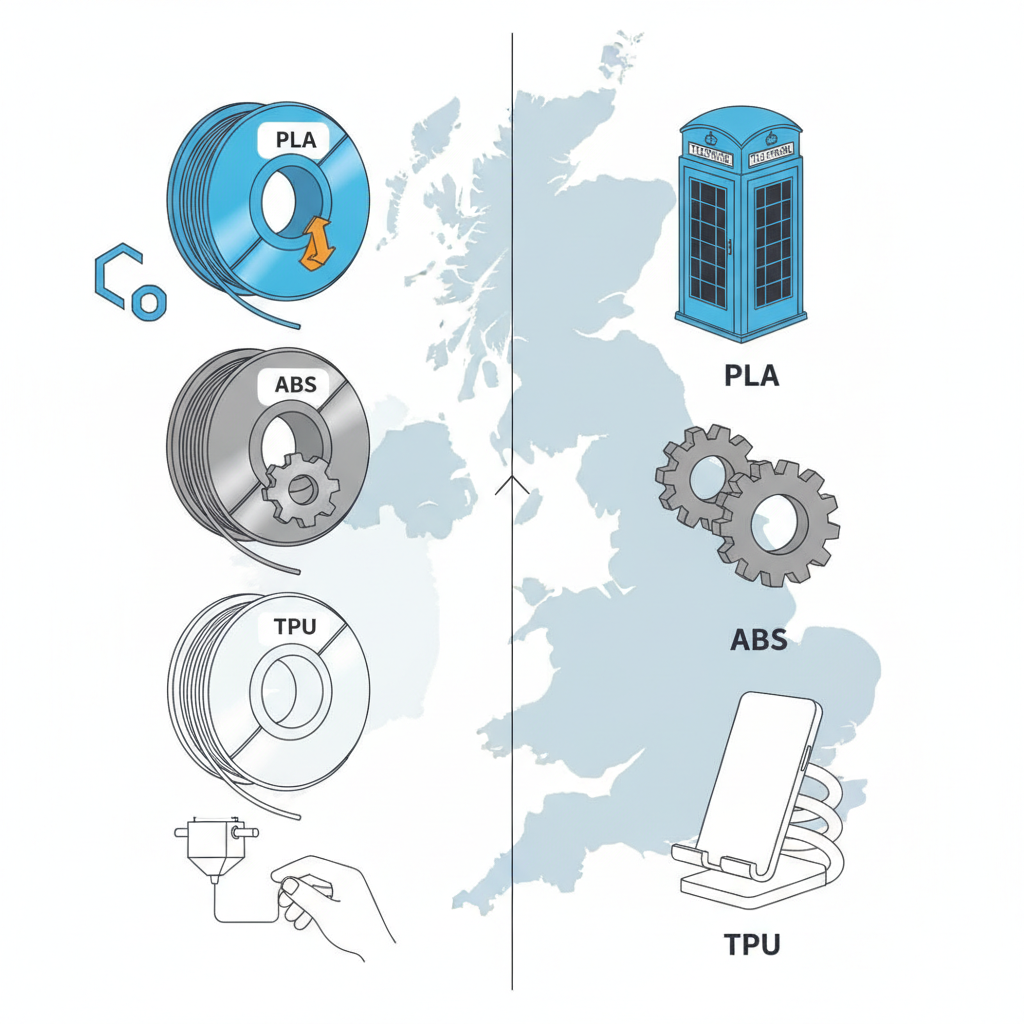
Polylactic Acid, or PLA, is arguably the most popular and widely used 3D printer filament, especially for beginners. It's derived from renewable resources like corn starch, making it a more environmentally friendly option compared to petroleum-based plastics. PLA is known for its ease of printing, excellent dimensional stability, and a wide array of vibrant colours and finishes, including matte, silk, glitter, and even glow-in-the-dark.
PLA prints at relatively low temperatures and doesn't typically require a heated print bed or an enclosed printing environment, which significantly reduces the barriers to entry for new users. Its low warping tendency and minimal odour during printing make it suitable for home or office use. While not as strong or temperature-resistant as some other filaments, PLA is perfect for aesthetic models, prototypes, educational tools, and low-stress functional parts.
- Ideal applications: Decorative prints, display models, prototyping non-functional parts, toys, low-stress jigs and fixtures.
- Printing temperature: Typically 190-220°C (hot end), 0-60°C (print bed).
- Pros: Easy to print, minimal warping, low odour, wide colour range, biodegradable.
- Cons: Brittle, lower heat resistance (can deform in hot environments), moderate strength.
- Consideration for sourcing: You can find a vast selection of SUNLU PLA filament and Bambu Lab PLA filament readily available from 3D printer filament UK suppliers.
Step 3: Mastering PETG Filament: Strength Meets Ease of Use
Polyethylene Terephthalate Glycol, or PETG, is often considered the best of both worlds, bridging the gap between PLA's ease of use and ABS's strength and durability. It offers excellent strength, impact resistance, and heat resistance, making it suitable for functional parts that need to endure more stress than PLA can handle. PETG is also food-safe in its natural state, though the printing process itself can introduce contaminants, so always verify specific filament certifications.
While slightly more challenging to print than PLA due to its tendency to string, PETG is still relatively forgiving. It generally requires a heated bed but doesn't necessarily need an enclosure, making it accessible to a wider range of printers. Its good layer adhesion and translucent appearance (in clear variations) make it popular for functional prototypes, protective casings, and parts that require a degree of flexibility without being fully elastic. For businesses looking for versatile 3d printed parts uk, PETG is often a go-to choice.
- Ideal applications: Functional prototypes, mechanical parts, protective housings, water-tight containers, outdoor items, medical components, drone parts.
- Printing temperature: Typically 220-250°C (hot end), 60-80°C (print bed).
- Pros: Good strength, high impact resistance, heat resistance, good layer adhesion, relatively easy to print compared to ABS.
- Cons: Prone to stringing, can be "sticky" leading to nozzle build-up, requires careful bed adhesion settings.
- Sourcing: Many 3d printer filament uk suppliers offer SUNLU PETG filament and other brands, providing robust options for your projects.
Step 4: Exploring ABS Filament: For High-Performance & Durability
Acrylonitrile Butadiene Styrene, or ABS, is a robust engineering plastic renowned for its strength, toughness, and good heat resistance. It's the same material used in LEGO bricks, demonstrating its durability and ability to withstand impact. ABS is a fantastic choice for functional end-use parts, enclosures for electronics, and components that require mechanical strength and resistance to higher temperatures. For specialized 3d printing service gb engineering uk applications, ABS is a primary material.
However, printing with ABS presents more challenges than PLA or PETG. It has a significant tendency to warp and crack due to thermal contraction, which necessitates a heated print bed and often an enclosed print chamber to maintain a stable ambient temperature. ABS also emits a distinct plastic odour during printing, so good ventilation is essential. Despite these challenges, its excellent post-processing capabilities (like acetone smoothing) and strength make it indispensable for certain projects.
- Ideal applications: Strong functional parts, automotive components, tool handles, electronic enclosures, prototypes requiring high durability. For projects needing robust 3d printed parts uk, ABS is often the best choice.
- Printing temperature: Typically 230-260°C (hot end), 90-110°C (print bed).
- Pros: High strength, toughness, good heat resistance, excellent post-processing with acetone.
- Cons: Prone to warping (requires heated bed and enclosure), strong odour during printing, can be challenging to print without proper setup.
- Sourcing: Finding quality abs filament uk is straightforward with dedicated 3d printer filament uk suppliers.
Step 5: Delving into Speciality Filaments: TPU, Nylon, and Beyond
Beyond the core three, a world of speciality filaments opens up possibilities for unique applications. These materials cater to specific needs, from extreme flexibility to chemical resistance, providing solutions that general-purpose plastics cannot.
TPU (Thermoplastic Polyurethane): The Flexible Powerhouse
TPU is a flexible, rubber-like filament known for its high elasticity, abrasion resistance, and excellent shock absorption. It's perfect for parts that need to bend, stretch, or compress without breaking. Think phone cases, vibration dampeners, seals, or wearable items. Printing TPU can be tricky due to its flexibility, often requiring slower print speeds and direct drive extruders to prevent tangling.
- Ideal applications: Phone cases, gaskets, flexible joints, protective covers, shoe soles, drone landing gear.
- Printing temperature: Typically 210-230°C (hot end), 30-60°C (print bed).
- Pros: Extremely flexible, high abrasion resistance, good shock absorption, durable.
- Cons: Difficult to print (prone to tangling, slower speeds), requires careful printer setup.
Nylon (Polyamide): The Engineering Marvel
Nylon is a strong, durable, and flexible engineering thermoplastic with excellent abrasion and impact resistance. It also boasts good chemical resistance and a low coefficient of friction, making it ideal for gears, bearings, and other moving parts. Nylon is highly hygroscopic, meaning it rapidly absorbs moisture, which can ruin prints; proper drying before printing is crucial. It also typically requires an all-metal hot end and a heated bed.
- Ideal applications: Gears, bearings, structural components, high-wear parts, jigs and fixtures, industrial 3d printed parts uk.
- Printing temperature: Typically 240-270°C (hot end), 70-100°C (print bed).
- Pros: High strength, excellent durability, good chemical and abrasion resistance, low friction.
- Cons: Highly hygroscopic (requires drying), challenging to print, needs an all-metal hot end.
Other Notable Filaments:
- PC (Polycarbonate): Extremely strong and heat resistant, but very challenging to print and requires very high temperatures.
- HIPS (High Impact Polystyrene): Often used as a dissolvable support material with ABS, but can also be printed as a standalone strong, lightweight material.
- Wood, Metal, Carbon Fibre Composites: These are usually PLA or PETG blended with fine particles of wood, metal, or carbon fibre to give aesthetic or strength properties.
Step 6: Matching Filament to Your Project Needs: A Practical Approach
With an understanding of the various filament types, the next critical step is to match the material to the specific requirements of your project. This isn't just about choosing a colour; it's about considering the environment, function, and aesthetic goals of your 3D printed object. A simple decorative piece will have vastly different material needs than a load-bearing bracket or a waterproof seal.
Consider the following factors when making your decision:
- Strength and Durability: How much force or impact will your part experience? For high-stress applications, consider ABS, Nylon, or PETG. For aesthetic or low-stress parts, PLA is often sufficient.
- Heat Resistance: Will your part be exposed to elevated temperatures (e.g., inside a car, near electronics, or outdoors)? PLA will deform quickly, while PETG, ABS, and Nylon offer better heat resistance.
- Flexibility: Does the part need to bend, stretch, or act as a dampener? TPU is the clear winner here.
- Chemical Resistance: Will the part come into contact with oils, solvents, or other chemicals? Nylon and some PETG variations offer good resistance.
- Aesthetics: What kind of finish do you need? PLA offers a vast range of colours and special finishes (silk, glitter, matte). PETG can be translucent.
- Post-Processing: Do you plan to sand, paint, or smooth your prints? ABS is excellent for acetone smoothing.
- Printing Difficulty: How experienced are you with 3D printing, and what are your printer's capabilities? Start with PLA, then move to PETG, and eventually ABS or more exotic materials as you gain experience and upgrade your setup.
If you're a 3d printing for small businesses looking to prototype, considering these factors early can save significant time and money. If you have a concept but no print-ready file, a 3D design service can turn your ideas into functional models.
Tip: When in doubt, print a small test piece with your chosen filament to assess its properties and how well it prints on your machine before committing to a large or critical print.Step 7: Sourcing Quality 3D Printer Filament in the UK
The performance of your 3D prints is intrinsically linked to the quality of the filament you use. In the UK, the market for 3D printer filament is robust, but not all filaments are created equal. Investing in good quality filament from reputable suppliers is crucial for consistent results, fewer failures, and a better overall printing experience.
Here’s what to look for when sourcing your 3d printer filament uk:
- Diameter Consistency: Inconsistent filament diameter leads to uneven extrusion, poor layer adhesion, and print failures. Look for brands that specify tight tolerances (e.g., +/- 0.02mm).
- Roundness: Filaments should be perfectly round. Oval or oddly shaped filament can cause jamming or inconsistent extrusion.
- Spooling: Poorly spooled filament (tangled or overlapping) can lead to frustrating knots and print interruptions, especially on long prints.
- Material Purity: Cheap filaments can contain impurities or recycled materials that affect strength, colour, and printability. Stick to known brands for reliability.
- Packaging: Quality filament should come vacuum-sealed with a desiccant pack to prevent moisture absorption.
- Local UK Suppliers: Opting for UK-based suppliers for your 3d printer filament uk needs often means faster delivery and easier returns, especially if you're aiming for something like same day 3d printing uk support for filament orders (though same-day dispatch for filament orders is common).
PrintIn3D.ie, for example, stocks quality filaments like Bambu Lab and SUNLU, offering fast delivery across the UK. Their focus on reliability means you're getting tested materials that perform consistently. This is particularly important for 3d printing company uk operations that depend on consistent output.
Warning: Be wary of excessively cheap, unbranded filament. While it might seem like a bargain, the hidden costs of failed prints, clogged nozzles, and wasted time often far outweigh the initial savings.Step 8: Proper Filament Storage & Handling for Optimal Prints
Even the highest quality filament can lead to poor prints if not stored and handled correctly. Moisture absorption is the arch-nemesis of 3D printer filament, causing a host of printing issues from bubbles and steam during extrusion to weak layer adhesion, stringing, and an overall rough surface finish. Different materials absorb moisture at different rates, with Nylon and PETG being particularly prone, but even PLA can suffer from prolonged exposure.
Proper storage is a simple yet vital step in maintaining filament quality and ensuring consistent print results. It not only preserves the material's properties but also extends its shelf life, saving you money in the long run by reducing waste. Taking a proactive approach to filament care will prevent many common printing frustrations and help you achieve the professional-quality 3d printed parts uk you desire.
- Vacuum Seal Bags: The best way to store filament is in vacuum-sealable bags with desiccant packs. These bags remove air and moisture, keeping the filament dry.
- Airtight Containers: For less frequent use, airtight plastic containers with desiccant can also work well.
- Filament Dryers: If your filament has already absorbed moisture, a dedicated filament dryer can restore it to optimal printing condition by slowly heating it to remove trapped water.
- Handle with Care: Avoid touching the filament directly with bare hands, as oils from your skin can transfer to the surface and affect bed adhesion.
- Keep it Tidy: Ensure filament spools are neatly wound. Loose or tangled filament can lead to snags and failed prints.
Common Mistakes to Avoid
- Ignoring Filament Type for Project: Using PLA for a high-heat, functional component, or ABS for a flexible part. Always match the material's properties to the application.
- Neglecting Filament Storage: Leaving filament spools exposed to ambient air leads to moisture absorption, causing poor print quality and material degradation.
- Incorrect Printing Temperatures: Using the wrong nozzle or bed temperatures for a specific filament can result in poor layer adhesion, warping, stringing, or clogs. Always check manufacturer recommendations.
- Skipping Bed Adhesion Prep: Not preparing your print bed (e.g., cleaning, applying adhesive) can lead to prints detaching mid-print, especially with materials prone to warping like ABS.
- Ignoring Diameter Consistency: Purchasing cheap, inconsistent filament can cause frustrating extrusion issues and wasted time, even for advanced 3d printing service gb engineering uk projects.
- Overlooking Ventilation for Certain Filaments: Printing ABS or certain resins without adequate ventilation can expose you to unpleasant and potentially harmful fumes.
- Not Considering Post-Processing: Choosing a filament that's difficult to finish if you have specific aesthetic requirements. For example, trying to achieve a smooth finish on a highly porous material.
FAQ
What is the best all-around plastic filament for 3D printing in the UK?
For beginners and general-purpose printing, PLA (Polylactic Acid) is considered the best all-around filament due to its ease of use, low printing temperature, minimal warping, and wide range of colours. However, for more durable or functional parts, PETG offers a great balance of strength and printability.
Can I get same day 3d printing uk services for complex projects?
While some services offer rapid prototyping or same day 3d printing uk for specific, smaller parts or designs, complex projects usually require more time for design, preparation, and printing. Services like PrintIn3D offer various turnaround times, including express options like 7 hours custom 3d printing service, but it's best to discuss your specific needs with the provider. For very intricate designs, a professional 3d design service might be needed first.
What's the difference between PLA and PETG filament?
PLA is easier to print, has less warping, and is biodegradable, making it ideal for aesthetic and low-stress models. PETG is stronger, more durable, more heat-resistant, and less brittle than PLA, making it suitable for functional parts. However, PETG can be more prone to stringing and requires a slightly higher printing temperature and often a heated bed.
Where can 3d printing for small businesses find reliable suppliers for 3d printer filament uk?
Small businesses in the UK can find reliable filament suppliers through established online retailers and specialist 3D printing companies like PrintIn3D.ie. Look for suppliers that offer brands with good reviews (e.g., Bambu Lab, SUNLU), consistent diameter tolerances, and fast delivery options. Many also provide technical support, which can be invaluable.
What if I have a physical object but need a 3D print of it?
If you have a physical object that needs to be replicated or modified, you'll need a 3d scanning service uk. This process captures the object's geometry to create a digital 3D model (often an STL file). From there, you might use a 3d scan to cad service if you need to make precise modifications or reverse-engineer the part before sending it to a custom 3d printing service online like PrintIn3D.
Next Steps / CTA
Armed with this knowledge of plastic filament types for your 3D printer in the UK, you're ready to tackle your next project with confidence. If you prefer to outsource your 3D printing, need expert 3D design assistance, or require a professional 3D scanning service uk, PrintIn3D.ie is your reliable partner. We provide hassle-free 3D printing services, ensuring your ideas come to life with the perfect material choice, and offer a wide range of quality 3D printer filament for your own projects. Let's bring your 3D dreams to reality!