Concept to Prototype: UK 3D Printing for Product Innovation
Bringing a brilliant product idea from your mind to the real world can seem like a monumental task. You have the vision, perhaps even a sketch or a detailed drawing, but how do you get a tangible, physical representation into your hands? This is where the power of 3D printing, especially through expert 3D printing services UK, truly shines. It's no longer a futuristic dream; it's a practical, accessible, and often indispensable tool for innovators, entrepreneurs, and businesses across the Great British landscape.
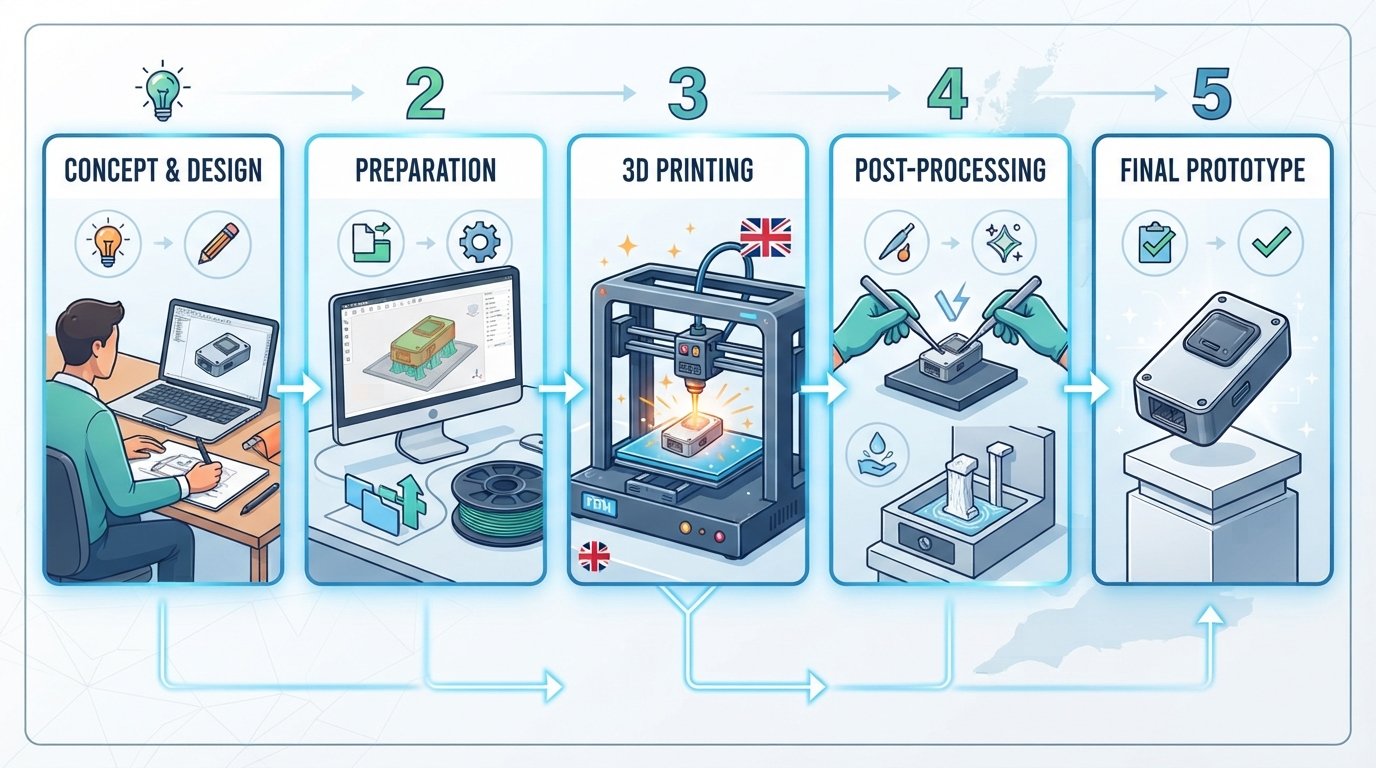
This comprehensive guide will walk you through every critical step of transforming your abstract product concept into a functional, physical prototype. Whether you're an inventor looking to test a groundbreaking gadget, a startup needing to iterate designs rapidly, or a large enterprise seeking to validate complex components, outsourcing your custom 3D printing to a reliable 3D printing service is a game-changer. We'll cover everything from refining your initial concept and creating detailed 3D models to selecting the perfect material, finding the right 3D printing services GB partner, and navigating the iteration process. By the end of this guide, you'll have a clear roadmap to leverage the efficiency and innovation of online 3D printing services to bring your ideas to life, hassle-free.
What You'll Need
- A clear product concept or idea.
- Basic understanding of your product's function and features.
- Access to design tools or the intention to use a 3D design service UK.
- A willingness to iterate and refine your design.
- An eye for detail and quality.
Step 1: Refine Your Product Concept & Requirements
Before any filament can be extruded or resin cured, your product concept needs to be as clear and defined as possible. This initial stage is crucial for laying a solid foundation for your prototype. Think of it as drafting the blueprint before you start building. The more detail you can provide at this stage, the smoother the subsequent steps will be, and the more accurate your prototype will be to your vision. Consider the core problem your product solves, its unique selling propositions, and its intended user experience.
Beyond the high-level vision, you need to delve into the nitty-gritty details. What are the exact dimensions of your product? What critical features must it have? How will different components interact? What kind of stresses will the prototype need to withstand during testing? Defining these parameters early will guide your material selection and inform the 3D modelling process. For instance, if you're developing custom replacement parts 3D printing for a machine, precise measurements and understanding the original part's function are paramount.
- Define the Purpose: What is the primary function of your prototype? Is it for aesthetic review, functional testing, ergonomic assessment, or a proof of concept?
- List Key Features: Detail all essential components, mechanisms, and design elements.
- Establish Dimensions: Provide precise measurements (length, width, height) and consider tolerances if your prototype needs to fit with other components.
- Consider Material Properties: Think about the environmental conditions and mechanical stresses your prototype might experience. This will influence your later material choice, such as PETG filament UK for durability or TPU filament UK for flexibility.
- Sketch & Annotate: Even rough sketches with dimensions and notes can be invaluable for translating your idea into a digital model.
Step 2: Create or Acquire Your 3D Model (CAD File)
Once your concept is crystal clear, the next step is to translate it into a digital blueprint – a 3D model, typically a CAD (Computer-Aided Design) file. This digital representation is what a 3D printing service will use to manufacture your physical prototype. You have a few options for creating this file, depending on your skills, resources, and the complexity of your design.
For those with technical design skills, using CAD software like SolidWorks, Fusion 360, Blender, or SketchUp allows for precise control over your design. There are also more accessible, beginner-friendly tools available. However, if 3D modelling isn't your forte or if your design requires intricate engineering, leveraging a professional 3D design service UK is often the most efficient and accurate path. These services can take your sketches, drawings, or even physical objects and transform them into print-ready 3D models. PrintIn3D, for example, offers expert 3D design services to bring your concepts to life.
- Design Yourself: If you have CAD software proficiency, create your model from scratch, ensuring it meets all specified requirements from Step 1. Focus on clean geometry and manifold meshes (no holes or self-intersecting surfaces).
- Hire a 3D Design Service UK: Provide your sketches, drawings, or detailed descriptions to a professional 3D design service. They will create a print-ready file for you, saving time and ensuring quality. This is especially useful for complex or engineered custom replacement parts 3d printing.
- 3D Scan an Object: If you need to replicate or modify an existing physical object, a 3D scanning service can create a digital model from it. This is a powerful tool for reverse engineering or archival purposes.
- Utilise Online Repositories: For common parts or simple geometries, you might find existing models on platforms like Thingiverse or GrabCAD. Always check licensing and suitability for your specific needs.
Step 3: Choose the Right Material for Your Prototype
The material you choose for your prototype is as important as the design itself. Different 3D printer filament types possess unique properties that make them suitable for various applications. Your selection should align with the functional requirements, environmental conditions, and desired aesthetics of your prototype. A cheap 3D printer filament UK might be fine for a visual model, but a robust engineering plastic is needed for functional testing.
Consider whether your prototype needs to be rigid, flexible, heat-resistant, or impact-resistant. Do you need a smooth surface finish or will a rougher texture suffice? The cost and printing complexity also vary significantly between materials. Discussing these needs with your chosen 3D printing service UK can provide valuable insights, as they have expertise in the strengths and weaknesses of different filaments like PLA, PETG, and TPU.
- PLA (Polylactic Acid): The most common and easiest to print. Ideal for initial concept models, aesthetic prototypes, and parts that don't require high strength or heat resistance. It's often the most cheap 3D printer filament UK option.
- PETG (Polyethylene Terephthalate Glycol): Offers improved strength, durability, and temperature resistance compared to PLA. It's a great all-rounder, suitable for functional prototypes that need to withstand more stress or be used outdoors. We offer excellent PETG filament UK options.
- TPU (Thermoplastic Polyurethane): Known for its flexibility and elasticity. Perfect for prototypes that need to bend, stretch, or absorb impact, such as gaskets, protective covers, or wearable components. Our TPU filament UK is a popular choice for these applications.
- Other Materials: Depending on the service, you might have access to ABS (tough, heat-resistant), Nylon (strong, flexible, chemical-resistant), or more exotic composites. Research these if your prototype has very specific needs.
Step 4: Select a Reputable UK 3D Printing Service
Finding the right 3D printing service UK is a pivotal step. A good service acts as your manufacturing partner, ensuring your concept is realised with precision and efficiency. With many providers available, from large industrial facilities to smaller specialised workshops, it's essential to choose one that aligns with your project's needs, budget, and timeline. You might be searching for "3d printing service London UK" or "3d printing near me UK," but remember to look beyond just proximity.
Look for a provider with a proven track record, excellent customer support, and the specific capabilities your project demands. PrintIn3D.ie, for example, is recognised for its quality, fast turnaround, and friendly support, evidenced by our "Rising Star" award at the Irish Print Awards 2026. A reputable 3D printing UK service will also offer clear communication, transparent pricing, and potentially even NDA options for sensitive projects, which is crucial for product development.
- Check Capabilities: Ensure the service offers the materials (PLA, PETG filament UK, TPU filament UK, etc.) and printing technologies (FDM, SLA, SLS) suitable for your prototype. Some services specialise in specific types of custom 3D printing.
- Review Turnaround Times: How quickly can they print and dispatch your order? For rapid prototyping, speed is often critical. PrintIn3D offers various expedited services, such as 8-hour, 12-hour, or 28-hour custom printing services.
- Evaluate Cost: Obtain quotes from several providers to compare pricing, but don't base your decision solely on cost. A slightly higher price might mean better quality, faster delivery, or superior support. Look for transparent pricing with no hidden fees.
- Assess Customer Support & Communication: Can you easily reach them for questions or project updates? Responsive and helpful support (like WhatsApp support) is invaluable.
- Read Reviews & Testimonials: Check online reviews (our reviews page) to gauge other customers' experiences regarding quality, reliability, and service.
- Location (if relevant): If you prefer a local pickup or face-to-face consultation, searching for a "3d printing service London UK" or "3d printing near me UK" might be beneficial, but many UK 3D printing services offer excellent nationwide delivery.
Step 5: Prepare Your Files for Submission
Once you've chosen your 3D printing UK service, the next step is to prepare your 3D model files for submission. This isn't just about sending an STL file; it involves a crucial review to ensure your model is print-ready and to provide all necessary instructions to the service provider. Proper file preparation minimises errors, speeds up the quoting process, and ensures your prototype comes out exactly as intended.
A well-prepared file helps the online 3D printing service understand your design intent and avoid common printing issues. This includes checking for geometric integrity, ensuring correct scaling, and providing clear instructions on orientation and support structures if you have specific preferences. Neglecting this step can lead to delays, unexpected costs, or a prototype that doesn't meet your expectations.
- Check for Errors: Use software tools (like Meshmixer, Netfabb, or even some CAD programs) to check your STL or OBJ file for common errors like non-manifold edges, inverted normals, or holes in the mesh. Most 3D printing services will perform a final check, but a clean file from your end speeds up the process.
- Verify Scale and Units: Double-check that your model is scaled correctly and saved in the desired units (e.g., millimetres). An incorrectly scaled model is a common and easily avoidable mistake.
- Consider Wall Thickness: Ensure all walls and features are thick enough to be printed successfully in your chosen material. Very thin features can break during printing or post-processing.
- Provide Detailed Instructions: Include a text file or notes with your submission. Specify desired material colour, surface finish, any critical dimensions, and preferred print orientation if it impacts strength or aesthetics. For custom replacement parts 3D printing, specifying fitting tolerances is key.
- Consolidate Files: If your product has multiple parts, package them clearly, perhaps with an assembly diagram or exploded view.
Step 6: Review Quotes and Place Your Order
After submitting your 3D model and requirements, you'll receive a quote from the 3D printing service UK. This quote will detail the cost, estimated turnaround time, and specific material usage for your project. This is your opportunity to review everything carefully, compare offers (if you've requested multiple quotes), and make an informed decision.
Don't hesitate to ask questions if anything in the quote is unclear. Understand what's included in the price – is it just the print, or does it include post-processing, shipping, and any design adjustments? A reliable 3D printing UK service will be transparent about their pricing structure and willing to explain any aspect of the quote. Once satisfied, you'll proceed to place your order, officially kicking off the manufacturing process for your prototype.
- Compare Quotes: If you've approached multiple providers (e.g., searching for "3d printing service London UK" vs. "3d printing near me UK" nationwide services), compare not just the bottom line but also the details like material cost, lead time, and included services.
- Clarify Details: Confirm the exact material, colour, and finish. Ensure the specified turnaround time meets your project deadlines. Ask about shipping costs and estimated delivery to your GB address.
- Review Terms and Conditions: Understand the service's policies regarding revisions, refunds, and intellectual property. PrintIn3D offers a 30-day risk-free return policy for peace of mind.
- Confirm Payment: Understand the payment schedule and accepted methods.
- Place Your Order: Once you're confident in your choice, proceed with placing your order. You might receive a confirmation outlining the next steps and expected delivery.
Step 7: Receive and Evaluate Your Prototype
The moment of truth arrives when your 3D printed prototype lands on your doorstep. This is an exciting stage where your digital concept transforms into a tangible object. Upon receiving your prototype, it's crucial to conduct a thorough evaluation against your initial requirements and design goals. This isn't just about admiring the print; it's about rigorous testing and critical assessment.
Inspect every aspect of the prototype, from its physical appearance to its functional performance. Does it look as you envisioned? Do the parts fit together correctly? Does it perform its intended function? This evaluation process will provide invaluable feedback for future iterations and help you refine your design towards a market-ready product. Remember, a prototype is a learning tool, designed to uncover issues and guide improvements.
- Initial Visual Inspection: Check for surface finish quality, layer lines, accuracy of details, and any visible defects or imperfections.
- Dimensional Accuracy: Measure critical dimensions with calipers or rulers to ensure they match your 3D model. This is especially important for custom replacement parts 3D printing.
- Fit and Assembly: If your prototype has multiple parts, test how they fit together. Are the clearances correct? Do they snap or slide into place as intended?
- Functional Testing: Subject the prototype to its intended use. Does it operate as expected? Does it withstand the anticipated forces or conditions? For parts made with PETG filament UK or TPU filament UK, test their specific properties like durability or flexibility.
- Ergonomics and User Experience: If applicable, test how the product feels in hand, its weight distribution, and ease of use. Gather feedback from potential users.
- Document Findings: Keep detailed notes of all observations, both positive and negative. Take photos or videos of any issues. This documentation will be essential for the next step.
Step 8: Iterate and Refine Your Design
The journey from concept to product is rarely a straight line; it's an iterative process. Your first prototype is unlikely to be perfect, and that's precisely the point. The feedback and insights gained from Step 7 are now used to improve your 3D model and move towards a more refined and functional design. This iterative cycle is where the true power of 3D printing services for rapid prototyping truly shines.
Each iteration allows you to address identified issues, incorporate new ideas, and optimise your product based on real-world testing. This continuous improvement process, often referred to as "design-build-test-learn," is fundamental to successful product development. Working with a flexible 3D printing UK service that understands this iterative nature can significantly accelerate your progress, turning lessons learned into tangible improvements with each new prototype.
- Analyse Feedback: Review all documented findings from your prototype evaluation. Prioritise the most critical issues that need addressing.
- Modify Your 3D Model: Go back to your CAD software (or engage your 3D design service UK) and make the necessary adjustments to your 3D model. This could involve tweaking dimensions, redesigning components, or changing internal structures.
- Consider Material Changes: Based on functional testing, you might decide a different material would be more suitable for the next iteration. Perhaps you need greater durability, so moving from PLA to PETG filament UK is appropriate, or if flexibility is key, increasing the use of TPU filament UK.
- Repeat Printing Process: Submit your revised 3D model to your chosen 3D printing service UK for a new prototype.
- Re-evaluate: Once the new prototype arrives, repeat the evaluation process, comparing it against the previous version and your updated requirements.
- Continue Until Satisfied: This cycle continues until your prototype meets all your design goals and is ready for the next stage of product development, whether that's mass manufacturing, crowdfunding, or market launch.
Common Mistakes to Avoid
While the process of transforming a product concept into a physical prototype using 3D printing services UK offers incredible advantages, certain pitfalls can derail your progress. Being aware of these common mistakes can save you time, money, and frustration on your prototyping journey:
- Skipping Concept Refinement: Jumping straight to 3D modelling without a clear vision of the product's function, features, and target dimensions can lead to prototypes that don't meet expectations and require numerous, costly reworkings.
- Poorly Prepared 3D Files: Submitting 3D models with errors (non-manifold geometry, holes, incorrect scaling) can cause printing failures, delays, or unexpected costs. Always check your files or let a professional 3D design service UK handle it.
- Choosing the Wrong Material: Using a cheap 3D printer filament UK like PLA for a functional part requiring high strength or heat resistance, or vice-versa, can lead to failed tests and inaccurate results. Match the material (PETG filament UK, TPU filament UK) to the prototype's intended use.
- Ignoring Design for Manufacturability (DFM): While 3D printing offers immense freedom, ignoring basic design for manufacturing principles can lead to weaker parts, excessive support material, or increased printing time and cost. Consult with your 3D printing UK service on DFM best practices.
- Underestimating Iteration Needs: Believing your first prototype will be perfect is a common trap. Successful product development almost always involves multiple iterations. Embrace the process of learning and refinement.
- Lack of Clear Communication with the Service: Failing to clearly articulate your requirements, specific print needs, or expectations to your chosen 3D printing service GB can lead to misunderstandings and unsatisfactory results.
- Only Considering Price: Choosing a cheap 3D printer filament UK or the lowest-cost service without considering quality, turnaround time, and support can lead to false economies and ultimately more expense down the line.
- Over-Complicating the First Prototype: Trying to incorporate every single feature into the very first prototype can make it overly complex, expensive, and difficult to test effectively. Focus on core functionalities first.
FAQ
How long does it take to get a prototype 3D printed in the UK?
The turnaround time for a 3D printed prototype in the UK can vary significantly based on the complexity and size of your model, the chosen material, and the service provider's workload. Many 3D printing services UK, including PrintIn3D, offer expedited options ranging from 8-hour to 28-hour custom printing services, while standard orders might take 2-7 working days. Always confirm the lead time with your chosen 3D printing UK service when requesting a quote.
How much does it cost to 3D print a prototype?
The cost of 3D printing a prototype depends on several factors: the volume of material used, the type of material (PLA is generally more affordable than PETG filament UK or TPU filament UK), the complexity of the geometry (which affects print time and support material), and the chosen service provider. Some services also charge for post-processing. Requesting a custom quote from a UK 3D printing service with your specific 3D model is the best way to get an accurate estimate.
What 3D file formats are accepted for custom 3D printing services in the UK?
Most custom 3D printing services in the UK primarily accept STL (.stl) and OBJ (.obj) file formats, as these are universally recognised for additive manufacturing. Some services may also accept other formats like 3MF or STEP, especially if they offer 3D design services. It's always best to check with your specific provider about their preferred file formats to ensure a smooth submission process.
Can I get custom replacement parts 3D printed in the UK?
Absolutely! Custom replacement parts 3D printing is one of the most popular applications for UK 3D printing services. Whether it's a broken component from an old appliance, a bespoke fitting, or a custom bracket for a project, 3D printing allows for precise, on-demand manufacturing. You'll need an accurate 3D model of the part, which can be created through measurement, CAD design, or 3D scanning an existing part.
What if I don't have a 3D model for my product concept?
No problem at all! Many UK 3D printing services, including PrintIn3D, offer comprehensive 3D design services UK. You can provide sketches, technical drawings, photographs, or even just a detailed description of your concept. Expert designers will work with you to create a print-ready 3D model, transforming your idea into a digital blueprint before it becomes a physical prototype.
Next Steps
Ready to turn your product concept into a physical reality? Let PrintIn3D.ie be your trusted partner for custom 3D printing services UK. Upload your design for a quick quote or engage our expert 3D design service UK to bring your ideas to life, hassle-free.