Digitise Objects: Your Guide to 3D Scanning Services in Ireland & 3D Printer Filaments
Introduction: Unlock the Digital Potential of Physical Objects
Imagine holding an antique part, a cherished memento, or a unique prototype, and instantly having a perfect digital copy. This isn't science fiction; it's the power of 3D scanning, and it's readily available right here in Ireland. In this comprehensive guide, we'll delve deep into how you can transform any physical object into a high-fidelity digital design using professional 3D scanning services. Whether you're an inventor looking to reverse-engineer a component, an artist seeking to preserve a sculpture, or a business aiming for precise manufacturing, understanding the 3D scanning process is your first step towards unlocking incredible possibilities.
We'll walk you through everything from preparing your object to understanding the output files, and crucially, how these digital designs can then be brought to life through 3D printing services. This journey from tangible to digital and back again is revolutionising industries and empowering creativity across Ireland. Get ready to explore how this cutting-edge technology, combined with the right expertise, can turn your physical world into a flexible, editable, and reproducible digital asset. You'll also learn about the importance of high-quality 3d printer filaments in bringing these scanned designs to life with exceptional detail and durability.
Who This Is For
- Engineers & Product Designers: For reverse engineering parts, creating prototypes, or quality inspection.
- Artists & Sculptors: To digitise artworks for archival, scaling, or replication purposes.
- Historians & Conservators: For preserving delicate artifacts and creating digital archives.
- Hobbyists & Makers: To replicate broken parts, create custom fits, or modify existing objects.
- Businesses & Manufacturers: Seeking efficient ways to digitise components for design, manufacturing, or inventory.
- Anyone without a 3D printer: Who needs a physical object replicated or digitally archived.
Step 1: Understanding the Power of 3D Scanning
Before embarking on your 3D scanning journey, it's essential to grasp what 3D scanning entails and its vast applications. At its core, 3D scanning is the process of analysing a real-world object or environment to collect data on its shape and appearance, typically resulting in a 3D digital model. This technology bridges the gap between the physical and digital realms, opening doors to innovation that were once unimaginable. From recreating legacy parts to designing custom modifications, 3D scanning provides the foundational digital twin needed for countless projects.
The beauty of 3D scanning lies in its precision and versatility. It captures complex geometries that would be incredibly difficult, if not impossible, to measure manually or recreate from scratch in design software. Whether you have an intricate mechanical component, a weathered archaeological artifact, or a unique handcrafted item, a professional 3D scanning service can render it into a digital format. This digital model can then be used for a myriad of purposes, including 3D printing in Dublin, CAD modification, virtual reality applications, or simply as a precise digital archive for future reference.
- What is 3D Scanning? It's the art and science of capturing the physical dimensions of an object or environment and translating them into a digital 3D model.
- Why is it Important? It enables reverse engineering, digital archiving, quality control, customisation, and replication of complex forms with unparalleled accuracy.
- Common Applications: Manufacturing, automotive, aerospace, healthcare, heritage preservation, art, gaming, and consumer product development.
- Types of Scanners: Different scanners (laser, structured light, photogrammetry) offer varying levels of accuracy, speed, and suitability for object types. Professional services typically use high-end structured light or laser scanners for optimal results.
Step 2: Defining Your Project & Object Characteristics
The success of your 3D scanning project begins with a clear understanding of your goals and the characteristics of the object you intend to scan. Before contacting a 3d scanning service Ireland, take the time to define what you hope to achieve with the digital model. Are you planning to 3D print a replica? Do you need to modify the design in CAD software? Is it for purely archival purposes? The answers to these questions will influence the scanning method, required accuracy, and the final file format.
Equally important is a thorough assessment of the object itself. Its size, material, surface finish, and complexity all play a crucial role in determining the feasibility and cost of scanning. For instance, shiny or transparent objects can pose challenges for certain scanning technologies, often requiring special preparation. Understanding these factors upfront allows you to provide a detailed brief to your chosen service, ensuring they can recommend the most appropriate techniques and deliver accurate results efficiently. This step is crucial for preventing misunderstandings and ensuring a smooth process.
- Identify Your Objective: Clearly state what you want to do with the scanned data (e.g., 3D print, CAD redesign, analysis, animation, digital archive).
- Measure Your Object: Note down its approximate dimensions (length, width, height) and weight. This helps in logistics and quoting.
- Describe the Material & Surface: Is it metallic, plastic, wood, stone? Is it shiny, matte, transparent, or textured? These details are vital for the scanning technician.
- Note Complexity: Does the object have intricate details, deep cavities, thin walls, or highly irregular shapes? The more complex, the more sophisticated the scanning approach might need to be.
- Specify Required Accuracy: For engineering or manufacturing, you might need sub-millimetre accuracy. For artistic or archival purposes, a slightly lower resolution might be acceptable and more cost-effective.
Step 3: Preparing Your Object for Optimal Scanning
Once you have a clear understanding of your project's goals and the nature of your object, the next critical step is proper preparation. While professional 3D scanning services handle the technical complexities, certain preparatory actions on your part can significantly improve the scanning process, enhance accuracy, and potentially reduce costs. The goal is to present the object in a way that allows the scanner to capture its geometry as clearly and completely as possible.
This preparation often involves cleaning the object, and in some cases, altering its surface characteristics to make it more amenable to optical scanning. Shiny or transparent surfaces, for example, can cause issues with light reflection, leading to incomplete data capture. Similarly, objects with very dark or highly absorbent surfaces can also present challenges. By addressing these factors proactively, you help the scanning technicians achieve the best possible scan, ensuring your digital model is a faithful representation of the physical original.
- Clean Thoroughly: Remove all dirt, dust, grease, and debris. Any imperfections on the surface will be captured by the scanner.
- Stabilise the Object: Ensure the object can be held steady during scanning. For smaller items, a stable base or jig might be necessary.
- Address Challenging Surfaces (if applicable):
- Shiny/Reflective: Objects like polished metal or glossy plastic can cause light scatter, confusing the scanner. A professional service might apply a temporary, fine matte spray (which can be easily removed afterwards) to create a uniform, non-reflective surface. Do NOT attempt this yourself without consulting the service provider, as it may damage your object.
- Transparent/Translucent: Glass or clear plastics are difficult to scan as light passes through them. Similar to reflective surfaces, a temporary matte coating might be applied by experts.
- Very Dark: Extremely dark objects can absorb too much light. Again, a light, temporary spray might be used.
- Consider Modularity: If the object is made of multiple detachable parts, consider if it's better to scan them separately and digitally assemble them later, especially if internal features are needed.
- Photograph the Object: Take clear photos from multiple angles. This provides a visual reference for the scanning team.
Step 4: Choosing the Right 3D Scanning Service Provider
Selecting the right 3D scanning service is paramount to the success of your project. In Ireland, you want a partner who not only possesses state-of-the-art equipment but also the expertise to handle diverse projects with precision and care. A good service provider will guide you through the process, understand your specific needs, and ensure the final digital model meets your expectations. Look for a company with a strong track record and a clear understanding of both scanning and post-processing.
PrintIn3D.ie, for example, offers comprehensive 3D scanning capabilities tailored to individuals and businesses across the country. We don't just scan; we provide solutions, from simple digitisation to complex reverse engineering projects that might require professional CAD design for manufacturing. Our commitment to quality and customer satisfaction, coupled with our expertise, makes us a reliable choice. When choosing, consider factors like turnaround time, communication, and the range of services offered beyond just scanning.
- Evaluate Expertise: Look for providers with experience in scanning objects similar to yours. Do they specialise in industrial, artistic, or small object scanning?
- Check Equipment: Inquire about the type of 3D scanners they use. High-resolution structured light or laser scanners are generally preferred for accuracy.
- Review Portfolio & Testimonials: Examine their previous work. Are there examples of successful projects? Read customer reviews to gauge their reliability and quality of service. (You can find ours here).
- Discuss Turnaround Times: Understand their estimated completion time for scanning and post-processing, especially if you have a deadline.
- Clarify Pricing Structure: Get a clear quote that outlines all costs, including scanning, post-processing, and file delivery.
- Assess Communication: A responsive and knowledgeable team, like our WhatsApp support, is crucial for a smooth collaboration. They should be able to answer your questions clearly and professionally.
- Beyond Scanning: Do they offer additional services like CAD modelling from scan data, custom 3D printing, or specific file conversions? This can be incredibly beneficial for a complete solution.
Step 5: The 3D Scanning Process – What Happens Next?
Once you've chosen your 3D scanning service Ireland and prepared your object, it's time for the magic to happen. The actual scanning process, while appearing effortless on the surface, involves sophisticated technology and skilled technicians. Understanding what occurs during this phase can demystify the process and give you confidence in the quality of the output. While the specifics depend on the scanner type, the general workflow follows a similar pattern.
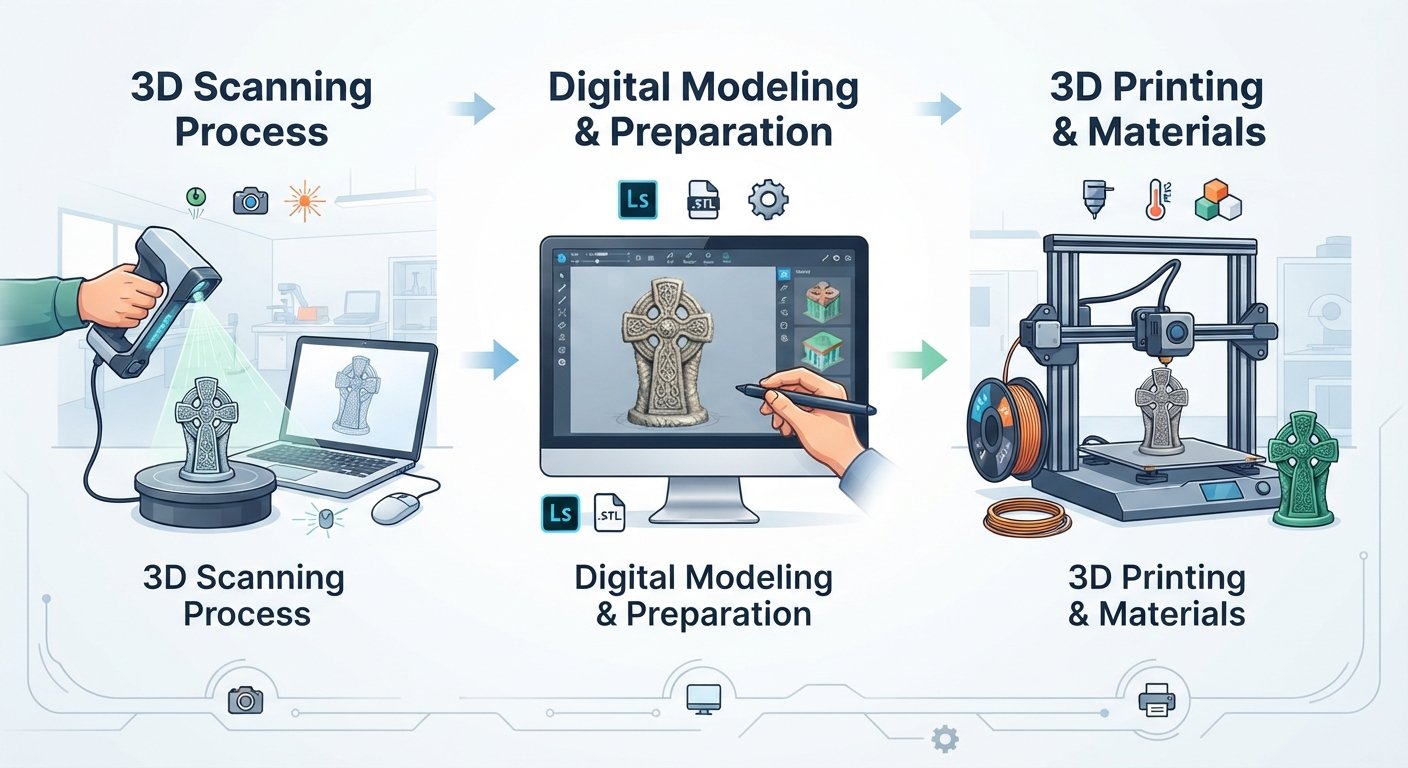
The core of the process involves the scanner capturing millions of data points from the object's surface. These points, known as a "point cloud," precisely map the object's geometry. For full coverage, the object is typically scanned from multiple angles, often requiring it to be repositioned or rotated. Advanced software then stitches these individual scans together, creating a comprehensive digital representation. This meticulous approach ensures that every intricate detail of your physical object is accurately translated into the digital realm, ready for post-processing and further application.
- Initial Setup: The object is carefully placed on a turntable or stable surface within the scanner's operational field. Calibration ensures accuracy.
- Data Acquisition: The scanner emits light (laser lines or structured light patterns) onto the object's surface. Cameras then capture the distortion of these patterns or the reflection of the laser, calculating the distance to each point.
- Multiple Passes: The object is scanned from various angles to ensure complete surface coverage, especially for complex geometries or objects with undercuts. This might involve manual repositioning or an automated turntable.
- Real-time Feedback: Many professional scanners provide real-time visual feedback, allowing technicians to identify and rescan any areas that might have been missed, ensuring data completeness.
- Point Cloud Generation: The raw data collected is a "point cloud" – a vast collection of individual XYZ coordinates representing the object's surface.
- Initial Alignment & Stitching: Software automatically aligns and merges these individual point clouds from different angles into a single, cohesive dataset.
Step 6: Post-Processing and Delivering Your Digital Model
Capturing the raw 3D scan data is only half the battle; the true utility of a 3D scan emerges during the post-processing phase. This crucial step transforms the dense "point cloud" into a clean, usable, and often editable 3D model, typically in formats like STL or OBJ. Post-processing is where the digital model is refined, optimised, and prepared according to your project's specific requirements, making it ready for applications such as custom 3D printing service online or detailed CAD work.
The skill of the technicians during post-processing is paramount. They clean up noise, fill small holes, smooth rough areas, and consolidate the point cloud into a meshed model. For projects requiring high accuracy or further manipulation, the mesh might be converted into a solid CAD model, a process often referred to as reverse engineering. This ensures that whether you need an exact replica or a design foundation for new iterations, your digital model is precise and fit for purpose. This is also the stage where texture and colour data, if captured, are mapped onto the model, adding another layer of realism.
- Noise Reduction & Cleaning: Irrelevant data points (noise) from the environment or scanner reflections are filtered out, leaving only the object's surface data.
- Meshing: The cleaned point cloud is converted into a 3D mesh, forming a continuous surface. This is typically a triangular mesh, representing the object's geometry.
- Hole Filling & Smoothing: Any small gaps or holes in the mesh (often caused by inaccessible areas during scanning) are patched, and the surface is smoothed to remove minor imperfections without losing critical detail.
- Topology Optimisation: The mesh is optimised for efficiency, reducing the polygon count where possible without compromising detail, making it easier to handle in software.
- Texture & Colour Mapping (if applicable): If the scanner captured colour information, it is applied as a texture map to the 3D model, adding photorealistic detail.
- File Format Conversion: The final mesh model is then exported into the requested file format, most commonly:
- STL (Standard Tessellation Language): The industry standard for 3D printing.
- OBJ (Object File): Supports colour and texture information, common for graphics and rendering.
- STEP/IGES: For solid CAD models, often resulting from reverse engineering.
- Quality Assurance: The service provider performs a final check to ensure the digital model's accuracy and integrity match the project brief.
Step 7: Utilising Your Digital Model: From Screen to Creation
With your physical object now transformed into a high-fidelity digital model, the real excitement begins! This digital asset is a versatile tool, ready to be used in countless ways, extending far beyond simple replication. Whether you received an STL for 3D printing, an OBJ for virtual visualisation, or a CAD file for engineering, the possibilities are vast and transformative. This step bridges the gap between digitisation and tangible application, allowing you to leverage your scanned data effectively.
From rapid prototyping and custom fabrication to digital archiving and product development, your new 3D model is a powerhouse. It allows for precise modifications, scalability, and integration into digital workflows. For those without their own 3D printers, services like PrintIn3D.ie provide the perfect solution, turning your digital design into a physical reality with professional quality and a wide range of 3d printer filaments, including popular choices like buy PLA filament Ireland and buy ABS filament Ireland. Embrace the flexibility and potential that your newly digitised object offers!
- 3D Printing: The most common application. Your STL file can be sent to a 3D printer to create an exact physical replica. This is perfect for prototyping, replacement parts, or producing custom items. You can choose from a range of 3d printer filaments like PLA for everyday objects, or PETG for more durable functional parts. If you're wondering which filament is best for beginners, PLA is generally recommended for its ease of use.
- Reverse Engineering & CAD Modification: Convert the mesh into a solid CAD model (if not already done) using software like SolidWorks or Fusion 360. This allows engineers to analyse, modify, or integrate the scanned part into new designs. This is crucial for professional CAD design for manufacturing.
- Quality Control & Inspection: Compare the scanned model against original CAD data to identify deviations, measure tolerances, and ensure parts meet specifications.
- Digital Archiving & Preservation: Create a permanent, high-fidelity digital record of historical artifacts, artworks, or critical components. This safeguards against loss or damage.
- Product Development & Customisation: Use the scan as a base to design custom accessories, ergonomic fits, or iterative improvements for existing products.
- Virtual Reality/Augmented Reality: Integrate the 3D model into VR/AR applications for interactive experiences, training, or virtual showrooms.
- CNC Machining & Tooling: Generate toolpaths for CNC machines to create moulds or machine new parts based on the scanned geometry.
Common Mistakes to Avoid
While 3D scanning offers incredible potential, certain pitfalls can derail a project or lead to unsatisfactory results. Being aware of these common mistakes can help you navigate the process smoothly and ensure you get the most out of your 3d scanning service Ireland.
- Unclear Project Brief: Failing to clearly articulate your objectives, desired accuracy, and end-use of the digital model can lead to misinterpretations and rework. Always provide as much detail as possible.
- Inadequate Object Preparation: Sending dirty, overly reflective, or transparent objects without discussing pretreatment options can result in incomplete or noisy scan data, requiring more costly post-processing.
- Ignoring Object Size/Complexity: Underestimating the challenge of scanning very large, very small, or highly intricate objects can lead to budget overruns or an inability to capture all necessary details.
- Choosing the Wrong File Format: Requesting an STL when you need a solid CAD model for engineering, or vice-versa, can cause significant issues down the line. Understand the purpose of each format.
- Overlooking Post-Processing Needs: Assuming the raw scan data is immediately usable. Most raw scans require significant cleanup, meshing, and optimisation before they are truly useful.
- Focusing Only on Cost: Opting for the cheapest service without verifying their expertise, equipment, and portfolio can result in low-quality scans and wasted investment. For professional outcomes, invest in a reputable service.
- Not Considering Material Properties for 3D Printing: If your end goal is 3D printing, not thinking about the properties of 3d printer filaments (e.g., strength, flexibility, temperature resistance) for your application can lead to a print that doesn't perform as expected.
FAQ
What types of objects can be 3D scanned?
Virtually any physical object can be 3D scanned, though some present more challenges than others. Common items include mechanical parts, sculptures, figurines, prototypes, consumer products, and even architectural elements. Objects with highly reflective, transparent, or extremely dark surfaces may require special pre-treatment (like a temporary matte spray) by the service provider to ensure accurate data capture. Very small or extremely large objects also require specialised scanning techniques and equipment, which a professional 3d scanning service Ireland can provide.
What file formats do 3D scanning services provide?
The most common file formats provided by 3D scanning services are STL (Standard Tessellation Language) and OBJ (Object File). STL is the industry standard for 3D printing and rapid prototyping, representing the object's surface as a mesh of triangles. OBJ files are similar but can also store colour and texture information, making them suitable for rendering, animation, and more visually rich applications. For engineering or manufacturing purposes that require a solid, editable model, services can also provide CAD-friendly formats like STEP or IGES, which involve a process known as reverse engineering from the mesh data.
How accurate are 3D scans?
The accuracy of 3D scans varies significantly depending on the scanner technology used, the object's characteristics, and the expertise of the technician. Professional-grade 3D scanners, like those used by PrintIn3D.ie, can achieve accuracies of ±0.01mm to ±0.1mm, making them suitable for precision engineering and quality control applications. For less critical applications, such as artistic replication or digital archiving, slightly lower resolutions may be acceptable and more cost-effective. Always discuss your required level of accuracy with your 3d scanning service Ireland provider to ensure the appropriate equipment and methods are used.
Can a 3D scan be directly 3D printed?
Yes, in most cases, a 3D scan can be directly 3D printed, especially if the output file is in the STL format, which is universally accepted by 3D slicing software. However, raw scan data often requires post-processing (meshing, hole filling, smoothing) to create a "watertight" and print-ready model. A professional service will ensure your scanned object is prepared correctly for custom 3D printing. The choice of 3d printer filaments will then determine the physical properties of the printed replica, whether you opt to buy PLA filament Ireland for aesthetic models or buy ABS filament Ireland for more durable functional parts.
Next Steps: Bring Your Digital Designs to Life
Ready to transform your physical objects into versatile digital designs and beyond? PrintIn3D.ie is your expert partner for comprehensive 3d scanning services in Ireland, offering precision, speed, and exceptional support. Whether you need an accurate digital model for reverse engineering, professional CAD design for manufacturing, or to create a physical replica using our affordable 3D printing near me services, we're here to help.
Don't have a 3D printer? No problem! Once your object is scanned and processed, we can use the digital model to print your desired item using a wide array of high-quality 3d printer filaments from our 3d printer filament shop Ireland, with fast delivery across the country. Contact us today for a hassle-free quote and let's bring your ideas to life!