Digitise Prototypes & Heirlooms with 3D Scanning in Ireland
Have you ever held an intricate family heirloom, wishing you could share its beauty with distant relatives without fear of damage? Or perhaps you've painstakingly crafted a prototype, dreaming of perfect duplicates or seamless modifications, but found traditional methods too cumbersome? In today's rapidly evolving digital world, these desires are no longer fantasies but achievable realities, thanks to the power of 3D scanning.
For individuals and businesses across Ireland, the ability to convert physical objects into precise digital models offers a wealth of possibilities. Whether you're an inventor needing to refine a rapid prototyping service Ireland for your next big idea, an engineer looking to reverse engineering 3d scan service a crucial component, or simply a guardian of family history wanting to preserve a cherished heirloom, 3d scanning services in Ireland provide the bridge between the tangible and the digital.
This comprehensive guide from PrintIn3D.ie will walk you through everything you need to know about digitising your prototypes and heirlooms using professional 3D scanning. We'll explore the 'hows' and 'whys', demystify the process, and show you how easy it is to bring your physical objects into the digital realm, ready for replication, modification, or archival. Get ready to unlock new potentials for your creations and treasures, all with the expert, hassle-free support of your trusted 3D printing partner in Ireland.
Who This Is For
- Inventors and entrepreneurs needing to digitise and iterate prototypes.
- Engineers and product developers looking for accurate digital models for 3d scanning for product development.
- Collectors and individuals wanting to digitally preserve unique or antique items and heirlooms.
- Businesses requiring 3d printed replacement parts service for discontinued components.
- Designers needing to create custom 3d printed parts Ireland from existing objects.
- Anyone interested in understanding the capabilities of 3d scanning services in Ireland.
Step 1: Understanding 3D Scanning and Its Transformative Benefits
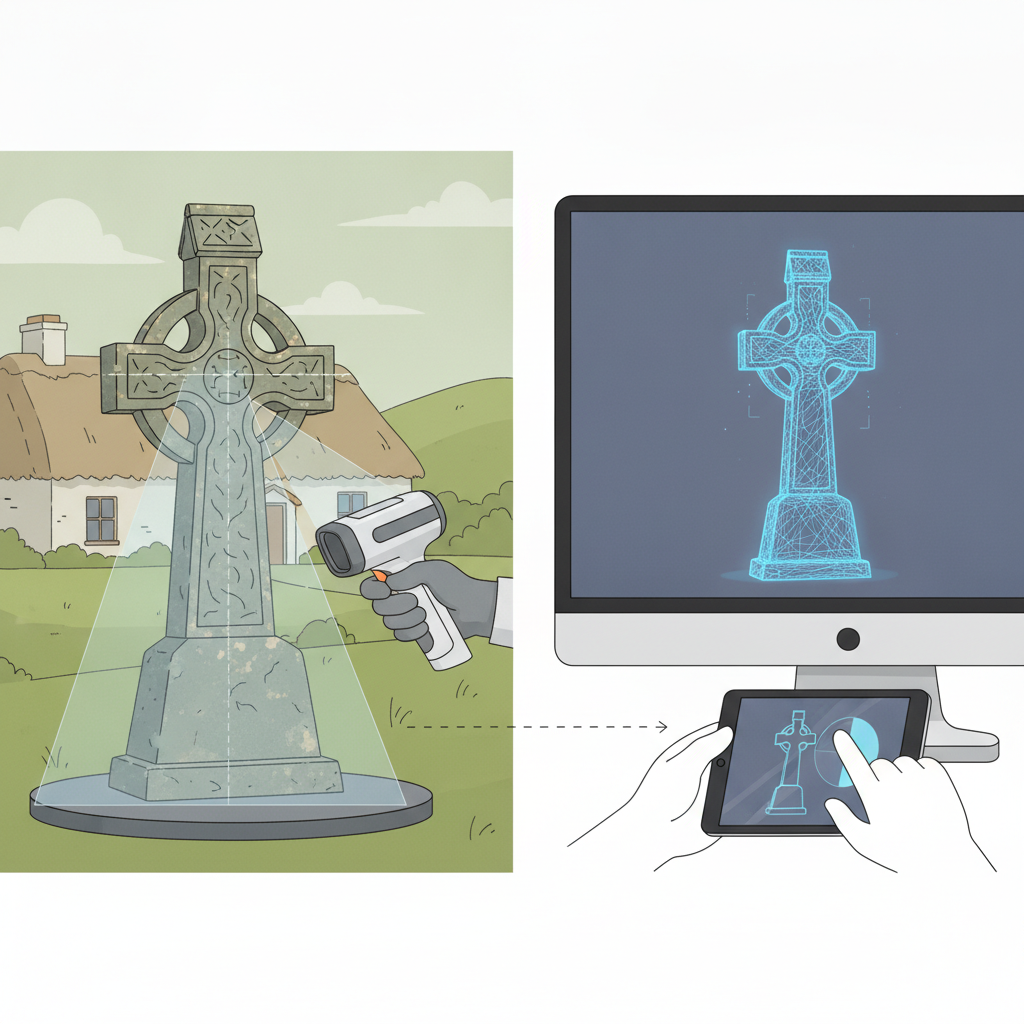
At its core, 3D scanning is the process of analysing a real-world object or environment to collect data on its shape and appearance, effectively creating a "digital twin." This data is then used to construct detailed, three-dimensional models. Think of it as taking millions of measurements and photographs simultaneously, culminating in a highly accurate digital representation.
The benefits of this technology are vast and transformative, particularly for prototypes and heirlooms. For prototypes, 3D scanning drastically accelerates the development cycle. Instead of manually measuring and redrawing a physical model, which is prone to error and time-consuming, a scanner captures all necessary data in minutes or hours. This allows for rapid iteration, precise modifications, and seamless integration into professional cad design for manufacturing workflows. Imagine having a physical mock-up, scanning it, making digital tweaks, and then having custom 3d printing services Ireland produce an improved version, all in a fraction of the time conventional methods would take.
For heirlooms and historical artefacts, 3D scanning offers unparalleled preservation. It creates a permanent digital record that is immune to physical decay, loss, or damage. These digital models can be studied, shared, and even replicated without ever touching the original object. This opens doors for museum exhibits, educational tools, and even the creation of accurate replicas using 3D printing technology, ensuring that the legacy of these treasures endures for generations.
- Accelerated Design Iteration: Quickly capture existing prototypes, make digital adjustments, and re-print.
- Enhanced Accuracy: Obtain highly precise measurements and geometries, far beyond manual methods.
- Digital Archiving: Create indestructible digital copies of irreplaceable items for future generations.
- Reverse Engineering: Convert physical parts into CAD models for modification or replication, crucial for a reverse engineering 3d scan service.
- Quality Control: Compare scanned objects to original CAD models to identify deviations and ensure manufacturing precision.
- Creative Exploration: Use digital models as a starting point for new designs or artistic interpretations.
Tip: Consider the long-term value. A digital scan isn't just a copy; it's a versatile asset that can be used for countless applications, from virtual reality experiences to creating custom 3D printed parts Ireland.
Step 2: Identifying Your Object's Needs and Characteristics
Before embarking on the 3D scanning journey, it's crucial to assess the object you wish to digitise. Not all objects are created equal when it comes to scanning, and understanding its characteristics will help you communicate effectively with your chosen 3d scanning services in Ireland provider and ensure the best possible results.
Consider the object's size. Is it a small, intricate jewellery piece, a medium-sized mechanical component, or a large sculpture? The scale dictates the type of scanner and approach required. Highly detailed small objects demand scanners with fine resolution, while larger items might use structured light or laser scanners that can cover more surface area efficiently. For industrial 3d scanning for product development, accuracy across larger dimensions is often paramount.
Next, think about the material and surface finish. Highly reflective, transparent, or very dark surfaces can pose challenges for certain scanning technologies. Transparent materials like clear plastic or glass often scatter light, making it difficult for scanners to capture a clean surface. Similarly, very shiny metal can bounce light away from the sensor. Our experts at PrintIn3D.ie have techniques and tools to overcome these hurdles, often involving temporary dulling sprays or specific scanning methods.
Finally, what is the ultimate purpose of the digital model? Are you looking for a precise 3d product design services Ireland blueprint for manufacturing, an artistic rendering for display, or just a basic digital archive? The level of accuracy and detail required directly impacts the scanning method and subsequent post-processing. A 3d printed replacement parts service might need micron-level accuracy, while a virtual heirloom display might prioritise texture and colour capture.
- Size and Geometry: Note the dimensions, complexity, and any intricate details or hidden geometries.
- Material and Surface Properties: Identify if the object is transparent, reflective, dark, matte, or features varying textures.
- Desired Accuracy: Determine the acceptable margin of error (e.g., within a millimetre, or down to microns).
- Colour and Texture Capture: Decide if colour and texture information are necessary for your final digital model, or if pure geometry suffices.
- Intended Use: Clarify whether the scan is for 3D design, custom 3d printed parts Ireland, archival, inspection, or reverse engineering 3d scan service.
Warning: Attempting to scan highly reflective or transparent objects without proper preparation or expertise can lead to incomplete or inaccurate data, wasting time and resources.
Step 3: Choosing the Right 3D Scanning Method (and Service Provider)
While there are various 3D scanning technologies, each with its strengths and weaknesses, the most critical decision for most users in Ireland isn't about which scanner to buy, but which professional 3d scanning services in Ireland provider to partner with. For intricate prototypes, precious heirlooms, or critical industrial components, relying on experts ensures quality, accuracy, and efficiency.
Professional services like PrintIn3D.ie utilise a range of advanced scanning technologies. Structured light scanners project patterns onto an object and analyse the distortion to create a 3D map. These are excellent for capturing fine details on stable objects and are frequently used for 3d scanning for product development. Laser scanners use laser lines or dots to measure distances, suitable for various sizes and often employed for reverse engineering 3d scan service tasks. Photogrammetry, while less common for precision engineering, uses multiple photographs to reconstruct a 3D model, good for capturing texture and colour.
When choosing a service provider, look for expertise in handling diverse objects and applications. PrintIn3D.ie offers a comprehensive 3D scanning service in Ireland, employing high-resolution industrial scanners capable of capturing even the most minute details. Our team understands the nuances of different materials and geometries, ensuring that your precious items or critical prototypes are handled with care and scanned with precision. We also understand the importance of confidentiality, offering Non-Disclosure Agreements (NDAs) for sensitive projects, particularly vital for new product prototypes or intellectual property.
- Assess Provider Experience: Look for a company with a proven track record in handling similar objects or industries.
- Technology Match: Ensure the service provider has the right scanning technology for your object's size, material, and required accuracy.
- Post-Processing Expertise: A good scan is only half the battle; skilled technicians are needed to clean, align, and refine the raw scan data into a usable 3D model.
- Confidentiality and Security: For sensitive prototypes or personal heirlooms, confirm the provider offers NDAs and secure handling protocols.
- Value-Added Services: Do they offer additional 3d product design services Ireland, custom 3D printing services Ireland, or guidance on file usage?
Tip: Don't hesitate to ask for examples of past work or case studies relevant to your project. This provides tangible evidence of a provider's capabilities.
Step 4: Preparing Your Object for Optimal Scanning Results
Proper preparation is key to achieving a high-quality 3D scan, regardless of the scanning technology or expertise of the service provider. While PrintIn3D.ie will guide you through this, understanding the basics can significantly streamline the process and improve outcomes.
First and foremost, cleanliness is paramount. Dust, grime, fingerprints, or any surface contaminants can interfere with the scanner's ability to accurately capture the object's true geometry and texture. Ensure your object is thoroughly cleaned and dry before sending it for scanning. For heirlooms, gentle cleaning with appropriate, non-abrasive methods is crucial to avoid damage.
For objects with challenging surface properties – such as highly reflective metals, transparent plastics, or very dark, non-reflective materials – temporary surface treatments may be necessary. This often involves applying a fine, matte, removable powder spray. This spray creates a uniform, non-reflective surface that scanners can easily capture. Don't worry, these sprays are designed to be easily removed without damaging the object, but it's always best to discuss this with your 3d scanning services in Ireland provider first, especially for delicate heirlooms.
Additionally, consider the stability of the object. It needs to remain perfectly still during the scanning process. If it's unstable or has moving parts, these should be secured or removed if possible. For larger objects, or those requiring multiple scans from different angles, strategically placed markers (small, adhesive dots) might be used to help the scanner align different data sets accurately. Again, professional services will handle this, but understanding the reasoning helps.
- Clean Thoroughly: Remove all dust, dirt, grease, and fingerprints. Use appropriate cleaning methods for delicate or antique items.
- Ensure Stability: Secure any loose parts. The object must be stable and stationary during scanning.
- Address Challenging Surfaces: Discuss reflective, transparent, or extremely dark surfaces with your service provider. They may recommend a temporary matte coating.
- Consider Markers: For complex or large objects, small, removable markers may be used for alignment; the service provider will apply these.
- Photograph if Desired: Take high-resolution photos of your object before sending it, especially for heirlooms, for your own record and for comparison.
Warning: Never apply any coating or cleaning solution to an heirloom or delicate prototype without first consulting with a conservation expert or your 3D scanning service provider, as irreversible damage could occur.
Step 5: Engaging a Professional 3D Scanning Service in Ireland
Once your object is ready and you understand the basics, the next step is to engage a professional 3d scanning services in Ireland provider like PrintIn3D.ie. This is where your ideas or precious objects begin their journey into the digital realm with expert care.
The process usually begins with a consultation. You'll discuss your specific needs, the object's characteristics, and your desired outcomes. This is the time to be clear about the purpose of the scan – whether it's for rapid prototyping service Ireland, creating a 3d printed replacement parts service, or simply digital archiving of an heirloom. Share any relevant details, sketches, or existing digital files you might have. If you need a 3d body scanning service for a small figurine or doll, for example, specify the required level of detail.
PrintIn3D.ie makes this process straightforward. You can contact us directly with your project details. We'll provide a quote and timeline based on the object's complexity and your requirements. For sensitive projects, we are happy to sign Non-Disclosure Agreements (NDAs) to protect your intellectual property, giving you peace of mind whether it's a new invention prototype or a valuable family secret.
After the agreement, you'll arrange for your object to be safely transported to our facility. We handle each item with the utmost care, recognising the value – both sentimental and commercial – it holds. Our skilled technicians will then perform the 3D scan using state-of-the-art equipment. The raw scan data undergoes rigorous post-processing, where it's cleaned, meshed, and optimised into a precise 3D model, ready for your intended use.
- Initial Consultation: Contact PrintIn3D.ie to discuss your project, object, and requirements. Provide as much detail as possible.
- Quotation and Agreement: Receive a detailed quote and agree on terms, including any NDAs for confidential projects.
- Secure Object Delivery: Safely send or drop off your object to the scanning facility.
- Professional Scanning: Our expert technicians will use advanced equipment to accurately capture your object's geometry.
- Data Post-Processing: Raw scan data is meticulously cleaned, optimised, and converted into a usable digital 3D model.
- File Delivery: Receive your completed digital 3D model in your desired file format.
Tip: Always clarify the turnaround time and delivery method for your digital files. For urgent rapid prototyping service Ireland needs, faster options might be available.
Step 6: Receiving and Utilising Your Digital Model
Once the 3D scanning process is complete and the raw data has been expertly processed, you'll receive your digital 3D model. This is the exciting culmination of the digitisation journey, opening up a world of possibilities for your prototypes and heirlooms.
Typically, professional 3d scanning services in Ireland will provide your digital model in common 3D file formats such as STL (Stereolithography), OBJ (Object), or sometimes STEP or IGES, depending on your needs. STL files are widely used for 3D printing and rapid prototyping, while OBJ files can store colour and texture information alongside geometry, making them ideal for visualisations or gaming assets. STEP and IGES files are often preferred in engineering for their mathematical precision, crucial for professional cad design for manufacturing.
With your digital model in hand, the real work (or play!) can begin. For prototypes, this digital twin allows for precise modifications in CAD software. You can refine dimensions, add new features, or integrate the part into a larger assembly. This is invaluable for 3d scanning for product development, allowing engineers to test fit, form, and function virtually before committing to physical production. From these modified models, PrintIn3D.ie can then produce custom 3d printed parts Ireland, completing the digital-to-physical loop.
For heirlooms, the digital model serves as an invaluable archive. You can share it globally, create virtual exhibitions, or even print miniature replicas for family members. If a piece breaks, the scan provides the exact dimensions for a 3d printed replacement parts service, bringing functionality back to a cherished item. The possibilities are truly endless, transforming how we interact with and preserve our most treasured possessions.
- File Format Selection: Choose the appropriate file format (STL, OBJ, STEP, etc.) based on your intended use. Discuss this with PrintIn3D.ie during the initial consultation.
- Review and Verify: Open the digital model in your preferred 3D software to ensure it meets your expectations for accuracy and detail.
- CAD Integration: Import the scanned model into CAD software for professional cad design for manufacturing, modifications, or 3d product design services Ireland.
- 3D Printing: Send the file to PrintIn3D.ie for custom 3d printing services Ireland to create replicas, replacement parts, or new iterations. You might even consider buy flexible tpu filament Ireland for specific functional parts.
- Digital Archiving: Store the digital model securely for future reference, preservation, or virtual display.
- Marketing & Visualisation: Use the model for high-quality renders, animations, or interactive online experiences.
Warning: Always ensure you have compatible software to open and work with the provided 3D file formats. If unsure, consult with PrintIn3D.ie.
Common Mistakes to Avoid When Digitising with 3D Scanning
While 3D scanning offers incredible advantages, a few common pitfalls can hinder the process or compromise the results. Being aware of these can help ensure a smoother and more successful digitisation experience:
- Underestimating Object Preparation: Sending an object that is dirty, unstable, or has problematic surface finishes (too shiny, too transparent) without prior discussion can lead to poor scan quality or require additional, time-consuming post-processing. Always prepare your object as advised in Step 4.
- Unclear Project Requirements: Not clearly defining the purpose of the scan, the desired accuracy, or the required output file format can lead to a model that doesn't meet your needs. Be specific during your initial consultation with 3d scanning services in Ireland.
- Ignoring Material Constraints: Believing all materials scan equally well. Highly reflective or transparent objects require specific techniques and sometimes pre-treatment that you need to discuss with your service provider.
- Choosing DIY for Complex Objects: While consumer-grade 3D scanners exist, they often lack the precision, resolution, and software capabilities of industrial machines. For prototypes needing high accuracy or irreplaceable heirlooms, a professional reverse engineering 3d scan service is almost always the better choice.
- Overlooking Confidentiality: For new prototypes or sensitive designs, failing to ensure an NDA is in place with your service provider can risk your intellectual property. PrintIn3D.ie offers NDAs for your peace of mind.
- Expecting an "Instant" CAD Model: Raw scan data (a mesh of triangles) is not automatically a perfect, editable CAD model. Converting mesh data into parametric CAD (STEP, IGES) for professional cad design for manufacturing often requires significant 3d product design services Ireland, known as reverse engineering, which is a separate, skilled process. Clarify if you need reverse engineering or just a clean mesh model.
- Neglecting Post-Processing: Even with a perfect scan, raw data needs cleaning, alignment, and optimisation. A reputable service includes this, but be wary of cheaper options that might skimp on this crucial step, leading to unusable files.
Frequently Asked Questions (FAQ)
What types of objects can PrintIn3D.ie scan?
PrintIn3D.ie can scan a wide range of objects, from small, intricate jewellery pieces and mechanical prototypes to larger sculptures and historical artefacts. We utilise industrial-grade scanners that can handle various materials and complexities, including those needing 3d scanning for product development or reverse engineering 3d scan service. If you have a unique or challenging item, contact us to discuss its feasibility.
How accurate are your 3D scanning services in Ireland?
Our 3d scanning services in Ireland employ high-resolution professional scanners capable of capturing details with micron-level accuracy, depending on the object and specific requirements. This precision is crucial for applications like 3d printed replacement parts service or professional cad design for manufacturing, where exact dimensions are critical. We'll discuss your specific accuracy needs during the initial consultation to ensure the chosen method delivers the desired results.
What file formats will I receive after the 3D scan?
Upon completion, you can typically receive your digital 3D model in industry-standard formats such as STL (Stereolithography), OBJ (Object), or potentially STEP/IGES for engineering applications. STL is ideal for 3D printing, while OBJ is excellent for models with colour and texture. We will confirm the best format for your intended use during the project setup.
Can you 3D scan people or animals (3d body scanning service)?
While some technologies allow for 3d body scanning service, PrintIn3D.ie primarily focuses on inanimate objects, prototypes, and heirlooms for industrial, commercial, and preservation purposes. If you're interested in scanning a small static figurine or a part of a larger model that resembles a body part, we can certainly assist. For live subjects, specific human/animal body scanners are usually required, which falls outside our current specialized offerings.
What if my object is very valuable or delicate?
We understand that heirlooms and prototypes can hold immense sentimental or commercial value. At PrintIn3D.ie, we handle all objects with the utmost care and professionalism. We offer Non-Disclosure Agreements (NDAs) for sensitive items and ensure secure storage and careful handling throughout the scanning process. Our non-contact scanning methods are gentle and non-invasive, ensuring no physical damage to your precious items. For specific concerns, please discuss them with our team.
Do you offer 3D printing services for the scanned models?
Absolutely! PrintIn3D.ie offers comprehensive custom 3d printing services Ireland. Once your object has been digitised, we can use the digital model to produce custom 3d printed parts Ireland, replicas, or modified versions. This is incredibly beneficial for rapid prototyping service Ireland, allowing for quick iterations and physical representations of your scanned and redesigned models. We also sell a range of 3D printer filaments, including options like flexible TPU.
Next Steps / Call to Action
Ready to unlock the full potential of your prototypes and heirlooms? Contact PrintIn3D.ie today to discuss your 3D scanning project, or explore our custom 3D printing services and 3D design expertise. Let us be your trusted partner in bringing your physical objects into the digital age, hassle-free.