From Sketch to Success: 3D Printing Your Prototype in Ireland
Introduction: Bringing Your Ideas to Life in Three Dimensions
Do you have a brilliant product idea sketched out on a napkin, a whiteboard, or even just in your mind? The journey from a raw concept to a tangible, testable object can seem daunting, especially if you're navigating the world of product development for the first time. This comprehensive guide is designed to demystify that process, showing you exactly how to transform your initial product idea sketch into a functional 3D printed prototype right here in Ireland. It's about taking that leap from imagination to innovation, making your dreams a physical reality without needing to invest in complex equipment or software yourself.
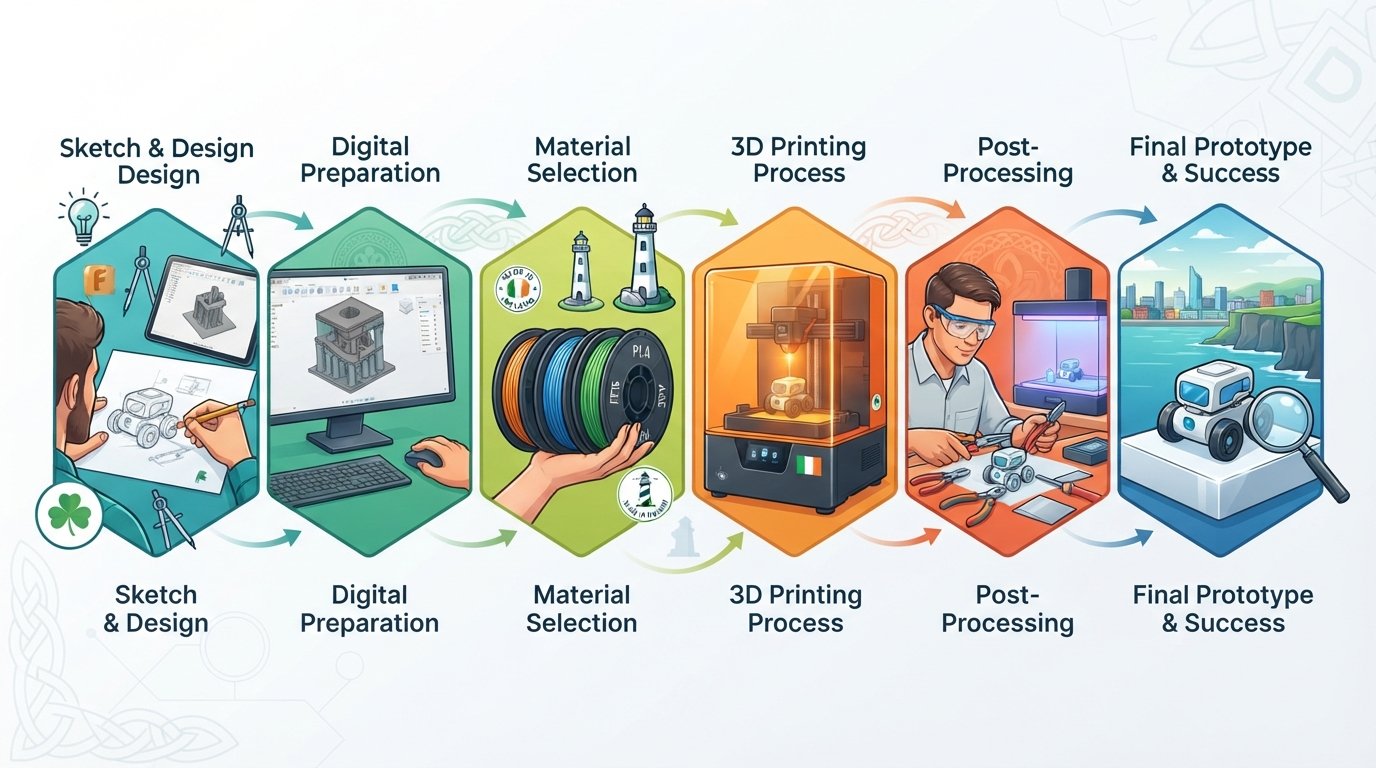
For innovators, entrepreneurs, and hobbyists across Ireland, the ability to quickly and affordably prototype is a game-changer. It allows you to test concepts, gather feedback, refine designs, and even present a physical model to potential investors or customers long before committing to expensive manufacturing processes. This isn't just about creating a model; it's about reducing risk, accelerating development, and ensuring your final product is exactly what you envision. Whether you're in Dublin, Cork, or anywhere in between, accessing top-tier 3D printing services has never been easier. We'll walk you through each critical stage, from refining your initial sketch to receiving your finished 3D printed model.
At PrintIn3D.ie, we understand the excitement and challenges of innovation. We pride ourselves on being your trusted 3D printing partner, offering seamless 3D design and custom 3D printing services that take the hassle out of prototyping. While our primary focus is on serving Ireland and the EU/EEA, our expertise is universal. Many of our clients are looking for reliable '3d prentunarþjónusta' or even specific '3d prentunarþjónusta reykjavík' quality services that we can replicate with our robust delivery network. We are dedicated to helping you bring your ideas to life, no matter how complex, and ensuring you get a high-quality prototype that truly reflects your vision. Let's embark on this exciting journey together to `prenta 3d hlut` from your creative spark.
Who This Is For
- Entrepreneurs and startups in Ireland looking to validate new product ideas.
- Engineers and designers needing functional prototypes for testing.
- Inventors aiming to present a physical model of their concept.
- Hobbyists and makers wishing to bring complex designs to life.
- Anyone with a product idea sketch who doesn't own a 3D printer or specialized design software.
Step 1: Clarifying and Refining Your Product Idea Sketch
The journey from a sketch to a 3D printed prototype begins with a clear and detailed understanding of your initial idea. Before any digital design work can commence, you need to ensure your physical sketch communicates all necessary information about your product. Think of your sketch not just as an artistic rendering, but as the blueprint for something real and functional. The more detail you can capture at this stage, the smoother the subsequent design and printing process will be.
Start by drawing your product from multiple angles: front, side, top, and even an isometric view if you can. These different perspectives help to convey the three-dimensional nature of your idea more effectively. Consider the purpose of your prototype – is it for aesthetic evaluation, functional testing, or both? This will influence the level of detail and accuracy required. Don't be afraid to make multiple sketches, iterating on your design as new thoughts or challenges arise. Each iteration brings you closer to a refined concept that can be translated into a digital model.
- Draw from multiple angles: Provide front, side, top, and isometric views to capture the full dimensionality of your idea.
- Add precise measurements: Even if they are estimates, include length, width, height, and critical dimensions for features. Use a ruler to ensure lines are straight and proportions are consistent.
- Annotate key features and functions: Label specific parts, explain their purpose, and note any moving components or assembly requirements.
- Indicate materials and textures: Jot down your ideal material (e.g., rigid plastic, flexible rubber, clear material) and any desired surface finishes.
- Consider scale: Clearly state the intended size of the final product and how this prototype will relate to it (e.g., 1:1 scale, half-scale model).
Step 2: Understanding Material and Design Constraints for 3D Printing
Once your sketch is as detailed as possible, the next crucial step is to consider the practicalities of 3D printing. Unlike traditional manufacturing methods, 3D printing has its own unique set of capabilities and limitations. Understanding these constraints early on can save significant time and resources, preventing rework and ensuring your design is actually printable and functional. This is where your vision meets the reality of additive manufacturing, and making informed decisions now will pave the way for a successful prototype.
Think about the intended use of your prototype. Will it need to withstand impact, heat, or flexibility? The choice of filament (e.g., PLA, PETG, ABS, TPU) will greatly impact its properties. For instance, PLA is excellent for general prototyping due to its ease of printing and biodegradability, but PETG offers better strength and temperature resistance. If your `3d prentun eftir pöntun` requires something flexible, TPU might be the answer. Additionally, consider the minimum feature size, wall thickness, and overhangs that 3D printers can reliably produce. Very thin walls might break, and extreme overhangs might require support structures, which can affect surface finish and cost.
- Research common 3D printing materials: Familiarise yourself with PLA, PETG, ABS, TPU, and their respective properties (strength, flexibility, heat resistance, appearance).
- Consider wall thickness: Ensure all walls and features are sufficiently thick (typically >1-2mm depending on material and printer) to be durable and printable.
- Evaluate overhangs and support structures: Identify areas of your design that extend outwards and might require support. This impacts print time, material usage, and post-processing.
- Account for tolerances: If parts need to fit together, allow for small gaps (e.g., 0.2-0.5mm) to ensure a smooth assembly after printing.
- Think about assembly: If your product has multiple parts, consider how they will be joined (snaps, screws, glue) and design those interfaces accordingly.
Step 3: Transforming Your Sketch into a Digital 3D Model
With a refined sketch and an understanding of 3D printing constraints, the next step is to convert your physical drawings into a digital 3D model. This is perhaps the most critical technical phase, as the quality and accuracy of your digital model directly translate to the quality of your `3d prentun eftir pöntun`. If you're not proficient in CAD (Computer-Aided Design) software, this is where partnering with a professional 3D design service like PrintIn3D.ie becomes invaluable. They possess the expertise to interpret your sketches and translate them into a print-ready file, such as an STL or OBJ.
A professional 3D designer will take your multi-angle sketches, measurements, and annotations, and meticulously recreate your product idea in a virtual environment. They'll ensure all dimensions are accurate, surfaces are smooth, and the model is structurally sound for 3D printing. This process often involves back-and-forth communication, where the designer might ask clarifying questions or suggest optimizations for manufacturability. They can also advise on design adjustments to reduce printing costs, improve strength, or enhance aesthetics, ensuring your digital model is perfectly optimised for the `prenta 3d hlut` stage.
- Gather all sketches and notes: Compile all your detailed drawings, measurements, and functional descriptions for the designer.
- Communicate clearly with your designer: Provide as much context as possible about the product's purpose, intended function, and aesthetic goals. Share any visual references or inspirations.
- Review preliminary designs: Ask for screenshots or rendered images of the digital model as it develops. Provide feedback on dimensions, features, and overall appearance.
- Approve the final 3D model: Once satisfied, formally approve the digital design for `3d prentunarþjónusta`.
- Request CAD files: Ask for the native CAD files (e.g., STEP, IGES) in addition to the STL or OBJ print files, for future revisions or intellectual property records.
Step 4: Choosing the Right 3D Printing Service Provider
Once you have a high-quality, print-ready 3D model, the next step is to select a reliable 3D printing service provider to bring it to life. This is a critical decision, as the right partner will ensure your prototype is produced to the highest standards, on time, and within budget. For businesses and individuals in Ireland, choosing a local or easily accessible service offers benefits like faster turnaround times and personalised support. However, for those seeking broader services, perhaps even looking for '3d prentun ísland' or '3d prentun reykjavík' levels of quality and efficiency, a service with a robust delivery network across the EU/EEA, such as PrintIn3D.ie, is an excellent choice.
Look for a provider that offers the specific materials and printing technologies suitable for your prototype's requirements. For most functional prototypes, FDM (Fused Deposition Modeling) using materials like PLA or PETG is common. Assess their reputation, customer reviews, and their ability to handle confidential projects (important for new product ideas). PrintIn3D.ie, for example, is an award-winning 'Rising Star' at the Irish Print Awards 2026, testifying to our quality and reliability. We also offer NDAs for your peace of mind. Our fast turnaround times, same-day dispatch for filament orders, and friendly WhatsApp support are designed to provide a truly hassle-free experience, whether you're in Wexford or searching for the best `3d printing ísland` option.
- Evaluate material and technology options: Ensure the service offers the materials (PLA, PETG, etc.) and printing methods (FDM, SLA, etc.) that best suit your prototype's needs.
- Check for quality assurance: Look for evidence of high-quality prints, consistent results, and attention to detail. Reviews and examples of their work are good indicators. You can see our five-star reviews here.
- Consider turnaround times and delivery: For fast prototyping, quick production and shipping are essential. PrintIn3D.ie offers rapid delivery across Ireland and the EU/EEA.
- Assess communication and support: A responsive and helpful team can make a significant difference, especially if you have questions or need adjustments.
- Confirm confidentiality measures: If your product idea is sensitive, ensure the provider offers NDAs or has strong privacy policies in place. We take your intellectual property seriously.
Step 5: Submitting Your Design and Getting an Estimate
Once you've chosen your trusted `3d prentunarþjónusta`, the next step is to submit your 3D model file and request a quote. This is where your digital design officially enters the production queue. A professional service will make this process straightforward, allowing you to upload your files easily and receive a transparent breakdown of costs and timelines. At PrintIn3D.ie, we've streamlined this to be as user-friendly as possible, making sure you understand every aspect of your order.
When submitting your file, you'll typically be asked to specify your preferred material, colour, and any post-processing requirements. The service provider will then analyse your model to determine the amount of material needed, the complexity of the print, and the estimated printing time. Factors like infill density, layer height, and the need for support structures will all influence the final cost and production schedule. For instance, a denser infill will use more material and take longer, increasing durability but also expense. Be prepared to discuss these options to balance cost, strength, and print quality effectively. This collaborative approach ensures your prototype `prenta 3d hlut` meets your exact specifications.
- Upload your 3D model file: Typically in STL or OBJ format, via the service provider's website.
- Specify material and colour: Select the material (e.g., PLA, PETG) and colour that aligns with your prototyping needs.
- Indicate desired print quality/resolution: This relates to layer height – finer layers result in smoother surfaces but longer print times and potentially higher costs.
- Review the estimated cost and turnaround time: Carefully examine the quote for all charges, including printing, materials, and shipping. Confirm the delivery date.
- Confirm and place your order: Once you're satisfied with the estimate, proceed to place your order.
Step 6: Reviewing and Approving Your Prototype Details
After submitting your design and receiving an estimate, a reliable 3D printing service may offer a final review stage before commencing with the actual printing. This step is a last opportunity to ensure that all details are correct and that the print parameters align with your expectations. While it might seem like an extra step, it's a crucial checkpoint, especially for complex or highly specific prototypes. This is particularly valuable for clients who are keen on getting their `3d prentun eftir pöntun` just right, whether they're in the bustling heart of Dublin or searching for quality `3d printing ísland` services.
During this review, the service provider might send you a rendering of how the print will look, or a detailed breakdown of the chosen print settings (e.g., infill percentage, layer height, orientation on the print bed, support material usage). This is your chance to clarify any uncertainties, confirm specifications, and make sure that the digital representation perfectly matches your vision for the physical `prenta 3d hlut`. Don't hesitate to ask questions about anything that's unclear. The goal is to avoid any surprises when your prototype arrives and to ensure that the final product is exactly what you envisioned for your project in Ireland.
- Examine provided renderings or print simulations: Check the orientation, scale, and general appearance of your model as it will be printed.
- Verify print settings: Confirm material, colour, layer height, and infill density are as desired.
- Review support structure details: Understand where support material will be used and how it might impact the final surface finish.
- Confirm estimated timeline: Ensure the projected completion and delivery dates still meet your project's schedule.
- Give final approval: Once all details are confirmed, provide your explicit approval for the printing process to begin.
Step 7: Receiving and Evaluating Your 3D Printed Prototype
The moment of truth arrives when your 3D printed prototype is delivered. This is an exciting step, as your initial sketch has now transformed into a tangible object. Unboxing your prototype is more than just receiving a package; it's the culmination of your idea, design work, and the precision of modern 3D printing technology. At PrintIn3D.ie, we ensure fast delivery across Ireland and the EU/EEA, often with same-day dispatch for filament orders, so your wait is minimal and your excitement can quickly turn into practical evaluation. Whether you're in the heart of Dublin or reaching us from the needs of '3d prentun reykjavík', our aim is to deliver excellence.
Once you have your prototype in hand, it's crucial to thoroughly evaluate it against your initial design objectives. Check for dimensional accuracy, structural integrity, and aesthetic appeal. Does it fit where it's supposed to? Does it perform the intended function? Are there any unexpected flaws or areas for improvement? This evaluation process provides invaluable insights that will guide further iterations of your design. Remember, prototyping is an iterative process – it's rare for the first prototype to be perfect, and feedback from this stage is essential for refinement.
- Unpack carefully: Handle your prototype with care, especially if it has delicate features.
- Inspect for print quality: Check for layer adhesion, surface finish, and any visible defects.
- Verify dimensions: Use calipers or a ruler to measure critical dimensions and compare them against your 3D model.
- Test functionality: If it's a functional prototype, test its intended use. Does it assemble correctly? Do moving parts articulate as expected?
- Gather feedback: Show your prototype to colleagues, potential users, or experts. Their fresh perspectives can reveal areas for improvement.
- Document observations: Keep detailed notes and photos of your findings – both positive and negative – to inform future design iterations.
Common Mistakes to Avoid When Prototyping
Turning a sketch into a 3D printed prototype is an exciting journey, but it's also fraught with potential pitfalls. Being aware of common mistakes can help you navigate the process more smoothly, saving time, money, and frustration. From initial design to final evaluation, these insights are crucial for anyone, whether you're a seasoned inventor or just starting your exploration into `3d prentun eftir pöntun` services.
- Lack of Detail in Initial Sketch: Starting with a vague or incomplete sketch forces the 3D designer to make assumptions, which can lead to a model that doesn't align with your vision. Ensure your sketch is as detailed as possible, with multiple views and dimensions.
- Ignoring 3D Printing Constraints: Designing a model without considering the limitations of 3D printing (e.g., minimum wall thickness, overhangs, required tolerances) can result in unprintable designs or prototypes that fail. Always factor in material properties and printer capabilities.
- Skipping Professional 3D Design: Attempting to create a complex 3D model yourself without adequate software skills often leads to poorly optimised files, print failures, and delays. Investing in professional 3D design services (like those offered by PrintIn3D.ie) is almost always a cost-effective solution for quality and speed.
- Choosing the Wrong Material: Selecting a material based solely on cost or availability without considering the prototype's intended function can lead to a non-functional or misleading prototype. Research material properties and consult with your `3d prentunarþjónusta` provider.
- Not Communicating Clearly with the Service Provider: Ambiguous instructions or a lack of feedback during the design and printing phases can lead to misinterpretations and errors. Maintain open and clear communication at all stages.
- Expecting Perfection on the First Try: Prototyping is an iterative process. Rarely is the first prototype perfect. Embrace feedback, learn from flaws, and be prepared for multiple revisions.
- Failing to Test Thoroughly: Receiving your prototype isn't the end; it's the beginning of testing. A superficial evaluation can miss critical flaws that could surface later, potentially at greater cost.
- Ignoring Intellectual Property: Neglecting confidentiality, especially when working with external services, can put your idea at risk. Ensure your `3d prentunarþjónusta` offers NDAs or has robust privacy policies.
- Over-optimising for Cost at the Expense of Quality: While budgeting is important, cutting corners on design or print quality can result in a prototype that doesn't accurately represent your product, leading to poor testing results or misinformed decisions.
Frequently Asked Questions (FAQ)
What file formats do I need to submit for 3D printing?
The most common file formats accepted for 3D printing are STL (stereolithography) and OBJ. These formats define the geometry of your 3D model. If you're working with a professional 3D design service like PrintIn3D.ie, they can typically convert various CAD file formats (e.g., STEP, IGES, SolidWorks) into print-ready STL or OBJ files for your `3d prentunarþjónusta` needs. Always confirm the preferred file format with your chosen service provider.
How long does it take to get a 3D printed prototype in Ireland?
The turnaround time for a 3D printed prototype depends on several factors: the complexity and size of your model, the chosen material, the workload of the service provider, and your shipping location. At PrintIn3D.ie, we offer fast turnaround times, with options for expedited services (e.g., 28-hour, 13-hour, 8-hour custom printing) and same-day dispatch for filament orders. Typical delivery for custom prints within Ireland is usually within a few working days, though it's best to get a specific estimate for your project. This efficiency is why we're a top choice for those seeking `3d prentun ísland` or `3d prentun reykjavík` quality with swift delivery.
What are the typical costs associated with 3D printing a prototype?
The cost of a 3D printed prototype varies widely based on:
- Material: Some materials are more expensive than others.
- Volume of material: Larger parts or those with high infill percentages use more material.
- Print time: Complex geometries, high resolution (smaller layer height), and large prints take longer.
- Post-processing: Sanding, painting, or assembly adds to the cost.
- 3D design services: If you need help converting your sketch to a 3D model, this will be an additional cost.
- Shipping: Delivery costs, especially for international orders.
Can I get an NDA (Non-Disclosure Agreement) for my product idea?
Absolutely. For sensitive product ideas, it's highly recommended to have an NDA in place to protect your intellectual property. At PrintIn3D.ie, we understand the importance of confidentiality and offer NDAs to ensure your innovative concepts remain secure. This is a standard practice for reputable 3D printing services, giving you peace of mind throughout the prototyping process, whether you're an inventor in Cork or an entrepreneur seeking `3d prentun eftir pöntun` from afar.
What if my prototype isn't perfect on the first print?
It's completely normal for the first prototype to not be perfect. Prototyping is an iterative process of testing, evaluating, and refining. The purpose of the first print is to identify areas for improvement. You'll likely need to make adjustments to your 3D model based on your physical evaluation and then order a revised print. This cycle of design, print, test, and refine is essential for developing a successful product. Our team at PrintIn3D.ie is here to support you through these iterations, ensuring your final prototype is exactly what you envision.
Next Steps: Turn Your Vision into Reality with PrintIn3D.ie
Ready to take your product idea from a simple sketch to a tangible 3D printed prototype? PrintIn3D.ie is your premier partner in Ireland, offering hassle-free custom 3D printing, expert 3D design, and reliable `3d prentunarþjónusta` that extends to those seeking '3d prentun ísland' quality. Visit PrintIn3D.ie today to upload your file, get an instant quote, or connect with our friendly team to discuss your project and `prenta 3d hlut` with confidence.