How to Get Your Custom 3D Print Made in Ireland: A Step-by-Step Guide
In a world increasingly driven by innovation and customisation, the ability to turn a digital idea into a tangible object is more valuable than ever. Whether you're an entrepreneur prototyping a new product, a small business creating bespoke components, a hobbyist bringing a creative vision to life, or even an educator looking for unique teaching aids, custom 3D printing services Ireland offers an unparalleled pathway to creation. Gone are the days when you needed to invest heavily in your own 3D printer, learn complex software, and spend hours troubleshooting prints.
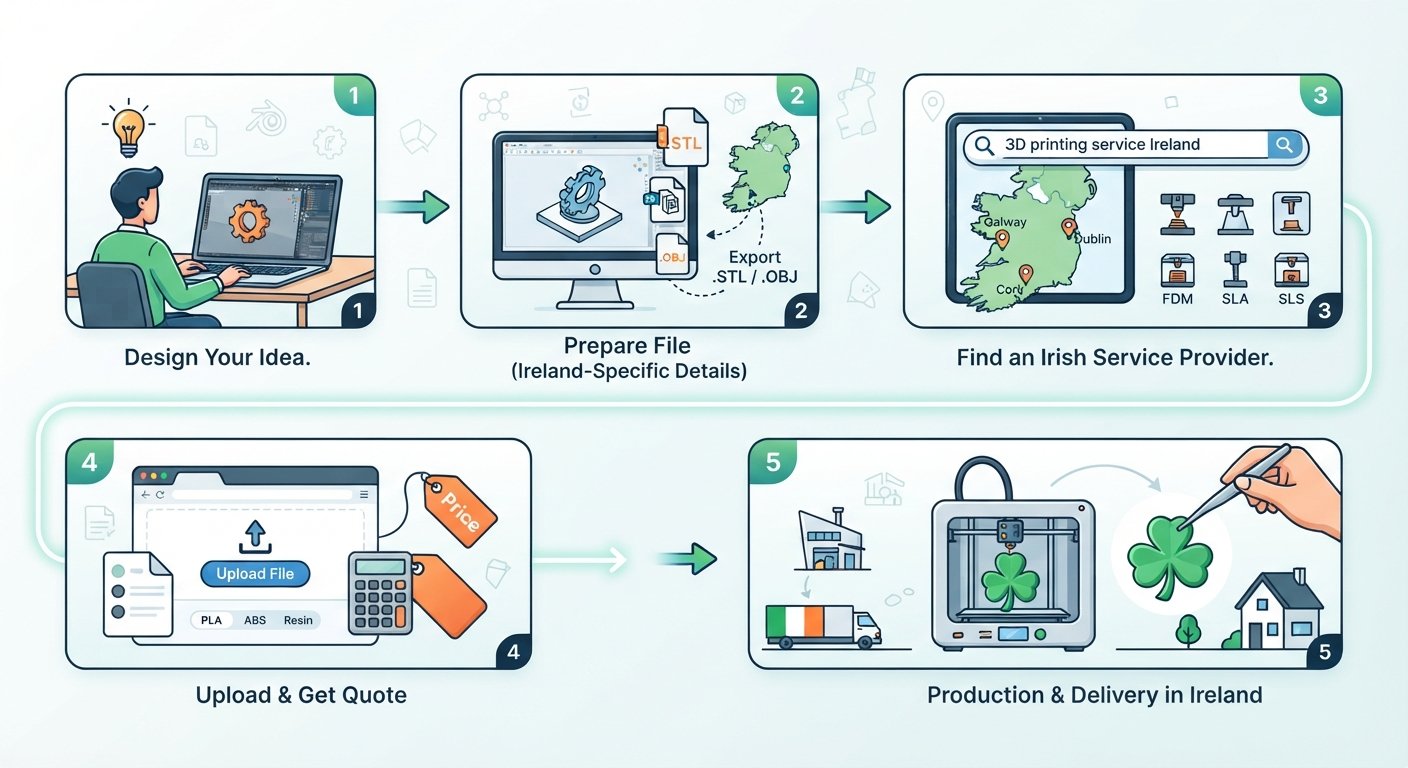
This comprehensive guide will walk you through every essential step of getting your custom 3D print made in Ireland, from the initial spark of an idea to holding the finished product in your hands. We’ll demystify the process, explain what you need to know, and show you how to leverage professional services like PrintIn3D.ie to make your 3D dreams a reality with absolute ease. You'll learn how to refine your concept, prepare your digital files, choose the right materials, and select the perfect service provider to ensure your project is a resounding success. Get ready to transform your innovative ideas into physical objects, hassle-free!
What You'll Need
- An idea for a 3D object, ranging from a rough sketch to a detailed CAD file.
- An understanding of your project's purpose and requirements.
- Basic knowledge of materials (or a willingness to learn/consult).
- Access to a reputable custom 3D printing service in Ireland.
Who This Is For
- Entrepreneurs and startups needing rapid prototyping.
- Small to medium-sized businesses requiring custom parts or low-volume manufacturing.
- Designers and engineers looking for a cad file to 3d print service.
- Hobbyists, artists, and creators wanting unique objects.
- Anyone in Ireland without a 3D printer who needs a physical 3D model.
Step 1: Conceptualise Your Idea & Define Your Needs
Every great 3D print begins with a clear idea. Before you even think about software or materials, take the time to fully conceptualise what you want to create and why. This foundational step is crucial for ensuring that the final printed object meets your expectations and serves its intended purpose. It's about translating your mental image or functional requirement into a tangible blueprint, even if it's just on paper to start.
Consider the primary function of your part. Is it a decorative piece, a functional component for a machine, a prototype for a new product, or a unique gift? How will it interact with other objects or environments? Understanding these aspects will guide every subsequent decision, from design complexity to material selection. This is also where you start thinking about the 3d product design services ireland might offer, especially if your idea is still in its infancy and you need expert help to bring it to a print-ready stage.
- Brainstorm and Sketch: Start by sketching your idea from multiple angles. Don't worry about perfection at this stage; focus on capturing the shape, proportions, and any key features.
- Define Purpose and Functionality: Clearly articulate what the object needs to do. Will it hold weight, withstand heat, flex, or simply look good?
- Consider Dimensions and Scale: Estimate the approximate size of your object. This will impact material choice, print time, and cost.
- Identify Key Features: Note down any specific details, textures, moving parts, or assembly requirements.
- Gather Inspiration: Look at existing products or designs that share similar characteristics or functions. This can help refine your vision and identify potential challenges or solutions.
- Research Existing Solutions: Is there already a similar product available? What makes yours unique or better? This can inform your design choices.
For businesses looking to innovate, this initial conceptualisation often involves collaboration with a 3d design and prototyping company. They can help flesh out ideas, provide design feedback, and ensure your concept is feasible for 3D printing, saving you time and resources in the long run. Whether you're a seasoned inventor or just starting, a solid conceptual foundation is the cornerstone of a successful custom 3D print.
Tip: Create a list of "must-have" features and "nice-to-have" features. This helps prioritise when design compromises might be necessary and keeps your project focused on its core objectives.
Step 2: Create or Acquire Your 3D Model File
Once your idea is clearly defined, the next critical step is to translate it into a digital 3D model. This file is the blueprint that your chosen 3D printer will follow to create your physical object. There are several paths you can take to acquire this file, depending on your skills, resources, and the complexity of your design.
Many individuals and businesses opt for a professional cad file to 3d print service. This is particularly beneficial if you have a complex mechanical part, an intricate artistic creation, or simply lack the expertise or time to create the model yourself. Services like PrintIn3D.ie specialise in taking your sketches, drawings, or even just detailed descriptions and transforming them into accurate, print-ready 3D models. This often involves using advanced Computer-Aided Design (CAD) software, which allows for precise measurements, complex geometries, and functional simulations.
- Design It Yourself: If you have experience with 3D modelling software (e.g., Fusion 360, Blender, SketchUp, SolidWorks), you can create the model yourself. Ensure your design is "watertight" (no gaps or holes in the mesh) and manifold (no overlapping faces or edges) to avoid printing errors.
- Hire a Professional 3D Designer: For intricate designs, functional prototypes, or if you don't have the software skills, hiring a professional 3d product design services ireland offers is a smart choice. They can bring your concept to life with accuracy and optimise it for 3D printing. Many 3d design and prototyping company firms provide this service.
- Use 3D Scanning: If you have an existing physical object that you want to duplicate or modify, 3D scanning in Ireland is an excellent option. A 3D scanner captures the geometry of the physical object and converts it into a digital 3D model. PrintIn3D.ie offers professional 3D scanning services, perfect for reverse engineering parts, creating digital archives, or simply reproducing items.
- Download Pre-existing Models: For common objects, spare parts, or decorative items, you might find suitable models on online repositories like Thingiverse, MyMiniFactory, or Cults3D. Always check the licensing and ensure the model meets your specific requirements before printing.
- Optimise for Printing: Regardless of how you obtain your file, it's crucial to ensure it's ready for printing. This includes checking for mesh errors, ensuring appropriate wall thickness, and considering support structures. A professional service will often do this for you.
The most common file format for 3D printing is STL (.stl), which stands for stereolithography. Other formats like OBJ (.obj), AMF (.amf), and 3MF (.3mf) are also widely accepted and can sometimes carry more information (like colour or material properties). When preparing your file or working with a designer, aim for one of these standard formats.
Warning: An improperly prepared 3D model file is one of the leading causes of failed prints. Ensure your model is "watertight" and free from errors to save time and material. If in doubt, always consult with your chosen 3D printing service; they can often perform a file check or make minor repairs.
Step 3: Choose Your Material and Finish
The material you select for your custom 3D print is just as important as the design itself, as it dictates the object's physical properties, aesthetic, and suitability for its intended use. With advancements in additive manufacturing, a wide array of 3D printer filaments are available, each with unique characteristics. Understanding these differences will help you make an informed decision and achieve the best results for your project.
At PrintIn3D.ie, we stock a variety of high-quality filaments, making it easy to buy PLA filament Ireland, buy flexible TPU filament Ireland, and even buy ABS filament Ireland, along with other specialised options. If you're considering larger projects or ongoing production, exploring a bulk filament supplier ireland can also be beneficial.
- PLA (Polylactic Acid):
- Characteristics: Easy to print, biodegradable, wide range of colours, rigid, good for aesthetic parts and prototypes.
- Best For: Decorative items, toys, architectural models, rapid prototypes, home solutions.
- Considerations: Lower heat resistance, can be brittle.
- PETG (Polyethylene Terephthalate Glycol):
- Characteristics: Strong, durable, good layer adhesion, food-safe (in some forms), chemical resistant, slightly flexible.
- Best For: Functional parts, mechanical components, outdoor use, watertight containers.
- Considerations: Can be stringy during printing if not properly dried.
- ABS (Acrylonitrile Butadiene Styrene):
- Characteristics: Very strong, high temperature resistance, durable, can be post-processed with acetone smoothing.
- Best For: Automotive parts, electronic enclosures, prototypes requiring high strength and durability.
- Considerations: Prone to warping without an enclosed printer, emits fumes (requires ventilation).
- TPU (Thermoplastic Polyurethane):
- Characteristics: Highly flexible, elastic, impact-resistant, rubber-like.
- Best For: Phone cases, gaskets, flexible prototypes, wearable items, dampeners.
- Considerations: Can be challenging to print, slower speeds, requires specific printer setups.
- Specialty Filaments: Beyond the core types, there are many specialty filaments like carbon fibre reinforced (for extreme strength), wood-filled (for aesthetic wood-like finishes), metal-filled, and glow-in-the-dark.
Choosing a Finish: The finish of your print can dramatically alter its appearance and feel.
- Standard/Matte: Most common, raw layered look of FDM printing.
- Smooth/Sanded: Post-processing can reduce layer lines for a smoother surface.
- Painted: For specific colours or protective coatings.
- Varnished/Coated: To add shine, protection, or texture.
Tip: If you're unsure which material is best for your project, don't hesitate to consult with your custom 3D printing services ireland provider. Experts at PrintIn3D.ie can guide you through the material selection process, ensuring your choice aligns perfectly with your design's functional and aesthetic requirements. Always communicate the intended use of the part; this helps greatly in recommending the ideal filament.
Warning: Material properties are crucial. Using the wrong material can lead to functional failures, aesthetic disappointment, or even safety issues. For instance, a part needing high heat resistance should not be printed in standard PLA.
Step 4: Select a Reputable Custom 3D Printing Service in Ireland
Choosing the right partner for your custom 3D printing services ireland is paramount to the success of your project. With the growing popularity of additive manufacturing, many services have emerged, but not all offer the same level of quality, expertise, or support. Your choice will directly impact the quality of your print, the turnaround time, and the overall experience. For projects requiring precision, durability, or complex designs, opting for an experienced and reliable provider is essential, especially if you're venturing into industrial 3d printing services.
At PrintIn3D.ie, we pride ourselves on being a trusted partner for individuals and businesses across Ireland and the wider EU/EEA. We understand that not everyone owns a 3D printer, or has the time and expertise to operate one, which is why we offer a hassle-free solution for bringing your 3D ideas to life. Our dedication to quality and customer satisfaction has even been recognised with the Silver Rising Star award at the Irish Print Awards 2026, making us a proven choice.
- Expertise and Experience: Look for a service with a proven track record. Do they have experience with your type of project or material? A knowledgeable team can offer invaluable advice on design optimisation, material selection, and potential challenges.
- Range of Services: Does the provider offer just printing, or do they also provide 3d design and prototyping company services, 3D scanning, or post-processing? A comprehensive service can streamline your workflow, especially if you need help from concept to final product.
- Quality of Equipment and Materials: Inquire about the printers and filaments they use. High-end industrial printers and quality filaments (like those from Bambu Lab and SUNLU, which we stock) lead to superior results. Ask if they are also a bulk filament supplier ireland if you have specific filament needs.
- Customer Support and Communication: Good communication is key. Can you easily reach them for questions or updates? Services offering friendly WhatsApp support, like PrintIn3D.ie, ensure you're never left in the dark.
- Turnaround Times: How quickly can they deliver your print? For urgent projects, inquire about expedited services. PrintIn3D.ie offers fast turnaround times and same-day dispatch for filament orders placed before 4 PM, with typical delivery within 2 working days for Ireland.
- Pricing and Transparency: Request a clear, itemised quote. Be wary of hidden fees. While cost is a factor, it shouldn't be the sole determinant. A slightly higher price for better quality and service is often a worthwhile investment.
- Reviews and Testimonials: Check independent reviews and testimonials from previous clients. This provides insight into their reliability and customer satisfaction. You can find PrintIn3D.ie's reviews directly on our site.
- Guarantees and Policies: Does the service offer any guarantees? PrintIn3D.ie stands out with its 30-Day Risk-Free Return policy, which even includes original and return shipping, demonstrating confidence in our quality and commitment to customer satisfaction.
Tip: Don't just pick the first service you find. Take the time to compare a few options, especially if your project is complex or critical. A quick consultation call can reveal a lot about their expertise and willingness to help. For fast 3d printing for startup prototypes in dublin or any part of Ireland, speed and reliability are key.
Step 5: Submit Your File and Get a Quote
With your 3D model ready and a reputable custom 3D printing services ireland provider chosen, the next step is to submit your design file and obtain a detailed quote. This is where your digital blueprint officially enters the manufacturing process. A well-prepared submission ensures an accurate quote and helps the service provider understand your exact requirements, leading to a smoother production process.
Most professional 3D printing services, including PrintIn3D.ie, have an online platform for file submission. This typically involves uploading your 3D model file (usually STL, OBJ, or 3MF), along with specifying key details about your project. The more information you provide, the more precise and useful your quote will be. Our platform makes it easy to test our custom 3d printing service online by simply uploading your file.
- Upload Your 3D Model File: Navigate to the service provider's upload portal. Ensure your file is in a supported format (STL is universal, but OBJ, 3MF, and sometimes STEP/IGES are also accepted).
- Specify Material: Select the material you decided on in Step 3 (e.g., PLA, PETG, ABS, TPU). If you're unsure, some platforms offer recommendations based on your part's intended use or allow you to request a material consultation.
- Choose Colour: Most filaments come in a variety of colours. Specify your preferred colour. For custom colours or specific shades, you might need to contact the service directly.
- Indicate Quantity: Clearly state how many copies of the object you need. For industrial 3d printing services or bulk orders, economies of scale often apply, reducing the per-unit cost.
- Define Print Quality/Resolution: Higher resolution (finer layer lines) results in smoother prints but takes longer and costs more. Standard resolution is often sufficient for functional parts, while higher resolution is ideal for aesthetic or highly detailed models.
- Request Specific Finishes: If you require any post-processing (e.g., sanding, painting, polishing, assembly), specify this in your submission. This will be factored into the quote.
- Add Special Instructions: Include any critical dimensions, tolerances, orientation preferences, or other notes relevant to your print. This is especially important for non-mechanical or mechanical parts that require precise functionality.
- Submit for Quote: Once all details are entered, submit your request. You should receive an estimated quote, often instantly or within a short timeframe, depending on the service's automation.
The quote will typically break down the cost by material usage, print time, post-processing fees, and shipping. It's an opportunity to review all the details and ensure they align with your project requirements and budget. If anything is unclear, don't hesitate to reach out to the service provider for clarification.
Tip: Always double-check your file's units (mm vs. inches) and scale before uploading. A common mistake is a print coming out too big or too small because the software interpreted the dimensions incorrectly. Most platforms will show you a preview of the scaled model, so use this to verify.
Warning: Be honest about your deadlines. While services like PrintIn3D.ie offer expedited 8-hour, 13-hour, or 28-hour custom printing services, last-minute requests for complex prints might incur higher costs or be impossible to meet without compromising quality. Plan ahead where possible.
Step 6: Review, Confirm, and Await Your Print
After submitting your 3D model and project details, you will receive a comprehensive quote. This pivotal stage involves reviewing all the proposed terms, confirming your order, and then patiently awaiting the creation and delivery of your custom 3D print. It's a testament to the efficient processes that professional custom 3D printing services ireland offer, taking the complexity out of manufacturing for you.
The quote will typically include the final price, estimated print time, chosen material and colour, any post-processing costs, and shipping details. This is your last opportunity to make any adjustments or ask questions before production begins. Once you give your approval and complete the payment, your project transitions from a digital concept into a physical manufacturing task within the service provider's facility.
- Carefully Review the Quote: Check every detail: material, colour, dimensions, quantity, print quality, shipping costs, and estimated delivery date. Ensure everything matches your expectations and initial specifications.
- Clarify Any Doubts: If anything in the quote is unclear or if you have second thoughts about a choice, contact the service provider immediately. Good communication at this stage can prevent misunderstandings later.
- Approve the Quote and Make Payment: Once satisfied, formally approve the quote. Most services require upfront payment before commencing production. PrintIn3D.ie offers secure payment options to ensure a smooth transaction.
- Receive Order Confirmation: After payment, you should receive an official order confirmation, often with a unique order number. Keep this for your records and for any future inquiries.
- Track Your Order: Reputable services provide updates on your print's progress, from "in production" to "shipped." For filament orders, PrintIn3D.ie offers same-day dispatch for orders placed before 4 PM, with typical delivery times of 2 working days for Ireland and 5-7 working days for Europe. For custom prints, lead times vary based on complexity and queue, but you'll be kept informed.
- Prepare for Delivery: Ensure your delivery address is accurate and that someone will be available to receive the package, especially for valuable or time-sensitive items.
During the production phase, skilled technicians will prepare your 3D model for printing (slicing), load the chosen filament into high-precision printers (like our Bambu Lab H2S machines), and closely monitor the printing process. This hands-off approach for you means you can focus on other aspects of your project or business, confident that experts are handling the manufacturing.
Tip: While waiting, avoid the temptation to constantly check for updates unless absolutely necessary. Trust in the process of your chosen custom 3D printing services ireland provider. They have an interest in delivering your print on time and to the highest standard.
Warning: Once an order is confirmed and production begins, significant changes to the design or material may not be possible or could incur additional costs and delays. Be absolutely sure of your specifications before giving the final green light.
Step 7: Receive and Inspect Your Custom 3D Print
The moment of truth arrives! Receiving your custom 3D print is an exciting milestone, marking the culmination of your idea, design efforts, and the professional 3D printing services you engaged. This final step is crucial for verifying that the physical object perfectly matches your vision and meets all the specified requirements. It's about unboxing your innovation and ensuring its quality.
When your package arrives from PrintIn3D.ie or any other provider, take your time to carefully unbox it and conduct a thorough inspection. This involves more than just a quick glance; it requires checking for accuracy, functionality, and overall quality against your initial specifications and expectations. Our commitment at PrintIn3D.ie is to deliver excellence, backed by our 30-Day Risk-Free Return policy, which means we stand behind our work.
- Careful Unboxing: Open the package gently to avoid any accidental damage to your new print. Remove any packaging materials and protective wraps.
- Visual Inspection:
- Overall Appearance: Does the print look as expected? Is the colour correct?
- Surface Finish: Check for any unexpected blemishes, excessive layer lines (if not intended), or material inconsistencies.
- Dimensional Accuracy: If your print has critical dimensions, use calipers or a ruler to verify them against your 3D model.
- Structural Integrity: Look for cracks, breaks, or weak points. Gently test any moving parts or joints.
- Support Markings: Some FDM prints require support structures during printing. Check if these have been removed cleanly or if any noticeable marks remain (which can sometimes be part of the manufacturing process depending on complexity).
- Functional Testing (if applicable): For functional prototypes or parts, test them in their intended application. Does it fit correctly? Does it perform its function as designed?
- Compare to Your 3D Model: Hold the physical print against images or the digital model on your screen to identify any discrepancies.
- Provide Feedback: Whether your print is perfect or if there are minor issues, consider providing feedback to the service provider. This helps them maintain quality and improve their services.
- Store Appropriately: Depending on the material, store your print in appropriate conditions (e.g., away from direct sunlight for some PLA, or in a temperature-controlled environment for sensitive resins).
If you identify any issues that fall short of the agreed-upon standards or specifications, it's important to communicate this promptly and clearly with your custom 3D printing services ireland provider. Prepare photographic evidence or a detailed description of the problem. A reputable service, like PrintIn3D.ie, will have a process for addressing such concerns, aiming for your complete satisfaction, especially with our risk-free return policy.
Tip: Keep your original order details and any communication with the service provider handy during inspection. This will make it easier to reference specifications if you need to raise a query.
Warning: Avoid modifying or attempting to "fix" a print if you suspect it's faulty. Doing so might void any return or rework policy the service provider offers. Always contact them first.
Common Mistakes to Avoid When Getting a Custom 3D Print Made
While the process of getting a custom 3D print made in Ireland has become remarkably streamlined, certain pitfalls can lead to delays, dissatisfaction, or wasted resources. Being aware of these common mistakes can help you navigate the process more smoothly and ensure a successful outcome for your project, whether it's a single prototype or part of an industrial 3d printing services order.
- Ignoring 3D File Integrity:
- Mistake: Submitting a 3D model that is not "watertight" (has holes), contains non-manifold edges, or includes intersecting geometry.
- Impact: Causes slicing errors, print failures, or unexpected results.
- Solution: Use software tools to check and repair your model, or leverage a cad file to 3d print service that includes file preparation.
- Underestimating Material Choice:
- Mistake: Choosing a material based solely on cost or a generic recommendation without considering the part's functional requirements.
- Impact: The printed object might lack durability, heat resistance, flexibility, or other critical properties for its intended use.
- Solution: Thoroughly research material properties and consult with your service provider. Clearly communicate the intended application of your part.
- Lack of Clear Communication:
- Mistake: Providing vague instructions, incomplete specifications, or failing to highlight critical aspects of your design (e.g., specific tolerances, required fit).
- Impact: Misinterpretations by the printer, resulting in a print that doesn't meet your needs.
- Solution: Be as detailed as possible in your submission notes. Include sketches, reference images, and any crucial dimensions. Utilise friendly WhatsApp support for clarifications.
- Overlooking Scale and Units:
- Mistake: Submitting a file where the units (e.g., millimeters vs. inches) or scale are misinterpreted by the printing software.
- Impact: Your object prints at a dramatically incorrect size.
- Solution: Always verify the scale and units within your 3D modelling software and on the service provider's upload platform.
- Prioritising Price Over Quality and Service:
- Mistake: Choosing the cheapest custom 3D printing services ireland offers without vetting their reputation, equipment, or customer support.
- Impact: Poor print quality, missed deadlines, lack of support, and overall frustration.
- Solution: Look for a balance of competitive pricing, proven quality (check reviews and awards), and reliable customer service. A 30-Day Risk-Free Return policy is a good indicator of confidence in quality.
- Forgetting Post-Processing Needs:
- Mistake: Not accounting for the time or cost of any necessary post-processing (sanding, painting, assembly, support removal).
- Impact: The final object might not have the desired finish or functionality, or you're surprised by additional work.
- Solution: Clearly state any desired finishes or post-processing requirements in your quote request.
- Ignoring NDA Requirements:
- Mistake: For sensitive or proprietary designs, failing to ensure the service provider has NDA policies in place.
- Impact: Risk of intellectual property leakage.
- Solution: Always confirm NDA availability and security protocols with your chosen service, especially for new product development. PrintIn3D.ie offers NDAs for your peace of mind.
FAQ
What file types are accepted for custom 3D printing services in Ireland?
The most commonly accepted file type is STL (.stl), which is a universal standard for 3D printing. Many services, including PrintIn3D.ie, also accept OBJ (.obj), 3MF (.3mf), and sometimes CAD native files like STEP (.step) or IGES (.iges) for more complex engineering parts, especially if you're using a cad file to 3d print service. It's always best to check with your specific provider before submitting.
How long does it take to get a custom 3D print made in Ireland?
The turnaround time for a custom 3D print depends on several factors: the complexity and size of your model, the chosen material, the current workload of the printing service, and any post-processing requirements. At PrintIn3D.ie, we offer various expedited options, including 8-hour, 13-hour, and 28-hour custom printing services for urgent projects. Standard delivery for many prints within Ireland is typically within a few working days. Always confirm the estimated delivery time when you receive your quote.
Can PrintIn3D.ie help with 3D design if I only have an idea or a sketch?
Absolutely! PrintIn3D.ie is more than just a printing service; we are a full-service 3d design and prototyping company. If you have an idea, a sketch, a drawing, or even a physical object that needs to be replicated via 3D scanning, our expert team can help you convert your concept into a print-ready 3D model. This makes us an ideal partner for 3d product design services ireland for both individuals and businesses.
What's the difference between PLA, PETG, and ABS filaments, and which should I choose?
- PLA (Polylactic Acid): Easy to print, biodegradable, rigid, and available in many colours. Ideal for aesthetic models, prototypes, and decorative items. Lower heat resistance.
- PETG (Polyethylene Terephthalate Glycol): Stronger and more durable than PLA, with good chemical and heat resistance. Slightly flexible. Excellent for functional parts, mechanical components, and outdoor use.
- ABS (Acrylonitrile Butadiene Styrene): Very strong, high heat resistance, and durable. Often used for automotive parts and electronic enclosures. Can be more challenging to print due to warping and requires good ventilation.
The best choice depends on your project's specific needs regarding strength, flexibility, temperature resistance, and appearance. We recommend discussing your application with our team at PrintIn3D.ie when you submit your quote request, and we can guide you to the optimal material. We also offer bulk filament supplier ireland options for those who might prefer to purchase their own.
Is it expensive to get a single custom 3D print?
The cost of a single custom 3D print varies significantly based on several factors: the size and complexity of the object, the chosen material, the amount of material used, the print time, and any post-processing services. While small, simple prints can be very affordable, larger or more intricate designs, especially those requiring premium materials or extensive finishing, will cost more. PrintIn3D.ie provides transparent, itemised quotes so you can understand the cost breakdown upfront. Often, the investment saves you the hassle and expense of owning and maintaining your own 3D printer.
Next Steps: Print Your 3D Dreams with Ease
You've now got the complete roadmap to getting your custom 3D print made in Ireland, from initial concept to the final inspection. The journey is made incredibly easy and accessible with the right partner. Ready to transform your ideas into tangible reality without the need for a personal 3D printer?
Visit PrintIn3D.ie today to get started. Upload your 3D model, get an instant quote, or connect with our friendly team to discuss your project. Let us be your 3D printing partner, bringing your visions to life with award-winning service and Irish expertise!