How to Get Your Custom 3D Print Made in Ireland: Idea to Object
Have you ever looked at an everyday problem and thought, "There must be a better way," or envisioned a unique gift, a specialized tool, or a bespoke part that simply doesn't exist on the market? The world of 3D printing makes these possibilities a reality, transforming abstract ideas into tangible objects. For individuals and businesses across Ireland and the wider EU/EEA, accessing this innovative technology has never been easier, even without owning your own 3D printer.
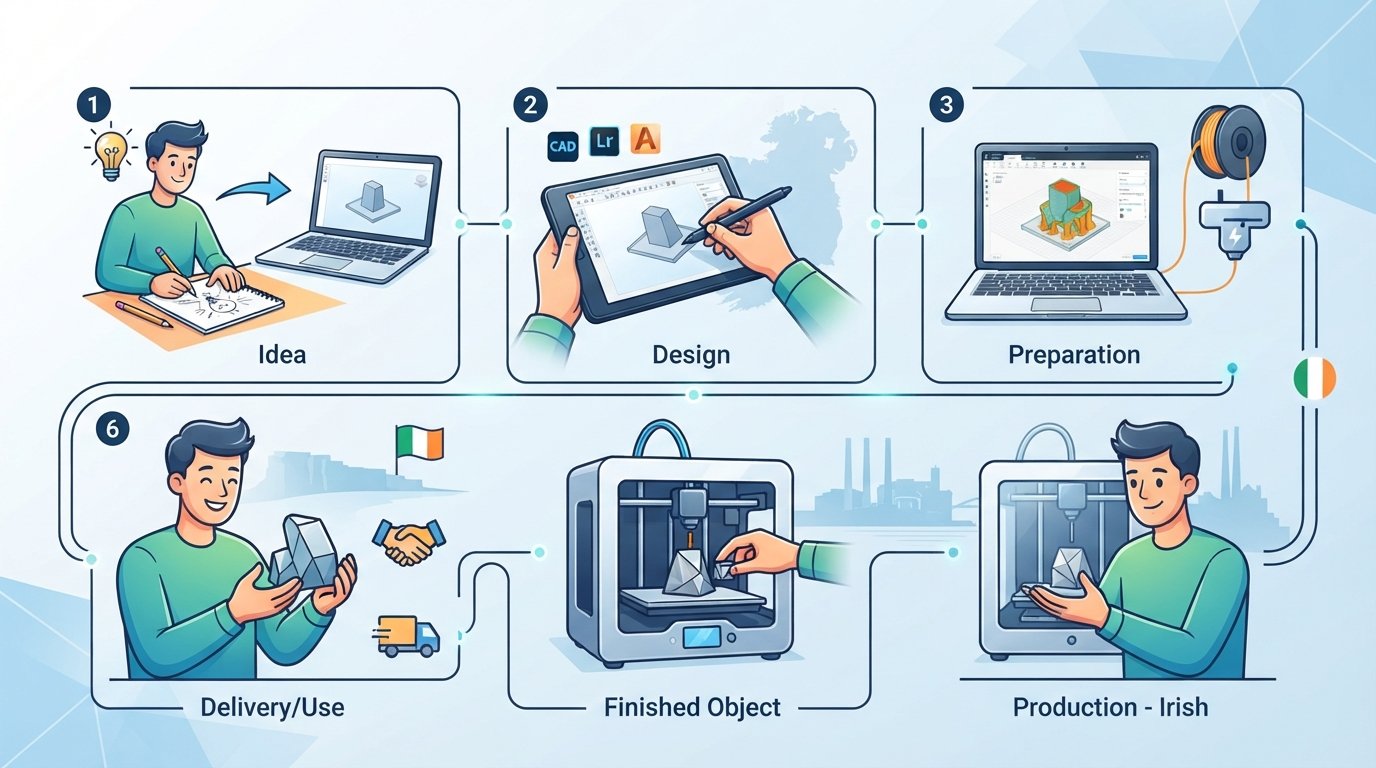
This comprehensive guide will walk you through the entire process of getting your custom 3D print made in Ireland, from the initial spark of an idea to holding the finished object in your hands. We'll demystify each step, covering everything from concept development and digital design to material selection, finding a reliable service provider like PrintIn3D.ie, and understanding what makes a successful print. Whether you're a budding entrepreneur, a passionate hobbyist, or a business looking for rapid prototyping solutions, mastering this journey will unlock a world of creative and practical applications. Get ready to bring your 3D dreams to life with expert guidance and hassle-free custom 3D printing services.
Who This Is For
- Individuals with a unique idea for a physical object.
- Entrepreneurs and startups needing prototypes or small-batch manufacturing.
- Designers and engineers requiring custom parts or models.
- Hobbyists and makers without access to their own 3D printer.
- Businesses seeking on-demand manufacturing solutions in Ireland or beyond.
- Anyone looking for 3d prentun eftir pöntun or 3d prentunarþjónusta in Iceland.
Step 1: From Concept to Clear Vision – Defining Your Idea
Every successful custom 3D print begins with a well-defined idea. This initial phase is crucial because it sets the foundation for all subsequent steps, from design to material selection. Don't rush it; take the time to fully articulate what you want to create, what purpose it will serve, and any specific requirements it might have. A clear vision at this stage saves time and resources later on.
Start by asking yourself key questions about your object. What is its function? How big does it need to be? What kind of forces will it endure? Will it be exposed to heat, water, or chemicals? Is aesthetics paramount, or is pure functionality the goal? Sketching your idea, even crudely, can help solidify your thoughts and communicate them more effectively to a designer or 3D printing service.
- Identify the Purpose: Is it a functional part, a decorative item, a prototype, a gift, or an educational model?
- Outline Key Features: List all essential dimensions, features, and desired characteristics. Think about moving parts, connection points, or specific textures.
- Consider the Environment: Where will the object be used? Indoors, outdoors? Will it come into contact with food, skin, or other sensitive materials?
- Sketch Your Idea: Visualizing your concept, even with simple drawings, helps clarify your vision and can be a valuable reference for designers. Include dimensions if possible.
- Gather Reference Images: If your idea is similar to existing objects, collect images that demonstrate the style, size, or functionality you envision.
Tip: Think about existing constraints early. For example, if your object needs to fit into a specific space, measure that space precisely. If it needs to connect with another part, consider how that connection will be made and what tolerances are required.
Step 2: Designing Your 3D Model – Creating a Digital File
Once your idea is clearly defined, the next step is to translate it into a digital 3D model. This digital file is the blueprint that a 3D printer reads to create your physical object. There are several paths you can take to obtain this crucial file, depending on your skills, resources, and the complexity of your design.
For those new to 3D design, free and user-friendly software like Tinkercad can be a great starting point for simple objects. More advanced users might opt for professional CAD software such as Fusion 360, SolidWorks, or Blender. If designing isn't your strong suit, don't worry; professional services can help. PrintIn3D.ie, for example, offers 3D design services to turn your sketches or concepts into print-ready models, taking the hassle out of the design phase. Alternatively, if you have a physical object you wish to replicate or modify, 3D scanning is an excellent solution for digitizing existing parts. You can learn more about this at 3D Scanning in Ireland: How It Works.
- Design It Yourself:
- Use CAD (Computer-Aided Design) software (e.g., Fusion 360, SolidWorks for functional parts) or 3D sculpting software (e.g., Blender, ZBrush for organic shapes).
- Ensure your design is "manifold" (watertight, no holes) and has appropriate wall thicknesses for 3D printing.
- Export your model in a common 3D printing file format like STL (.stl) or OBJ (.obj).
- Hire a Professional 3D Designer:
- Provide your detailed sketches, reference images, and specifications to an expert designer.
- Collaborate closely, reviewing iterations to ensure the design matches your vision.
- This is often the best option for complex, precision-demanding, or highly aesthetic designs.
- Utilize 3D Scanning:
- If you have an existing physical object you want to reproduce or modify, 3D scanning can create a digital model.
- A 3D scanning service will capture the geometry of your object, generating a point cloud or mesh that can then be converted into a printable file.
- This is ideal for reverse engineering, replication, or archiving physical artifacts.
- Download Existing Models:
- For generic parts or popular items, platforms like Thingiverse, MyMiniFactory, or Cults3D offer a vast library of free and paid 3D models.
- Always check licensing and ensure the model is suitable for your specific needs.
Warning: Poorly designed models can lead to print failures, increased costs, or parts that don't function as intended. If in doubt, consult with a professional 3D printing service's design team.
Step 3: Choosing the Right Materials & Finishes for Your Custom Print
The material you choose is as critical as the design itself, directly impacting the object's strength, flexibility, appearance, and suitability for its intended application. Different 3D printing filaments possess unique properties, making them ideal for specific uses. Understanding these differences is key to a successful custom 3D print. At PrintIn3D.ie, we stock a range of high-quality 3D printer filaments from trusted brands like Bambu Lab and SUNLU, including popular choices like PLA and PETG.
Consider the environment your object will inhabit: will it be exposed to sunlight, water, or chemicals? Does it need to withstand impacts, be flexible, or maintain rigid precision? Each material has its strengths and weaknesses. For instance, PLA is generally good for visual models, while PETG offers more durability and temperature resistance. Think about the desired aesthetic too – some materials offer a matte finish, others glossy, and colours can significantly alter the final look.
- PLA (Polylactic Acid):
- Pros: Easy to print, biodegradable, wide range of colours, good for aesthetic parts and prototypes.
- Cons: Brittle, low heat resistance (deforms around 60°C), not suitable for outdoor use or high-stress applications.
- Ideal For: Decorative items, toys, low-stress prototypes, architectural models.
- PETG (Polyethylene Terephthalate Glycol):
- Pros: Strong, durable, good layer adhesion, food-safe options, higher temperature resistance than PLA, good chemical resistance.
- Cons: Can be stringy during printing, slightly more challenging to work with than PLA.
- Ideal For: Functional parts, mechanical components, outdoor use, containers, cases (like the Agami River Monitoring Boat PETG case study).
- TPU (Thermoplastic Polyurethane):
- Pros: Flexible, rubber-like, excellent impact resistance, good abrasion resistance.
- Cons: Can be challenging to print due to flexibility, slower print speeds.
- Ideal For: Gaskets, phone cases, wearables, flexible prototypes, vibration dampeners.
- ABS (Acrylonitrile Butadiene Styrene):
- Pros: Strong, tough, good heat resistance, commonly used in consumer products.
- Cons: Prone to warping (requires heated bed), emits fumes, can be difficult to print cleanly.
- Ideal For: Automotive parts, electronic housings, functional prototypes.
- Specialty Filaments:
- Wood/Metal Composites: PLA mixed with wood or metal particles for aesthetic finishes.
- Carbon Fibre/Glass Fibre Reinforced: For extremely strong and rigid parts.
- Silk/Glitter PLA: For unique visual effects.
Tip: If you're unsure which material is best, describe your object's intended use and environment to your 3D printing service. Their experts can recommend the most suitable filament. Always factor in post-processing needs; some materials are easier to paint, sand, or finish than others.
Step 4: Finding a Reliable 3D Printing Service in Ireland
With your digital 3D model ready and a material in mind, the next crucial step is selecting the right 3D printing service. In Ireland, the demand for accessible and professional 3D printing solutions is growing, and finding a local partner is beneficial for communication, turnaround times, and support. A top-tier service will not only execute your print but also offer expert advice throughout the process, providing true 3d prentunarþjónusta reykjavík or wherever you are in the EU/EEA.
When searching for a service, look for providers that emphasize quality, customer support, and a transparent process. Awards and positive customer reviews are strong indicators of reliability and excellence. For instance, PrintIn3D.ie, recognized as a 'Rising Star' at the Irish Print Awards 2026, exemplifies these qualities, offering bespoke printing, design, and scanning services. They are committed to being your 3D printing partner, ensuring a hassle-free experience whether you want to prenta 3d hlut in Ireland or need 3d printing ísland services.
- Look for Local Expertise: Prioritize services based in Ireland for quicker delivery and direct communication. However, ensure they also serve the wider EU/EEA if you're located elsewhere, for example, if you're seeking 3d prentun ísland.
- Check for Service Range: Does the provider offer only printing, or do they also provide 3D design and scanning services? A comprehensive service can be a huge advantage.
- Review Material Options: Ensure they offer the materials you need or can guide you to suitable alternatives.
- Evaluate Customer Support: Look for responsive communication channels (e.g., WhatsApp support) and a willingness to offer advice.
- Read Testimonials and Awards: Positive feedback and industry recognition (like PrintIn3D.ie's 'Rising Star' award) speak volumes about a company's reliability and quality.
- Ask About Turnaround Times: Understand their typical lead times for custom prints and whether they offer expedited options.
- Inquire About NDAs: If your project is confidential, ensure the service offers Non-Disclosure Agreements to protect your intellectual property.
- Verify Return Policies: A risk-free return policy (like PrintIn3D.ie's 30-day policy) demonstrates confidence in their service and products.
Tip: Don't hesitate to contact multiple services for quotes and to gauge their responsiveness and helpfulness. A good service will be happy to answer your questions and guide you.
Step 5: Preparing Your File for Professional Printing
Even with a perfectly designed 3D model, proper file preparation is paramount for a smooth and successful printing process. Professional 3D printing services rely on specific file formats and require models to meet certain criteria to ensure printability and accuracy. Neglecting this step can lead to delays, errors, or additional costs.
Typically, the most common file formats for 3D printing are STL (.stl) and OBJ (.obj). These formats define the geometry of your object using a mesh of triangles. Before submitting your file, it's good practice to perform some basic checks yourself or ensure your chosen service offers a file validation step. This ensures that your digital model translates flawlessly into a physical object, whether you're in Dublin, Wexford, or seeking 3d prentun reykjavík.
- Choose the Right File Format:
- STL (.stl): The most widely accepted format. It describes the surface geometry of a 3D object using a mesh of triangles. Ensure it's exported in binary format for smaller file sizes.
- OBJ (.obj): Also common, can store colour and texture information, though often only geometry is used for FDM printing.
- Other Formats: Some services might accept STEP, IGES, or 3MF, especially for complex designs or assemblies, but STL is usually the safest bet.
- Check for Manifold (Watertight) Geometry:
- A 3D model must be "watertight" or "manifold," meaning it has no holes or gaps in its surface. Every edge must be shared by exactly two faces. Non-manifold edges can cause printing issues.
- Verify Wall Thickness:
- Ensure all walls and features have sufficient thickness for the chosen material and printing technology. Too thin, and they might not print or will be extremely fragile.
- Minimum wall thickness often varies by material and printer, but generally aim for at least 0.8mm-1.5mm.
- Correct Scale and Units:
- Export your model in the correct scale (e.g., millimeters, inches). Confirm the units with your 3D printing service to avoid unexpected size differences.
- Orient Your Model:
- For some projects, orienting the model to minimize support structures or optimize print quality can be beneficial. Discuss this with your service provider.
- Remove Internal Intersections:
- Ensure no parts of your model intersect themselves or other components within the same file unless intended (e.g., for specific assembly methods).
Warning: Never submit files with open edges, inverted normals, or self-intersecting meshes. These are common issues that cause print failures and require extensive repair, which can incur additional costs or delays from the service provider.
Step 6: Getting a Quote & Placing Your Custom 3D Print Order
Once your digital 3D model is perfect and you've chosen a reliable service, the next step is to obtain a quote and place your order. This phase involves clearly communicating your project requirements to the service provider, ensuring that all details are captured for an accurate price and production plan. Most professional 3D printing services, including PrintIn3D.ie, offer an online quotation system for convenience.
When submitting your request, provide as much detail as possible. This includes the chosen material, desired colour, any specific finish requirements, and the quantity of parts you need. Transparency at this stage ensures that there are no surprises down the line, and you receive an accurate estimate for your custom 3D printing service. Remember, a good service will provide a clear breakdown of costs and estimated turnaround times.
- Upload Your 3D Model:
- Use the service provider's online platform to upload your STL or OBJ file. Many services have an instant quoting tool that analyzes your model.
- Specify Material and Colour:
- Select the desired filament type (e.g., PLA, PETG, TPU) and the exact colour from their available options.
- Indicate Quantity:
- Clearly state how many copies of the object you need. Volume discounts are often available for larger orders.
- Choose Print Quality/Infill:
- Depending on the service, you might be able to specify print resolution (e.g., layer height) and infill density (how solid the inside of the print is). Higher resolution means smoother surfaces but longer print times; higher infill means stronger parts but uses more material and time.
- Add Special Instructions:
- If your project has unique requirements (e.g., specific orientation, post-processing needs like sanding or painting, assembly requirements), include these in the notes section.
- Review the Quote:
- Carefully examine the detailed quote, checking the cost per part, total price, estimated production time, and shipping fees. Ensure all your specifications are correctly reflected.
- Confirm and Place Order:
- Once you're satisfied with the quote, proceed to payment and confirm your order. You'll typically receive an order confirmation with tracking information.
Tip: If the quote seems unusually high or low, ask for clarification. A reputable service will be transparent about their pricing structure. Also, always inquire about their shortest turnaround times, such as PrintIn3D.ie's 8-hour, 12-hour, or 24-hour custom printing service for urgent projects.
Step 7: Reviewing and Approving Your Print (For Prototypes/Complex Projects)
For highly critical projects, complex functional prototypes, or large-batch manufacturing, an interim review and approval stage can be invaluable. While not always necessary for simple items, having a checkpoint after the first prototype is printed can prevent costly errors and ensure the final product meets your exact expectations. This is particularly important when iterating on a design or producing a custom 3D print for the first time.
This phase allows you to physically inspect the first print, test its functionality, and make any necessary adjustments to the design or material before full production. It's an opportunity to catch subtle issues that might not be apparent in a digital model, such as tolerances, fitment, or ergonomic considerations. A good 3D printing partner will facilitate this review process, offering insights and adapting to your feedback to refine your print 3D model 3D printing output.
- Request a Prototype:
- For new or complex designs, consider ordering a single prototype first, even if you plan for a larger batch.
- This allows for a real-world assessment before committing to mass production.
- Thoroughly Inspect the Print:
- Examine the prototype for any visual defects, surface finish quality, and dimensional accuracy. Use calipers if precision is critical.
- Check for layer lines, warping, stringing, or any signs of print quality issues.
- Test Functionality:
- If your object has a specific function (e.g., fits another part, holds weight, moves), test it rigorously in its intended environment.
- Verify fit and assembly with mating parts, if applicable.
- Provide Detailed Feedback:
- Communicate any required changes or observations to your 3D printing service. Be specific about what needs to be altered in the design or printing parameters.
- Consider photos or videos to illustrate points effectively.
- Approve for Production:
- Once you are completely satisfied with the prototype and any revisions, give formal approval for the service to proceed with the full order.
Warning: Skipping the prototype review for critical parts can lead to costly rework or a batch of unusable items. Invest the time upfront to save resources later.
Step 8: Receiving Your Custom 3D Print and Final Checks
The final step in the process is receiving your custom 3D print. This is the exciting moment when your idea finally comes to life in a tangible form! Professional services like PrintIn3D.ie pride themselves on fast turnaround times and reliable delivery across Ireland and the EU/EEA, ensuring your custom items reach you promptly and in perfect condition. For instance, filament orders typically see same-day dispatch before 4 PM, with 2 working days for Ireland and 5-7 for Europe, reflecting their commitment to efficiency.
Upon arrival, it's essential to conduct a final inspection to ensure everything meets your expectations and the specifications agreed upon. Even with the most meticulous process, a quick check guarantees that your journey from idea to object has been a complete success. This step is particularly important for those who need 3d prentun eftir pöntun for specific projects, as the final quality is paramount.
- Unpack Carefully:
- Open your package with care, especially if the print is delicate or has intricate features.
- Check for proper packaging that protects the print during transit.
- Conduct a Visual Inspection:
- Examine the entire surface of your print for any signs of damage during shipping, such as cracks, breaks, or excessive scratching.
- Look for consistency in colour and finish, and ensure there are no obvious printing errors (e.g., missing layers, significant warping).
- Verify Dimensions:
- If dimensional accuracy is crucial, use calipers or other measuring tools to confirm the key measurements of your print against your original design.
- Test Fit and Functionality (Again):
- Perform any necessary fitment tests with other parts or in its intended application.
- Verify that all functional aspects work as expected.
- Post-Processing (If Applicable):
- If you planned for any post-processing steps like sanding, painting, or assembly, you can now proceed with these.
- Some prints may arrive with minor support material still attached, which can usually be easily removed.
- Provide Feedback:
- If you're completely satisfied, consider leaving a positive review. If there are any issues, contact the service provider immediately to discuss solutions, leveraging their customer support and return policies.
Tip: Keep all packaging until you've fully inspected and are satisfied with your custom 3D print. This is important in case a return or claim for damage during shipping is necessary.
Common Mistakes to Avoid When Getting a Custom 3D Print
While the process of getting a custom 3D print made in Ireland has become remarkably streamlined, there are common pitfalls that can lead to frustration, delays, or a less-than-ideal final product. Being aware of these mistakes can help you navigate the process more smoothly and achieve the best possible results for your 3d prentunarþjónusta needs.
- Insufficiently Defined Idea: Rushing the initial concept phase leads to vague designs, costly revisions, and prints that don't quite meet expectations. Spend time clarifying your vision.
- Poor File Preparation: Submitting non-manifold models, files with insufficient wall thickness, or incorrect scaling is a frequent cause of print failures and requires extra work from the service provider, often incurring additional charges.
- Ignoring Material Properties: Choosing a material based solely on colour or price without considering its mechanical properties (strength, flexibility, heat resistance) for the intended application can result in a fragile or unsuitable part.
- Not Communicating Clearly: Failing to provide detailed instructions or specific requirements to the 3D printing service can lead to misunderstandings and prints that don't align with your vision.
- Overlooking Post-Processing Needs: Assuming a print will be perfectly smooth or ready for immediate use straight off the printer can be a mistake. Factor in any sanding, painting, or assembly steps.
- Choosing the Cheapest Service Only: While cost is a factor, prioritizing the absolute cheapest option over quality, reliability, and customer support can lead to poor print quality, missed deadlines, or a frustrating experience.
- Not Utilizing Prototyping: For complex or critical parts, skipping a prototype review can mean committing to a large batch of items that have unnoticed flaws, costing more in the long run.
- Disregarding Confidentiality: For sensitive projects, neglecting to inquire about Non-Disclosure Agreements (NDAs) can expose your intellectual property. Always confirm a service's commitment to confidentiality.
- Underestimating Turnaround Times: While fast services exist (like PrintIn3D.ie's express options), not factoring in design time, potential revisions, and shipping can lead to tight deadlines being missed.
Frequently Asked Questions About Custom 3D Printing in Ireland
What is the typical cost for a custom 3D print in Ireland?
The cost of a custom 3D print varies significantly based on several factors: the complexity and size of your 3D model, the material chosen (e.g., PLA is generally cheaper than PETG or specialty filaments), the print quality (layer height/infill), and the quantity of parts. Services like PrintIn3D.ie often provide instant online quotes when you upload your 3D file, allowing you to get a precise estimate based on your specific requirements. Simpler, smaller prints can be quite affordable, while intricate, large, or high-strength parts will naturally cost more.
How long does it take to get a custom 3D print made?
Turnaround times depend on the service provider, the complexity and size of your model, and the chosen material. Generally, standard custom prints can take anywhere from a few days to a week for production, plus shipping time. Many services, including PrintIn3D.ie, offer expedited options for urgent projects, such as 8-hour, 12-hour, or 24-hour printing services, followed by fast delivery across Ireland and the EU/EEA. Always confirm the estimated lead time with your chosen service provider.
What file formats are accepted for 3D printing?
The most commonly accepted file formats for 3D printing are STL (.stl) and OBJ (.obj). These formats accurately represent the geometry of your 3D model. Some services may also accept other CAD formats like STEP, IGES, or 3MF, especially for engineering or more complex projects. It's always best to check the specific requirements of your chosen 3D printing service, but having your design ready as a watertight STL file is generally the safest approach.
Can I get a custom 3D design if I only have a sketch or an idea?
Absolutely! Many 3D printing services, including PrintIn3D.ie, offer comprehensive 3D design services. You can provide them with sketches, detailed descriptions, reference images, or even a physical object (for 3D scanning), and their expert designers will transform your concept into a print-ready 3D model. This is an ideal solution for individuals and businesses without in-house design capabilities, making custom 3D printing truly accessible from just an idea.
What if my custom 3D print doesn't turn out as expected?
Reputable 3D printing services prioritize customer satisfaction. If your custom 3D print doesn't meet the agreed-upon specifications or arrives damaged, you should contact the service provider immediately. PrintIn3D.ie, for example, offers a 30-Day Risk-Free Return policy, which includes original and return shipping, demonstrating their commitment to quality and customer care. Be prepared to provide photos or detailed descriptions of the issue to facilitate a quick resolution, which may include a reprint or a refund.
Next Steps: Bring Your Ideas to Life with PrintIn3D.ie
Your journey from a brilliant idea to a tangible 3D object doesn't have to be complicated. With this guide, you now have the knowledge to confidently navigate the world of custom 3D printing in Ireland. Whether you're ready to upload a file, need help with 3D design, or want to explore 3d prentun reykjavík or elsewhere, PrintIn3D.ie is your trusted partner. Visit PrintIn3D.ie today and let's turn your 3D dreams into reality, hassle-free!