Rapid Prototyping Service GB: Your Complete UK Guide
Introduction: Accelerate Your Innovation with Rapid Prototyping in GB
In today's fast-paced market, getting your ideas from concept to reality quickly and efficiently is paramount for success. For businesses and innovators across the UK, from the bustling hubs of London and Birmingham to the innovative centres in Scotland, rapid prototyping service GB has emerged as a game-changer. This revolutionary approach allows you to swiftly create physical models of your designs, test their functionality, and gather crucial feedback long before committing to costly mass production.
Whether you're a startup looking to validate a new product, a small business aiming to refine an existing component, or an established enterprise exploring innovative solutions, understanding the power of rapid prototyping is essential. This comprehensive guide will walk you through everything you need to know about utilising rapid prototyping services in GB. We'll demystify the process, highlight key considerations, and show you how to leverage these services to accelerate your product development, reduce costs, and stay ahead of the competition. Get ready to transform your 3D dreams into tangible reality with ease and expertise.
Who This Is For:
- Entrepreneurs and startups needing to validate product concepts quickly.
- Engineers and product developers seeking efficient ways to test designs.
- Small to medium-sized businesses (SMEs) looking to streamline their R&D processes.
- Designers requiring physical models for presentations or user testing.
- Anyone in the UK needing custom 3d printed parts UK for proof-of-concept or low-volume production.
- Students and academics working on innovative projects requiring physical prototypes.
Step 1: Understanding Rapid Prototyping & Its Benefits for GB Businesses
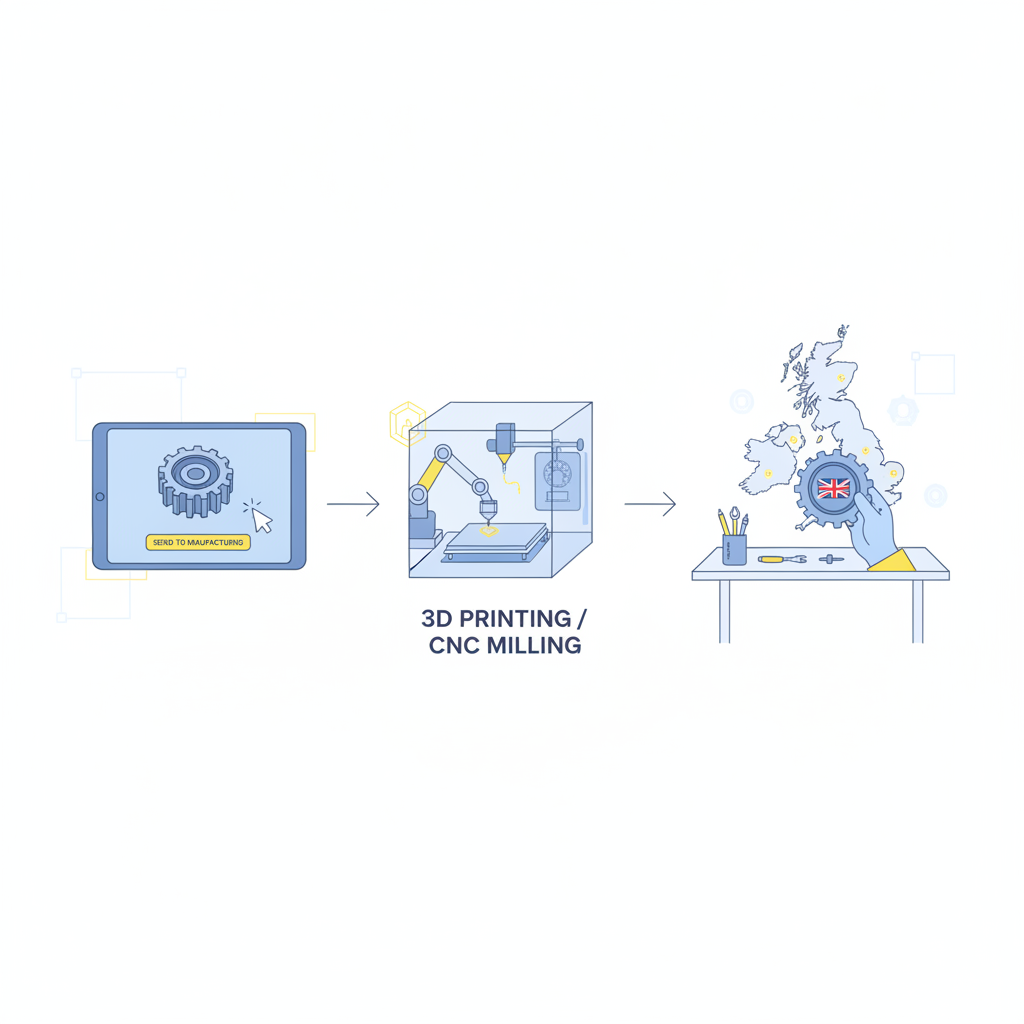
Rapid prototyping is a group of techniques used to quickly fabricate a scale model of a physical part or assembly using three-dimensional computer-aided design (CAD) data. Essentially, it's about bringing your digital designs into the physical world at speed. While traditional manufacturing methods can take weeks or months to produce a prototype, modern rapid prototyping, primarily driven by 3D printing service GB, can deliver functional models in days, or even hours.
For businesses in the United Kingdom, embracing rapid prototyping offers a multitude of competitive advantages. It's not just about speed; it's about smart, iterative development that saves time and money in the long run. By quickly producing physical prototypes, you can test theories, identify design flaws, and gather user feedback much earlier in the development cycle. This agility significantly reduces the risk of costly rework down the line and ensures your final product is robust and market-ready.
- Accelerated Time-to-Market: Quickly create and test prototypes, slashing development cycles and bringing products to market faster than competitors.
- Cost Reduction: Identify and rectify design errors early, preventing expensive retooling and material waste during mass production. Get an accurate 3d printing price uk upfront.
- Enhanced Design Iteration: Easily make design changes and produce new prototypes for continuous refinement, leading to a superior final product.
- Improved Communication & Validation: Provide tangible models for stakeholders, investors, and potential customers, facilitating clearer communication and faster validation.
- Functional Testing: Create functional prototypes to perform real-world stress tests, fit checks, and assembly evaluations.
- Customisation and Complexity: Produce complex geometries and intricate designs that would be difficult or impossible with traditional manufacturing methods.
Tip: Think beyond just visual models. Rapid prototyping allows for functional prototypes that can be tested under realistic conditions, providing invaluable data for design improvements. Consider a dedicated 3D printing for product prototyping UK guide to explore this further.
Step 2: Defining Your Prototype Requirements
Before you even think about engaging a rapid prototyping service GB, it's crucial to clearly define what you need your prototype to achieve. A well-defined set of requirements will guide the entire process, from material selection to the type of 3D printing technology used, ultimately ensuring your prototype effectively serves its purpose.
Start by outlining the primary function of your prototype. Is it purely for visual presentation? Does it need to be a functional part that withstands stress or heat? Will it interact with other components? The answers to these questions will dictate the precision, strength, and material properties required. Next, consider the environmental conditions your prototype will encounter – exposure to moisture, UV light, chemicals, or specific temperatures. These factors are critical for selecting the right 3d printing service gb filament uk.
- Clarify the Prototype's Purpose:
- Is it a visual model (form, aesthetics)?
- Is it a functional prototype (testing movement, assembly, strength)?
- Is it a proof-of-concept to demonstrate an idea?
- Is it for user testing or market research?
- Specify Key Performance Indicators (KPIs):
- What level of dimensional accuracy is needed? (e.g., +/- 0.1mm)
- What are the required mechanical properties (e.g., tensile strength, flexibility, impact resistance)?
- Are there any thermal or chemical resistance requirements?
- What surface finish is acceptable or desired?
- Determine Critical Dimensions and Tolerances:
- Highlight any areas where precise measurements are crucial for fit or function.
- Understand that 3D printing has inherent tolerances, so communicate your needs clearly.
- Consider Post-Processing Needs:
- Will the prototype need sanding, painting, drilling, or assembly with other components?
- Factor this into your material choice and design.
Warning: Vague requirements can lead to prototypes that don't meet expectations, causing delays and additional costs. Be as specific as possible about what your prototype needs to do and endure.
Step 3: Creating or Sourcing Your 3D Design File
The foundation of any successful rapid prototyping service GB project is a high-quality 3D design file. This digital blueprint contains all the information needed for a 3D printer to accurately reproduce your object layer by layer. Without a precise and well-prepared 3D model, even the most advanced 3D printing technology can't deliver the desired results. Most 3D printing services, including ours, accept common file formats like STL, OBJ, and STEP.
If you already have a 3D design ready, ensure it's fully optimised for 3D printing. This means checking for common issues like non-manifold edges, inverted normals, or self-intersecting geometries, which can cause printing errors. Many CAD software packages have tools to perform these checks. If you're starting from scratch or need assistance, there are several pathways to obtaining a print-ready file. For complex parts or reverse engineering, consider professional 3D design services or 3d scanning for reverse engineering.
- Design it Yourself with CAD Software:
- Utilise professional CAD software (e.g., SolidWorks, Fusion 360, AutoCAD) or free/open-source tools (e.g., Tinkercad, FreeCAD) if you have the expertise.
- Focus on creating a solid, watertight model without open edges or overlapping geometries.
- Ensure all features are appropriately sized for the chosen printing technology and material.
- Hire a Professional 3D Designer:
- If you have a concept, sketch, or 2D drawing but lack CAD skills, a professional 3D designer can transform your ideas into a print-ready file.
- Services like PrintIn3D.ie offer expert 3D design to convert your concepts into precise 3D models.
- Utilise 3D Scanning:
- For existing physical objects that need to be replicated or modified, 3D scanning can create a digital model.
- This is particularly useful for 3d scanning for reverse engineering, allowing you to create replacement parts or improve existing designs.
- Download Existing Models:
- For non-commercial or hobby projects, platforms like Thingiverse, MyMiniFactory, or Cults3D offer a vast library of downloadable 3D models.
- Always check licensing agreements if you intend to use these for commercial purposes.
- Prepare Your File for Printing:
- Once your 3D model is created or sourced, export it in a common 3D printing format, such as STL (Standard Tessellation Language) or OBJ.
- Ensure the model's scale and orientation are correct.
Tip: If you're unsure about your file's readiness, most reputable 3D printing service GB providers will offer a file review service before printing. Don't hesitate to ask for this, as it can prevent costly reprints.
Step 4: Choosing the Right Rapid Prototyping Service in GB
With your design file ready and requirements clear, the next critical step is selecting the best rapid prototyping service GB for your project. The UK market offers various options, from local bureaus to online platforms, each with its own strengths. The right choice depends on your project's complexity, budget, turnaround time needs, and desired level of support.
When evaluating providers, consider their experience, the range of technologies and materials they offer, their reputation for quality, and their customer service. A reliable service will not only print your model but also offer advice on material selection, design optimisation, and post-processing. For businesses in key regions, finding a dedicated 3d printing service birmingham uk or 3d printing service scotland uk can provide localised support and faster delivery, though national services like PrintIn3D.ie often offer competitive advantages across the whole of GB.
- Evaluate Service Provider Expertise:
- Look for companies with proven experience in rapid prototyping and a strong portfolio of completed projects.
- Check reviews and testimonials to gauge customer satisfaction (e.g., PrintIn3D reviews).
- Consider Technology and Material Offerings:
- Ensure the service offers the 3D printing technologies (e.g., FDM, SLA, SLS) and materials (e.g., PLA, PETG, abs filament uk) suitable for your prototype's requirements.
- A wider range provides more flexibility for complex projects.
- Assess Turnaround Times and Delivery Options:
- For rapid prototyping, speed is key. Inquire about typical lead times for printing and shipping.
- Services like PrintIn3D offer various turnaround options, from standard to expedited.
- Compare Pricing and Quoting Process:
- Obtain quotes from multiple providers to understand the market 3d printing price uk.
- Look for transparent pricing models and easy-to-use online quoting tools.
- Customer Support and Communication:
- A responsive and helpful customer support team can be invaluable, especially for complex or time-sensitive projects.
- Look for services that offer clear communication channels (e.g., WhatsApp support).
- Local vs. Online Services:
- While local services might offer face-to-face interaction, online services like PrintIn3D often provide broader material choices, competitive pricing, and faster processing due to centralised operations. We serve the entire UK, offering a reliable custom 3d printing service uk.
Tip: Don't just go for the cheapest option. A slightly higher 3d printing price uk often reflects better material quality, advanced technology, and superior customer support, which can save you money in the long run by avoiding reprints.
Step 5: Selecting the Optimal Material for Your 3D Printed Parts UK
The material you choose for your 3d printed parts UK is as crucial as the design itself, directly impacting the prototype's functionality, durability, and appearance. Different 3d printing service gb filament uk options offer unique properties tailored to specific applications. Understanding these differences is key to making an informed decision that aligns with your prototype's requirements.
Common rapid prototyping materials include PLA, PETG, and ABS, each with distinct advantages. PLA (Polylactic Acid) is popular for its ease of printing and biodegradability, making it suitable for visual models and simple functional prototypes. PETG (Polyethylene Terephthalate Glycol) offers a good balance of strength, flexibility, and chemical resistance, ideal for parts requiring more durability. ABS filament uk (Acrylonitrile Butadiene Styrene) is known for its strength, toughness, and heat resistance, making it suitable for more demanding applications. PrintIn3D offers a wide range of these high-quality filaments, including Bambu Lab PLA and SUNLU PETG.
- PLA (Polylactic Acid):
- Pros: Easy to print, low warp, good for aesthetic models, biodegradable, wide range of colours.
- Cons: Lower temperature resistance, can be brittle.
- Best For: Visual prototypes, fit-testing parts, concept models, educational projects.
- PETG (Polyethylene Terephthalate Glycol):
- Pros: Good strength and flexibility, chemical resistance, low warp, food-safe options.
- Cons: Can be stringy during printing, requires higher printing temperatures than PLA.
- Best For: Functional prototypes, enclosures, mechanical parts with moderate stress, items needing some flexibility.
- ABS (Acrylonitrile Butadiene Styrene):
- Pros: High strength and toughness, heat resistant, good for post-processing (sanding, painting).
- Cons: Prone to warping without an enclosed printer, emits fumes (requires ventilation).
- Best For: Durable functional prototypes, end-use parts, components exposed to higher temperatures or impact.
- Other Speciality Filaments:
- TPU (Thermoplastic Polyurethane): For flexible, rubber-like parts.
- Nylon: High strength, wear resistance, often used for gears and structural components.
- PC (Polycarbonate): Extremely strong, impact-resistant, high-temperature applications.
- Composites: Filaments infused with carbon fibre or glass fibre for enhanced strength and stiffness.
Warning: Always ensure the chosen material meets the functional and environmental requirements of your prototype. Selecting the wrong material can lead to failure during testing and negate the benefits of rapid prototyping.
Step 6: Getting an Instant Online Quote and Placing Your Order
Once you've defined your prototype's requirements, finalised your 3D design file, and chosen a reliable rapid prototyping service GB like PrintIn3D, the next step is to obtain a quote and place your order. This process is designed to be streamlined and user-friendly, allowing you to quickly get an estimate and initiate production for your 3d prototype printing needs.
Most modern 3D printing services offer instant online quoting tools. You simply upload your 3D model, select your desired material, colour, print quality, and any post-processing options. The system then calculates the estimated 3d printing price uk based on factors like material volume, print time, and chosen service level. PrintIn3D.ie, for example, provides transparent pricing and various turnaround times to suit your project's urgency, including options for faster services like 8-hour, 12-hour, or 24-hour custom 3D printing services.
- Access the Online Quoting Tool:
- Navigate to the service provider's dedicated 3D printing quote page, such as PrintIn3D's print 3d model 3d printing portal.
- Upload Your 3D Model:
- Upload your print-ready file (ideally STL or OBJ format). The system will usually perform an initial check for common errors.
- Configure Your Print Settings:
- Material: Select the material that best suits your prototype's functional and aesthetic needs (e.g., PLA, PETG, abs filament uk).
- Colour: Choose from available colours.
- Infill Density: Determine the internal structure's density, affecting strength and weight.
- Layer Height/Print Quality: Opt for finer layers for smoother surfaces and higher detail, or thicker layers for faster prints and rougher finishes.
- Quantity: Specify how many 3d printed parts UK you need.
- Select Production Speed/Turnaround:
- Choose from standard, express, or super-express options depending on your deadline.
- Review Your Quote:
- The online tool will instantly display the total cost and estimated delivery date. Review all parameters carefully.
- Place Your Order:
- Proceed to checkout, provide shipping details (for 3d printing service gb filament uk delivery), and complete payment.
- You'll typically receive an order confirmation and updates on your project's progress.
Tip: If your project involves multiple parts or a highly complex design, consider breaking it down or reaching out directly to the service for a custom consultation. This can often result in a more optimised and cost-effective solution for 3d printing for small businesses.
Step 7: Reviewing and Iterating Your Prototype
Receiving your 3D printed prototype is an exciting moment, but it's just one step in the iterative design process. The true value of rapid prototyping service GB lies in the ability to quickly review, test, and refine your design based on real-world feedback. This crucial phase allows you to validate your assumptions, identify unforeseen issues, and make informed improvements before moving towards final production.
Thoroughly inspect your prototype against your initial requirements (from Step 2). Does it meet the specified dimensions? Does it fit correctly with other components? Does it perform its intended function? Gather feedback from potential users, engineers, and stakeholders. This feedback loop is what makes rapid prototyping so powerful, enabling you to refine your design through multiple iterations, leading to a much stronger and more robust final product. Remember, a prototype is meant to be tested and improved upon, not necessarily perfect on the first try.
- Perform Initial Visual Inspection:
- Check for overall aesthetics, surface finish, and accuracy of details compared to your 3D model.
- Look for any visible defects, layer lines that are too prominent, or unexpected imperfections.
- Conduct Functional Testing:
- If it's a functional prototype, put it through its paces. Test its moving parts, assembly, and interaction with other components.
- Evaluate its strength, flexibility, or heat resistance based on the material chosen.
- Measure Critical Dimensions:
- Use calipers or other precise measuring tools to verify that critical dimensions and tolerances match your design specifications.
- Gather Feedback:
- Share the prototype with team members, potential users, and stakeholders. Collect their impressions, suggestions, and identify any usability issues.
- Identify Design Flaws and Areas for Improvement:
- Document any issues discovered during inspection or testing. Categorise them by severity and priority.
- Consider what design changes could address these issues.
- Iterate and Re-Print (if necessary):
- Based on the feedback and identified flaws, revise your 3D model.
- Order a new 3d prototype printing through your chosen rapid prototyping service GB for the next iteration.
- Repeat the process until the prototype meets all your requirements.
Tip: Don't be afraid to make significant changes between iterations. The whole point of rapid prototyping is to allow for agile development. Embrace the opportunity to perfect your design without the high costs associated with traditional manufacturing changes.
Common Mistakes to Avoid in Rapid Prototyping
While rapid prototyping service GB offers immense advantages, certain pitfalls can derail your project if not carefully avoided. Being aware of these common mistakes can save you time, money, and frustration, ensuring a smoother and more successful prototyping journey for your 3d printed parts UK.
- Skipping Clear Requirements Definition: Diving into design or printing without a precise understanding of the prototype's purpose, function, and critical specifications leads to wasted effort and irrelevant results.
- Over-Designing the First Prototype: Trying to make the initial prototype perfect or feature-complete. The first iteration should be about validating core concepts, not every minute detail. Keep it simple and focused.
- Neglecting Material Properties: Choosing a material based solely on price or availability without considering its mechanical, thermal, or chemical properties relative to the prototype's intended use. This often leads to functional failures.
- Poor 3D File Preparation: Uploading a 3D model with errors (e.g., non-manifold geometry, inverted normals, thin walls) can result in failed prints, reduced quality, or unexpected features. Always use validated files for printing 3D models.
- Ignoring Print Orientation & Supports: While many rapid prototyping service GB providers handle this, understanding how your part is oriented during printing and where support structures are needed can impact surface finish, strength, and cost.
- Not Factoring in 3D Printing Price UK & Turnaround: Underestimating the budget or time required, especially for complex parts or multiple iterations. Always get a clear quote and understand lead times.
- Lack of Iteration: Viewing the first prototype as the final product. The power of rapid prototyping lies in its iterative nature – test, gather feedback, refine, and re-print.
- Insufficient Testing: Receiving the prototype and not subjecting it to rigorous functional or user testing. Without proper testing, you miss critical opportunities for improvement.
- Failing to Communicate with Your Service Provider: Not asking questions, clarifying doubts, or providing detailed feedback to your 3D printing service GB can lead to misunderstandings and suboptimal results.
- Overlooking 3D printing for small businesses Scaling Issues: Not considering how the prototype design might translate to mass production, or if the chosen material is viable for larger scale.
FAQ: Your Questions About Rapid Prototyping in GB Answered
What is the typical turnaround time for a rapid prototype in the UK?
Turnaround times for a rapid prototyping service GB can vary significantly based on the complexity of your design, the chosen material, and the service provider's workload. At PrintIn3D, we offer a range of options, from standard delivery to express services that can deliver your 3d prototype printing in as little as 8 hours for smaller parts, or 24-72 hours for more standard projects. We strive for fast delivery across the UK, ensuring your project stays on schedule.
How does the 3d printing price uk for prototyping compare to traditional methods?
The 3d printing price uk for rapid prototyping is generally much lower than traditional manufacturing methods (like injection moulding or CNC machining) for producing single or low-volume prototypes. This is because 3D printing eliminates the need for expensive tooling and setups. While the per-unit cost for mass production might be higher with 3D printing, for initial prototypes and small batches, it offers significant cost savings, especially when factoring in the speed of iteration and reduced risk of design errors. You can get an instant quote on our upload page.
Can rapid prototyping be used for functional 3D printed parts UK?
Absolutely! Modern rapid prototyping service GB techniques, particularly FDM (Fused Deposition Modeling) with materials like PETG, ABS filament UK, Nylon, or even carbon fibre composites, are excellent for creating functional 3d printed parts UK. These materials offer varying degrees of strength, flexibility, and heat resistance, making them suitable for real-world testing and even some end-use applications. It's crucial to select the right material based on the part's intended function and environment.
What file formats do I need to provide for rapid prototyping service GB?
The most common file format accepted by rapid prototyping service GB providers is STL (Standard Tessellation Language). This format is universally supported by 3D printing software. Other widely accepted formats include OBJ and 3MF. If you have a CAD file in formats like STEP, IGES, or SolidWorks (.SLDPRT), many services, including PrintIn3D, can convert them to a print-ready format or assist with 3D design optimization. We recommend providing a watertight, error-free STL file for the fastest and most accurate quoting and printing process.
Is 3d scanning for reverse engineering applicable for prototyping?
Yes, 3d scanning for reverse engineering is incredibly useful in the prototyping process, especially when you need to recreate, modify, or improve an existing physical object for which you don't have a digital design file. By 3D scanning the object, you can create a digital model that can then be modified in CAD software and subsequently used for 3d prototype printing. This is invaluable for replicating old parts, integrating new designs with existing components, or simply getting a starting point for innovation.
Next Steps: Bring Your 3D Dreams to Life with PrintIn3D
Ready to transform your innovative ideas into tangible realities? At PrintIn3D.ie, we are your trusted partner for rapid prototyping service GB, offering expert 3D printing services, comprehensive 3D design assistance, and a wide range of high-quality 3D printer filaments. Upload your 3D model today for an instant quote, or reach out to our friendly team for bespoke support, and let us help you accelerate your product development with ease and precision.