Sketch to 3D Print: Your Guide to Custom Design with PrintIn3D.ie
Introduction: From Doodle to Dimension – Your Ideas, Realised
Have you ever had a brilliant idea for a product, a replacement part, a unique gift, or a functional tool, only to find yourself limited by the inability to bring it to life? Perhaps you've scribbled countless concepts in your notebook, but the leap from a two-dimensional sketch to a tangible, three-dimensional object seems like an insurmountable challenge. You're not alone! Many innovators, hobbyists, and businesses face this exact hurdle, especially if they don't own a 3D printer or possess advanced 3D design software skills.
At PrintIn3D.ie, we believe that your creativity shouldn't be confined to paper. We're here to bridge that gap, offering a seamless and hassle-free solution to transform your hand-drawn sketches and innovative concepts into high-quality, 3D printable models. This comprehensive guide will walk you through every step of the journey, demystifying the process of designing 3d printed objects from your initial drawings. You'll learn exactly how to get a 3d model made, utilising our expert 3D design services right here in Ireland. Whether you're an individual with a unique gadget idea or a business seeking custom prototype manufacturing Ireland, we're your trusted partner in turning imagination into reality. Get ready to unlock the full potential of your designs!
What You'll Need
- Your creative idea, no matter how rough
- Pen and paper, or a digital sketching tool
- A camera or scanner for digitising your sketches
- A clear understanding of your object's purpose and desired features
- An open mind for collaborative design and feedback
Step 1: Conceptualise Your Idea and Initial Sketching
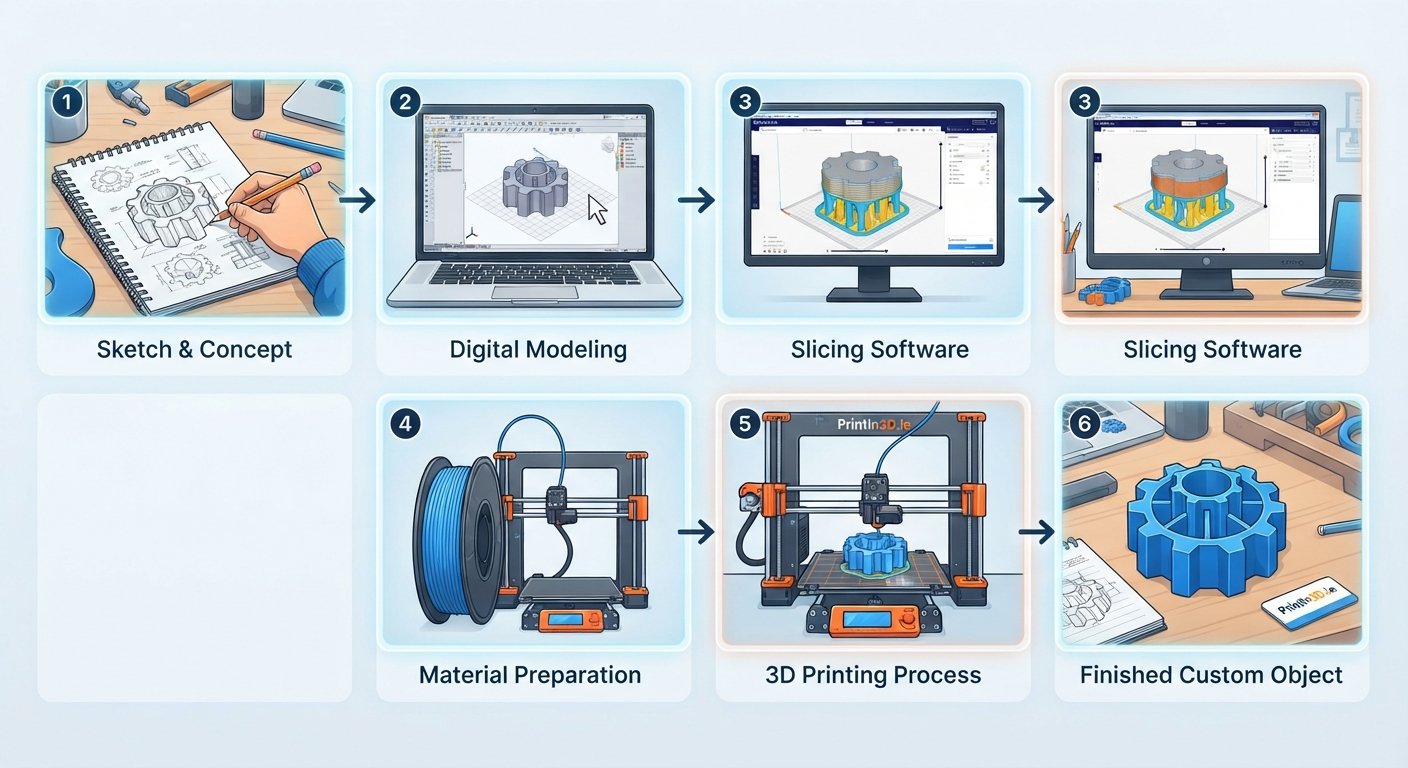
Every great 3D print begins with a great idea. Before you even touch a pencil, take some time to deeply conceptualise what you want to create. What problem does it solve? What function does it serve? Who is it for? The clearer you are on the purpose, the easier it will be to translate that into a tangible design. Don't worry about perfection at this stage; the goal is to get your ideas flowing and onto paper.
Begin by simply sketching out your concept from various angles. Think about the overall form, basic proportions, and how different parts might fit together. Multiple rough sketches are often more helpful than one overly-detailed initial drawing, as they allow you to explore different possibilities and identify potential challenges early on. Remember, this is about exploration, not engineering precision. Focus on communicating the core essence of your idea.
- Brainstorm freely: Jot down all related thoughts, functions, and aesthetic preferences.
- Sketch multiple perspectives: Draw your object from the front, side, top, and even isometric views if you can. This provides a comprehensive visual understanding.
- Focus on form and function: Initially, prioritise the shape and how it works, rather than intricate details.
- Annotate key features: Use arrows and short notes to highlight specific parts or ideas that are crucial to your design.
Tip: Don't be afraid to make 'ugly' sketches. The purpose of these initial drawings is to get ideas out of your head, not to create a masterpiece. The more ideas you explore, the stronger your final concept will be. Consider drawing the object in relation to other objects to give a sense of scale, e.g., next to a hand or a common household item.
Step 2: Refine Your Sketch and Add Key Details
Once you have a solid conceptual foundation, it's time to refine your sketches and inject more specificity. This stage is crucial for clear communication with our 3D product design services Ireland team. The more detail you provide, the more accurately and efficiently we can translate your vision into a digital 3D model. Think of this as the blueprint stage for your idea.
Take your best initial sketches and start adding precise measurements, material considerations, and any mechanical features. If your object needs to fit into another part, measure that part. If it needs to hold a specific item, measure that item. Even approximate dimensions are better than none at all. Clearly label each dimension and any critical tolerances. If there are moving parts or specific assembly requirements, sketch them out and explain their interaction. This level of detail helps our designers understand the exact requirements and constraints of your project, minimising back-and-forth and ensuring a successful outcome for your custom prototype manufacturing Ireland needs.
- Clean up your best sketches: Choose the clearest and most representative drawings from your initial brainstorming.
- Add precise dimensions: Use a ruler and clearly mark lengths, widths, heights, diameters, and radii. Specify units (mm, cm, inches).
- Annotate crucial features: Label specific parts (e.g., "mounting hole," "clip mechanism," "textured grip").
- Indicate tolerances (if critical): If a part needs to fit snugly or loosely, make a note.
- Show internal structures: If your object has internal cavities, channels, or support structures, sketch cross-sections to reveal them.
- Consider functionality: How will the object be used? Add notes on moving parts, assembly methods, or points of stress.
Warning: Ambiguous or missing details in your refined sketches can lead to misunderstandings and require significant revisions during the 3D modelling phase. Take your time at this step to ensure clarity and completeness, as it saves time and resources in the long run.
Step 3: Consider Material and Functionality for 3D Printing
The choice of material and how your object will function are intrinsically linked and play a vital role in the design process. Different 3D printing materials possess unique properties that make them suitable for various applications. Thinking about these aspects early on will inform the structural design and ensure your final product meets its intended purpose. This is where designing 3d printed objects truly comes into its own.
For instance, if your object needs to be rigid and perhaps hold fine detail, PLA filament is an excellent choice for a wide range of applications, from aesthetic models to functional prototypes. If it needs to be more durable, heat-resistant, or suitable for outdoor use, then materials like PETG filament might be better. Flexible objects might require TPU. Consider the environment your object will be in, the forces it might encounter, and any specific requirements like food-safety or chemical resistance. Our team can guide you on the best material for your specific needs, whether you're looking to buy PLA filament Ireland for your own printer or utilise our extensive range for your custom prints.
- Define the object's ultimate purpose: Is it a decorative piece, a functional prototype, a replacement part, or a tool?
- Assess environmental factors: Will it be exposed to heat, cold, UV light, moisture, or chemicals?
- Consider mechanical stress: Does it need to withstand impacts, bending, compression, or tension?
- Research common 3D printing materials: Familiarise yourself with the basic properties of PLA, PETG, ABS, TPU, etc. PrintIn3D.ie primarily uses PLA and PETG for their versatility and strength.
- Note colour preferences: While material properties are key, also indicate any desired colours or finishes.
- Think about assembly: If your object is multi-part, how will it be assembled? Screws, glue, snap-fits?
Tip: Don't feel pressured to be an expert on all materials. Provide our designers with as much information as possible about how the object will be used, and they will recommend the most suitable material and design adjustments. This collaboration ensures your custom 3D printed parts Ireland are robust and fit-for-purpose.
Step 4: Prepare Your Design for Submission to PrintIn3D.ie
Once your sketches are refined and you've considered material and functionality, it's time to consolidate all your information into a package ready for our expert designers. Clear, organised submission is key to an efficient and accurate design process. This step is about making it as easy as possible for our team to understand your vision, moving you closer to getting your 3D model made.
Digitising your sketches is the next logical step. High-quality scans or well-lit photographs of your drawings will ensure that all details, dimensions, and annotations are legible. If you have any additional reference images, mood boards, or even existing physical parts that your design needs to interface with, include those too. Compile all this information into a single document or a clearly labelled folder. Write a brief summary explaining your project's purpose and any critical requirements that might not be immediately obvious from the drawings. The more context you provide, the better our designers can hit the mark on the first attempt, saving you time and potential revision costs.
- Digitise your sketches: Use a scanner or take clear, well-lit photos of your refined drawings. Ensure all text and lines are legible.
- Consolidate all information: Gather all sketches, notes, reference images, and any existing 3D files (if applicable) into one place.
- Write a project brief: Summarise the object's purpose, key features, desired material (if you have a preference), and any critical dimensions or functionalities.
- Highlight priorities: If certain aspects are more important than others (e.g., specific dimensions over aesthetic curves), make that clear.
- Specify desired output: Do you need just the 3D model file, or do you want PrintIn3D.ie to handle the printing as well?
Tip: Think of yourself as preparing a design brief for an engineer. The more comprehensive and organised your submission, the more accurate and faster the initial quote and design iteration will be. A well-prepared submission accelerates the entire process of getting your 3D model designed and printed.
Step 5: Engage PrintIn3D.ie's 3D Design Service
With your comprehensive design package ready, it's time to officially engage with PrintIn3D.ie's expert design team. This is where your sketches begin their transformation into a digital reality. Our service is designed to be user-friendly and collaborative, ensuring that even if you're new to the world of 3D printing, you'll feel supported every step of the way.
Head over to our dedicated 3D Design Services page on PrintIn3D.ie. You'll find a straightforward process to upload your digitised sketches and project brief. Our team will review your submission and often provide an initial consultation to discuss your specific needs, clarify any details, and provide an estimate for the design work. We pride ourselves on offering affordable 3d printing near me for customers across Ireland, including bespoke design services. We understand that your ideas are often proprietary, which is why we offer Non-Disclosure Agreements (NDAs) to protect your intellectual property. Communication is key here, so don't hesitate to use our friendly WhatsApp support for any questions during this initial phase.
- Visit our 3D Design Services page: Navigate to the relevant section on PrintIn3D.ie.
- Upload your design package: Follow the instructions to submit your digitised sketches, notes, and project brief.
- Request a quote: Our system will guide you to submit for an initial design service quote based on complexity.
- Engage in initial consultation: Expect our team to reach out for a brief discussion to confirm understanding and project scope.
- Discuss NDA: If your project requires confidentiality, mention this to our team, and we can arrange an NDA.
- Clarify expectations: Ensure you and our team are aligned on the deliverables (e.g., 3D model file, physical print, revisions included).
Tip: Don't be shy about asking questions during the initial consultation. This is your opportunity to ensure our designers fully grasp your vision and for you to understand the process. Clear communication at this stage sets the foundation for a successful outcome, especially for those seeking 3D product design services Ireland.
Step 6: Review and Collaborate on the 3D Model Draft
Once our skilled designers have translated your sketches into a preliminary 3D model, you'll receive a draft for your review. This is an exciting milestone – seeing your idea take shape in three dimensions for the first time! This stage is highly collaborative, allowing you to provide feedback and request adjustments to ensure the digital model perfectly matches your vision and functional requirements. We value your input to create the best custom 3D printed parts Ireland.
You'll typically receive high-quality renders or even an interactive 3D viewer link, allowing you to examine the model from all angles. Take your time to scrutinise every detail. Does it match your sketches? Are the dimensions correct? Does it look and feel right? Provide clear, concise feedback, highlighting specific areas that need modification. For example, instead of saying "make it better," specify "the corner needs to be more rounded" or "the hole diameter should be 5mm, not 4.5mm." Our designers will then incorporate your feedback and provide a revised draft. This iterative process continues until you are completely satisfied with the 3D model.
- Thoroughly examine the 3D model draft: Rotate, zoom, and inspect every angle and feature.
- Compare against your original sketches and requirements: Ensure all details, dimensions, and functionalities are accurately represented.
- Provide clear and specific feedback: Pinpoint exact areas for revision and explain what changes are needed.
- Communicate any new insights: If reviewing the 3D model sparks new ideas or reveals unforeseen issues, share them.
- Request a second iteration (if necessary): It's common for designs to go through one or two rounds of revisions.
- Maintain open communication: Respond promptly to our team's questions to keep the process moving efficiently.
Warning: Reviewing the 3D model draft thoroughly is critical. Once the model is approved for printing, changes can become significantly more complex and costly. Avoid rushing this step; a detailed review now prevents potential disappointment later and ensures your custom prototype manufacturing Ireland is perfect.
Step 7: Approve the 3D Model for Printing
After one or more rounds of revisions, you'll reach the pivotal moment: approving the final 3D model for production. This signifies your complete satisfaction with the digital representation of your idea and gives us the green light to proceed with the physical printing phase. This is the last stop before your idea goes from concept to object.
Before giving final approval, perform one last comprehensive check. Ensure every dimension, curve, and detail aligns with your expectations. Confirm the selected material and any specific finish requests. Once you provide your approval, our team will prepare the 3D model file for printing, optimising it for the chosen material and printer. Our state-of-the-art Bambu Lab printers are then set into motion, meticulously building your object layer by layer. This stage is particularly exciting, as the digital concept transforms into a physical reality, ready to be delivered to you.
- Conduct a final, meticulous review: Double-check all aspects of the 3D model, ensuring it's exactly as desired.
- Confirm material and finish: Verify that the chosen material (e.g., PLA, PETG) and any specific colour or surface finish are correct.
- Provide explicit approval: Clearly communicate your approval to the PrintIn3D.ie team.
- Confirm print order details: Review quantities, lead times (e.g., 28-hour, 72-hour, 196-hour service), and delivery information.
- Relax: With your approval, the complex technical work of preparing the model for print begins, and your physical object is now in production.
Tip: If you're planning for industrial 3D printing services or bulk filament supplier Ireland orders for your ongoing projects, now is also a good time to discuss scalability with our team. We can advise on batch production and even provide cost-effective options for larger quantities.
Step 8: Receive Your Custom 3D Printed Object
The final and most rewarding step in this entire journey is receiving your custom 3D printed object. After all the conceptualisation, sketching, designing, and printing, your idea has finally taken physical form. This is the moment to hold your innovation in your hands, inspect its quality, and marvel at the transformation from a simple sketch to a tangible product. Our custom 3D printed parts Ireland service ensures quality and fast delivery.
PrintIn3D.ie prides itself on fast turnaround times and reliable delivery across Ireland and the wider EU/EEA. Once your object has been printed, cleaned, and carefully inspected for quality, it will be securely packaged and dispatched directly to your doorstep. Upon arrival, take a moment to unbox your creation. Examine the print quality, verify its dimensions, and test its functionality. This is your chance to see if your vision has been perfectly realised. We encourage you to share your satisfaction and any feedback with us; your success is our success!
- Anticipate delivery: Keep an eye on tracking information provided by PrintIn3D.ie for your order.
- Unbox with care: Gently remove your custom 3D printed object from its packaging.
- Inspect the print quality: Check for smooth surfaces, accurate dimensions, and overall finish.
- Test functionality: If it's a functional part, test its fit, assembly, or intended use.
- Provide feedback (optional): We always appreciate hearing about your experience and seeing your completed projects. Consider leaving a review!
- Enjoy your creation: Put your new custom 3D printed object to use or display it proudly.
Tip: If you're planning for future projects or need more PLA or PETG filament for your own printer, remember PrintIn3D.ie offers same-day dispatch for filament orders placed before 4 PM, with typical delivery times of 2 working days for Ireland.
Common Mistakes to Avoid When Turning Sketches into 3D Models
While the journey from sketch to 3D print with PrintIn3D.ie is designed to be as smooth as possible, there are several common pitfalls that can hinder the process. Being aware of these can save you time, effort, and potential costs:
- Insufficient Detail in Sketches: Submitting vague drawings without clear dimensions, annotations, or multiple views forces designers to make assumptions, often leading to models that don't quite match your vision. Always aim for clarity and specificity.
- Ignoring Printability Early On: Designing complex overhangs without supports, extremely thin walls, or intricate internal structures that are difficult to print can lead to failed prints or increased costs. While our designers will advise, thinking about printability from the sketching stage can streamline the process.
- Overlooking Material Properties: Not considering how the chosen material will impact the object's strength, flexibility, or heat resistance can result in a functionally inadequate part. For example, using PLA for a part exposed to high heat is a common mistake.
- Poor Communication with Designers: Failing to provide clear feedback during the review phase or not asking questions can lead to misunderstandings. Be proactive and precise in your communication.
- Rushing the Review Process: Approving a 3D model prematurely without a thorough review can mean discovering flaws only after the object has been printed, necessitating costly reprints. Take your time at Step 6 and 7.
- Over-Complicating the Design: Sometimes, less is more. Unnecessary aesthetic flourishes or overly complex mechanisms can increase design time and printing costs without adding significant value. Focus on core functionality and clean aesthetics.
- Not Providing Context: Simply providing a drawing without explaining the object's purpose, environment, or how it interacts with other parts can leave designers in the dark. Provide a brief project overview.
- Neglecting Confidentiality Needs: If your idea is proprietary, failing to discuss an NDA before sharing detailed designs can expose your intellectual property. Always bring this up early if it's a concern.
Frequently Asked Questions (FAQ)
What if I only have a rough idea and no sketch? Can PrintIn3D.ie still help me?
Absolutely! While sketches are helpful, we understand that ideas sometimes start as mere concepts or descriptions. Our 3D Design Services can work with you from the ground up. You can provide written descriptions, reference images, or even participate in an initial consultation where you explain your concept. Our designers are adept at translating abstract ideas into concrete designs, making it easy to get a 3D model made, even without an initial sketch.
How long does the 3D design process typically take?
The timeline for the 3D design process varies significantly depending on the complexity of your object, the clarity of your initial submission, and the number of revisions required. Simple designs might be completed within a few days, while complex, multi-part prototypes could take several weeks. During your initial consultation, PrintIn3D.ie will provide you with an estimated timeline for the design phase, and then for custom 3D printing service based on your chosen turnaround time (e.g., 28 hours, 72 hours, etc.).
What materials can PrintIn3D.ie print my custom 3D model in?
PrintIn3D.ie primarily offers printing in high-quality PLA (Polylactic Acid) and PETG (Polyethylene Terephthalate Glycol) filaments. PLA is an excellent all-rounder, known for its ease of printing and wide range of colours, suitable for prototypes, models, and non-stress-bearing parts. PETG offers greater strength, durability, and temperature resistance, making it ideal for functional parts and components requiring more resilience. We also sell these filaments if you want to buy PLA filament Ireland. Our team can advise on the best material for your specific application, ensuring your custom 3D printed parts Ireland meet your functional requirements.
Is my design idea confidential? What about NDAs?
We understand that your ideas are valuable, and confidentiality is paramount. PrintIn3D.ie offers Non-Disclosure Agreements (NDAs) to protect your intellectual property. You can discuss this requirement with our team during the initial engagement phase, and we will be happy to sign an NDA to ensure your concepts and designs remain private and secure throughout the entire design and printing process.
What if I need to create a 3D model from an existing physical object rather than a sketch?
That's where 3D scanning services Ireland come into play! If you have a physical object that you need replicated, modified, or reverse-engineered into a 3D model, PrintIn3D.ie offers professional 3D scanning services. We can capture the exact geometry of your existing item and convert it into a digital 3D file, which can then be printed directly or further modified by our design team.
Next Steps: Bring Your 3D Dreams to Life!
Ready to turn your initial sketches and innovative concepts into tangible, functional 3D printed realities? PrintIn3D.ie is your trusted 3D Printing Partner. Visit our 3D Design Services page today to get started, or explore our comprehensive custom 3D printing options to bring your ideas to life with unparalleled ease and quality across Ireland and beyond.