Sketch to Reality: Your 3D Printed Prototype Guide in Ireland
How to Turn Your Concept or Sketch into a 3D Printed Prototype in Ireland
Every groundbreaking product, every ingenious invention, and every clever solution begins with an idea. Often, that idea first takes shape as a rough sketch on a napkin, a detailed drawing in a notebook, or a vivid concept in your mind. But how do you bridge the gap between that initial spark of creativity and a physical object you can hold, test, and refine? The answer lies in the transformative power of 3D printing, and PrintIn3D.ie is your dedicated partner in Ireland for bringing those ideas to life, hassle-free.
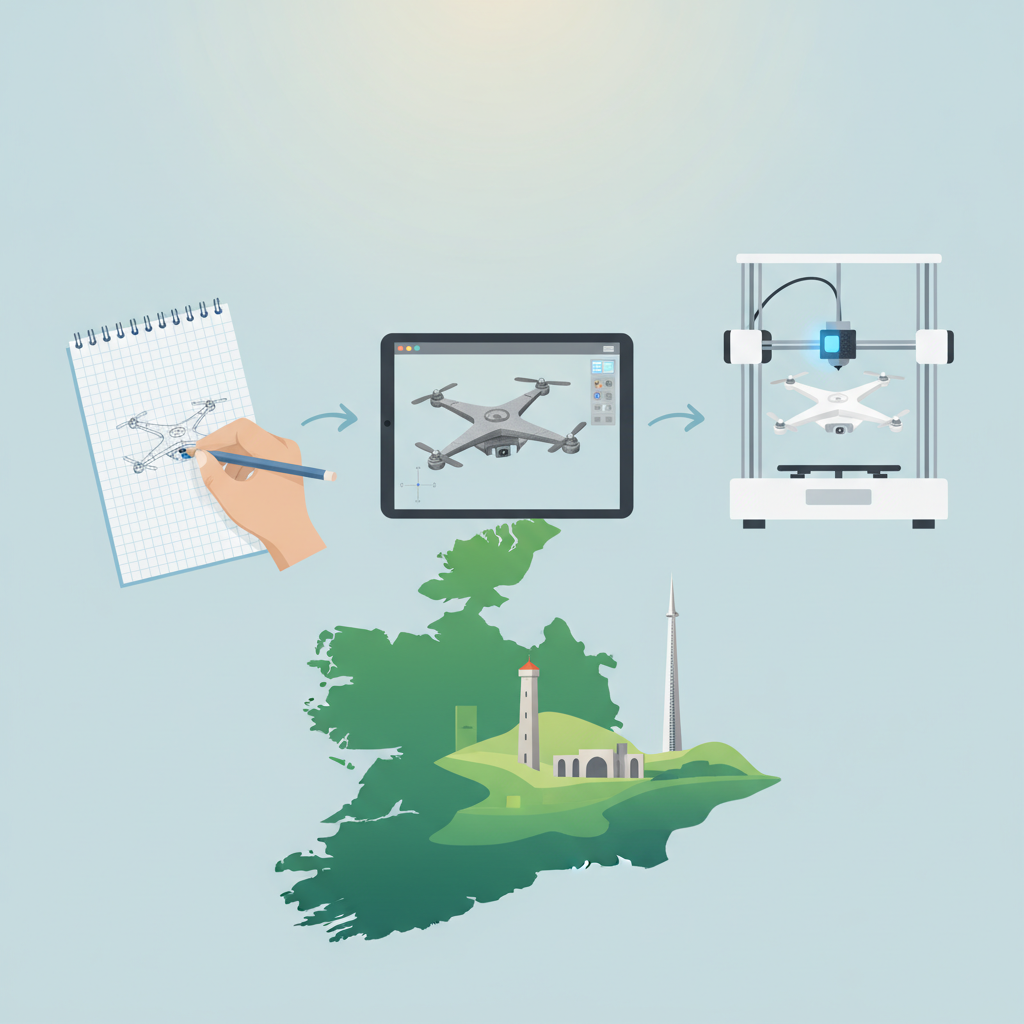
This comprehensive guide will walk you through the entire journey, from your initial concept to holding a tangible 3D printed prototype. We’ll cover everything from refining your idea and transforming it into a digital design, to choosing the right materials and navigating the printing process. Whether you're an inventor, an entrepreneur, a student, or a hobbyist, you'll learn how to effectively leverage custom 3D printing services in Ireland to accelerate your innovation, iterate quickly, and turn your visions into reality without the need for expensive equipment or specialised skills. Get ready to unlock the potential of your creativity with PrintIn3D.
Who This Is For:
- Entrepreneurs and startups needing rapid prototyping for new products.
- Engineers and designers seeking to test form, fit, and function.
- Inventors looking to validate their concepts before mass production.
- Businesses requiring 3d printed replacement parts service.
- Individuals with unique ideas wanting to see them physically realised.
- Anyone without access to a 3D printer or CAD design expertise.
Step 1: Solidifying Your Concept and Initial Sketch
The first and arguably most crucial step is to clearly define your concept. Before any digital design or physical printing can begin, you need a precise understanding of what you want to create, its purpose, and its key features. Think beyond just the aesthetics; consider functionality, dimensions, and how it will interact with its environment or other components. Your initial sketch serves as the blueprint, translating abstract ideas into a visual representation.
Don't worry if your drawing skills aren't professional – the goal here is clarity, not artistic perfection. Use notes, arrows, and multiple views to convey as much information as possible. This stage is all about externalising your thoughts and creating a solid foundation for the next steps. A well-defined concept early on can save significant time and resources later in the prototyping process.
- Detail the Purpose: What problem does your prototype solve? What function does it perform?
- Sketch Multiple Views: Draw your object from different angles (top, front, side, isometric) to provide a comprehensive understanding of its geometry.
- Add Key Dimensions: Include approximate measurements for crucial parts, even if just ratios initially. These will guide the 3D designer.
- Annotate Features: Label specific parts, materials, textures, or moving components. Explain any unique mechanisms or assembly requirements.
- Consider Constraints: Think about the environment it will operate in (temperature, stress, moisture) and any limitations (size, weight, budget).
- Gather Reference Images: If your concept is inspired by existing objects, collect photos or examples that illustrate your ideas.
Tip: Create a "design brief" document. This doesn't have to be formal, but it helps consolidate all your ideas, requirements, and constraints in one place, making it easier to communicate with a professional 3D designer.
Step 2: Transforming Your Sketch into a Digital 3D Model (CAD Design)
Once your concept and sketches are clear, the next critical phase is to translate them into a digital 3D model. This process is known as Computer-Aided Design (CAD). A CAD model is a precise, mathematically defined digital representation of your object, essential for 3D printing. If you don't have CAD software experience or the time to learn, this is where professional 3d product design services Ireland become invaluable.
At PrintIn3D.ie, our expert designers can take your sketches, photographs, or even vague ideas and transform them into print-ready CAD files (like STL, OBJ, or STEP). This eliminates the learning curve and ensures your model is optimised for successful 3D printing, accounting for tolerances, wall thickness, and printability. For existing physical objects, a reverse engineering 3d scan service can also be used to create a digital model.
- Choose Your Design Method:
- DIY (If Experienced): Utilise software like Fusion 360, SolidWorks, SketchUp, or Blender. This requires a significant time investment to learn the tools and principles of design for additive manufacturing.
- Professional Service (Recommended): Engage a service like PrintIn3D.ie. Simply submit your sketches, detailed descriptions, and any reference materials. Our team will handle the complex modelling, ensuring accuracy and printability.
- Communicate Clearly: Provide your chosen designer with all the information from Step 1. Be open to feedback and suggestions regarding design feasibility and optimisation for 3D printing.
- Review Digital Renders: Before proceeding to printing, review 2D drawings and 3D renders of the digital model. Ensure it accurately reflects your vision and meets all functional requirements. Ask for any necessary adjustments.
- Approve the CAD File: Once satisfied, approve the final CAD file. This file will then be prepared for the 3D printer.
Warning: Attempting DIY CAD design without proper training can lead to unprintable models, costing you more time and money in corrections. Professional designers understand the nuances of design for 3D printing.
Step 3: Getting an Online 3D Printing Quote and Choosing Materials
With a finalised 3D model (typically an STL file), you're ready to get an online 3d printing quote Ireland. This is where you'll define the specifications for your physical prototype, including material type, colour, and desired finish. Understanding how much does 3d printing cost Ireland involves considering these factors, as well as print complexity and urgency.
PrintIn3D.ie makes this process straightforward. Our online platform allows you to upload your CAD file to 3d print service and instantly receive a quote, making it easy to compare options and make informed decisions. We offer various materials suitable for different prototype needs, from basic functional testing to highly durable parts.
- Upload Your 3D Model: Visit our website and use the upload tool to submit your STL (or other compatible) file. The system will analyse your model's geometry to provide an accurate estimate.
- Select Your Material:
- PLA (Polylactic Acid): Excellent for general prototyping, visual models, and low-stress parts. Biodegradable and easy to print.
- PETG (Polyethylene Terephthalate Glycol): Offers better strength, temperature resistance, and durability than PLA, making it suitable for functional prototypes that require more resilience.
- ABS (Acrylonitrile Butadiene Styrene): Known for its strength, flexibility, and heat resistance. Often used for end-use parts.
- TPU (Thermoplastic Polyurethane): A flexible, rubber-like material perfect for gaskets, grips, or parts requiring elasticity.
- Consult with PrintIn3D.ie if you're unsure which material best suits your prototype's intended function.
- Choose Colour and Finish: Select the desired colour for your prototype. Consider if any post-processing (sanding, painting, assembly) is required, as this can affect the final cost and lead time.
- Specify Quantity and Urgency: Indicate how many units you need and if you require expedited service. PrintIn3D offers various turnaround times, including 8-hour, 13-hour, and 28-hour custom printing service for urgent projects.
- Review and Confirm: Carefully review your quote, ensuring all specifications are correct before proceeding with your order.
Tip: If this is your first time prototyping, consider ordering one unit in PLA for initial form and fit testing. Once validated, you can order additional units in a more robust material like PETG for functional testing.
Step 4: The 3D Printing Process and Quality Assurance
Once your order is confirmed, PrintIn3D.ie springs into action. Your digital 3D model is prepared for printing, sliced into thousands of thin layers, and sent to our high-precision 3D printers, including advanced machines like the Bambu Lab X1C. Our skilled technicians oversee the printing process, ensuring optimal settings for your chosen material and model complexity.
Quality assurance is paramount. Each prototype undergoes a thorough inspection to ensure it meets your specifications and adheres to our high standards. This includes checking for dimensional accuracy, surface finish, and overall structural integrity. Our goal is to deliver a prototype that not only looks good but also functions as intended.
- File Preparation: Your 3D model is processed through "slicer" software, which converts it into machine-readable instructions (G-code) layer by layer, defining paths, temperatures, and speeds.
- Printing Execution: Our state-of-the-art 3D printers build your prototype layer by layer, precisely extruding molten filament (for FDM printing) or curing resin (for SLA printing) based on the G-code instructions.
- Support Material Removal: For complex geometries or overhangs, support structures are often necessary during printing. These are carefully removed after printing, followed by any necessary cleanup.
- Post-Processing (Optional): Depending on your chosen finish, prototypes may undergo additional steps like sanding, polishing, or priming to achieve a smoother aesthetic or prepare for painting.
- Rigorous Quality Check: Every printed part is inspected for accuracy, defects, and adherence to your design. We use precise measuring tools to verify critical dimensions.
- Secure Packaging and Dispatch: Once approved, your prototype is carefully packaged to prevent damage during transit. Filament orders also receive same-day dispatch if ordered before 4 PM, with fast delivery across Ireland.
Warning: Rushing the printing process or skipping quality checks can lead to prototypes that fail to meet expectations or provide inaccurate testing results. Professional services prioritise precision and quality.
Step 5: Delivery, Review, and Iteration
After meticulous printing and quality checks, your 3D printed prototype is shipped directly to your location in Ireland or across the EU/EEA. Upon arrival, the real fun begins: hands-on review and testing. This stage is crucial for validating your design, identifying areas for improvement, and moving closer to a final product.
PrintIn3D.ie prides itself on fast delivery, with typical delivery times of 2 working days for Ireland and 5-7 working days for Europe. We also offer a 30-Day Risk-Free Return policy, demonstrating our commitment to your satisfaction. Your feedback on the prototype is invaluable, as it informs subsequent design iterations.
- Receive Your Prototype: Unpack your 3D printed prototype and inspect it immediately for any transit damage or discrepancies.
- Conduct Thorough Testing:
- Form: Does it look right? Does it fit aesthetically with other components?
- Fit: Does it assemble correctly with other parts? Are clearances sufficient?
- Function: Does it perform its intended task? Does it withstand expected stresses?
- Ergonomics: For handheld items, how does it feel? Is it comfortable to use?
- Document Findings: Keep detailed notes on what works well and what needs improvement. Take photos or videos of any issues.
- Gather Feedback: Share the prototype with colleagues, potential users, or target audience members to get diverse perspectives.
- Iterate and Refine: Based on your testing and feedback, revise your initial sketches or CAD model. This might involve small tweaks or significant redesigns. This cyclical process of design-print-test-refine is central to successful product development. You might require further 3D design services for these iterations.
- Order New Prototypes: Once revisions are made, you can order updated prototypes through PrintIn3D.ie, continuing the cycle until your design is perfect.
Tip: Don't be afraid to iterate multiple times. Prototypes are meant to be imperfect initial versions. Each iteration brings you closer to a refined, market-ready product. This iterative process is a key advantage of additive manufacturing.
Step 6: Finalising Your Design and Scaling Up
With a fully validated prototype in hand, you’ve successfully transformed your initial concept into a tangible, functional object. This final version is ready for presentation, market testing, or even small-batch production. You’ve proven your concept and refined your design, paving the way for the next stage of your project.
For those looking to move beyond prototyping to small-scale manufacturing or even launch a product online (perhaps on platforms like Etsy), PrintIn3D.ie can continue to be your partner. We can produce multiple units for market samples, initial sales, or further rigorous testing. If you're looking to create an etsy 3d printed products Ireland presence, having a reliable manufacturing partner is key.
- Prepare for Production: Ensure your final CAD model is robust and suitable for the chosen manufacturing method, whether that's continued 3D printing, injection moulding, or another process.
- Consider Material Choices for Scale: If moving to mass production, evaluate how the material used for your prototype translates to production materials in terms of cost, properties, and manufacturing feasibility.
- Plan for Post-Production: Think about any assembly, finishing, packaging, or quality control steps required for final products.
- Market and Present: Use your finalised prototype to pitch investors, conduct user testing, showcase at trade shows, or start your pre-sales campaigns.
- Leverage PrintIn3D.ie for Small Batch Production: For quantities that aren't yet viable for traditional manufacturing, our custom 3D printing services Ireland can produce small to medium runs, offering flexibility and cost-effectiveness.
Tip: Even if you plan for mass manufacturing, 3D printing can be used to create jigs, fixtures, and tools for your production line, optimising efficiency and accuracy.
Common Mistakes to Avoid When Prototyping
Bringing an idea to life can be exhilarating, but it's also easy to fall into common pitfalls. Being aware of these can save you time, money, and frustration.
- Skipping the Concept Refinement Stage: Rushing into design without a clear, detailed concept often leads to numerous costly revisions down the line. Take time in Step 1.
- Neglecting Design for Additive Manufacturing (DFAM): Designing a model that looks good in CAD but isn't structurally sound or easily printable can lead to failed prints or weak prototypes. Wall thickness, overhangs, and tolerances are critical. This is where professional 3D design services shine.
- Underestimating Material Selection: Using the wrong material for your prototype’s intended function can lead to misleading test results. For example, using PLA for a part that needs high heat resistance will yield inaccurate performance data.
- Failing to Communicate Clearly with Designers/Printers: Ambiguous instructions, missing dimensions, or not providing context can result in prototypes that don't match your vision. Always be as detailed as possible.
- Not Iterating Enough (or Too Much): Some projects fail because they don't iterate enough, pushing a flawed design forward. Others get stuck in an endless loop of minor tweaks, delaying launch. Find a balance based on your goals.
- Ignoring Cost Factors Early On: Not getting an online 3d printing quote Ireland early can lead to budget overruns. Understand how material choice, print time, and design complexity affect the overall cost.
- Expecting Perfection from the First Prototype: Prototypes are for learning and improving. They are rarely perfect. Embrace the iterative process and learn from each version.
- Overlooking Legal Protection: If your idea is innovative, consider intellectual property protection (like NDAs, which PrintIn3D offers) before sharing detailed designs, especially with manufacturers.
FAQ About Turning Concepts into 3D Printed Prototypes
Q1: How long does it take to get a 3D printed prototype from a sketch?
The timeline varies depending on the complexity of your sketch, the time taken for 3D design, and your chosen printing speed. A simple sketch can be converted into a CAD model and printed within a few days using our expedited services like the 8-hour custom printing service. More complex designs or those requiring multiple iterations will naturally take longer. Factors like clear communication and prompt feedback also significantly impact the speed of the process.
Q2: What file format do I need for 3D printing?
The most common and widely accepted file format for 3D printing is STL (stereolithography). Other formats like OBJ, 3MF, and STEP are also frequently used, especially for more complex models that retain colour or material information. If you're providing sketches, our 3d product design services Ireland will convert your concept into one of these print-ready formats.
Q3: Can PrintIn3D.ie help me design my idea if I only have a rough sketch?
Absolutely! That's one of our core services. We specialise in taking your initial concepts, sketches, or even just descriptions and turning them into professional, print-ready 3D CAD models. Our expert designers will work closely with you to ensure the digital model accurately reflects your vision and is optimised for 3D printing. This service is perfect for anyone needing 3d product design services Ireland.
Q4: How much does 3D printing a prototype cost in Ireland?
The cost of 3D printing in Ireland for a prototype depends on several factors: the complexity and size of your model, the chosen material (e.g., PLA is generally cheaper than PETG or TPU), the required print quality, and the turnaround time. A basic prototype in common material can be very affordable, while larger, more intricate designs or those needing premium materials and expedited delivery will naturally cost more. You can get an instant online 3d printing quote Ireland by uploading your file to our website.
Q5: What if my prototype doesn't work as expected? Can I get revisions?
Yes, the prototyping process is inherently iterative. It's common for the first (and sometimes second or third) prototype to reveal areas for improvement. Once you receive your 3D printed prototype, you can test it thoroughly. Based on your findings, you can provide feedback for design revisions. Our 3D design services can then modify the digital model, and you can order a new, improved prototype, continuing the cycle until your design is perfect.
Next Steps: Bring Your Ideas to Life with PrintIn3D.ie
Your journey from concept to a tangible 3D printed prototype is an exciting one, full of innovation and discovery. Don't let a lack of equipment or design expertise hold you back. PrintIn3D.ie is your reliable 3D printing partner, ready to guide you through every step. Visit our website today to explore our custom 3D printing services, learn about our 3D design expertise, or get an online 3D printing quote and take the first step towards turning your dreams into reality.