Your Ultimate Guide to Finding a 3D Printer Filament Supplier in the USA
Introduction: Your Blueprint for Sourcing 3D Printer Filament in the USA
Embarking on a 3D printing project, whether for hobby, prototype, or production, hinges critically on one foundational element: your filament. The quality, consistency, and availability of your 3D printer filament can make or break your creations, impacting everything from print success rates to the final aesthetics and functional integrity of your parts. For makers, businesses, and educators across the United States, finding a reliable 3d printer filament supplier usa is not just a convenience; it's a strategic necessity.
This comprehensive guide is meticulously crafted to empower you with the knowledge and actionable steps required to navigate the vast landscape of filament suppliers in the US. We’ll delve into defining your specific needs, meticulously researching and evaluating potential suppliers, understanding the nuances of material quality, comparing crucial factors like pricing and shipping, and establishing a robust supply chain. By the end of this guide, you’ll be equipped to confidently identify a top-tier pla filament supplier usa or any other material provider that aligns perfectly with your 3D printing aspirations. You'll learn how to ensure consistent quality, competitive pricing, and reliable service, ultimately streamlining your workflow and elevating the standard of your 3D printed projects.
Who This Is For
- Hobbyists and enthusiasts looking for reliable filament sources.
- Small and medium-sized businesses needing consistent material for prototyping or production.
- Educational institutions equipping their labs.
- Engineers and designers requiring specialized or high temperature 3d printer filament.
- Anyone seeking to optimize their 3D printing supply chain in the United States.
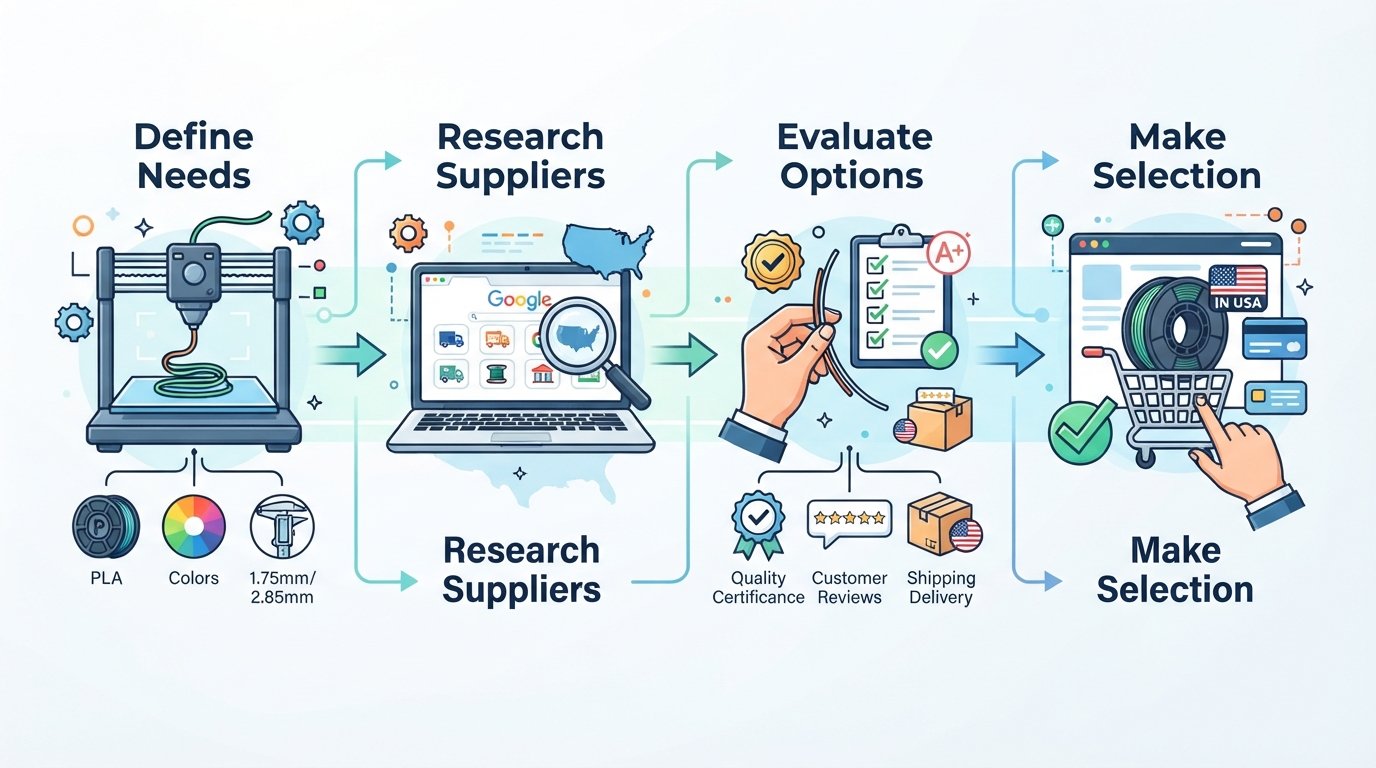
Step 1: Define Your Specific Filament Needs
Before you even begin searching for a 3d printer filament supplier usa, the most critical first step is to clearly define what you need. The world of 3D printing filaments is incredibly diverse, with materials offering different properties, strengths, flexibilities, and thermal resistances. Understanding your project requirements will narrow down your search significantly and prevent wasted time and resources on unsuitable options.
Consider the intended application of your 3D printed part. Will it be a decorative item, a functional prototype, a jig or fixture for manufacturing, or a part exposed to high temperatures or chemicals? Each application demands specific material characteristics. For example, if you're creating an aesthetic model, standard PLA might suffice. However, if you're prototyping a mechanical part, PETG or ABS might be more appropriate. For parts that will experience significant heat, you'll specifically be looking for a supplier of high temperature 3d printer filament.
- Identify Material Type: Common options include PLA, PETG, ABS, ASA, TPU, Nylon, and specialized composites (carbon fiber, wood-filled, metal-filled). Research the properties of each and match them to your project's needs (e.g., strength, flexibility, heat resistance, biodegradability).
- Determine Filament Diameter: The vast majority of consumer 3D printers use either 1.75mm or 2.85mm filament. Always check your printer's specifications to ensure compatibility.
- Select Color and Finish: While seemingly aesthetic, color consistency and finish (matte, glossy, transparent) can be crucial for brand consistency or visual appeal.
- Estimate Quantity and Frequency: Are you buying a single spool for a small project, or do you need bulk quantities for ongoing production? Your volume needs will influence the type of supplier you seek and potential discounts.
- Consider Specific Properties: Do you need food-safe, UV-resistant, impact-resistant, chemical-resistant, or conductive properties? These specialized requirements will significantly narrow your material choices.
Tip: Keep a log of your project requirements and desired filament properties. This "spec sheet" will be invaluable when comparing different suppliers and their offerings.
Step 2: Identify Potential US Filament Suppliers
Once you have a clear understanding of your filament needs, it's time to hit the ground running and identify potential 3d printer filament supplier usa options. The US market is robust, with numerous manufacturers, distributors, and resellers, each with their own specializations and geographical reach. A multi-pronged approach to research will yield the best results.
Start with broad online searches, using terms like "pla filament supplier usa," "best 3d printer filament USA," or "high temperature 3d printer filament US." These queries will often lead you to major online retailers, dedicated filament brands, and even niche suppliers. Explore dedicated 3D printing forums, communities, and review sites (like Reddit's r/3Dprinting, MatterHackers forums, or YouTube reviews) where users frequently discuss and recommend their preferred suppliers. These community insights can be goldmines for honest feedback on product quality and customer service.
- Online Marketplaces & Retailers:
- Large E-commerce Platforms: Amazon, eBay, and others host numerous filament brands and resellers. While convenient, verify seller reputation.
- Dedicated 3D Printing Stores: Websites like MatterHackers, Printed Solid, and Micro Center (which also has physical locations) specialize in 3D printing supplies and often carry a wide range of filaments.
- Manufacturer Direct: Many filament manufacturers, such as Prusament (Prusa Research), Proto-pasta, or Atomic Filament, sell directly from their own websites. This can ensure freshness and direct support.
- Geographic-Specific Searches:
- If local pickup or support is important, search for "3d printing services in california" or "3d printing services in texas" combined with "filament supplier." Many local 3D printing hubs or service bureaus might also sell filaments or provide recommendations.
- Consider searching for a "3d printing company usa" that offers both services and filament sales, providing a comprehensive solution.
- Specialty Suppliers:
- For advanced materials like engineering-grade composites or unique blends, you might need to seek out specialized suppliers who focus solely on these niche products.
- Industry Directories and Trade Shows:
- While more for businesses, industry directories or attending virtual/in-person trade shows can connect you directly with manufacturers and distributors.
Warning: Be wary of overly cheap, unbranded filament on marketplaces. While tempting, these often come with inconsistent quality, poor winding, and inadequate material data, leading to failed prints and frustration.
Step 3: Evaluate Supplier Reliability and Product Quality
Once you've compiled a list of potential 3d printer filament supplier usa options, the next critical step is to thoroughly evaluate their reliability and the quality of their products. This is where you separate the excellent from the merely adequate, ensuring your investment leads to successful prints rather than headaches.
A reputable supplier will always be transparent about their filament specifications and manufacturing processes. Look for comprehensive Material Data Sheets (MDS) or Technical Data Sheets (TDS) on their website. These documents should detail the material composition, physical properties (e.g., tensile strength, heat deflection temperature), recommended printing parameters, and any safety information. This is particularly crucial if you're sourcing high temperature 3d printer filament or other engineering-grade materials where precise properties are paramount.
- Check Customer Reviews and Testimonials:
- Beyond a supplier's own website, scour independent review platforms, 3D printing forums, and social media for unbiased feedback. Look for comments on filament consistency, dimensional accuracy, spool quality, color fidelity, and overall print performance. Pay attention to reviews mentioning specific materials like "pla filament supplier usa" and their experiences.
- A pattern of positive reviews regarding consistent quality, good packaging, and responsive support is a strong indicator of a reliable supplier.
- Verify Manufacturing Standards and Certifications:
- Some suppliers adhere to specific quality control standards (e.g., ISO certifications). While not always common for smaller brands, it speaks to a commitment to consistency.
- For certain applications (e.g., medical, food contact), look for specific material certifications if available.
- Assess Material Consistency:
- Diameter consistency is paramount. Even slight variations can lead to under-extrusion, over-extrusion, or nozzle clogs. Look for suppliers who guarantee tight tolerances (e.g., +/- 0.02mm).
- Color consistency between batches is also important, especially for multi-color projects or if you need to reorder the exact shade.
- Proper spool winding prevents tangles and snags during printing. Check reviews for comments on tangled spools.
- Evaluate Freshness and Storage:
- Filament is hygroscopic, meaning it absorbs moisture from the air, which can degrade print quality. A good supplier stores their filament in dry, climate-controlled environments and seals it with desiccant upon packaging. Ask about their storage practices or look for indicators like vacuum-sealed packaging.
- Review Return and Refund Policies:
- A transparent and fair return policy is a sign of a confident supplier who stands behind their product. Understand their process for damaged or unsatisfactory filament.
Tip: Don't hesitate to contact a prospective supplier directly with technical questions about their filament. Their responsiveness and depth of knowledge can tell you a lot about their expertise and commitment to customer service. For instance, you might inquire about the specific heat deflection temperature of their high temperature 3d printer filament.
Step 4: Compare Pricing, Shipping, and Customer Support
With a refined list of reliable 3d printer filament supplier usa options, it's time to delve into the practicalities of pricing, shipping logistics, and the quality of their customer support. These factors directly impact your overall cost and satisfaction.
Pricing isn't just about the cost per spool; it encompasses the total cost of ownership, including shipping, potential bulk discounts, and the value of good customer service. A slightly more expensive filament that consistently delivers perfect prints might be more cost-effective than a cheaper option that leads to frequent print failures and material waste. When seeking "online 3d printing quotes usa" for materials, ensure you're comparing apples to apples, factoring in all associated costs.
- Analyze Unit Pricing:
- Compare the price per kilogram (or per spool) across different suppliers for the same material type and quality. Be mindful of variations in spool weight (e.g., some spools are 750g instead of 1kg).
- Look for potential bulk discounts. If you're a heavy user or a business, buying in larger quantities can significantly reduce your per-kilogram cost.
- Consider subscription services offered by some suppliers, which can provide consistent supply and often a discounted rate.
- Evaluate Shipping Costs and Speed:
- Since you're looking for a 3d printer filament supplier usa, domestic shipping should generally be faster and more affordable than international options.
- Check for free shipping thresholds. Many suppliers offer free shipping once your order reaches a certain value.
- Understand typical delivery times and available shipping options (standard, expedited). This is crucial for planning your projects and avoiding downtime.
- If you're in a specific region, consider a supplier that has a distribution center nearby. For example, a supplier with a strong presence in California might offer faster shipping if you're looking for "3d printing services in california" or a supplier there. The same applies for "3d printing services in texas."
- Assess Customer Support:
- What support channels do they offer (phone, email, live chat)?
- How responsive are they? Try reaching out with a simple question to gauge their response time and helpfulness.
- Do they offer technical support for printing issues related to their filament? This can be invaluable, especially when working with new or challenging materials.
- A US-based customer service team can be beneficial for ease of communication and understanding local needs.
- Check Payment Options and Security:
- Ensure the supplier offers secure payment methods and that their website is protected with SSL encryption.
Warning: Be wary of suppliers that have exorbitant shipping fees that negate any savings on the filament itself. Always calculate the total cost, including shipping, before making a purchase decision.
Step 5: Test and Validate Your Chosen Filaments
Even after extensive research and careful comparison, the true test of a 3d printer filament supplier usa comes down to actual performance. Before committing to large bulk orders, it's always wise to test their filament under real-world conditions in your specific 3D printer. This validation step is crucial for ensuring the filament meets your expectations and works seamlessly with your equipment.
Think of this stage as a short-term trial period. You wouldn't buy a car without a test drive, and the same principle applies to your 3D printing materials. Different 3D printers, even of the same model, can have slight variations, and what works perfectly for one user might require minor adjustments for another. This is particularly true for specialized materials like high temperature 3d printer filament which often require specific print settings and environments (like enclosed chambers).
- Order Samples or Small Spools:
- Many reputable suppliers offer sample packs or smaller spool sizes (e.g., 250g or 500g) specifically for testing. Take advantage of these to try out different materials or colors from a new supplier.
- If a supplier doesn't offer samples, start with a single 1kg spool of the material you're most interested in.
- Conduct Comprehensive Test Prints:
- Use standardized test prints (e.g., calibration cubes, temperature towers, retraction tests) to assess dimensional accuracy, adhesion, bridging capabilities, and stringing.
- Print a representative part of your actual project. This provides the most relevant feedback on how the filament performs for your intended application.
- Pay close attention to consistency throughout the spool. Does the print quality degrade as you get towards the end of the spool?
- Document Your Findings:
- Keep detailed notes on your print settings (temperature, speed, retraction), environmental conditions (ambient temperature, humidity), and the results of your test prints. Include photos if possible.
- Compare the actual performance against the supplier's advertised specifications, especially for engineering-grade materials.
- Assess Print Consistency Over Time:
- If you plan to use a particular filament regularly, evaluate how consistently it performs across multiple prints and even across different spools from the same batch. This is key for production environments or for a reliable "prototype 3d printing service."
- Provide Feedback:
- If you encounter issues, reach out to the supplier's customer support. Their response and willingness to help resolve problems can reinforce their reliability.
Tip: Don't just test one color or material from a new supplier. If you plan to use various types, test them all. The quality of a supplier's PLA doesn't automatically guarantee the quality of their PETG or ABS.
Step 6: Explore Value-Added Services and Special Considerations
Beyond simply providing spools of plastic, many leading 3d printer filament supplier usa companies offer additional services, expertise, or specialized product lines that can greatly enhance your 3D printing experience and capabilities. As your projects evolve, considering these value-added aspects can help you solidify a long-term partnership.
For businesses or advanced users, the relationship with a filament supplier can extend beyond transactional purchases. Some suppliers are part of a larger ecosystem that offers comprehensive solutions. For example, a "3d printing company usa" might not only sell filaments but also provide "online 3d printing quotes usa" for finished parts, or even integrate "3d scanning and 3d printing" services to turn physical objects into digital designs and then back into printed parts. This holistic approach can be incredibly efficient.
- Consultation and Technical Expertise:
- Does the supplier offer advice on material selection for specific applications? This can be especially helpful for niche or engineering filaments.
- Do they have resources like printing guides, troubleshooting tips, or educational content on their website? This demonstrates a commitment to supporting their customers beyond just sales.
- Specialty and Advanced Filaments:
- Beyond standard PLA and PETG, explore suppliers who offer a wide range of specialty materials. This could include flexible filaments (TPU), carbon fiber reinforced composites, glow-in-the-dark, conductive, or highly abrasive materials.
- Look for suppliers who continually innovate and introduce new material blends, such as those focusing on truly high temperature 3d printer filament for industrial applications.
- Sustainability Initiatives:
- For environmentally conscious makers and businesses, investigate suppliers who offer recycled filaments, take-back programs for empty spools, or utilize eco-friendly packaging.
- Integration with 3D Printing Services:
- Some filament suppliers might also be "prototype 3d printing service" providers, offering to print your designs if you lack the equipment or time. This can be a great way to test a material or get a quick turnaround on a project.
- If your workflow involves reverse engineering, consider suppliers or affiliated companies that offer "3d scanning service usa" or even "3d scan to cad service." This full-service capability can streamline complex projects.
- Non-Disclosure Agreements (NDAs):
- For businesses developing proprietary products, a supplier willing to sign an NDA can be a significant advantage, especially if you share sensitive project details during consultation or material development.
Tip: Building a relationship with a supplier that offers comprehensive support and services can transform them from a mere vendor into a valuable partner, especially as your 3D printing needs grow in complexity.
Common Mistakes to Avoid When Sourcing Filament
- Ignoring Filament Storage: Even the best filament will degrade if not stored properly. Don't assume your supplier's excellent packaging means you can leave spools exposed to humidity indefinitely. Invest in dry boxes or dehumidifiers.
- Prioritizing Price Over Quality: While cost is a factor, choosing the cheapest filament often leads to inconsistent prints, jams, and wasted time and material. A slightly higher initial investment in quality can save you headaches and money in the long run.
- Overlooking Dimensional Accuracy: Many cheap filaments have poor diameter consistency. This is a silent killer for print quality, causing extrusion issues you might wrongly attribute to your printer settings. Always check for stated tolerances and customer reviews on accuracy.
- Not Reading Reviews (or Only Reading On-Site Reviews): Always look for independent reviews on forums, social media, and third-party sites. Supplier websites naturally highlight positive feedback.
- Forgetting About Shipping Costs: A low per-spool price can quickly be negated by high shipping fees. Always factor in the total cost of your order.
- Ignoring Material Data Sheets: Especially for functional parts, understanding the mechanical and thermal properties listed in an MDS/TDS is critical. Don't just guess which filament will work. This is particularly important for high temperature 3d printer filament where specific environmental conditions and printing parameters are essential for optimal performance.
- Stockpiling Too Much Filament: While bulk discounts are appealing, filament has a shelf life, especially if not perfectly stored. Only buy what you expect to use within a reasonable timeframe (e.g., 6-12 months).
- Failing to Test New Filaments: Never assume a new brand or material will print the same as your old one. Always perform calibration and test prints with any new filament.
- Underestimating Customer Support: When things go wrong (and sometimes they do), good customer support is invaluable. A supplier that's difficult to reach or unhelpful can add significant stress and delays.
FAQ
What are the most common filament types for beginners in the US?
For beginners in the US, PLA (Polylactic Acid) is by far the most recommended filament. It's easy to print, has good adhesion, comes in a vast array of colors, and doesn't require a heated bed or enclosure. PETG (Polyethylene Terephthalate Glycol) is another popular choice, offering more strength and temperature resistance than PLA, though it can be slightly trickier to print.
How can I ensure the filament I buy from a US supplier is fresh?
To ensure freshness, look for suppliers who explicitly state their quality control and storage practices. Good indicators include vacuum-sealed packaging with desiccant, recent manufacturing dates (if provided), and positive customer reviews mentioning consistent quality. Buying directly from a manufacturer or a high-volume reseller with quick inventory turnover often ensures fresher stock. If you're looking for a "pla filament supplier usa," check their packaging details.
What should I look for when choosing a high temperature 3d printer filament supplier?
When sourcing high temperature 3d printer filament (like ABS, ASA, Nylon, PC, or PEEK/PEI), prioritize suppliers who provide comprehensive Material Data Sheets (MDS) detailing heat deflection temperatures (HDT), glass transition temperatures (Tg), and recommended print settings. Look for consistent dimensional accuracy, strong vacuum sealing, and reviews from users who have successfully printed with these demanding materials. Technical support is also crucial, as these filaments often require specialized printers and enclosures.
Are there any US suppliers that offer eco-friendly or recycled filaments?
Yes, many 3d printer filament supplier usa companies are increasingly offering eco-friendly options. Look for brands that specifically market recycled PLA, PETG, or other materials, often derived from post-industrial or post-consumer waste. Some also offer programs for recycling empty spools. Check their sustainability pages or product descriptions for details. This is a growing trend as the industry seeks to reduce its environmental impact.
Can I get bulk discounts from US filament suppliers?
Absolutely. Most 3d printer filament supplier usa companies, especially those catering to businesses and high-volume users, offer tiered pricing with significant discounts for bulk purchases. This can be particularly beneficial for "3d printing company usa" or "prototype 3d printing service" providers. Inquire directly with the supplier or check their website for bulk pricing structures. Minimum order quantities may apply.
Next Steps / CTA
Mastering your 3D printing projects begins with the right materials. While this guide focuses on finding your ideal 3d printer filament supplier usa, remember that the journey from idea to physical object often requires more than just filament. If you need assistance with custom designs, precise 3D scanning services, or professional 3D printing services for complex parts without owning a printer, explore the expert capabilities offered by PrintIn3D.ie to bring your visions to life with ease and precision.