3D Printing Drives Germany's Green Revolution
Germany Pioneers Sustainable 3D Printing for a Greener Circular Economy
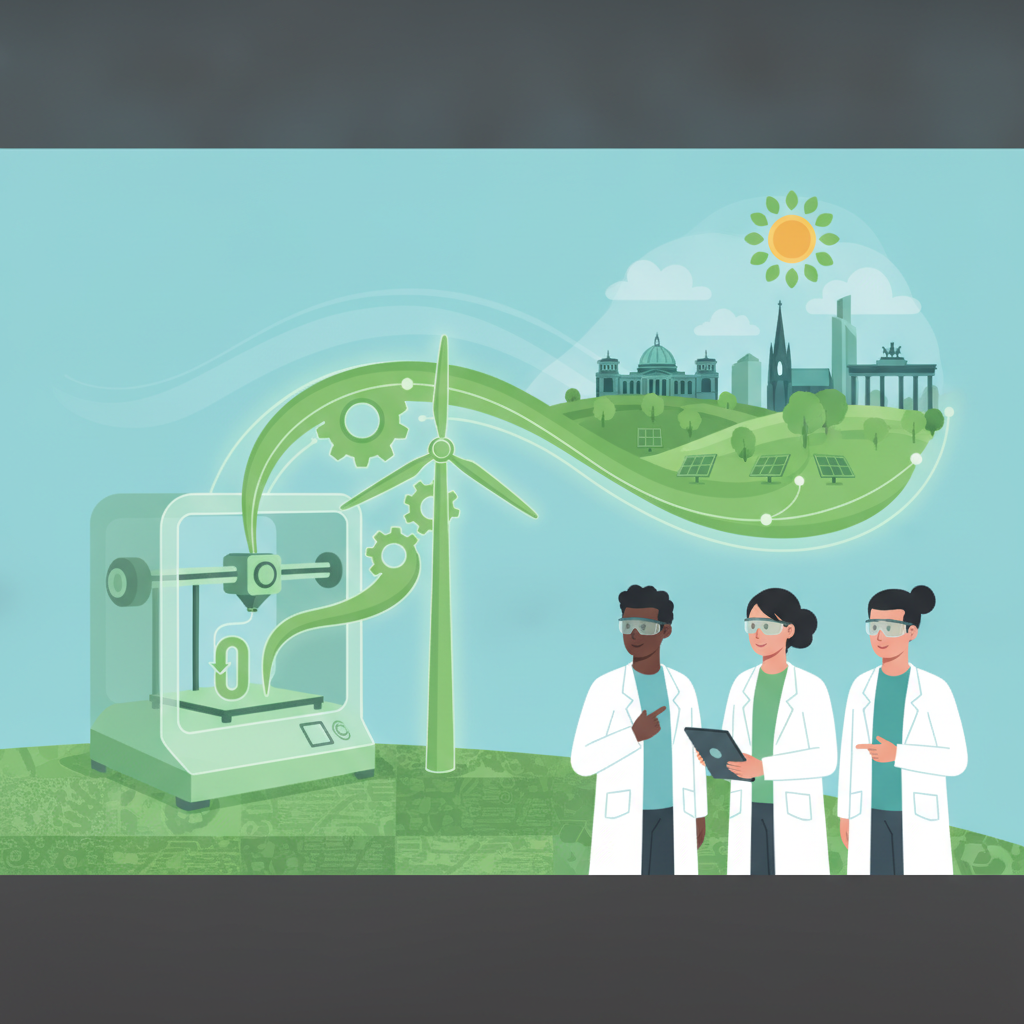
Germany is at the forefront of a significant shift towards integrating 3D printing into its circular economy, with recent developments highlighting the technology's potential to dramatically enhance sustainability across various sectors. The focus is squarely on reducing waste, optimizing resource use, and creating greener manufacturing processes, as evidenced by a fresh report from the DBU (Deutsche Bundesstiftung Umwelt) on custom-fit packaging and widespread innovation in bio-based materials.
This commitment to sustainability, particularly in the logistics and manufacturing industries, showcases how additive manufacturing is not just about innovation but also about environmental responsibility. Companies and research institutions across Germany are actively pursuing solutions that leverage 3D printing to minimize ecological footprints, from reducing packaging waste to developing advanced recyclable materials.
Custom-Fit Packaging: A New Era for Sustainable Logistics
A leading initiative gaining traction in Germany is the development of “Passgenaue Verpackungen per 3D-Druck für nachhaltige Logistik” (Custom-fit packaging via 3D printing for sustainable logistics). This concept, highlighted in recent recycling news, addresses one of the major challenges in the supply chain: excessive packaging waste. By enabling on-demand creation of packaging that precisely fits a product, 3D printing eliminates the need for bulky, standardized solutions filled with unnecessary void fillers.
The ability to produce tailor-made packaging for every item means significant reductions in material consumption and shipping volume, leading to lower transportation costs and a substantial decrease in CO₂ emissions. This application of 3D printing for logistics optimization represents a concrete step towards a more efficient and environmentally friendly distribution network, impacting everything from small e-commerce shipments to large industrial components.
Revolutionary Bio-based Filaments and Advanced Materials
Beyond packaging, the German bioeconomy sector is buzzing with innovations in 3D printable materials. Researchers and industry partners, including Fraunhofer IMWS, are making strides in developing advanced 3D printer filament from biopolymers, often reinforced with natural fibres like hemp or flax. These materials are not only sustainable but also boast impressive properties, being described as “stark dehnbar, chemisch recycelbar” (highly elastic, chemically recyclable), and even exhibiting partial self-repairing capabilities.
Such developments are paving the way for a truly circular material flow in additive manufacturing. One notable project, NaRo-3D, is exploring digital process chains for individually adapted prosthetic sockets using these innovative filaments, demonstrating the potential for life-changing applications where customisation meets ecological benefit. For those looking to 3d-drucker filament kaufen, these sustainable options are rapidly becoming more accessible and attractive.
Driving Industrial Efficiency and CO₂ Reduction
The impact of 3D printing on sustainability extends deeply into industrial applications. A compelling report from industrial transformation coverage showcases how additive manufacturing, combined with smart material selection and renewable energy, can significantly cut carbon footprints. In one documented case, the digital selection of materials for an industrial gripper, leveraging secondary materials and additive manufacturing powered by green energy, resulted in a CO₂ emission reduction of up to 40%.
This highlights 3D printing's role in creating lightweight, optimized designs that use less material and can be produced locally and on-demand, thus reducing the energy and emissions associated with traditional manufacturing and global supply chains. For businesses needing 3d-druck kleinserien fertigen lassen or prototypen aus dem 3d-druck, these advancements mean not only faster iterations but also a greener product lifecycle.
The Power of Customisation: From Design to Reality
At the heart of these sustainable advancements is the inherent customisability of 3D printing. Whether it's creating 3d-design nach maß for unique packaging, developing bespoke prosthetics, or optimizing industrial components, the ability to tailor solutions precisely to needs minimizes waste and maximizes efficiency. Services like 3d-scanner service and cad design für 3d-druck are crucial enablers in this ecosystem, allowing ideas to be translated into tangible, sustainable products.
The ongoing commitment in Germany to pushing these boundaries, from innovative materials to new applications, solidifies 3D printing's position as a key technology for achieving circular economy goals. This movement aligns perfectly with the global call for more responsible manufacturing and consumption patterns.
What This Means for Our Audience
For individuals and businesses across Germany and the wider EU/EEA, these developments signify an exciting future where innovative, sustainable 3D printing solutions are more accessible than ever. Whether you're looking to reduce your carbon footprint with custom 3D printed parts, experiment with bio-based filaments like 3d-druck-filament für bambu lab, or simply bring a sustainable idea to life, the German focus on circularity through additive manufacturing offers immense opportunities. You don't need your own 3D printer to participate in this green revolution. As your trusted 3D printing partner, we make it hassle-free to tap into these advancements, providing expert custom 3D printing, 3D design, and 3D scanning services, alongside a range of quality filaments for your projects. Embrace the future of sustainable manufacturing – let us help you print your 3D dreams responsibly.