Circular Economy Drive: 3D Printing Emerges as Key to Reducing Waste
Ireland's Waste Challenge Highlights Urgent Need for Circular Economy Solutions Across the EU
As Ireland grapples with its rising packaging waste, generating nearly 1.2 million tonnes in 2023 and falling short of critical EU recycling targets, the spotlight turns to innovative solutions capable of transforming waste management. This pressing issue, with Ireland's 2023 recycling rate at 59% risking the EU's 65% target by 2025, underscores a broader European challenge. The Environmental Protection Agency (EPA) emphasizes the need for better waste segregation and accelerated implementation of circular economy initiatives, a call that resonates deeply across the EU, including Luxembourg, as stricter packaging rules loom.
The European Union's Packaging and Packaging Waste Regulation (PPWR) aims for ambitious reductions: 5% by 2030, 10% by 2035, and 15% by 2040, demanding that all packaging on the EU market be recyclable by 2030. These targets highlight an urgent requirement for businesses and industries across all member states to rethink their production, consumption, and waste strategies. This is where advanced manufacturing, particularly 3D printing, presents itself as a powerful enabler for a true circular economy.
3D Printing: A Cornerstone of Waste Reduction and Localised Production
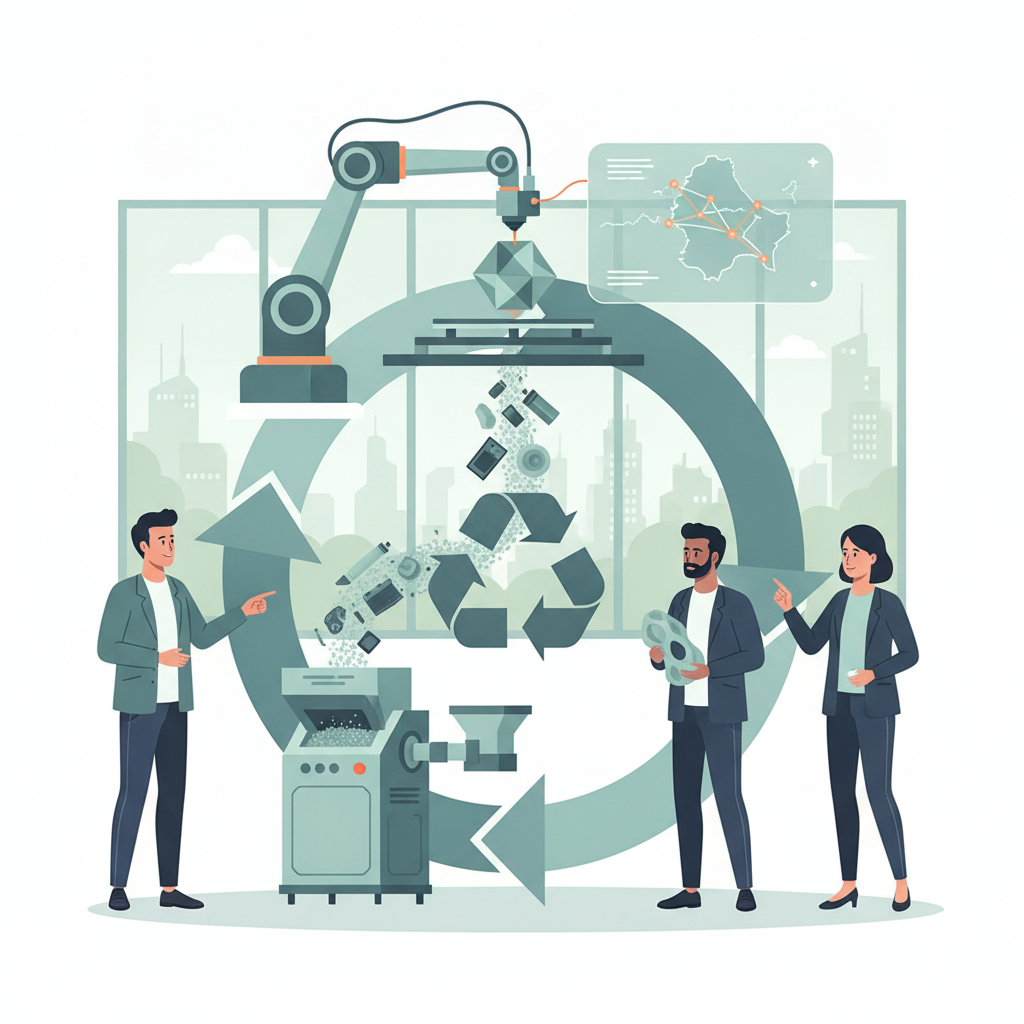
The core principles of the circular economy — "repair, reuse, refurbish, remanufacture, repurpose, recycle, recover" — align perfectly with the capabilities of 3D printing. Traditional manufacturing often leads to significant waste through overproduction, complex supply chains, and a "take-make-dispose" linear model. 3D printing, however, offers a paradigm shift:
- On-Demand Manufacturing: By producing items only when they are needed, 3D printing drastically reduces overproduction and inventory waste. This "just-in-time" approach is a game-changer for businesses aiming for efficiency and sustainability.
- Material Efficiency: Additive manufacturing builds objects layer by layer, often using only the material required for the final product, leading to minimal scrap waste compared to subtractive methods.
- Localised Production: The ability to manufacture products closer to the point of consumption significantly cuts down on transport-related emissions and packaging waste. This brings production home, making the supply chain more resilient and environmentally friendly. For an entreprise impression 3d luxembourg, this means less reliance on distant factories and a reduced carbon footprint for their products.
Driving Circularity Through Design and Repair
Beyond new production, 3D printing also empowers repair and refurbishment, extending product lifecycles. If a small, critical component breaks, it can be 3D scanned and then reprinted, often saving the entire product from being discarded. This approach is invaluable for industries and individuals alike:
- 3D Scanning for Reverse Engineering: Service scan 3d luxembourg enables businesses to capture the precise geometry of existing parts, facilitating reverse engineering for repair or improvement. This capability is vital for maintaining older machinery or creating custom solutions.
- Custom Parts and Prototyping: The ability to create custom 3d printing luxembourg solutions means bespoke components can be designed for specific needs, reducing the need for generic, ill-fitting parts that might not last. Furthermore, prototypage rapide luxembourg allows for quick iterations and testing of designs, ensuring products are perfected before full-scale production, thus minimizing material waste in the design phase.
- Recyclable Filaments: The growing market for recycled and recyclable achat filament 3d luxembourg, including PLA and filament petg luxembourg prix, further closes the loop, turning waste into new resources. This development is crucial for making 3D printing truly sustainable.
The EPA's warning that "Ireland is at risk of not meeting the recycling rate target of 65% by 2025" serves as a stark reminder for all EU nations. The call for "better segregation by households and businesses of materials into the correct waste bin" needs to be complemented by systemic changes in how products are designed, made, and consumed. An impression 3d industriel luxembourg can play a significant role in achieving these systemic shifts, offering flexible and sustainable manufacturing options.
Your Partner in Embracing the Circular Economy in Luxembourg
For businesses and individuals in Luxembourg looking to embrace these circular economy principles, leveraging 3D printing, 3D design, and 3D scanning services is a strategic move. Whether it's to create a new, waste-efficient product, replicate a broken part, or simply explore the possibilities of additive manufacturing, the opportunity to contribute to a more sustainable future is immediate. By choosing a comprehensive offre d'impression 3d luxembourg, you can ensure your projects align with EU sustainability goals and benefit from localised production and reduced waste.
The challenges highlighted by Ireland's waste statistics are a clear signal for all EU member states. For our target audience in Luxembourg, this means that adopting 3D printing solutions is not just about innovation, but also about playing a crucial role in building a resilient, circular economy. Partnering with experts like PrintIn3D.ie allows you to effortlessly bring your 3D ideas to life, contributing to a greener future without needing your own printer. Explore the possibilities, from création modèle 3d luxembourg to obtaining high-quality filament 3d prix luxembourg, and be part of the solution.