Circular Economy Reshaping Dutch 3D Printing Sector
Dutch 3D Printing Sector Shifts Towards Circular Economy Principles
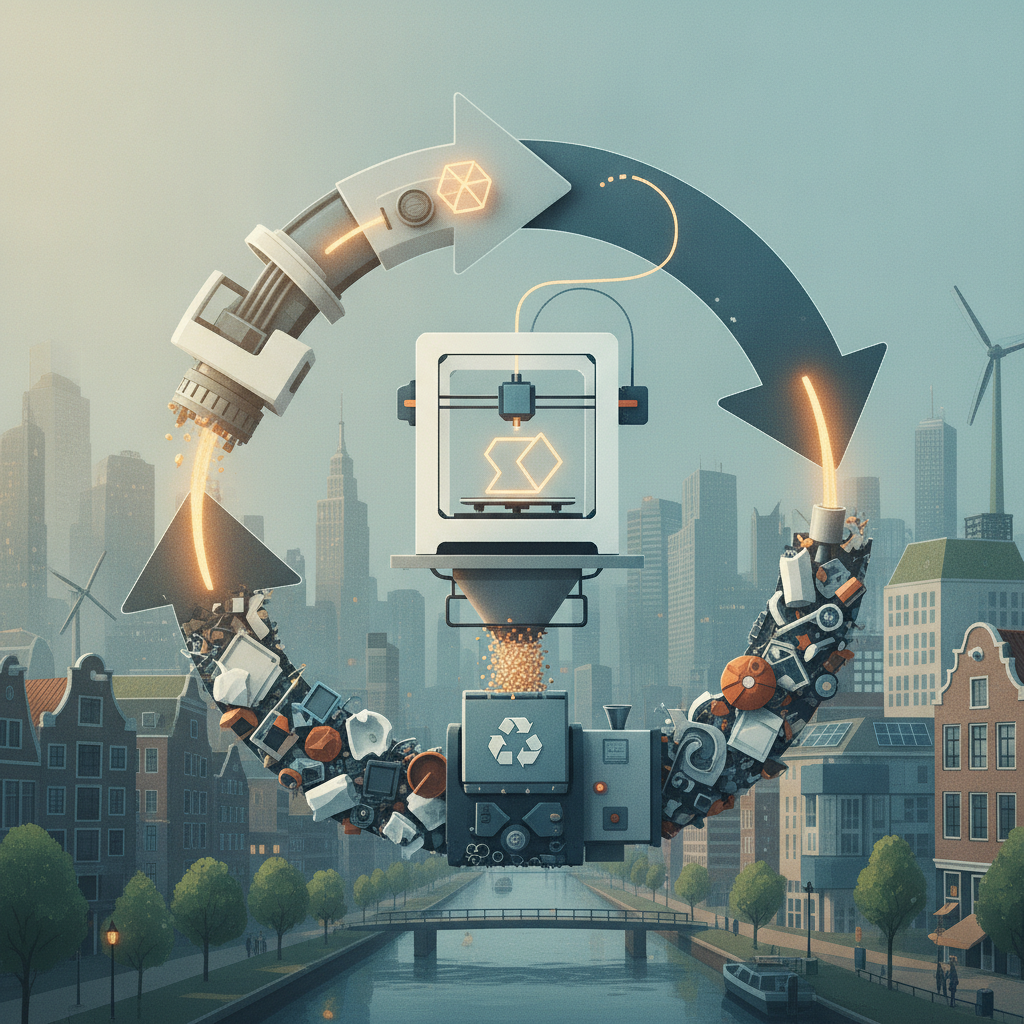
The 3D printing landscape in the Netherlands is undergoing a significant transformation, driven by the escalating focus on the circular economy. This shift extends beyond mere recycling, encompassing a broader commitment to longer product lifespans, ease of repair, extensive reuse, and the strategic integration of renewable raw materials. While no specific 48-hour news items detail this exact shift, current insights from key players like NEN, Prusa Research, and Materialise confirm a robust, ongoing movement towards sustainable practices that are reshaping the entire 3D print chain for both individuals and businesses across the Netherlands and the wider EU/EEA.
NEN's Vision for a Resource-Efficient Future
At the heart of this evolution is the Dutch Standardisation Institute (NEN), whose Circular Economy program is actively working across five key sectors, including manufacturing and plastics, to establish agreements aimed at significantly reducing raw material consumption. NEN emphasises that this initiative transcends simple recycling, focusing on a more holistic approach. According to NEN, "The program Circulaire Economie van NEN werkt in vijf sectoren en een aantal horizontale thema’s aan afspraken die het gebruik van grondstoffen terugdringen." This commitment extends to fostering a "langere levensduur van producten, mogelijkheid tot reparatie, hergebruik en het stimuleren van het gebruik van hernieuwbare grondstoffen." These principles are particularly pertinent for 3D printing, where design choices directly impact a product's maintainability, upgradeability, and eventual recyclability.
Industry Leaders Champion Sustainable Design
Leading 3D printing innovators are echoing NEN's call for circularity. Prusa Research, a prominent name in the industry, explicitly defines circular design by stating a product must be "easy to maintain, upgrade or repair," and at the end of its lifecycle, components should be "recycled or reused." This forward-thinking approach ensures that materials remain in use for as long as possible, reducing waste and the need for new resources. Similarly, Materialise, another key player, describes sustainability in additive manufacturing as "minimizing waste, efficient water and energy use, reducing raw material usage." These statements underscore a collective industry commitment to making 3D printing a truly sustainable technology.
Implications for the Dutch 3D Print Ecosystem
The push for a circular economy has profound implications for every aspect of the Dutch 3D printing sector:
- 3D Design Services: The emphasis is shifting significantly towards designing for disassembly, repair, and material reuse. For businesses and individuals in the Netherlands, this means a growing demand for expert 3d ontwerp service nederland that incorporates these principles from conception. Our CAD ontwerp 3d printen service is perfectly positioned to help clients transform ideas into print-ready models that meet future sustainability standards.
- 3D Printing Services: Businesses are increasingly seeking a reliable 3d print service voor bedrijven that aligns with circular principles, offering not just rapid prototyping but also durable, repairable end-use parts. The demand for 3d printen kunststof nederland solutions using recycled or bio-based materials is set to grow exponentially.
- 3D Scanning: While not explicitly stated in the immediate news, the focus on extending product lifespans and reuse makes 3D scanning more critical. It enables the digitisation of existing parts for repair, remanufacture, or the creation of small series of replacement components, directly supporting the longevity goals of the circular economy.
- Filament Sales: The market for 3D printer filaments in the Netherlands is seeing an increased demand for recycled, bio-based, or otherwise renewable raw materials. Companies must prepare for a future where material passports and closed-loop concepts become standard, driving the availability of more sustainable PLA and PETG options. Even 3d printen voor hobbyisten is seeing a move towards more conscious material choices.
This evolving landscape suggests that when you 3d print offerte aanvragen, asking about material origins, design for longevity, and end-of-life options will become increasingly common. Moreover, while sustainability is paramount, the need for 3d printen snelle levering nederland will remain crucial for businesses and individuals bringing their innovative ideas to life.
Looking Ahead: A Greener Future for 3D Printing
The push for a circular economy in the Netherlands signifies a pivotal shift for the 3D printing sector. It underscores a commitment to innovation that not only creates but also sustains. For individuals and businesses looking to bring their 3D ideas to life without owning a printer, this means access to services that are increasingly mindful of environmental impact, offering solutions that are not only high-quality and fast but also responsibly designed and manufactured. As your trusted 3D printing partner, we embrace these evolving standards, offering hassle-free services that align with a sustainable future. Explore how our custom 3D printing, 3D design, and filament services can support your projects with an eco-conscious approach.