EU Circular Economy Initiatives Boost 3D Printing's Role
EU Circular Economy Initiatives Pave Way for 3D Printing's Sustainable Future
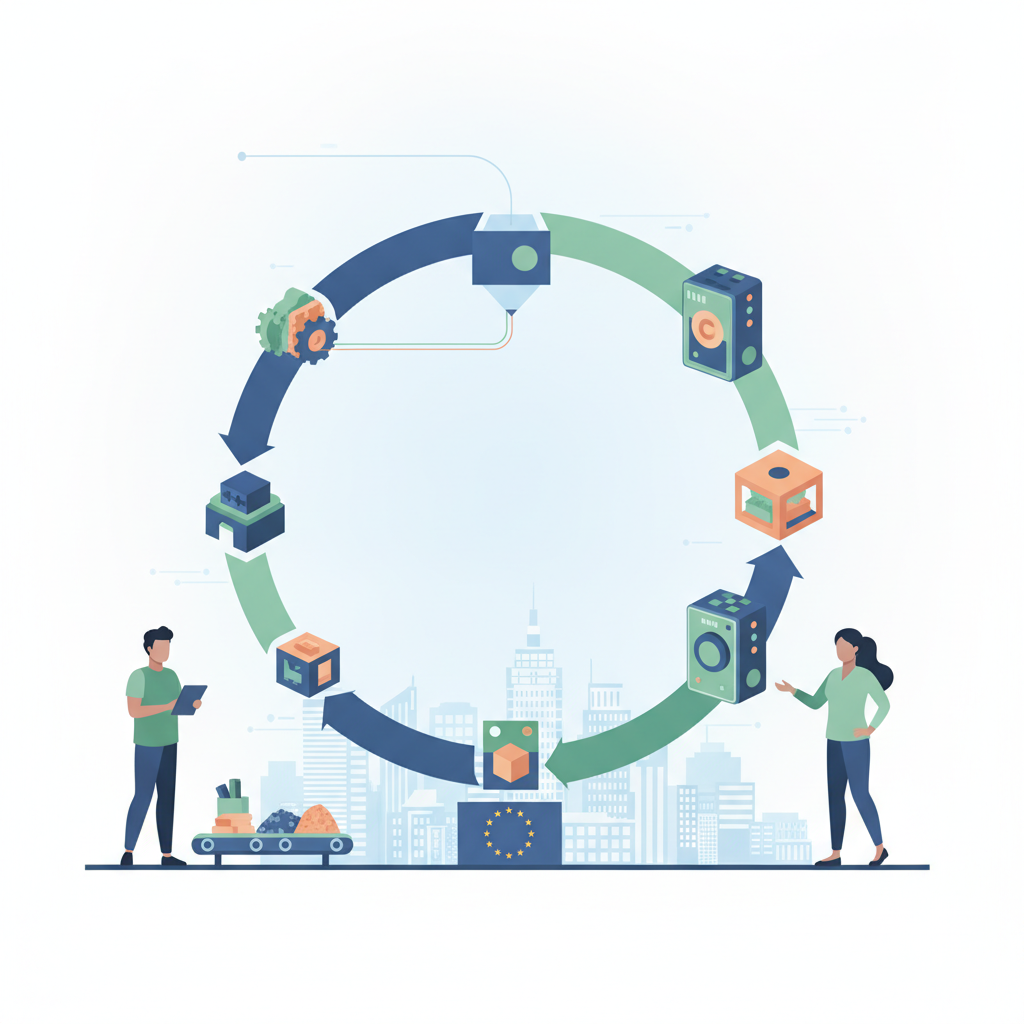
Recent advancements in the European Union's circular economy framework are setting a new precedent for sustainable manufacturing and consumption, with significant implications for the 3D printing sector across the EU, including Luxembourg. Key developments, such as the live Digital Product Passport Registry and the impending Packaging and Packaging Waste Regulation (PPWR), are driving demand for innovative solutions in product design, repair, and material use, positioning 3D printing as a crucial technology for achieving a low-carbon, circular economy.
These regulatory shifts underscore Europe's commitment to strengthening its industrial base while accelerating the transition to more sustainable practices. For businesses and innovators in Luxembourg, this signals a growing need for services that can adapt to these evolving demands, from advanced création modèle 3d luxembourg to the provision of filament 3d prix luxembourg that meets new sustainability criteria.
EU Regulations Drive Circularity and Innovation
The European Union is actively implementing a comprehensive strategy to foster a circular economy, moving away from the traditional linear 'take-make-dispose' model. A cornerstone of this strategy is the recently launched Digital Product Passport Registry. This initiative is designed to bolster supply chain transparency, empower consumers with sustainable and informed choices, and streamline compliance across the Single Market. For 3D printing, this translates into an increased need for traceable material inputs and robust digital product data management, ensuring every component's journey is documented and verifiable.
Further strengthening the circular framework is the Ecodesign for Sustainable Products Regulation (ESPR), which now prohibits large EU companies from destroying unsold clothing, accessories, and footwear. This regulation strongly encourages reuse, resale, donation, and recycling, compelling businesses to think innovatively about product lifecycle management. This directly benefits 3D printing by promoting repair-oriented design and local, on-demand production models that minimise waste.
Looking ahead, the Packaging and Packaging Waste Regulation (PPWR), effective from August 2026, mandates that all packaging must be designed for recycling by 2030 and recyclable at scale by 2035. This will undoubtedly spur innovation in sustainable packaging solutions, an area where 3D printing can offer rapid prototyping and custom design services for eco-friendly alternatives.
3D Printing: A Natural Ally for the Circular Economy
The inherent capabilities of 3D printing make it an ideal partner for the EU's circular economy goals. Its ability to create parts and products on-demand significantly reduces waste associated with overproduction and inventory. This is particularly relevant given the ESPR, as companies can leverage offre d'impression 3d luxembourg services to produce exact quantities, avoiding excess stock that might otherwise be destined for destruction.
Moreover, 3D printing excels in facilitating repair and maintenance. Instead of replacing an entire product, broken components can be reverse-engineered using service scan 3d luxembourg and then reproduced precisely. This extends the lifespan of goods, contributing directly to resource efficiency. This capability supports the growing demand for durable goods and the right to repair movement. For businesses requiring precise measurements for repair or replication, a scan 3d professionnel luxembourg service becomes invaluable.
The technology also drives innovation in materials. The push for a low-carbon and circular economy is increasing the demand for recycled and bio-based filaments. Companies are increasingly seeking to buy 3d filament luxembourg that aligns with these sustainability goals, including options like filament petg luxembourg prix and other low-carbon alternatives. This focus on sustainable materials, combined with the precision of impression 3d industriel luxembourg, allows for the creation of durable, resource-efficient products.
A Strategic Advantage for Luxembourg
For businesses and individuals in Luxembourg, these EU directives present not just compliance challenges, but also significant opportunities. The increasing emphasis on repair, reuse, and recycling will drive demand for expert création modèle 3d luxembourg services that can design parts for longevity and repairability. The need for traceable materials will boost interest in high-quality, sustainably sourced achat filament 3d luxembourg. Furthermore, the shift towards local, on-demand manufacturing perfectly aligns with the capabilities of 3D printing, enabling rapid prototyping luxembourg for new products and replacement parts, reducing global supply chain dependencies and environmental footprint.
In essence, the EU's ambitious circular economy agenda is creating a fertile ground for 3D printing to flourish as a cornerstone of sustainable industry. By embracing these changes, Luxembourg can solidify its position at the forefront of innovative and responsible manufacturing.
This evolving landscape presents a clear pathway for individuals and businesses in Luxembourg to leverage 3D printing for greater sustainability. Whether you're looking to develop repair-oriented designs, prototype new products with minimal waste, or source recycled and low-carbon filaments, the tools and services are increasingly vital. Embracing these advanced manufacturing methods offers a hassle-free solution to meet the demands of the circular economy.
As your dedicated 3D printing partner, we're here to help you navigate these exciting changes, offering custom 3D printing, expert design, and precise 3D scanning services, along with a wide range of quality filaments, to bring your sustainable visions to life. Explore how PrintIn3D.ie can support your journey towards a more circular future today.