German Mittelstand Embraces 3D Printing for Supply Chain Boost
German Mittelstand Drives Innovation with 3D Printing for Optimised Supply Chains and Cost Reduction
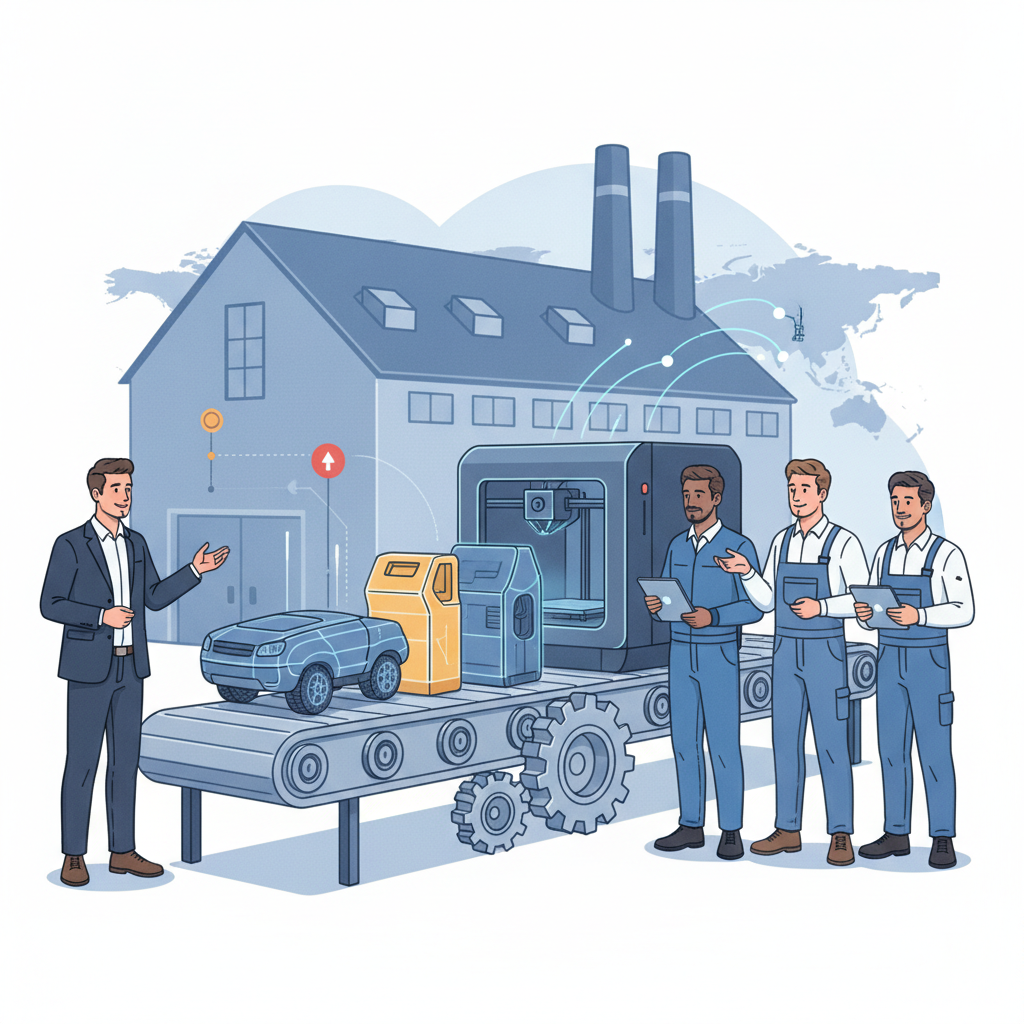
In a significant shift, the German Mittelstand is increasingly leveraging 3D printing, moving it from a prototyping tool to a core component of serial production. This strategic embrace of additive manufacturing is proving crucial for optimising supply chains and achieving substantial cost savings, as recent industry reports highlight a pivotal moment where serial products now represent the largest share of additively manufactured parts.
From Prototype to Production: The New Industrial Standard
For the first time, a German industry report confirms that serial production now accounts for the largest proportion of additively manufactured parts. This signals a mature transition where 3D printing is no longer just for development but is firmly established as a production tool within German industry. This development is particularly relevant for businesses seeking individuelle 3d-druck teile and ersatzteil nach maß 3d-drucken, enabling them to produce complex components with greater agility.
The timing aligns perfectly with the current economic climate. While the German economy ministry notes a slight easing in material shortages—falling to 13.7% of firms in July from 17.2% in June—the enduring lessons from recent supply chain disruptions underscore the value of localized production. Additive manufacturing offers a robust solution for businesses looking to secure their supply chains and reduce reliance on distant, potentially unstable sources. This empowers companies to produce 3d-druck ersatzteile on demand, dramatically cutting lead times and mitigating risks.
Accelerating Design and Reverse Engineering with Advanced 3D Scanning
The speed and efficiency of bringing ideas to life are also undergoing a significant transformation. Advances in 3D scanning and reverse engineering workflows are dramatically reducing turnaround times. Hexagon, a leader in digital reality solutions, recently announced an enhanced workflow linking its ATLASCAN Pro with Geomagic Design X. This integration promises to speed up model recreation for maintenance and repair teams by up to eight times compared to traditional CAD tools. This means that converting a physical object into a printable digital model – 3d-modell aus 3d-scan erstellen – is now faster and more accessible than ever. For the German Mittelstand, this translates into quicker development of prototypen aus dem 3d-druck and efficient creation of 3d-scan für ersatzteile, solidifying the role of a professional 3d-scan service. Whether it's for 3d-scanning von objekten or establishing a comprehensive 3d-scan service deutschland, these advancements make it easier to digitize existing parts and concepts.
The Era of High-Speed Filaments and Digital Supply Chains
Further driving the economic viability of 3D printing is the rapid development of high-speed filaments. eSUN recently introduced PLA-HF, a filament engineered for exceptionally fast FDM printing, claiming to maintain print quality at 600 mm/s and support up to an astonishing 1000 mm/s in compatible systems. This innovation opens new possibilities for rapid prototyping and small-batch production, making filament für prusa drucker and other FDM machines more efficient than ever. Whether businesses need petg filament kaufen deutschland, abs filament kaufen deutschland, asa filament für 3d-druck kaufen, or tpu filament kaufen deutschland, the focus is increasingly on materials that deliver both speed and quality.
This confluence of technological advancements is reshaping how German companies perceive their manufacturing processes. One report aptly describes this evolution as a shift "from a physical supply chain to a digital supply chain." This concept aligns perfectly with the Mittelstand's pursuit of cost and lead-time benefits, offering a streamlined approach to production. While the benefits for industry are clear, it's also important to acknowledge that the technology, like any powerful tool, requires responsible use. Recent news from Karlsruhe, where police discovered four 3D printers allegedly used for weapon production, serves as a stark reminder of the need for vigilance and ethical application.
What This Means for the German Mittelstand
For German businesses, these developments mean tangible improvements: lead times can be dramatically reduced by producing essential components and 3d-druck ersatzteile locally. Cost savings are becoming more accessible, particularly in low-volume, high-mix scenarios and for specialized repair applications where traditional tooling costs are prohibitive. The integration of advanced scanning and CAD tools makes 3d-modellierung für 3d-druck and reverse engineering a practical, fast route for legacy-part replacement. Finally, continuous filament innovation is pushing desktop and workshop printers towards faster throughput, significantly enhancing the economics for both prototyping and small-batch serial production.
As the German Mittelstand navigates an increasingly complex global landscape, embracing these 3D printing innovations offers a clear path to greater resilience, efficiency, and competitiveness. For those looking to capitalize on these trends, whether by needing a 3d-druck angebot anfragen, to 3d-datei erstellen lassen, or to source high-quality filaments, the future of manufacturing is here. You can even find inspiration or 3d-druck dateien downloaden to kickstart your next project.