Ireland's Right to Repair Boosts 3D Printing for Circular Economy
Ireland's Right to Repair Directive Paves Way for 3D Printed Spare Parts in Circular Economy Push
Ireland is making significant strides towards a robust circular economy, with the recent implementation of the **Right to Repair Directive** explicitly recognising the crucial role of **3D-printed spare parts**. This governmental commitment underscores a growing national focus on sustainability, offering unprecedented opportunities for **3D printing services in Dublin** and across the country to contribute to longer-lasting products and reduced waste.
The directive, managed by the Department of Enterprise, Trade and Employment, is a game-changer for consumers and businesses alike. Manufacturers covered by the new rules must now offer repair services, provide repairs within a reasonable timeframe, and make spare parts available at fair prices. Crucially, the legislation states that manufacturers “may not prevent the use of compatible, second-hand or certain 3D-printed spare parts where these comply with safety and legal requirements.” This policy shift directly empowers individuals and businesses to opt for repair over replacement, fostering a culture of reuse and resource efficiency.
3D Printing: A Catalyst for Repair and Sustainability
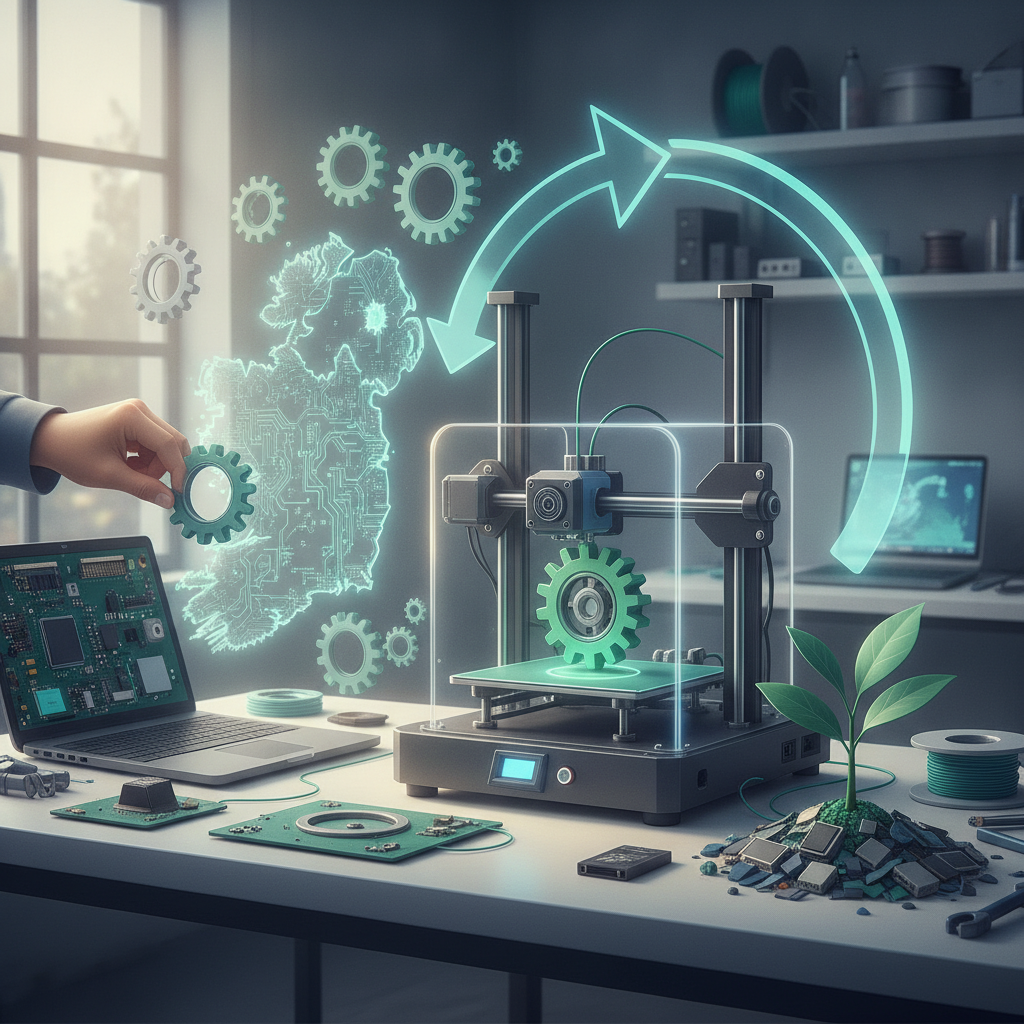
The explicit mention of 3D-printed spare parts in the Right to Repair Directive highlights additive manufacturing's unique position to revolutionise the repair industry. Traditional manufacturing often involves costly and time-consuming processes for producing replacement parts, especially for older or less common items. **Custom 3D printing services Ireland** can bypass these hurdles, rapidly producing bespoke components on demand.
For items that are no longer in production, or for which spare parts are simply unavailable, **3D scanning service Ireland** combined with **reverse engineering 3D scan service** becomes invaluable. A broken part can be scanned, digitally reconstructed, and then 3D printed, effectively bringing defunct items back to life. This process is not only cost-effective for consumers – making **how much does 3d printing cost ireland** a less daunting question compared to full replacement – but also significantly reduces the environmental footprint associated with manufacturing and discarding entire products.
This innovative approach directly supports the national repair directory, repairmystuff.ie, which aims to connect consumers with local B2C repair enterprises. As Ireland builds out its circular economy infrastructure, the demand for adaptable and efficient solutions like **3d printed replacement parts service** is set to soar. Businesses and individuals looking to contribute to this eco-conscious movement can leverage technologies like **rapid prototyping service ireland** to quickly develop and test new, durable replacement components.
Embracing Sustainable Materials for a Greener Future
While the Right to Repair Directive focuses on enabling repair, the broader context of the circular economy naturally leads to a focus on sustainable materials. Globally, the additive manufacturing sector is seeing significant advancements in this area, from recycled metal powders to bio-based filaments. For Irish businesses, this policy framework creates an environment where sourcing and utilising more sustainable 3D printing materials become a practical and environmentally responsible choice.
Companies acting as **bulk filament supplier Ireland** are increasingly important as the demand for diverse and sustainable materials grows. Filaments like PLA, often derived from renewable resources, and PETG, known for its durability and recyclability, are becoming staples. Furthermore, specialised materials such as **flexible TPU filament Ireland** are critical for creating robust and resilient parts that can withstand wear and tear, extending product lifespans even further. The availability of high-quality options like **Bambu Lab filament Ireland** also ensures that sustainable choices do not compromise on performance.
Recycling and resource recovery providers, such as Enva, operating across the UK and Ireland, play a vital role in closing the loop by processing waste into new feedstocks. This infrastructure is essential for the future growth of truly circular 3D printing within Ireland, where materials can be reused and repurposed, minimising landfill waste.
PrintIn3D.ie: Your Partner in Ireland's Circular Economy
For individuals and businesses in Ireland seeking to embrace the principles of the circular economy and leverage the power of 3D printing for repair and sustainability, PrintIn3D.ie stands as an expert and friendly partner. Whether you need a bespoke **custom 3d printed parts Ireland** for a broken appliance, require **3d scanning for product development** to reverse engineer a component, or seek **3d design and prototyping company** services to bring a sustainable solution to life, we offer hassle-free, high-quality services.
As Ireland moves decisively towards a more sustainable future, the synergy between policy, innovation, and dedicated service providers like PrintIn3D.ie will be key. We help you print your 3D dreams, supporting repair, reuse, and ultimately, a healthier planet. With our comprehensive **custom 3d printing services ireland**, we are ready to assist you in making your contribution to the circular economy, from a single part to **industrial 3d printing services** for larger projects. Get an online 3d printing quote Ireland today and discover how easy it is to bring your sustainable ideas to life.