Irish Schools Embrace Digital Future, Paving Way for 3D Printing Innovation
Irish Schools Invest in 21st-Century Learning, Fostering Innovation
In a significant move signalling a strong commitment to modern education, Kinsale Community School in County Cork is undergoing a massive €22 million, five-storey expansion. This ambitious project, announced recently, includes a state-of-the-art digital research hub designed to support “innovative teaching, collaboration and 21st-century learning.” This investment exemplifies a broader trend across Ireland to equip students with the skills necessary for a rapidly evolving digital world, creating fertile ground for advanced technologies like 3D printing to flourish in educational settings.
The substantial upgrade at Kinsale Community School, lauded by Micheál Martin as a reflection of “many of the positive advances in Irish society,” will also incorporate additional science facilities and specialist rooms for students with additional educational needs. This holistic approach to educational development highlights an understanding that preparing students for future careers requires not only traditional academic rigor but also hands-on experience with cutting-edge tools and methodologies.
Digital Hubs: A Gateway to Practical Innovation
The inclusion of a dedicated digital research hub at Kinsale is particularly noteworthy for its implications for technologies such as 3D printing, 3D design, and 3D scanning. These hubs provide the infrastructure and environment where students can move beyond theoretical concepts to practical application, turning digital ideas into tangible realities. Such facilities are crucial for developing problem-solving skills, fostering creativity, and nurturing the next generation of engineers and innovators.
While there hasn't been a recent, nationwide rollout report specifically detailing 3D printing adoption in Irish schools, these significant investments in digital learning infrastructure signal a clear path forward. Educational initiatives like the STEM Passport for Inclusion programme, which recently welcomed three secondary schools in Tallaght and Drimnagh for the 2026/27 academic year, further underscore Ireland’s commitment to broadening participation in STEM fields. These programmes naturally align with the capabilities offered by 3D technologies, which make complex concepts accessible and engaging.
3D Printing: Empowering Young Minds
The value of 3D printing in education has already been recognized in Ireland. A past primary-school competition tied to Stryker’s Empower3D prizes, for example, successfully challenged pupils to solve real school problems using 3D printing, significantly widening early STEM participation. Such initiatives demonstrate how readily students embrace this technology and its potential to transform their learning experience.
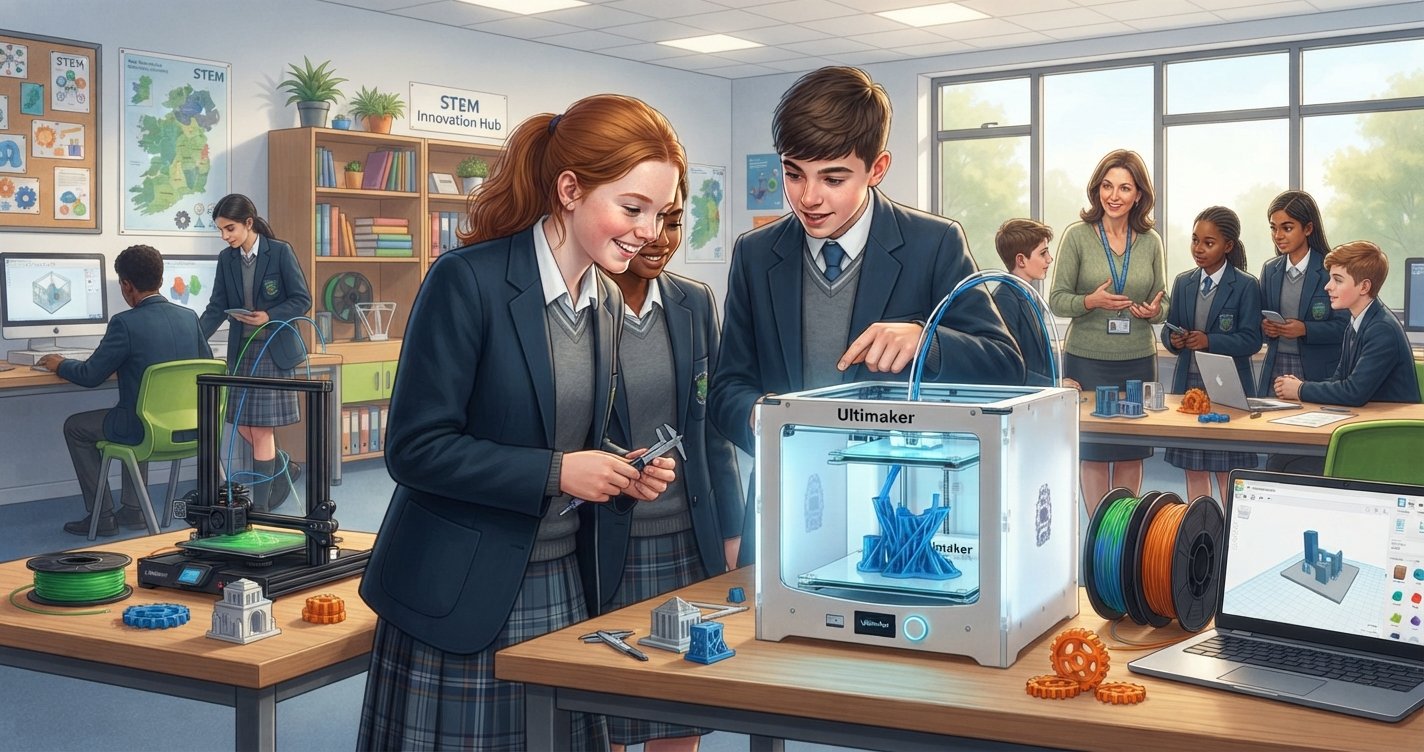
For young learners, 3D printing transforms abstract lessons into concrete experiences. Students can design and print prototypes for science projects, create historical artifacts for history lessons, or even engineer solutions to real-world problems. This hands-on approach encourages critical thinking and design iteration, skills that are invaluable in today's workforce. The ability to engage in 3d prentun eftir pöntun (3D printing on demand) within schools empowers students to rapidly test ideas and learn from practical experimentation, much like professional engineers and designers do.
A Future Shaped by Design and Fabrication
As Irish schools continue to invest in digital learning and STEM, the demand for accessible 3D printing, 3D design, and 3D scanning solutions will undoubtedly grow. These technologies are not just tools; they are gateways to new ways of thinking and creating. They help students understand manufacturing processes, material science, and digital fabrication from an early age, giving them a significant advantage as they progress through their education and into careers.
The shift towards integrating advanced digital technologies into the core curriculum means that future generations will be more adept at leveraging tools for rapid prototyping and innovative design. Whether it’s through dedicated digital research hubs or broader STEM programmes, Irish education is clearly setting the stage for a future where students are not just consumers of technology but active creators and innovators.
For educators and institutions looking to integrate custom 3D printing capabilities into their curricula, or for students and departments requiring 3D design services for projects, the evolving landscape presents exciting opportunities. The growth in digital learning environments provides an ideal backdrop for expanding the use of such transformative technologies, supporting students in their journey to become future leaders in design and engineering. For those seeking expert 3d prentunarþjónusta (3D printing services) or even high-quality 3D printer filament, the infrastructure to support these educational advancements is readily available.
This commitment to digital and STEM education means that the next generation of Irish innovators will be well-prepared to tackle complex challenges, bringing their creative ideas to life with advanced tools like 3D printing, mirroring the dynamism found in 3d prentun ísland (3D printing in Ireland) and across the globe.