NL Boosts Circular Economy, 3D Printing Key
Netherlands Forges Ahead with Circular Manufacturing Roadmaps, Paving Way for 3D Printing Innovation
The Hague, Netherlands – August 8, 2026 – The Dutch government's ongoing commitment to a robust circular economy has taken another significant step forward with the publication of new "routekaarten circulaire maakindustrie" (circular manufacturing industry roadmaps) by PIANOo on August 4, 2026. These comprehensive guidelines, integral to the national strategy for critical materials, lay the groundwork for industries to transition towards more sustainable practices. While not explicitly naming additive manufacturing, these roadmaps inherently highlight the pivotal role technologies like 3D printing can play in fostering a truly circular economy in the Netherlands, particularly through enabling on-demand repair parts, localized production, and optimized material usage.
The PIANOo initiative underscores the strategic importance of integrating circular principles across the manufacturing sector. This national approach aims to reduce dependence on virgin raw materials, minimize waste, and create more resilient supply chains. For the rapidly evolving 3D printing industry, these policy developments open vast opportunities, aligning perfectly with its core strengths in efficiency, customization, and local manufacturing capabilities.
How 3D Printing Drives Circularity in the Netherlands
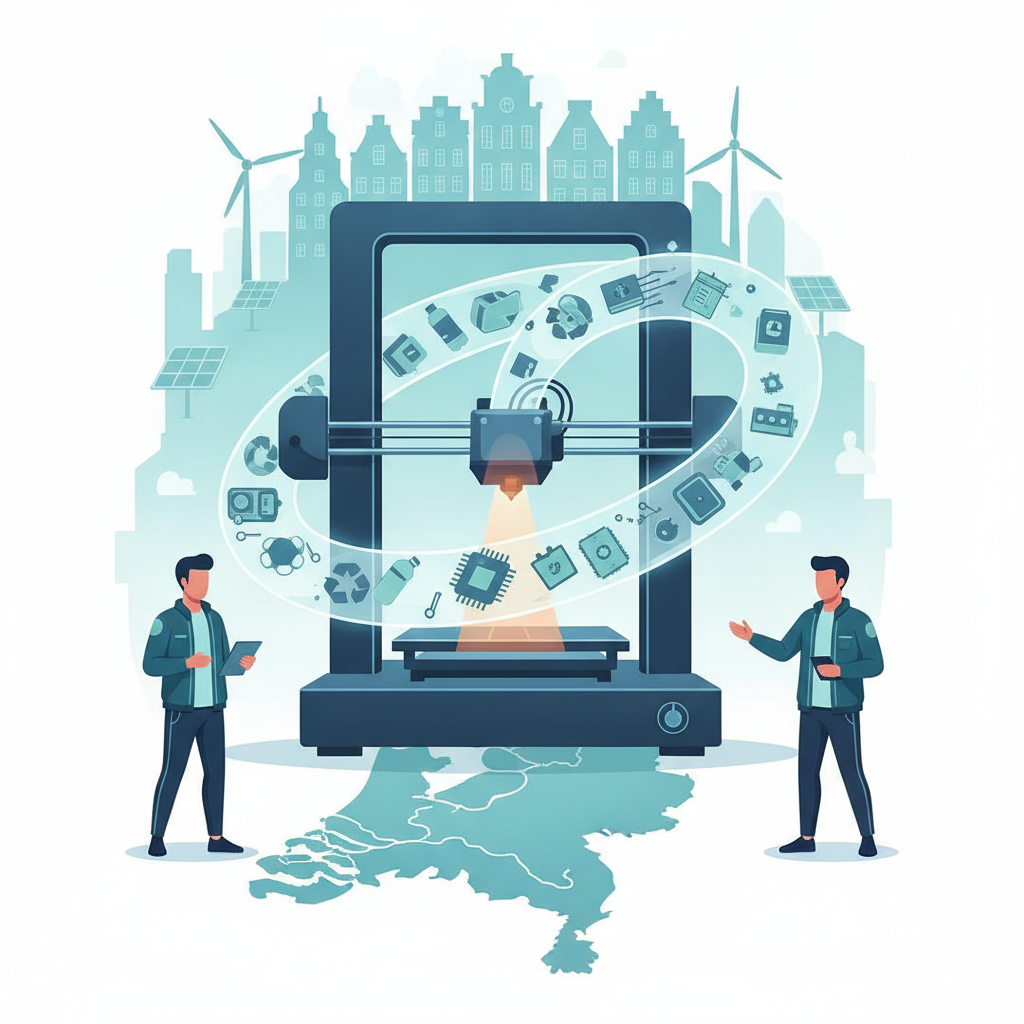
The vision outlined in the circular manufacturing roadmaps resonates strongly with the inherent advantages of 3D printing. This technology is uniquely positioned to address several key pillars of the circular economy:
- On-Demand Repair and Longevity: A major aspect of circularity is extending the lifespan of products. Traditional manufacturing often necessitates stocking a wide array of spare parts, which can be inefficient and costly. However, with 3D printing, components can be produced only when needed, reducing inventory waste and ensuring immediate availability. This is particularly transformative for industries requiring custom or obsolete parts. For businesses and even 3d printen voor hobbyisten, the ability to replicate a broken part or design a customized replacement using a 3d ontwerp service nederland means products can be repaired rather than replaced, saving resources and money.
- Local Production and Reduced Logistics: The roadmaps encourage local value creation and reduced reliance on global supply chains. 3D printing facilitates decentralized production, enabling goods to be manufactured closer to the point of consumption. This drastically cuts down on transportation emissions and logistics costs, making "lokaal produceren" a tangible reality. A 3d print service voor bedrijven in the Netherlands can offer 3d printen snelle levering nederland, providing quick turnaround times for custom parts and prototypes, thus strengthening local economies and supply chains.
- Material Efficiency and Waste Reduction: Additive manufacturing is inherently more material-efficient than traditional subtractive methods, which often generate significant waste through cutting and shaping. 3D printing builds objects layer by layer, using only the necessary material. This precision leads to less scrap and a more efficient use of resources, especially crucial when working with diverse materials like 3d printen kunststof nederland. Furthermore, the potential for using recycled filaments or designing products for easier disassembly and recycling post-life fits perfectly within circular principles.
- Rapid Prototyping and Iteration for Circular Design: The ability to quickly prototype and iterate designs with 3D printing allows engineers and designers to test circularity concepts from the outset. Companies can experiment with modular designs, designs optimized for repair, or those that facilitate material recovery, ensuring circular principles are embedded from the initial cad ontwerp 3d printen phase. This accelerates the development of truly sustainable products.
Broader Dutch Commitment to Industrial Sustainability
The PIANOo report is not an isolated event but part of a broader national push towards industrial decarbonisation and circularity. Recent news highlights from the National Programme for Industrial Decarbonisation showcase initiatives such as the reuse of captured heat and the establishment of a circular factory for processing end-of-life tires into raw materials. Additionally, a "moonshot project" for refurbished installation materials, launched on August 7, 2026, further exemplifies the Netherlands' dedication to integrating circular practices across various industrial sectors.
These developments create a fertile ground for 3D printing to flourish as a key enabling technology. As businesses in the Netherlands look to align with national sustainability goals and seek innovative solutions, the value proposition of additive manufacturing becomes increasingly clear. From individual makers to large corporations, the demand for adaptable, efficient, and locally available manufacturing solutions is set to grow.
What This Means for Individuals and Businesses in the Netherlands
For individuals and businesses across the Netherlands, these national circular economy roadmaps signal a future where sustainability is not just an aspiration but a fundamental aspect of manufacturing and consumption. 3D printing stands out as a critical tool in this transition, offering practical solutions for everything from custom repair parts to innovative product development. Whether you're a designer looking for a reliable 3d ontwerp service nederland, a business seeking a responsive 3d print service voor bedrijven, or simply need to request a 3d print offerte aanvragen for a sustainable project, the alignment of 3D printing with national circular goals ensures its growing relevance and impact.
As your dedicated 3D printing partner, PrintIn3D.ie is ready to help you contribute to a more circular future. We provide hassle-free custom 3D printing, expert 3D design, and quality 3D printer filaments, ensuring your projects are not only brought to life with precision but also contribute to a more sustainable economy.