Pentagon Drives US Defense Via On-Demand 3D Printing
Pentagon Intensifies Push for On-Demand 3D Printed Parts, Fortifying US Defense Supply Chains
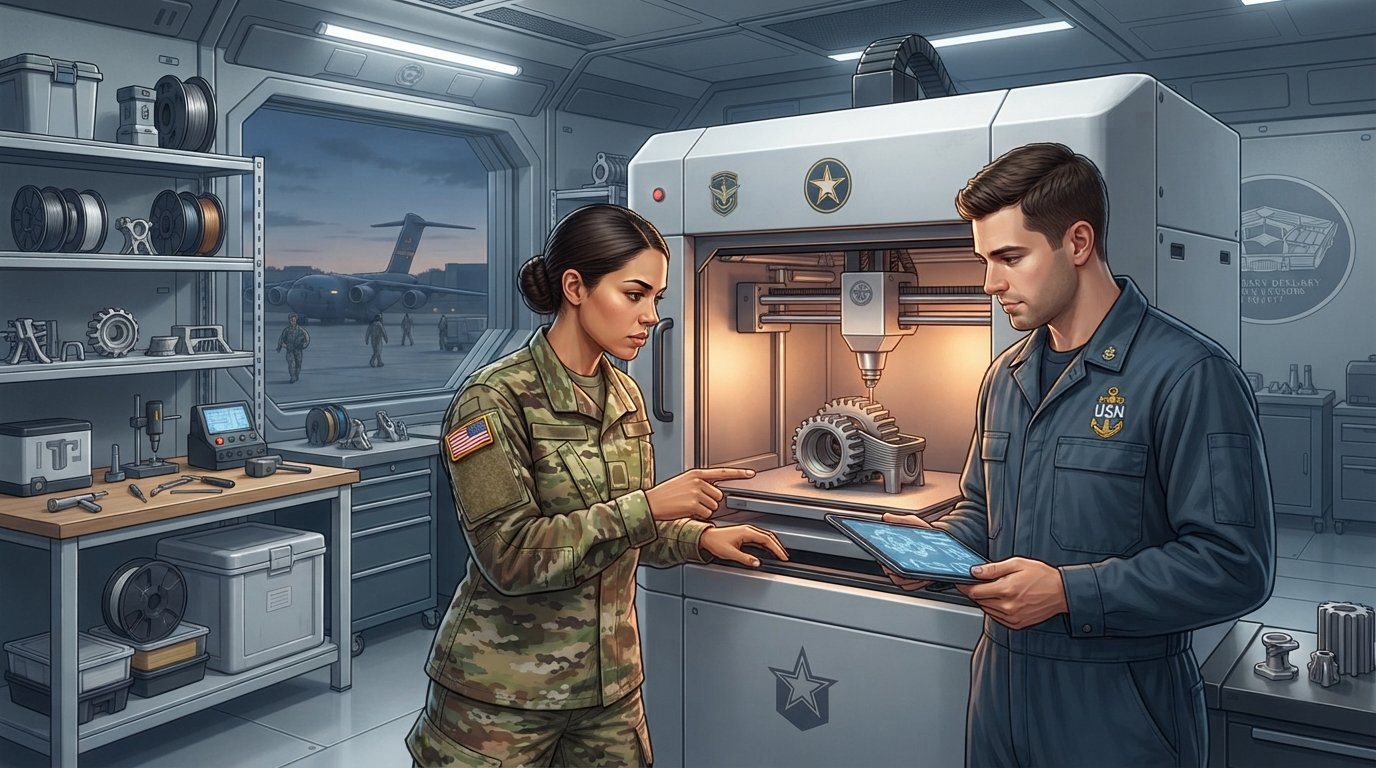
The United States defense sector is rapidly accelerating its adoption of on-demand 3D printing and advanced additive manufacturing technologies, with recent developments underscoring a strategic pivot towards enhanced supply chain resilience and distributed production. This decisive move, spearheaded by entities like the Pentagon and the Defense Logistics Agency (DLA), aims to ensure the continuous availability of critical parts, reduce logistical vulnerabilities, and drive industrial-scale innovation across military applications.
DLA's Vision: AI, 3D Printing, and Digital Part Inventories
Central to this initiative is the DLA's proactive engagement in distributed production wargames, which recently highlighted the indispensable roles of Artificial Intelligence (AI), 3D printing, and rigorously "qualified digital part inventories." According to a recent DLA post, the bedrock of supply chain resilience lies not just in the physical printers but equally in the certification data accompanying these digital inventories. This emphasis signals a future where parts can be manufactured closer to the point of need, mitigating disruptions and ensuring rapid deployment of essential components. This innovative approach to managing parts speaks directly to the benefits of a robust 3D design and 3D printing service, where digital models are paramount.
Industrial Scale Manufacturing Takes Center Stage
The shift from prototyping to industrial-scale application is evident across several key advancements:
- Submarine Production with AML3D: Australian additive manufacturing specialist AML3D has commenced metal 3D printing production parts for U.S. Navy submarines at its technology center in Stow, Ohio. This significant step demonstrates the military's confidence in bulk 3D printing service capabilities for highly critical and complex components, showcasing industrial-scale metal additive manufacturing.
- Rapid Large-Scale Fabrication by U.S. Army: The U.S. Army Engineer Research and Development Center recently achieved a remarkable feat, 3D printing its largest miter gate model to date in just 27 hours. Utilizing a CEAD Flexbot and Adaxis slicing software, this underscores the potential for rapid, large-scale fabrication in defense engineering, dramatically shortening lead times for infrastructure and specialized equipment.
- Hypersonic Munitions with VulcanForms and Specter Aerospace: A new manufacturing partnership between VulcanForms and Specter Aerospace aims to scale low-cost hypersonic munitions, interceptors, and cruise missiles. This collaboration is specifically designed to "shorten design cycles, strengthen its supply chain, and cut costs," leveraging advanced manufacturing for high-performance defense systems. The integration of sophisticated cad design services for 3d printing is crucial for such complex projects.
Boosting Efficiency and Mitigating Risk with Advanced Tooling and Data Management
Further bolstering the defense sector's capabilities are innovations in tooling and data sharing:
- Massivit's RapidWings for Aerospace: Massivit has expanded its RapidWings composite tooling platform into North America, targeting aerospace and defense clients. This platform promises to slash tooling lead times from months to mere days and reduce overall tooling time by an astonishing 90%, offering unprecedented agility in manufacturing complex composite parts. Such efficiency could pave the way for advancements using specialized materials, including potentially high temperature 3d printer filament for robust tooling applications.
- Velo3D Joins GIDEP: Velo3D, a prominent 3D printing company, has joined the Government-Industry Data Exchange Program (GIDEP). This provides access to a vast database encompassing technical, reliability, obsolescence, and nonconformance data for tens of millions of part records. This participation is a critical move towards supply-chain risk mitigation, ensuring reliability and availability of components across the defense industrial base. The ability to 3d scan to cad service and integrate physical parts into such digital inventories becomes invaluable here, linking the physical to the digital for comprehensive data management.
Resilience Through Distributed Production and Data
The overarching theme emerging from these developments is a robust commitment to resilience through distributed production. The ability to print parts closer to the point of need, reduce dependence on lengthy and potentially vulnerable supply chains, and validate components through shared digital data and certification workflows is paramount. This signals a future where specialized components, spare parts, and tooling can be produced on-demand, transforming the defense landscape from reactive to proactively adaptable. For businesses needing components quickly, having an online 3d printing service that can cater to varying volumes, from custom prototypes to a bulk 3d printing service, is increasingly vital.
What This Means for Our Audience
These transformative advancements in the US defense sector underscore the burgeoning importance of 3D printing, 3D design, and 3D scanning across all industries. The military's push for distributed, on-demand manufacturing highlights the immense value of accessible, high-quality 3D printing services for businesses and individuals alike. Whether you're an innovator looking to prototype a new idea, a small business requiring specialized tools, or a large enterprise needing a reliable supply of custom parts, the core principles of rapid production, design flexibility, and supply chain resilience apply. PrintIn3D.ie stands ready to be your partner, offering hassle-free custom 3D printing, expert 3D design, and precise 3D scanning services to bring your 3D dreams to life, along with a wide range of quality filaments.