UK Green Manufacturing Shifts with Sustainable 3D Printing
UK Green Manufacturing Shifts with Sustainable 3D Printing Filaments
Recent innovations in sustainable 3D printing filaments and green manufacturing processes are rapidly reshaping the production landscape for businesses across the UK. Key developments, including the launch of advanced filament recycling systems and the introduction of UK-made biopolymer products, signal a significant pivot towards circular economy practices within the additive manufacturing sector. This shift offers UK businesses tangible, evidence-based solutions for greener procurement and more environmentally conscious production methods.
Creality Unveils Circular Material Workflow at IFA 2026
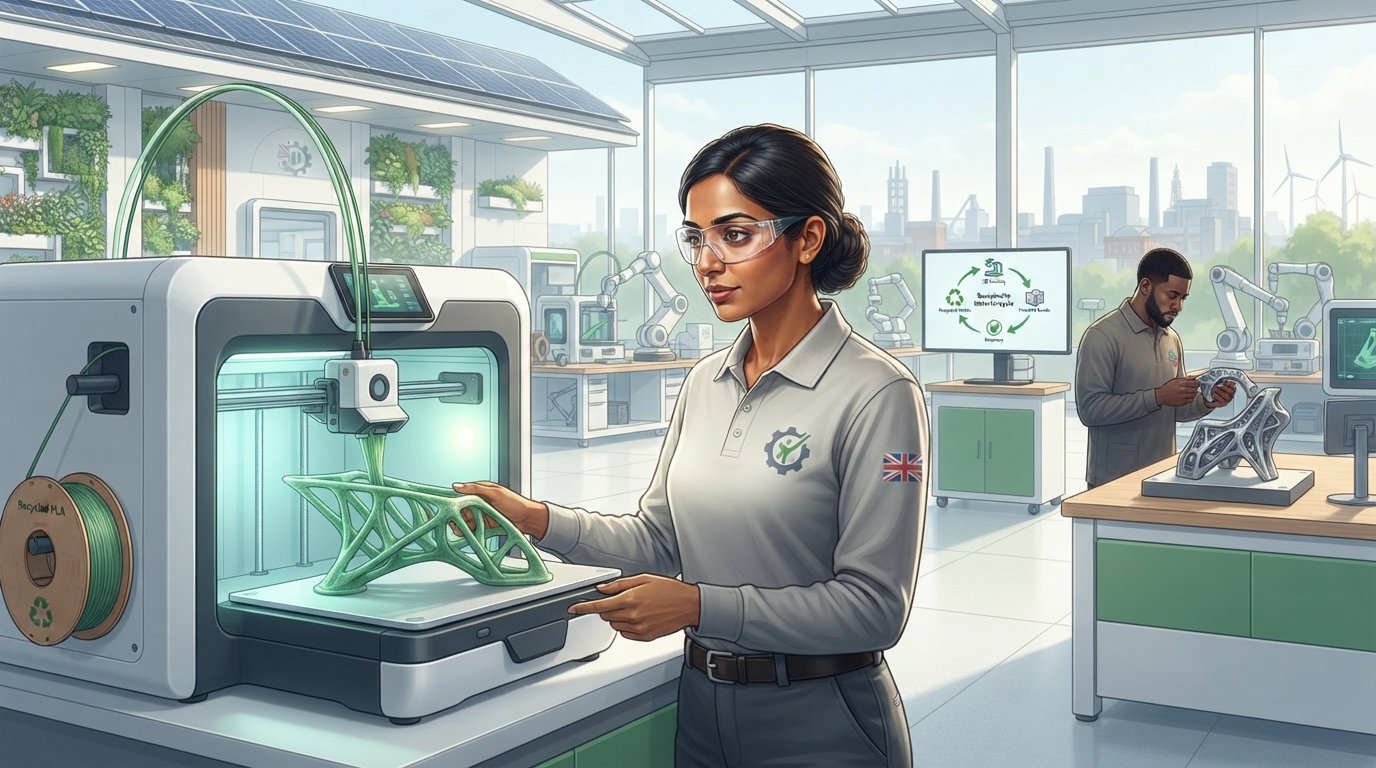
At IFA 2026, global 3D printing giant Creality introduced a groundbreaking filament-recycling workflow, reinforcing the industry's commitment to sustainability. Their new ecosystem, which spans multi-channel and multi-material 3D printing, alongside resin printing, 3D scanning, and laser creation, prominently features the **M1 Filament Maker**. This innovative system allows users to process plastic waste and failed prints into new, usable filament, effectively closing the loop on material consumption. Creality explicitly stated that "the M1 Filament Maker extends 3D printing into a more circular material workflow," enabling users to "process plastic and failed prints into new filament."
The significance of this development was further highlighted by its recognition at the IFA Innovation Awards 2026, where the M1 Filament Maker was named a Winner, with the K3 system receiving an Honoree award. This accolade explicitly linked Creality's advancements to "more sustainable material workflows," underscoring the potential for businesses looking to enhance their environmental credentials. For any 3D printing company UK or a business seeking a comprehensive 3D design service for new, eco-friendly prototypes, this kind of innovation points towards a future where waste is minimised, and resources are maximised.
UK Innovation: Biopolymer Lights and Domestic Recycling Options
Further strengthening the UK's position in green manufacturing, Peterborough-based Shoplight recently unveiled a significant advancement in the built-environment sector. They introduced what is described as the first UK-made track-mounted linear luminaire crafted from naturally derived plastic. This innovative product showcases a blend of manufacturing techniques, with the body extruded and the end caps meticulously 3D printed using a biopolymer. This initiative demonstrates how advanced manufacturing techniques, including 3D printing rapid prototyping UK, are being applied to create sustainable, commercially viable products, moving beyond mere experimentation.
In parallel, UK businesses looking for reliable, domestically sourced recycled filament options continue to benefit from companies like Filamentive. This UK-based firm specialises in making rPLA from post-industrial extrusion waste, offering a compelling choice for those prioritising responsible sourcing. As of mid-2025, Filamentive's PLA contains 50% verified recycled content, a claim independently verified to ISO 14021. This provides procurement and operations buyers with a strong, evidence-based option for their premium 3d printer filament needs, directly supporting ESG initiatives and enhancing customer-facing sustainability claims. The availability of high-quality PLA filament UK with such robust verification offers a clear path to greener production for many businesses.
The Impact on UK Businesses: Embracing a Circular Future
These recent developments hold significant implications for UK businesses engaged in or considering additive manufacturing. The most actionable trend is the move towards closed-loop filament use, exemplified by Creality's M1 system. The ability to convert waste prints and scrap plastic back into usable filament can drastically reduce material waste and provide strong data for sustainability reporting. This is particularly relevant for companies that generate a high volume of 3D printed parts UK, whether for prototyping or final production.
For UK buyers, the landscape of green procurement is becoming clearer and more robust. With options like Filamentive's ISO 14021-verified recycled 3D printing materials UK, businesses now have stronger, evidence-based choices that align with environmental goals and help meet increasingly stringent regulatory and consumer demands for sustainable products. Whether a business needs a 3D printing service London UK or a 3D printing company near me in other regions, the availability of these materials will drive demand for providers who can utilise them.
The broader manufacturing signal is unmistakable: 3D printing is evolving beyond its traditional role in prototype tooling. It is now moving confidently towards circular production workflows, especially in products that intelligently blend 3D printing with recycled or bio-based polymers. This trend empowers businesses to pursue ambitious sustainability goals, from creating custom designs with a custom 3d design service to full-scale production of 3D printing online UK, knowing their choices contribute positively to the environment.
Your Partner in Sustainable 3D Printing
For UK businesses and individuals looking to explore these sustainable opportunities, the message is clear: 3D printing offers a tangible path to greener production. Whether you require a professional 3d modelling service UK for an innovative biopolymer design, need custom 3D printing local UK for a new product, or are looking to source verified recycled PLA filament UK for your own projects, the industry is ready to support your green initiatives. These advancements mean that bringing your 3D dreams to life can now be more environmentally responsible than ever before.