
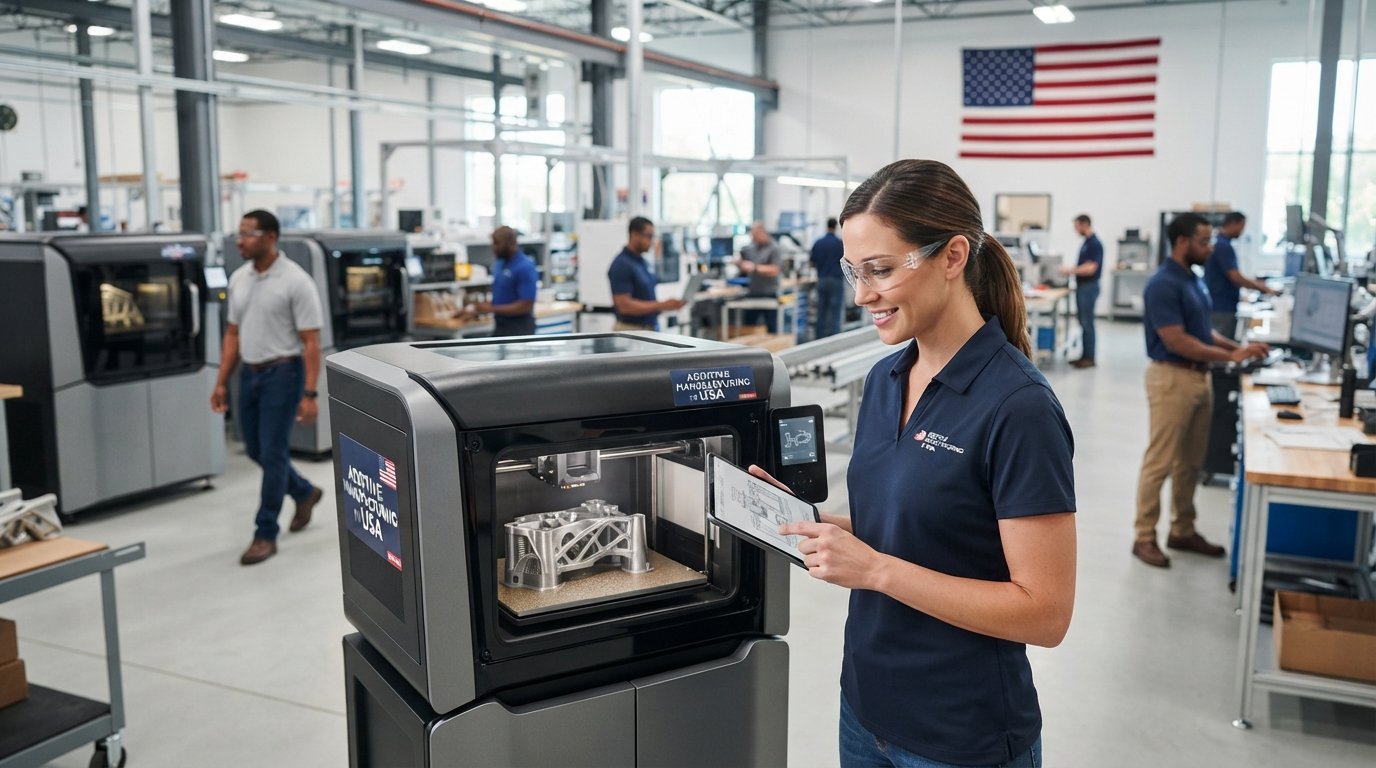
US Manufacturing Boosts Resilience with Local 3D Printing
US Manufacturing Embraces Local 3D Printing to Bolster Supply Chain Resilience
In a significant shift towards enhancing domestic supply chain resilience, leading US manufacturers are rapidly expanding their adoption of local 3D printing technologies. Recent developments reveal that industry giants like General Motors and Georgia-Pacific are integrating additive manufacturing (AM) directly into their facilities, signaling a strategic move to shorten lead times, reduce dependence on distant suppliers, and foster faster, more agile production networks. This trend is underscored by new research indicating widespread concern over future supply chain disruptions, despite a general confidence in current resilience.
Manufacturers Prioritize Local Production and Agility
The imperative for stronger, more reliable supply chains is clearly driving this accelerated embrace of 3D printing. General Motors, for example, is making a substantial investment by expanding Stratasys 3D printing capabilities across 20 manufacturing facilities. This allows their teams to locally develop and validate critical solutions, which can then be shared throughout the network, leading to significantly faster response times and a reduced reliance on external, often distant, suppliers. This initiative speaks volumes about the growing need for a responsive 3d printing service near me within the industrial landscape.
Similarly, Georgia-Pacific is showcasing the immediate benefits of onsite 3D printing at its Oklahoma and Alabama facilities. By producing small parts and protective solutions in-house, they are effectively replacing lengthy lead times with immediate, on-demand manufacturing. This demonstrates how custom 3d printing service capabilities, when localized, can dramatically cut costs and improve operational efficiency for various components, from specialized tooling to replacement parts.
Addressing Supply Chain Concerns with Additive Manufacturing
New insights from Supply Technologies' 2026 resilience study highlight the driving force behind these strategic investments. An alarming 82% of manufacturing professionals express worry about potential disruptions in the next 12 months. While 80% rate their current supply-chain resilience at 7/10 or higher, the proactive measures being taken are undeniable. A significant 48% are actively expanding nearshore or regional sourcing, and 54% are diversifying their supplier base. These figures reinforce the strategic shift towards localized production and the invaluable role that additive manufacturing plays in achieving this.
The move also addresses a broader ambition to reestablish "technological sovereignty." Meltio's release of a US-assembled Robot Cell through its partner FORCE Automation is a testament to this goal. As Meltio's North America sales manager noted, this local assembly aims to tackle "obsolescence, logistics nightmares, and excessive costs of operation"—challenges that often plague global supply chains. For a us 3d printing company, supporting such localization efforts is paramount.
Advanced Materials and Digital Transformation
Beyond traditional manufacturing, advanced sectors are also leveraging 3D printing for greater resilience. Recent reports indicate that VulcanForms and Specter Aerospace are utilizing additive manufacturing to accelerate adaptive development, paving the way for a more resilient supply chain, particularly in defense applications. This push for advanced capabilities often involves specialized materials, increasing the demand for suppliers of high-performance options like carbon fiber filament supplier or robust industrial-grade materials.
The current news flow also strongly supports an increased focus on the "digital thread" and reverse-engineering applications. This means an escalating demand for expert 3d design and 3d printing service providers who can convert physical objects or concepts into print-ready 3D models. Moreover, 3d scanning service providers are becoming essential for creating precise digital twins of parts, enabling rapid replication and on-demand production, further reinforcing the local manufacturing ecosystem.
Implications for the 3D Printing Market
This widespread industrial adoption of localized 3D printing signals a robust demand surge across several facets of the additive manufacturing sector. For businesses and individuals, this means a growing ecosystem that supports quicker prototyping, specialized tool production, and on-demand part fabrication without the need for significant capital investment in their own equipment. The market for industrial-grade filaments, such as those made from PETG and TPU, is also set to benefit significantly.
For those looking to procure materials, the emphasis on local production means a steady rise in demand for a reliable 3d printer filament supplier usa. Whether it's bulk pla filament usa for general manufacturing, petg filament supplier usa for durable parts, or specialized options like tpu filament for 3d printer for flexible applications, the need for readily available materials is growing. This also extends to businesses requiring larger volumes, driving the demand for 3d printer filament wholesale and services like bulk 3d printing service to support new regionalized production strategies.
These transformative changes in US manufacturing underline the increasing importance of accessible and reliable 3D printing solutions. For individuals and businesses looking to leverage these advancements without the overhead of owning and operating their own equipment, services that offer custom 3D printing, 3D design, and 3D scanning are invaluable. Whether you're a small business needing a prototype, or a larger entity looking for a reliable partner to produce parts, the ability to access an expert online 3d printing service and filament supplier is more critical than ever. We're here to be your partner, bringing your 3D ideas to life with hassle-free, expert service.