3D Printer vs. Service: Your Icelandic Guide to Hassle-Free Printing
Owning a 3D Printer vs. Using a 3D Printing Service in Iceland: Your Ultimate Guide
In the vibrant, innovative landscape of Iceland, the world of 3D printing is rapidly expanding, offering incredible possibilities for hobbyists, entrepreneurs, and businesses alike. As you consider bringing your digital designs to life, a fundamental question often arises: should you invest in your own 3D printer, or is it more advantageous to utilise a professional 3d prentunarþjónusta (3D printing service)? This decision isn't just about cost; it's about weighing convenience, quality, time, and your specific needs.
Here at PrintIn3D, your trusted 3D printing partner, we understand this dilemma deeply. We're here to help you navigate these options, ensuring you make the choice that best suits your goals for 3d prentun ísland. Whether you're looking to prenta 3d hlut for a personal project, create rapid prototypes for your startup, or require high-quality components for your business, understanding the pros and cons of each path is crucial.
Quick Overview: Your Paths to 3D Creation in Iceland
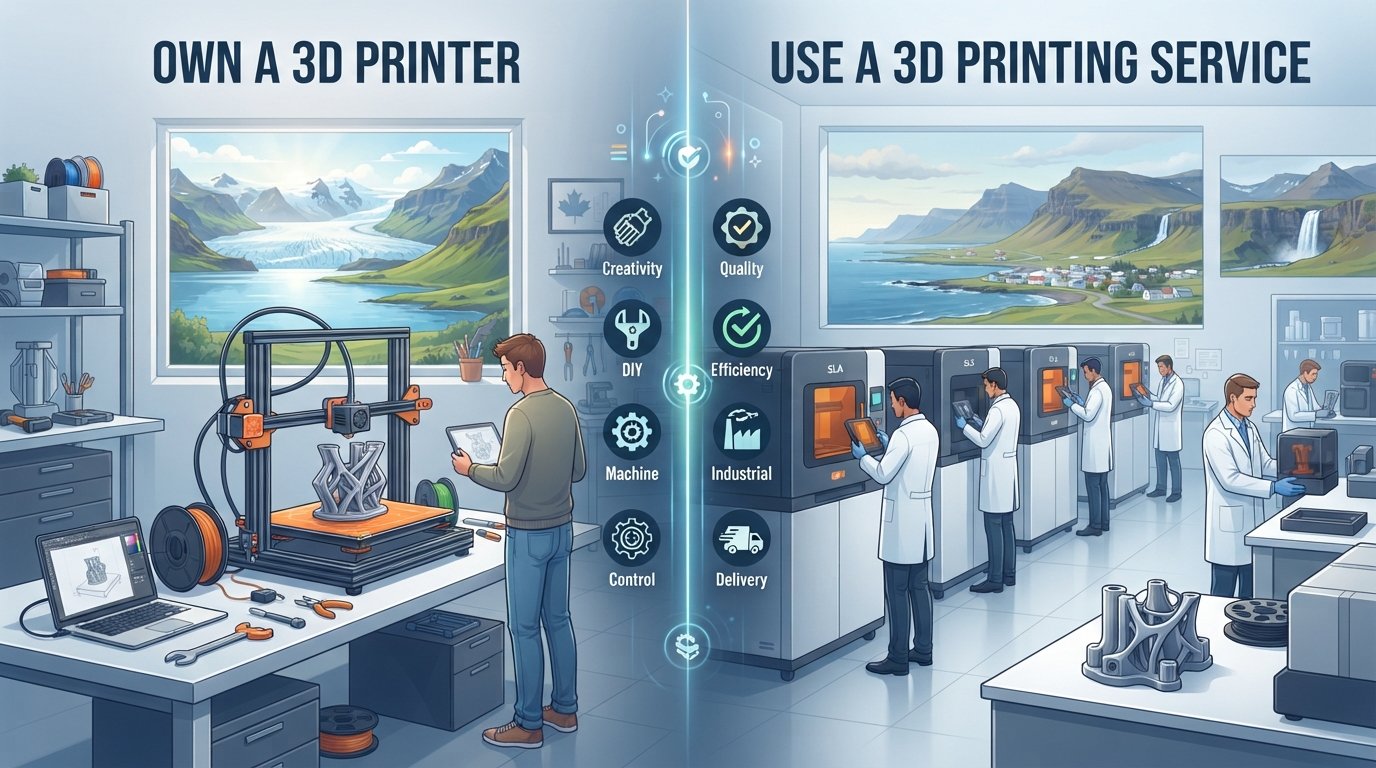
Owning a 3D Printer: This path offers the ultimate hands-on experience. You purchase the machine, set it up, learn its intricacies, buy your own filaments, and handle all aspects of the printing process yourself. It's a journey of discovery and control, perfect for those with a keen interest in the technology and the time to dedicate to it. You gain immediate access to your printer, allowing for spontaneous creation and iterative design.
Using a 3D Printing Service: Opting for a professional 3d prentun eftir pöntun (3D printing by order) service means you simply upload your 3D model, choose your material and specifications, and let experts handle the rest. This hassle-free approach provides access to industrial-grade printers, a wider range of materials, and professional expertise without the upfront investment, maintenance, or learning curve. It's ideal for those who value quality, speed, and convenience, allowing them to focus on their designs rather than the printing process itself.
Feature-by-Feature Comparison: Own vs. Service
Let's dive into a detailed comparison to help you understand which option aligns best with your vision for 3d printing ísland.
| Criterion | Owning a 3D Printer | Using a 3D Printing Service |
|---|---|---|
| 1. Initial Investment | Requires a significant upfront cost for the printer itself, which can range from a few hundred euros for basic models to several thousand for professional-grade machines. This doesn't include necessary accessories like tools, extra build plates, or software. | Virtually no initial investment is required. You only pay for the services and materials used on a per-project basis. This makes it a highly accessible option for testing ideas or producing one-off items without financial commitment. |
| 2. Ongoing Costs & Materials | Involves continuous expenses for filament (which can add up quickly), replacement parts (nozzles, print beds, belts), software licenses, electricity, and potential upgrades. Troubleshooting and failed prints also consume time and material. | Costs are transparent and project-specific. You pay for the final print, material, and any additional services like design or post-processing. There are no hidden costs for maintenance, repairs, or wasted materials from failed prints. |
| 3. Technical Expertise & Time | A steep learning curve is often involved, requiring knowledge of 3D modeling software, slicing parameters, printer calibration, troubleshooting common issues, and material properties. It demands significant time investment in learning, setup, and ongoing management. | Requires minimal technical expertise in 3D printing itself. You simply need a print-ready file (or utilise design services), and the service provider handles all the technical aspects. This frees up your time to focus on design and innovation. |
| 4. Print Quality & Reliability | Quality can vary greatly depending on the printer's cost, the user's skill, and the time invested in calibration. Home printers typically offer lower resolution and slower speeds compared to industrial machines, with a higher chance of print failures. | Offers consistent, professional-grade quality due to industrial equipment, experienced technicians, and stringent quality control processes. Service providers often specialise in optimising prints for accuracy, strength, and finish, ensuring reliable results every time. |
| 5. Material & Technology Variety | Limited by the capabilities of the specific printer you own. Most consumer printers handle common plastics like PLA and PETG. Access to advanced materials, larger build volumes, or different printing technologies (SLA, SLS) is often restricted. | Provides access to a vast array of materials, including engineering-grade plastics, resins, and even metals, along with various printing technologies. This versatility allows for the creation of highly specialised parts tailored to specific functional requirements. |
| 6. Maintenance & Support | All maintenance, troubleshooting, and repairs fall on the owner. This requires time, patience, and often additional expenses for replacement parts or tools. Online communities can help, but professional support is rarely available for personal machines. | Maintenance and technical support are entirely the responsibility of the service provider. You don't have to worry about printer breakdowns, repairs, or upgrades. Many services, like PrintIn3D, offer friendly WhatsApp support for your orders. |
| 7. Turnaround Time & Scalability | Printing speed is dictated by your machine, and complex or large parts can take days. Scaling up production means buying more printers, which is a massive investment in space, cost, and management. | Professional services offer efficient workflows and often multiple machines, leading to faster turnaround times, especially for urgent projects. They can also handle large-batch 3D printing in bulk, making them highly scalable for production runs without additional capital expenditure from your side. |
Pros & Cons of Owning a 3D Printer
Pros:
- Creative Freedom & Learning: You have complete control over every aspect of the printing process, fostering a deep understanding of the technology and allowing for endless experimentation. It's a fantastic educational tool.
- Immediate Access: Print anything, anytime you want, right from your home or workshop. This is great for spontaneous ideas or quick iterations.
- Cost-Effective for Very Frequent, Small Prints: If you plan to print small, simple items almost daily and can manage all maintenance yourself, the per-print cost of filament can be lower than service fees over a long period.
- Privacy & Security: Your designs never leave your premises, which can be crucial for highly sensitive projects.
Cons:
- High Upfront & Ongoing Costs: The initial investment, plus continuous expenses for materials, spare parts, and electricity, can be substantial.
- Steep Learning Curve: Mastering 3D printing requires significant time and effort, from preparing models to understanding printer settings and troubleshooting.
- Maintenance & Troubleshooting: Be prepared to spend time diagnosing and fixing issues, which can be frustrating and interrupt your workflow.
- Limited Capabilities: Consumer-grade printers often have smaller build volumes and are restricted to a narrow range of materials compared to industrial machines.
- Space & Environment: A 3D printer requires dedicated space, and some materials can emit fumes, necessitating good ventilation.
- Time Consuming: From setting up the print to post-processing, the entire workflow can be very time-intensive.
Pros & Cons of Using a 3D Printing Service
Pros:
- No Upfront Investment: You avoid the significant cost of purchasing a printer and all its accessories, making 3D printing accessible on a project-by-project basis.
- Expert Quality & Reliability: Professional services like PrintIn3D utilise industrial-grade printers and experienced technicians to ensure superior print quality, accuracy, and consistent results. We pride ourselves on being an award-winning service, recognised as a 'Rising Star' at the Irish Print Awards 2026.
- Access to Advanced Materials & Technologies: Get your designs printed in a wider variety of materials, including engineering-grade plastics like PETG, strong resins, or even flexible TPU, often unavailable on home printers.
- Time-Saving & Hassle-Free: Focus on your design and leave the complexities of printing, maintenance, and troubleshooting to the experts. This is especially valuable if you need to prenta 3d hlut quickly without delays.
- Scalability: Easily scale from a single prototype to small-batch production without investing in additional equipment.
- Professional Support & Guidance: Benefit from expert advice on material selection, design optimisation, and printability, ensuring your project succeeds. Our friendly WhatsApp support is always ready to assist.
- Risk-Free Guarantee: Services like ours offer a 30-Day Risk-Free Return policy, including original and return shipping, demonstrating our confidence in quality.
Cons:
- Less Immediate: While PrintIn3D offers fast turnaround times (with options like 8-hour, 13-hour, and 28-hour custom printing services), you don't have the same "print on a whim" capability as owning a machine.
- Dependency on Provider: You rely on the service provider's schedule and capabilities. However, reputable services like PrintIn3D ensure reliability and swift dispatch.
- No Hands-On Learning: You miss out on the technical learning experience of operating a 3D printer yourself.
- Cost Per Print: For very high volumes of simple, low-cost parts, the cumulative cost of a service might eventually exceed the material cost of owning a printer, but this only applies after significant output and factoring in all ownership costs.
Who Should Choose Each Option in Iceland?
Understanding your specific needs and goals is key to making the right choice for your 3d prentun ísland projects.
Who Should Own a 3D Printer?
- Dedicated Hobbyists & Enthusiasts: If you are passionate about the technology, enjoy tinkering, and want to deeply understand the mechanics of 3D printing, owning a printer is an enriching experience.
- Educators & Students: For educational purposes, a personal printer offers a hands-on learning tool for STEM subjects, encouraging experimentation and problem-solving.
- Those with Very Frequent, Small, Non-Critical Prints: If you plan to print small, non-essential items almost daily (e.g., small toys, aesthetic upgrades, simple fixes) and are comfortable with a variable quality output and extensive maintenance.
- Individuals Prioritising Complete Control & Privacy: If your projects involve highly sensitive intellectual property and you prefer to keep all production in-house, a personal printer might be suitable, provided you have the expertise to manage it.
Who Should Choose a 3D Printing Service?
- Businesses & Startups in Iceland: For rapid prototyping, product development, custom tooling, or small-batch manufacturing without the enormous capital expenditure and operational overhead of owning industrial printers. Services provide access to advanced capabilities for fast 3D printing for startup prototypes.
- Designers & Engineers: When high-quality, precise, and functional parts are crucial. A service guarantees professional results that meet specifications, allowing designers to focus on innovation. If you're a designer in Reykjavík looking for 3d prentun reykjavík with top-tier results, a service is ideal.
- Occasional Users & Complex Projects: If you only need to prenta 3d hlut occasionally, or your projects require specific materials (like flexible PETG or specialty filaments from brands like Bambu Lab and SUNLU) or larger print volumes than a desktop printer can handle.
- Anyone Seeking Hassle-Free Experience: If you want to transform your ideas into tangible objects without the learning curve, maintenance, or troubleshooting associated with owning a printer, a service is your partner. This includes those in Reykjavík seeking reliable 3d prentunarþjónusta reykjavík.
- Those Prioritising Speed & Consistency: When project deadlines are tight or consistent quality across multiple parts is essential, a professional service delivers.
- Individuals without Dedicated Space or Time: If you lack the space for a printer or simply don't have the hours to dedicate to its operation and maintenance, a service is a practical solution.
The Verdict: Your Best Path for 3D Printing in Iceland
For the vast majority of individuals and businesses in Iceland, especially those seeking professional-grade results without the burden of significant investment, technical expertise, and ongoing maintenance, utilising a dedicated 3D printing service like PrintIn3D is the clear winner.
While owning a 3D printer offers a unique journey of learning and personal control, it comes with considerable financial, time, and technical commitments. For many, these hurdles outweigh the benefits, particularly when looking for reliable, high-quality output for demanding projects or 3d prentun eftir pöntun.
PrintIn3D stands out as your ideal partner for 3d printing ísland. We combine award-winning service (Silver Rising Star at the Irish Print Awards 2026), a 30-Day Risk-Free Return policy, fast turnaround times, and friendly expert support to provide a truly hassle-free experience. Whether you're in Reykjavík or anywhere across Iceland and the wider EU/EEA, we offer a seamless way to bring your 3D dreams to life, ensuring your projects are printed to perfection with professional-grade materials and expertise. Choose convenience, quality, and peace of mind.
Ready to bring your ideas to life without the hassle? Visit PrintIn3D.ie/3d-printing-services to explore our custom 3D printing services and start your project today!