3D Printing Service vs. Traditional Fabrication for Prototypes in Ireland
3D Printing Service vs. Traditional Fabrication for Prototypes in Ireland
In the exciting journey of bringing a new product to life, creating accurate and functional prototypes is a critical step. For innovators, engineers, and businesses across Ireland, the choice often boils down to two primary methods: leveraging a cutting-edge 3D printing service or opting for more established traditional fabrication techniques. Each approach offers distinct advantages and disadvantages, and understanding these differences is key to making the best decision for your project, budget, and timeline.
At PrintIn3D.ie, we're passionate about helping you navigate this landscape. As your dedicated 3D design and prototyping company, we've seen firsthand how crucial the right prototyping method is. Whether you're a startup looking for a rapid prototyping service Ireland or an established enterprise refining a complex component, knowing the ins and outs of both 3D printing and traditional fabrication will empower you to make informed choices and truly print your 3D dreams.
Quick Overview
3D Printing Services like PrintIn3D.ie utilise additive manufacturing, building objects layer by layer from a digital design. This method excels at producing complex geometries quickly and cost-effectively, especially for low-volume production or intricate prototypes. It's a fantastic solution for iterative design, allowing for swift modifications and tests without significant overhead.
Traditional Fabrication encompasses a range of subtractive and formative manufacturing processes such as CNC machining, injection moulding, casting, and sheet metal fabrication. These methods typically involve removing material from a larger block or forming material using moulds and dies. Traditional techniques are renowned for their material strength, surface finish, and cost-effectiveness at high production volumes, but often come with higher initial setup costs and longer lead times for prototypes.
Feature-by-Feature Comparison
Let's dive into a detailed comparison of how 3D printing services stack up against traditional fabrication for prototyping in Ireland.
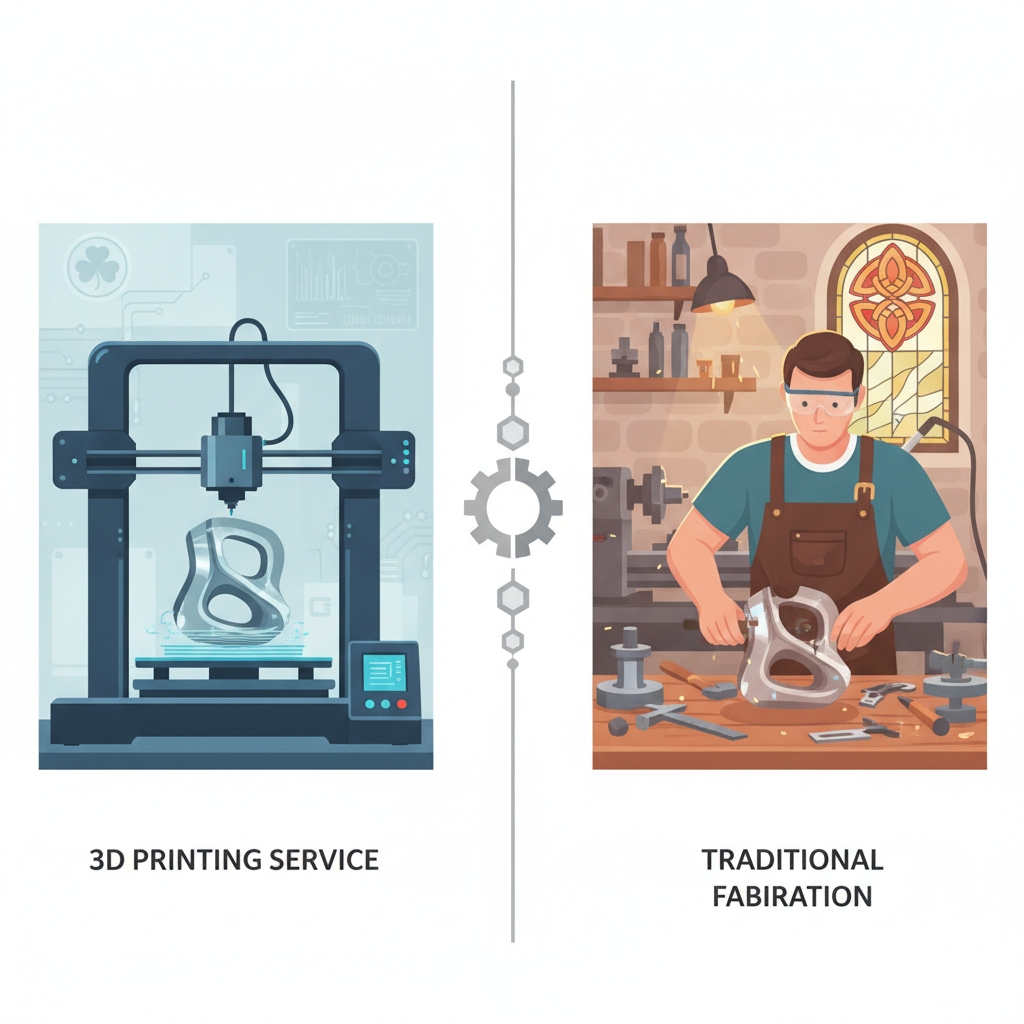
| Criterion | 3D Printing Service | Traditional Fabrication |
|---|---|---|
| Speed & Lead Time | Very Fast: Prototypes can often be produced within days, sometimes even hours, depending on complexity and service capacity. No tooling required means minimal setup time. Ideal for urgent projects. | Slower: Can range from weeks to months. Requires significant setup time for tooling (moulds, jigs, fixtures) and machine programming, especially for complex parts. |
| Cost for Prototypes | Cost-Effective for Low Volumes & Complexity: Cost is primarily based on material usage and print time. No expensive tooling means lower upfront investment. For an online 3d printing quote Ireland, the process is quick and transparent, helping you understand how much does 3d printing cost Ireland for your specific project. | High Initial Investment: Significant tooling costs (moulds for injection moulding, complex CNC programming) make initial prototypes very expensive. Cost per part decreases dramatically with scale, but prototyping remains costly. |
| Design Complexity & Freedom | High: Excels at producing intricate geometries, organic shapes, internal structures, and complex assemblies that are impossible or prohibitively expensive with traditional methods. Minimal design constraints related to manufacturing. | Moderate to Low: Design is limited by the capabilities of the specific manufacturing process. Features like undercuts, internal channels, and complex curves can add significant cost and difficulty or be impossible without multi-axis machining or intricate mould designs. |
| Material Versatility | Growing: Wide range of plastics (PLA, PETG, ABS, Nylon, TPU), resins, and some metals. While versatile, the material properties might not always perfectly match end-use production materials in terms of strength or heat resistance for all applications. PrintIn3D offers popular options like Bambu Lab and SUNLU filaments. | Extensive: Can work with almost any engineering-grade plastic, metal, or composite. Materials are often available with specific properties (e.g., high strength, temperature resistance, chemical inertness) perfectly suited for final production. |
| Surface Finish & Accuracy | Good, but often requires post-processing: Layer lines are visible and typically necessitate sanding, painting, or chemical smoothing for a refined finish. Accuracy depends on the printer and material, generally suitable for functional prototypes. | Excellent, often production-ready: Achieves very smooth surfaces and tight tolerances directly off the machine for many processes (e.g., CNC machining). Minimal post-processing often required for aesthetic or functional precision. |
| Scalability for Production | Limited for Mass Production: While 3D printing is great for low-volume manufacturing and custom runs, scaling to tens of thousands or millions of units typically becomes uneconomical compared to traditional methods. It's fantastic for bridging the gap between prototype and full production. | Highly Scalable: Once tooling is created, traditional methods are designed for efficient, cost-effective mass production. The per-unit cost drops significantly as production volume increases. |
| Tooling & Setup | Minimal to None: Relies on digital files, eliminating the need for expensive physical moulds, dies, or complex fixtures, which drastically reduces setup time and cost. | Extensive: Requires significant investment in custom tooling, jigs, and fixtures. This setup process is often the most time-consuming and expensive part of traditional fabrication, making it less agile for iterative design. |
Pros & Cons of Each Prototyping Method
3D Printing Service
Pros:
- Rapid Iteration: Quickly produce multiple design versions for testing and refinement. If you need to tweak a design based on user feedback, a 3D printing service can turn around a new prototype in days.
- Design Freedom: No manufacturing constraints mean you can create highly complex, intricate, and organic shapes that would be impossible or incredibly expensive with traditional methods.
- Cost-Effective for Low Volumes: For one-off prototypes or small batches, the absence of tooling costs makes 3D printing significantly more affordable. Getting an online 3d printing quote Ireland is straightforward and gives you immediate cost insights.
- Reduced Waste: Additive manufacturing uses only the material needed, leading to less waste compared to subtractive methods.
- Accessibility: No need for expensive equipment or specialised skills; simply upload your design to a service like PrintIn3D.ie and let the experts handle the rest.
- Customisation: Ideal for custom 3d printed gifts Ireland or highly specific, one-off functional parts.
Cons:
- Material Limitations (Historically): While constantly improving, some industrial-grade materials for extreme strength or heat resistance are still primarily the domain of traditional methods.
- Surface Finish: Visible layer lines often require post-processing (sanding, polishing, painting) to achieve a smooth, production-quality finish.
- Speed for Mass Production: Not ideal for producing thousands or millions of identical parts as quickly or cheaply as injection moulding.
- Part Size Limitations: The size of parts is limited by the build volume of the 3D printer. Large components may need to be printed in sections and assembled.
Traditional Fabrication
Pros:
- Material Strength & Selection: Access to a vast array of engineering-grade metals and plastics with superior mechanical properties, crucial for demanding applications.
- Excellent Surface Finish: Many traditional processes naturally yield very smooth, high-quality surface finishes suitable for end-use products without extensive post-processing.
- High Accuracy & Tolerances: Capable of achieving extremely tight dimensional tolerances required for precision engineering and assembly.
- Cost-Effective for Mass Production: Once tooling is established, the per-unit cost for high-volume manufacturing drops significantly, making it the most economical choice for large runs.
- Established Processes: Decades of refinement mean well-understood processes, quality control, and industry standards.
Cons:
- High Upfront Costs: The initial investment in tooling (moulds, dies, fixtures) can be very substantial, making prototyping expensive.
- Long Lead Times: The time required for tooling design and fabrication means prototypes take much longer to produce, slowing down the design iteration cycle.
- Design Constraints: Designs must adhere to the limitations of the specific manufacturing process, potentially limiting complexity and innovation.
- Less Agile: Changes to the design after tooling is made are extremely costly and time-consuming, hindering iterative development.
- Higher Material Waste: Subtractive processes often generate considerable material waste, particularly for complex parts.
Who Should Choose Each
You Should Choose a 3D Printing Service if:
- You're in the Early Stages of Product Development: For initial concepts, functional prototypes, and proof-of-concept models, 3D printing offers speed and flexibility. If you're using 3d scanning for product development to reverse-engineer parts or digitise existing objects, 3D printing is the perfect complement for creating physical iterations.
- Your Design is Complex or Intricate: If your prototype features complex geometries, internal channels, or organic shapes that would be difficult or impossible with traditional machining, 3D printing is your best bet.
- You Need Multiple Design Iterations: When you anticipate making several changes to your design based on testing and feedback, the low cost and fast turnaround of 3D printing make it ideal for agile development.
- You Need Low-Volume Production or Customisation: For bespoke items, personalised products, or small runs of specialty parts, 3D printing provides an economical solution without the need for expensive tooling. This is great for custom 3d printed gifts Ireland.
- You Have a Tight Deadline: When time is of the essence, a 3D printing service can deliver functional prototypes significantly faster than traditional methods, helping you meet critical project milestones.
- You Require 3d design assistance: If you have an idea but no 3D model, services offering both 3d design and printing can take your concept from sketch to physical prototype.
You Should Choose Traditional Fabrication if:
- You're Producing High Volumes: For mass production runs of thousands or millions of parts, traditional methods like injection moulding become far more cost-effective per unit.
- Your Prototype Requires Specific High-Performance Materials: If your part absolutely needs the superior strength, heat resistance, or chemical properties of certain engineering-grade metals or plastics that are not yet widely available or cost-effective in 3D printing.
- Your Project Demands Extremely Tight Tolerances and Flawless Surface Finish: For precision components where even microscopic inaccuracies are unacceptable, or where a smooth, polished surface is non-negotiable without extensive post-processing.
- Your Design is Simple and Geometrically Uncomplicated: For straightforward, block-like parts or those easily machined, traditional methods can sometimes be more direct, especially if you already have existing tooling.
- You're Producing Very Large Parts: While 3D printing build volumes are increasing, extremely large parts may still be more feasible or economical to produce via traditional methods.
Verdict: Your 3D Printing Partner in Ireland
In the dynamic world of product development, there's no single "best" method; the optimal choice depends entirely on your project's unique requirements. However, for most prototyping needs in Ireland today, particularly those requiring speed, design flexibility, and cost-effectiveness for low volumes, a professional 3D printing service offers an undeniable advantage.
At PrintIn3D.ie, we pride ourselves on being that trusted partner. We understand that turning an idea into a tangible object requires expertise, speed, and reliability. That's why we've invested in state-of-the-art technology and processes to offer a seamless experience, whether you're seeking an online 3d printing quote Ireland, exploring 3d scanning services for reverse engineering, or need comprehensive 3d design assistance to bring your vision to life.
Our award-winning service (Silver Rising Star at the Irish Print Awards 2026!) and 30-Day Risk-Free Return policy underscore our commitment to quality and customer satisfaction. We provide fast turnaround times, use high-quality filaments (such as when you buy Bambu Lab filament Ireland), and offer friendly WhatsApp support to ensure your prototyping journey is as smooth and successful as possible. For businesses needing a reliable bulk filament supplier Ireland, we also have solutions to support your ongoing needs.
While traditional fabrication certainly has its place for high-volume, highly specified end-part manufacturing, for the agility and innovation demanded by modern product development, 3D printing is often the superior choice for prototypes. Let PrintIn3D.ie be your bridge from concept to reality.
Ready to bring your ideas to life with speed and precision? Get an instant online quote for your 3D printing project today!