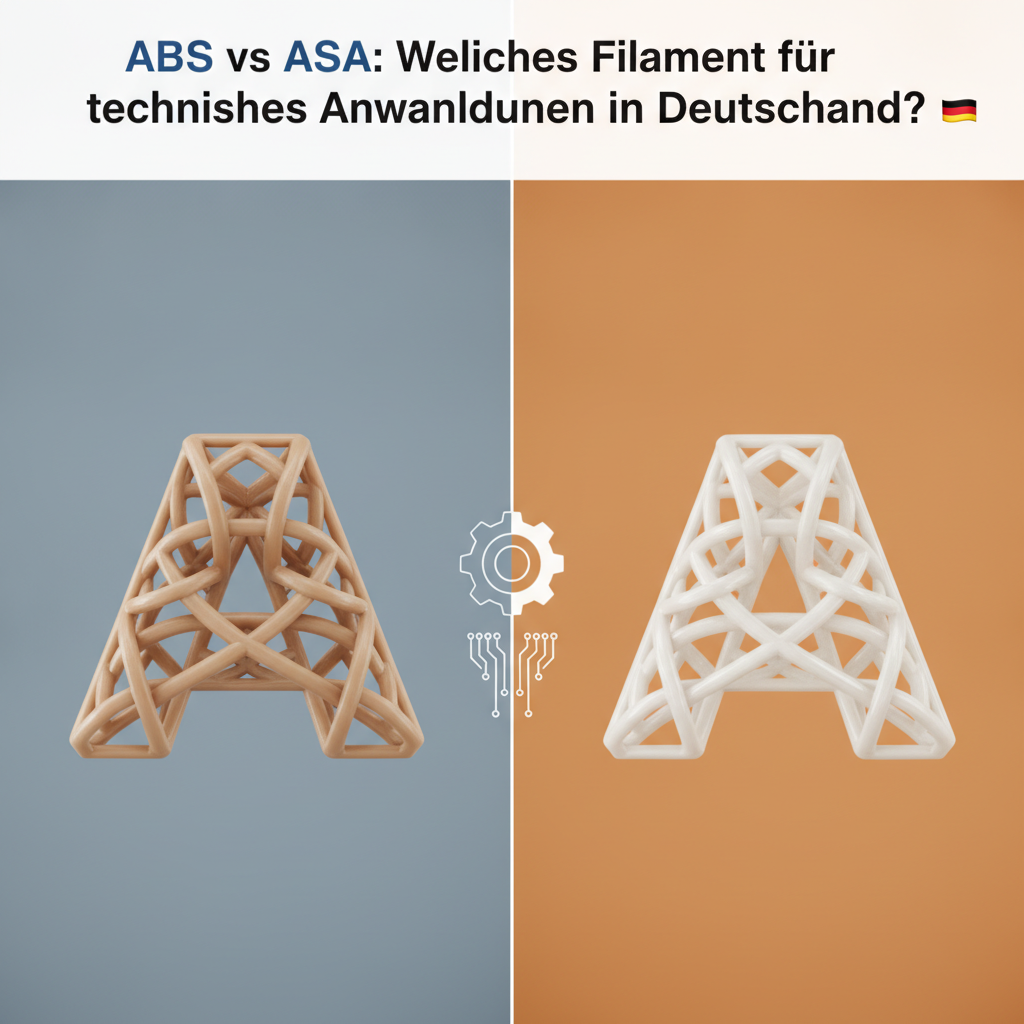
ABS vs ASA: Welches Filament für technische Anwendungen in Deutschland?
ABS vs ASA: Welches Filament für technische Anwendungen in Deutschland?
In the dynamic world of 3D printing, selecting the right filament is paramount, especially when tackling technical applications where performance and reliability are non-negotiable. For engineers, product designers, and innovators across Germany, the choice often narrows down to two robust thermoplastics: ABS (Acrylonitrile Butadiene Styrene) and ASA (Acrylonitrile Styrene Acrylate). Both materials are renowned for their strength and versatility, making them ideal for creating everything from 3d-druck ersatzteile to complex functional prototypes and 3d-druck kleinserie components.
But how do you decide which one is the superior choice for your specific project? This comprehensive comparison will delve into the nuances of ABS and ASA filaments, highlighting their unique properties, printability, and best-suited applications. Our aim at PrintIn3D.ie, your trusted 3D printing partner, is to equip you with the expert knowledge needed to make an informed decision, ensuring your 3D printed dreams come to life with the perfect material for the job, hassle-free.
Quick Overview: ABS and ASA Filaments
ABS Filament: Acrylonitrile Butadiene Styrene has long been a workhorse in both conventional manufacturing and 3D printing. Celebrated for its excellent mechanical properties, including good impact resistance and hardness, ABS is a go-to material for durable, functional parts. It's the same plastic used in LEGO bricks, demonstrating its toughness and reliability. Historically, it was one of the first widely available filaments, setting a benchmark for strength and heat resistance. However, it's also known for certain printing challenges, such as warping and emitting a distinct odor, requiring specific printing environments.
ASA Filament: Acrylonitrile Styrene Acrylate emerged as a direct evolution of ABS, engineered to address its predecessor's limitations, particularly concerning UV and weather resistance. Often referred to as "automotive-grade ABS," ASA shares many of ABS's desirable mechanical properties but significantly outperforms it in outdoor applications. It offers superior resistance to UV radiation, harsh weather conditions, and chemicals, all while maintaining excellent strength and a better aesthetic finish. While still requiring a heated print bed, ASA generally exhibits less warping and less noticeable odor compared to ABS, making it a more user-friendly option for many.
Feature-by-Feature Comparison
| Criterion | ABS (Acrylonitrile Butadiene Styrene) | ASA (Acrylonitrile Styrene Acrylate) |
|---|---|---|
| UV Resistance | Poor. Degrades and yellows quickly when exposed to sunlight, losing mechanical strength over time. Not suitable for long-term outdoor use. | Excellent. Highly resistant to UV radiation, maintaining colour and mechanical properties even with prolonged outdoor exposure. Ideal for external parts. |
| Weather Resistance | Poor. Susceptible to cracking and degradation from environmental factors like rain, frost, and heat, in addition to UV. | Superior. Withstands various weather conditions, including moisture, temperature fluctuations, and sunlight, without significant degradation. |
| Mechanical Strength & Durability | Good. Offers high impact strength, hardness, and rigidity. Ideal for many indoor functional parts and prototypes that require toughness. | Excellent. Comparable to ABS in tensile and impact strength, often slightly superior. Maintains these properties better in harsh environments, leading to greater long-term durability. |
| Temperature Resistance | High. Typically has a glass transition temperature (Tg) around 105°C, making it suitable for applications requiring heat resistance below this point. | Very High. Similar to ABS with a Tg around 105°C, but its stability in various environmental conditions enhances its functional performance at elevated temperatures, especially outdoors. |
| Printability (Warping, Odour) | Challenging. Prone to significant warping (shrinkage) without a heated bed and enclosed printer. Produces strong, potentially unpleasant fumes (styrene). | Improved. Less prone to warping than ABS, though a heated bed and enclosure are still recommended. Produces less styrene odor, making for a more pleasant printing experience. |
| Chemical Resistance | Good against various chemicals, but susceptible to attack by strong acids, ketones, esters, and chlorinated hydrocarbons. | Good, generally better than ABS. Resists a wider range of chemicals and solvents, further enhancing its suitability for industrial and outdoor applications. |
| Aesthetic Finish | Can produce good surface finish, but prone to visible layer lines if not post-processed. Tends to yellow over time, even indoors. | Excellent. Often results in a smoother, more matte finish directly from the printer. Retains colour better and does not yellow, providing a more professional and long-lasting appearance. |
| Cost | Generally more affordable than ASA, making it a budget-friendly option for many projects. | Typically slightly more expensive than ABS due to its enhanced properties and manufacturing process. |
Pros & Cons
ABS Filament
Pros:
- High Strength and Durability: Offers excellent mechanical properties, including good impact resistance, making it suitable for robust, functional parts.
- Heat Resistance: Can withstand relatively high temperatures, making it a good choice for components exposed to moderate heat.
- Cost-Effective: Generally more affordable than ASA, providing a budget-friendly option for prototyping and indoor applications.
- Easy Post-Processing: Can be easily sanded, painted, glued, and is particularly amenable to solvent smoothing (e.g., with acetone) for a glossy finish.
- Wide Availability: One of the most common 3D printing filaments, widely available from numerous manufacturers, including quality 3d-druck-filament für bambu lab options.
Cons:
- Prone to Warping: Significant shrinkage during cooling can lead to severe warping, especially on larger prints, requiring a heated print bed and often an enclosed print chamber.
- Strong Odor: Emits styrene fumes during printing, which can be unpleasant and require good ventilation.
- Poor UV Resistance: Degrades and yellows quickly when exposed to sunlight, becoming brittle and losing strength, making it unsuitable for outdoor use.
- Limited Weather Resistance: Not ideal for parts exposed to the elements due to its susceptibility to moisture and temperature changes.
- Hygroscopic: Absorbs moisture from the air, which can negatively affect print quality and require filament drying.
ASA Filament
Pros:
- Superior UV Resistance: Maintains its mechanical properties and colour remarkably well under prolonged exposure to sunlight, making it perfect for outdoor applications.
- Excellent Weather Resistance: Highly resistant to environmental factors like rain, snow, and extreme temperatures, ensuring longevity and performance outdoors.
- High Mechanical Strength: Offers strength and durability comparable to, or even slightly better than, ABS, with enhanced long-term stability in harsh conditions.
- Improved Printability: While still needing a heated bed and often an enclosure, ASA exhibits significantly less warping and better bed adhesion than ABS.
- Reduced Odor: Produces a much milder odor during printing compared to ABS, contributing to a more comfortable printing environment.
- Great Aesthetics: Often yields a more matte, professional finish directly off the print bed and resists yellowing, maintaining its appearance over time.
Cons:
- Higher Cost: Generally more expensive than ABS, which can impact project budgets, especially for large volumes or 3d-druck kleinserie.
- Requires Heated Bed: Still demands a heated print bed (and ideally an enclosure) to achieve optimal results and minimize potential warping, though less severe than ABS.
- Limited Post-Processing (Acetone): While ABS can be smoothed with acetone, ASA is less reactive to it, limiting this popular post-processing technique.
- Slightly More Challenging to Source: While increasingly popular, some specialized ASA variants might be less readily available than common ABS types.
Who Should Choose Each
The choice between ABS and ASA largely depends on your specific application and environmental requirements. Both are excellent for technical parts, but their distinct strengths cater to different scenarios.
Choose ABS if:
- Your parts are for indoor use: If your components will not be exposed to direct sunlight or harsh weather, ABS offers excellent performance for internal mechanisms, housings, and functional prototypes.
- Budget is a primary concern: ABS is generally more affordable, making it a good choice for projects with tight budgets or when producing a large volume of prototypes.
- You require specific mechanical properties for indoor applications: For parts that need high impact resistance and rigidity in a controlled environment, ABS performs admirably. Think 3d-druck ersatzteile for household appliances or internal components of electronics.
- You intend to use acetone smoothing for aesthetics: If a smooth, glossy finish achieved through vapour smoothing is part of your post-processing plan, ABS is the better option.
- You have a well-ventilated print area or enclosed printer: Given its odor and warping tendencies, ABS thrives in environments where these factors can be managed effectively.
Choose ASA if:
- Your parts will be exposed to outdoor elements: This is ASA's strongest suit. For anything from automotive exterior parts, garden equipment, drones, marine components, or outdoor signage, ASA's UV and weather resistance are unmatched.
- Longevity and aesthetic stability are critical: If your part needs to retain its colour, finish, and mechanical integrity over years of outdoor exposure, ASA is the clear winner. This is crucial for individuelle 3d-druck teile anfertigen lassen that need to maintain a professional appearance.
- You need high mechanical strength in demanding environments: For industrial components, protective covers, or fixtures that face both physical stress and environmental challenges, ASA provides superior reliability.
- You want improved printability over ABS: While still an advanced material, ASA's reduced warping and odor make the printing process smoother and more enjoyable, especially for those working in less-than-ideal ventilation conditions (though ventilation is always recommended).
- You are designing for consumer products where premium aesthetics matter: ASA's ability to produce a consistently good finish without yellowing makes it ideal for 3d-druck geschenke personalisiert or functional items where appearance is key, alongside durability.
For those needing assistance with design, our 3d-design service can help transform your concepts into print-ready models, whether you choose ABS or ASA. If you have an existing physical object and need a digital model, our 3d-scan service can provide the necessary data for reproduction or modification.
Verdict
For technical applications in Germany, the choice between ABS and ASA ultimately boils down to the environmental conditions your printed part will face. If your components are destined for indoor use, protected from the sun and elements, ABS remains a highly capable and cost-effective material, offering excellent strength and rigidity. It's a fantastic choice for functional prototypes, jigs, fixtures, and internal components where UV stability isn't a factor. Many of our customers opt for ABS when they need 3d-drucker filament günstiger preis for robust internal parts.
However, if your technical application involves any outdoor exposure, direct sunlight, or harsh weather conditions, ASA is the undisputed champion. Its superior UV and weather resistance ensure that your parts maintain their mechanical integrity and aesthetic appeal for the long haul. The slightly higher cost is a worthwhile investment for the enhanced longevity and performance in demanding outdoor or industrial environments.
At PrintIn3D.ie, we understand that selecting the perfect material is a critical step in bringing your innovations to life. Whether you require the robust versatility of ABS or the unparalleled outdoor performance of ASA, our expert team is here to help. We offer high-quality filaments, including 3d-druck-filament für bambu lab and other top brands, and provide professional 3D printing services for individuelle 3d-druck teile anfertigen lassen across Germany. From initial 3d-design nach maß to the final print, we are your hassle-free partner in 3D manufacturing. While we focus on PLA and PETG for general offerings, we also cater to specific needs with more technical filaments like ASA and even flexible tpu filament kaufen deutschland requirements.
Trust PrintIn3D.ie to guide you through the complexities of material selection and deliver exceptional 3D printed parts, backed by our award-winning service and a 30-day risk-free return policy. We're here to make your 3D printing journey seamless and successful.
Ready to bring your technical applications to life with the right filament? Explore our 3D printing services and filament selection today!