FDM vs SLA 3D Printing: Choosing Right for Your UK Project
FDM vs SLA 3D Printing: Choosing the Right Technology for Your UK Project
In the exciting world of additive manufacturing, selecting the perfect 3D printing technology is paramount to the success of your project. For businesses and individuals across the UK, from a bustling 3d printing service london uk to a specialized 3d printing service manchester uk, the choice often boils down to two dominant and distinct methods: Fused Deposition Modeling (FDM) and Stereolithography (SLA). Each technology offers unique advantages and caters to different needs, whether you're creating a simple prototype or a highly intricate, detailed model.
At PrintIn3D, we pride ourselves on being your trusted 3D printing partner, dedicated to helping you navigate these choices with ease. We understand that deciphering the technical jargon can be daunting, which is why we've put together this comprehensive comparison. Our goal is to empower you with the knowledge to make an informed decision, ensuring your vision is brought to life with the most suitable and cost-effective method.
Whether you require a robust 3d printing for engineering prototypes or a visually stunning artistic piece, understanding the core differences between FDM and SLA is your first step. Let's dive in and explore which technology is best suited to print your 3D dreams.
Quick Overview of FDM and SLA 3D Printing
Before we delve into a feature-by-feature breakdown, let's get a quick grasp of what each technology entails.
Fused Deposition Modeling (FDM)
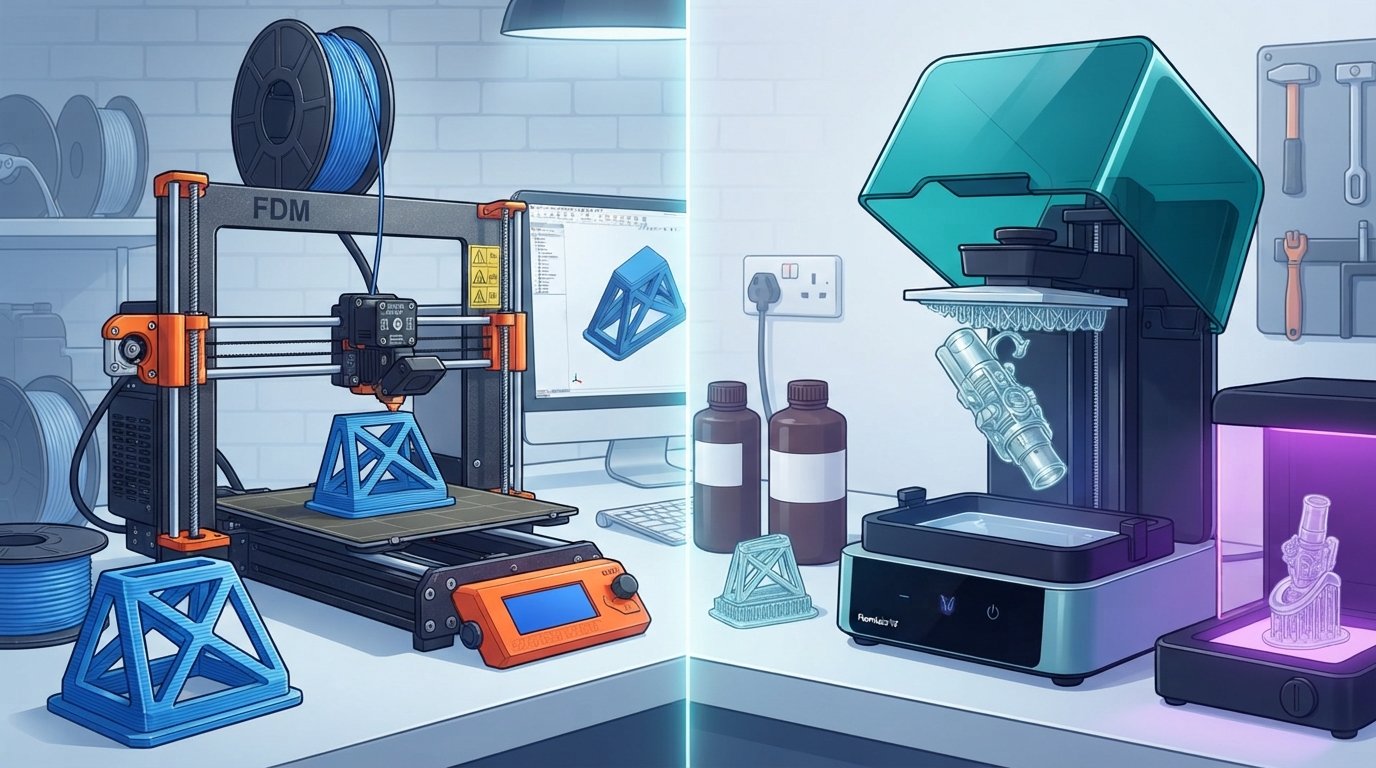
FDM, also known as Fused Filament Fabrication (FFF), is the most common and accessible form of 3D printing. It works by extruding a thermoplastic filament, such as PLA or PETG, through a heated nozzle and depositing it layer by layer onto a build platform. Imagine a robotic hot glue gun carefully drawing your object slice by slice. This "bottom-up" approach builds physical models from a digital design, offering a straightforward and often more affordable path to creating physical parts. FDM is widely used for functional prototypes, jigs and fixtures, and end-use parts where strength and cost-effectiveness are key.
Stereolithography (SLA)
SLA is one of the oldest and most precise 3D printing technologies. Instead of melting plastic, SLA uses a UV laser to cure liquid resin layer by layer. The laser solidifies specific areas of the resin bath, building the object upwards from a submerged platform. Think of it like drawing with light in a liquid. This method is renowned for producing exceptionally smooth surfaces, fine details, and intricate geometries, making it ideal for visual prototypes, master patterns for moulding, and highly detailed models where aesthetic quality and precision are paramount.
Feature-by-Feature Comparison: FDM vs SLA
Let's examine the key aspects of FDM and SLA side-by-side to highlight their differences and help you decide for your next UK-based project.
| Criterion | FDM 3D Printing | SLA 3D Printing |
|---|---|---|
| Printing Method | Extrudes melted thermoplastic filament layer by layer from a heated nozzle. | Cures liquid photopolymer resin layer by layer using a UV laser or projector. |
| Materials Used | Thermoplastic filaments like PLA, ABS, PETG, ASA, Nylon, TPU. PrintIn3D offers a variety of 3d printer filament supplier uk options, including Bambu Lab and SUNLU. | Photopolymer resins with various properties (standard, tough, flexible, castable, dental, high-temp). |
| Surface Finish & Detail | Visible layer lines; generally rougher surface finish. Detail depends on nozzle size and layer height. | Extremely smooth surface finish; capable of capturing very fine details and intricate geometries with high accuracy. |
| Part Strength & Durability | Stronger in X/Y plane than Z plane due to layer adhesion. Good for functional parts and general prototyping. | More isotropic (uniform strength in all directions) than FDM. Parts can be more brittle depending on resin, but specialty resins offer enhanced durability. |
| Post-Processing | Typically involves removing support structures, sanding, and sometimes painting. Can be relatively quick. | Requires washing in isopropyl alcohol to remove uncured resin, followed by UV post-curing for optimal strength. Supports are often easier to remove cleanly. |
| Cost (Service/Machine) | Generally lower service cost per part; FDM printers are more affordable to purchase and operate. Excellent for budget-conscious projects. | Higher service cost per part due to material expense and specialized equipment; SLA printers and resins are more expensive. |
| Typical Applications | Functional prototypes, low-cost iterations, jigs & fixtures, large parts, architectural models, hobbyist projects. Ideal for 3d printing for engineering prototypes. | High-detail visual prototypes, aesthetic models, jewellery, dental models, casting patterns, intricate enclosures, medical devices. |
| Speed | Can be faster for larger, less intricate parts. Print speed varies significantly with part size, infill, and layer height. Our same day 3d printing uk options demonstrate FDM's capability for speed. | Generally slower print times for equivalent part volume due to the precise laser curing process, but overall part quality is higher. |
Pros & Cons of FDM 3D Printing
Pros:
- Cost-Effective: Both the printers and the thermoplastic filaments (like PLA and PETG from a reliable 3d printer filament supplier uk) are generally more affordable, making FDM an excellent choice for budget-conscious projects and iterative design.
- Wide Material Selection: A vast array of thermoplastic filaments are available, offering diverse properties such as strength, flexibility (TPU), and heat resistance. This versatility makes FDM suitable for many functional applications.
- Durability for Functional Parts: FDM parts, especially with materials like ABS or Nylon, can be quite strong and suitable for functional prototypes, tools, and end-use parts that need to withstand mechanical stress.
- Larger Build Volumes: FDM printers often feature larger build volumes, allowing for the creation of bigger parts or multiple smaller parts in a single print run.
- User-Friendly: FDM technology is relatively simpler to operate and maintain, making it a popular choice for hobbyists and educational institutions, as well as businesses looking for accessible 3D printing services.
- Environmentally Friendly Options: Materials like PLA are biodegradable, offering a more sustainable choice for certain projects.
Cons:
- Visible Layer Lines: The layer-by-layer extrusion process often leaves visible lines on the surface, requiring additional post-processing (sanding, painting) for a smooth finish.
- Lower Detail and Accuracy: FDM struggles with very fine details, intricate geometries, and small features compared to SLA, due to the nozzle size limitations.
- Anisotropic Properties: Parts tend to be weaker along the Z-axis (between layers) due to the nature of layer adhesion, which can be a concern for parts requiring uniform strength.
- Support Removal: While supports are often necessary, their removal can sometimes leave marks or require careful post-processing, especially for complex geometries.
- Warping and Shrinkage: Some FDM materials, particularly ABS, are prone to warping during cooling, which can affect print accuracy and adhesion.
Pros & Cons of SLA 3D Printing
Pros:
- Exceptional Detail and Smoothness: SLA is unmatched in its ability to produce parts with incredibly smooth surface finishes and capture minute details, making it ideal for aesthetic models and intricate designs.
- High Accuracy and Precision: The laser-curing process allows for very high dimensional accuracy and tight tolerances, crucial for precision 3d printing for engineering prototypes, jigs, and fixtures requiring exact fits.
- Versatile Resins: A wide range of specialty resins is available, offering diverse mechanical properties such as flexibility, toughness, high temperature resistance, and castability for jewellery.
- Clean Support Removal: Supports in SLA are typically lighter and easier to remove, often leaving minimal marks that can be polished away with relative ease.
- Watertight Parts: Due to the way resin cures, SLA prints are generally watertight, which can be beneficial for specific applications.
Cons:
- Higher Cost: Both SLA printers and their proprietary liquid resins are significantly more expensive than FDM counterparts, leading to higher per-part costs, especially for custom 3D printing service online.
- Post-Processing Requirements: SLA parts require mandatory washing in isopropyl alcohol and subsequent UV post-curing, adding extra steps and time to the production process.
- Brittleness: Standard SLA resins can be brittle, making them less suitable for highly functional parts that require significant impact resistance or flexibility, though specialty resins mitigate this.
- Material Handling: Liquid resins can be messy to work with and require careful handling, storage, and disposal due to their chemical nature.
- Smaller Build Volumes: SLA printers typically have smaller build volumes compared to FDM machines, which can limit the size of parts that can be printed in a single go.
- UV Degradation: Cured resin parts can be susceptible to degradation or yellowing over time if exposed to direct UV light, requiring protective coatings for long-term outdoor use.
Who Should Choose Each Technology for Their UK Project?
Understanding the strengths and weaknesses of FDM and SLA helps you align the technology with your specific project requirements:
Choose FDM 3D Printing if:
- You need functional prototypes for testing form, fit, and basic function.
- Your project involves large parts or needs to be cost-effective for multiple iterations.
- You require durable, strong parts for jigs, fixtures, or end-use applications where aesthetics are secondary.
- You're looking for a quick turnaround time, perhaps leveraging a same day 3d printing uk or 3d printing express uk service for less intricate items.
- You want access to a wide range of materials with varying properties at a lower cost, often sourcing from a dedicated 3d printer filament supplier uk.
- You have basic design files, or require cad design service uk for functional components, and can tolerate visible layer lines.
Choose SLA 3D Printing if:
- Your project demands exceptional surface finish, fine details, and intricate geometries, such as for jewellery, figurines, or highly aesthetic prototypes.
- You need high dimensional accuracy and precision for parts that require tight tolerances or exact fits, especially for 3d printing for engineering prototypes in medical or dental fields.
- You are creating master patterns for casting, moulding, or vacuum forming.
- Visual appeal and presentation quality are paramount, such as for sales models or concept validation.
- You require specialised material properties that only certain resins can provide, like extreme toughness, flexibility, or biocompatibility.
- You have complex physical objects that need to be replicated with high fidelity, possibly after a 3d scan to cad service or 3d scan to 3d model service uk, even for reverse engineering.
Verdict: Partnering for Your Perfect Print
Ultimately, the "better" technology isn't FDM or SLA in isolation; it's the one that best matches your project's specific requirements for aesthetics, strength, accuracy, and budget. For those in the UK needing a reliable 3d printing service, it's crucial to have a partner who understands both technologies deeply and can guide you to the optimal choice.
At PrintIn3D, we offer both FDM and SLA capabilities, ensuring we can provide the ideal solution for your unique needs. Whether you're a startup in London seeking a 3d printing express uk service for a rapid FDM prototype, or an engineering firm in Manchester needing a high-precision SLA part for 3d scanning for reverse engineering uk, our expert team is here to help. We combine our award-winning service (Silver Rising Star at the Irish Print Awards 2026) with friendly WhatsApp support and a 30-Day Risk-Free Return policy, so you can trust us with your most important projects.
If you have a physical object you need to duplicate, our 3d scan to cad service can transform it into a digital file for printing. And if you have a concept that needs to become a print-ready model, our comprehensive cad design service uk is at your disposal. We offer fast turnaround times and same-day dispatch for filament orders, making us a comprehensive solution for all your 3D printing needs.
Don't let the technical choices overwhelm you. Let PrintIn3D be your expert partner in bringing your ideas to life.
Ready to turn your designs into reality with the perfect 3D printing technology? Get an instant quote and start your custom 3D printing project today!