In-house vs. Service: 3D Printing for Prototypes in the UK
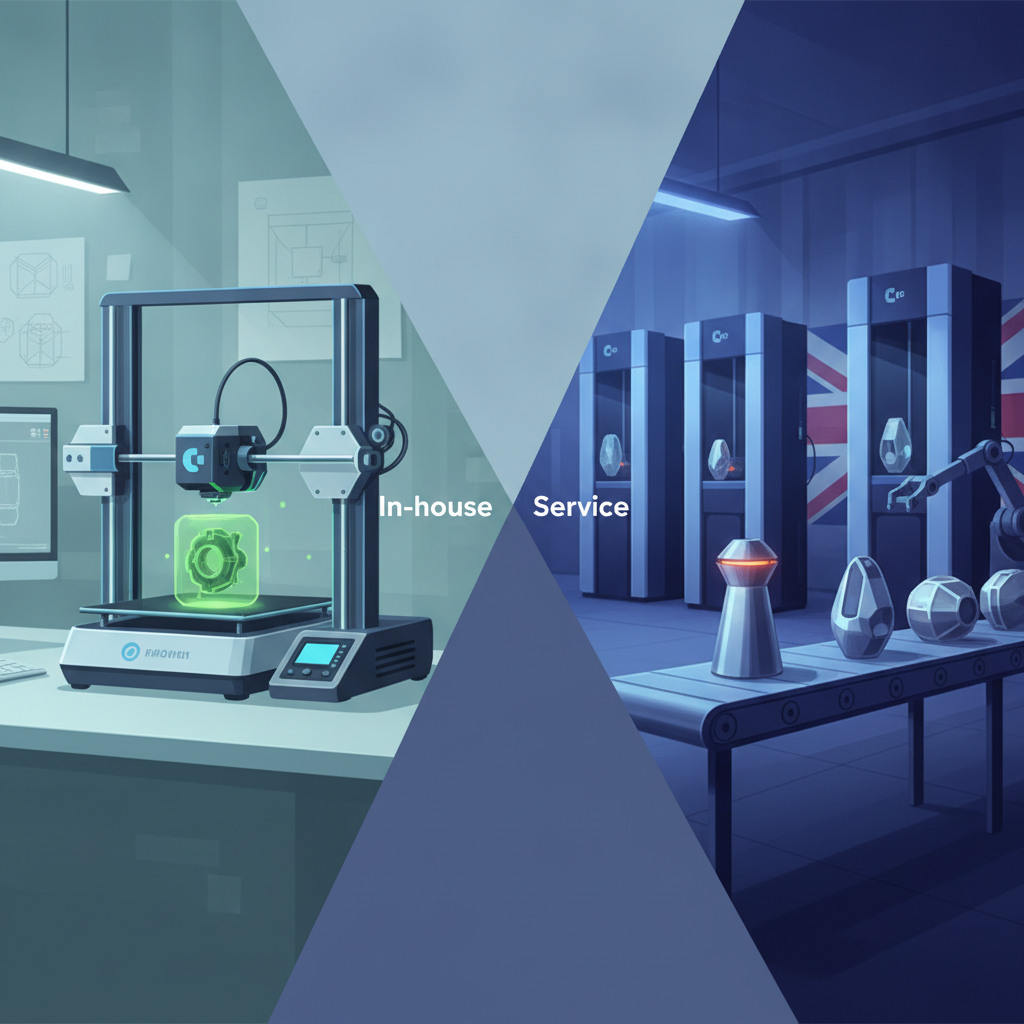
In-house 3D Printer vs. Professional Service for Engineering Prototypes in the UK
In the fast-paced world of engineering and product development, bringing ideas from concept to tangible reality quickly and cost-effectively is paramount. 3D printing for engineering prototypes has revolutionised this process, allowing innovators to rapidly test designs, validate functionality, and iterate with unprecedented speed. But for businesses and individuals across the UK, a critical decision often arises: should you invest in an in-house 3D printer, or is a professional 3D printing service the smarter choice for your prototyping needs?
This comprehensive guide will break down the pros and cons of each approach, helping you navigate the complexities and make the best decision for your projects, ensuring you get high-quality 3d printed parts uk that meet your exacting standards.
Quick Overview: Your Prototyping Pathways
Investing in an In-house 3D Printer: This option offers the allure of immediate access and complete control over your prototyping process. It involves purchasing a 3D printer, setting it up in your workshop or office, and handling all aspects of printing, from file preparation to post-processing. While it seems like a direct path to flexibility, it comes with significant hidden costs and a steep learning curve that many underestimate.
Utilising a Professional 3D Printing Service: Opting for a dedicated 3D printing service, such as PrintIn3D, means leveraging expert knowledge, industrial-grade equipment, and a vast array of 3d printing materials uk without the overheads. This pathway focuses on delivering high-quality, precise 3d printing for engineering prototypes efficiently, allowing you to concentrate on design and development while specialists handle the manufacturing.
Feature-by-Feature Comparison: In-house vs. Professional Service
Let's delve deeper into how these two options stack up against each other across key criteria relevant to engineering prototyping:
| Criterion | In-house 3D Printer | Professional 3D Printing Service |
|---|---|---|
| Initial Investment & Operating Costs | High upfront cost for the printer (entry-level to industrial £500 - £100,000+), software licenses, consumables (filament like pla filament uk, tpu filament uk), spare parts, electricity, and dedicated staff time. Significant hidden costs in wasted prints and troubleshooting. | No upfront capital investment in machinery. Pay per project for 3d printing for engineering prototypes, with costs dependent on material, complexity, and turnaround. Eliminates maintenance, software, and staff costs. Transparent 3d printing price uk structure. |
| Required Expertise & Time | Requires dedicated staff with technical knowledge in 3D printing operations, CAD software, slicing, printer maintenance, and troubleshooting. Significant time investment in learning, calibration, and problem-solving. Quality is highly dependent on operator skill. | No in-house expertise required. You provide the design file, and the service handles the rest. This frees up your team to focus on core engineering and design tasks. Provides a 3d printing service gb design uk for those without print-ready files. |
| Material & Technology Range | Limited to the capabilities of your specific printer(s). Most in-house setups can only handle one or a few material types (e.g., FDM for PLA, PETG, ABS) and a single printing technology. Expanding requires significant additional investment. | Access to a vast array of 3d printing materials uk (PLA, PETG, ABS, ASA, Nylon, TPU, resins, metals) and multiple technologies (FDM, SLA, SLS, MJF, DMLS). Allows selection of the optimal material and process for each unique prototype requirement. |
| Print Quality & Precision | Variable, heavily dependent on printer quality, calibration, material, and operator skill. Entry-level printers may struggle with fine details and consistent surface finishes. Achieving high precision for engineering tolerances can be challenging. | Consistently high quality and precision due to industrial-grade machines, expert calibration, and quality control processes. Professional services are geared towards meeting strict engineering specifications for demanding 3d printing custom parts uk and complex designs. |
| Turnaround & Scalability | Limited by the speed and capacity of your single or few machines. Multiple prototypes or larger parts can take days or weeks. Scalability is poor; increasing output means buying more printers. Downtime for maintenance halts all production. | Often offers rapid turnaround times, including express options (e.g., 8-hour or 28-hour services). Highly scalable to accommodate fluctuating demand or bulk orders, utilising an array of machines simultaneously. No impact on your workflow from machine downtime. |
| Maintenance & Troubleshooting | Requires regular maintenance, troubleshooting common issues (clogged nozzles, bed levelling, software errors), and stocking spare parts. This can be time-consuming and frustrating, diverting resources from core tasks. | No maintenance burden for you. The service provider handles all upkeep, calibration, and repairs of their machines. You simply submit your order and receive your finished 3d printed parts uk. |
| Design Support & Post-Processing | Design optimisation for 3D printing (DFM) is often learned through trial and error. Post-processing (sanding, painting, assembly) is entirely your responsibility. | Often includes expert advice on design for manufacturability (DFM) to ensure optimal print results. Many services also offer 3d printing service gb design uk and extensive post-processing options (surface finishing, assembly, painting) to deliver ready-to-use prototypes. They may also offer 3d scanning service gb for reverse engineering or design capture. |
| Confidentiality (NDAs) | Full control over your IP as parts are produced in-house. However, internal security protocols must be robust. | Reputable services, like PrintIn3D, offer Non-Disclosure Agreements (NDAs) to protect your intellectual property, providing peace of mind when dealing with sensitive prototype designs. They have established security protocols for handling client files. |
Pros & Cons: A Deeper Look
In-house 3D Printer
- Pros:
- Immediate Access: Print small, non-critical parts whenever needed without waiting for shipping.
- Full Control: Complete oversight of the printing process, from filament choice to print settings.
- Educational Value: Provides hands-on learning experience for teams interested in additive manufacturing processes.
- Rapid Iteration (Simple Parts): For very basic, small parts, you can quickly make minor tweaks and reprint.
- Cons:
- High Upfront & Running Costs: Beyond the printer itself, factor in software, materials, maintenance, electricity, and dedicated labour. The true 3d printing price uk can quickly escalate.
- Steep Learning Curve: Requires significant time and effort to master operation, slicing, maintenance, and troubleshooting.
- Limited Capabilities: Often restricted to one or two materials and technologies, unsuitable for complex engineering prototypes requiring specific properties.
- Maintenance Burden: Printers require regular calibration, cleaning, and replacement of wear parts, leading to downtime and unexpected costs.
- Quality Inconsistency: Achieving industrial-grade precision and surface finish can be challenging without expert knowledge and high-end equipment.
- Scalability Issues: Not suitable for high-volume production or large parts without substantial additional investment.
- Time Sink: Operators spend significant time managing prints, failures, and post-processing, detracting from core engineering tasks.
Professional 3D Printing Service
- Pros:
- No Capital Investment: Avoids the high upfront cost of purchasing and setting up 3D printing equipment.
- Expertise at Your Fingertips: Access to experienced technicians and engineers who understand the nuances of various printing technologies and materials.
- Wide Material & Technology Selection: Utilise industrial-grade machines capable of printing with a broad range of 3d printing materials uk (e.g., PLA, PETG, TPU filament UK, nylon, resins, and even metals) and processes (FDM, SLA, SLS, etc.).
- Superior Quality & Precision: Consistent, high-resolution prints with excellent surface finishes suitable for demanding engineering applications.
- Fast Turnaround & Scalability: Benefit from expedited services and the ability to scale production up or down instantly, perfect for rapid prototyping and bulk orders without bottlenecks.
- Focus on Core Competencies: Frees up your internal resources to concentrate on design, innovation, and other critical business activities.
- Design Optimisation & Post-Processing: Many services offer DFM advice, 3D design modifications, and comprehensive post-processing for ready-to-use parts.
- Confidentiality Assured: Reputable services offer NDAs to protect your sensitive intellectual property, vital for competitive engineering projects.
- Risk-Free Guarantee: Some services, like PrintIn3D, offer a 30-day risk-free return, including shipping, demonstrating confidence in their quality.
- Cons:
- Less Immediate Control: You hand over the manufacturing process, so direct, on-the-fly adjustments during printing aren't possible.
- Lead Times: While often faster overall, there's a shipping time involved, though expedited options minimise this.
- Dependency: You rely on the service provider's schedule and capabilities.
Who Should Choose Each Option?
Choose an In-house 3D Printer if:
- You are a hobbyist or an educational institution primarily interested in learning and experimentation.
- Your prototyping needs are very basic, non-critical, and involve simple geometries that don't require high precision or strength.
- You have a dedicated budget and technical staff willing to invest significant time in learning, operating, and maintaining the equipment.
- You produce very low volumes of prototypes where immediate physical access outweighs all other considerations.
- You are prototyping non-engineering-critical parts where aesthetic quality and material properties are less important.
Choose a Professional 3D Printing Service if:
- You are an engineering firm, product developer, or business in the UK requiring high-quality, precise 3d printing for engineering prototypes.
- You need access to a diverse range of advanced 3d printing materials uk and technologies beyond standard PLA or PETG.
- You require quick turnaround times and scalability for multiple iterations or small-batch production of 3d printing custom parts uk.
- You want to eliminate capital expenditure, maintenance overheads, and the need for in-house 3D printing expertise.
- Confidentiality and intellectual property protection are critical for your proprietary designs and 3d printing service gb prototypes uk.
- You need comprehensive support, from 3d printing service gb design uk to 3d scanning service gb, and high-quality post-processing to deliver ready-to-use 3d printed parts uk.
- You operate in competitive sectors like automotive, aerospace, medical devices, or consumer electronics, where precision and speed are crucial for a 3d printing service birmingham uk or wider GB reach.
Verdict: The Smart Choice for Engineering Prototypes
For most businesses and engineers focused on innovation and efficiency in the UK, the choice is clear: a professional 3D printing service offers a compelling advantage for 3d printing for engineering prototypes. While the immediate accessibility of an in-house printer might seem appealing, the hidden costs of equipment, materials, software, maintenance, and the significant time investment required for operation and troubleshooting often outweigh the benefits.
A dedicated 3D printing service, like PrintIn3D, eliminates these burdens entirely. You gain instant access to industrial-grade machines, a vast selection of 3d printing materials uk (including PLA filament UK and flexible TPU filament UK), and expert knowledge without the capital outlay. This translates to consistently high-quality, precise 3d printed parts uk, faster turnaround times, unparalleled scalability, and the invaluable peace of mind that comes with confidentiality agreements and award-winning service.
As a 'Rising Star' at the Irish Print Awards 2026, PrintIn3D is recognised for its commitment to quality and customer satisfaction. We empower engineers and businesses across the UK to bring their ambitious projects to life with a hassle-free 3d printing service gb prototypes uk. Our expert team ensures your 3d printing custom parts uk are produced to the highest standards, allowing you to focus on what you do best: innovating.
Ready to bring your engineering prototypes to life with ease and expertise? Get an instant quote from PrintIn3D today!