PLA vs. PETG: Choosing Filament for Your Irish 3D Printing Projects
PLA vs. PETG Filament for Irish Makers: Choosing the Best Material for Your Project
As an Irish maker diving into the exciting world of 3d printing, one of the most fundamental decisions you'll face is choosing the right filament. With a plethora of options available, two materials consistently stand out as popular choices: Polylactic Acid (PLA) and Polyethylene Terephthalate Glycol (PETG). Both offer unique properties, making them suitable for different applications, but understanding their nuances is key to bringing your 3D dreams to life effectively and efficiently.
Whether you're crafting intricate models, designing functional prototypes, or creating durable 3d printed replacement parts service components, the filament you select will significantly impact the success, appearance, and longevity of your final print. This comprehensive guide is designed specifically for Irish makers like you, aiming to demystify the PLA vs. PETG debate. We'll break down their characteristics, performance, and ideal use cases, helping you make an informed decision to ensure your next 3D printing project is a resounding success. At PrintIn3D.ie, we're your dedicated 3D printing partner, and we're here to help you navigate these choices, offering both expert advice and high-quality filaments like Bambu Lab PLA and SUNLU PETG.
Quick Overview: PLA vs. PETG
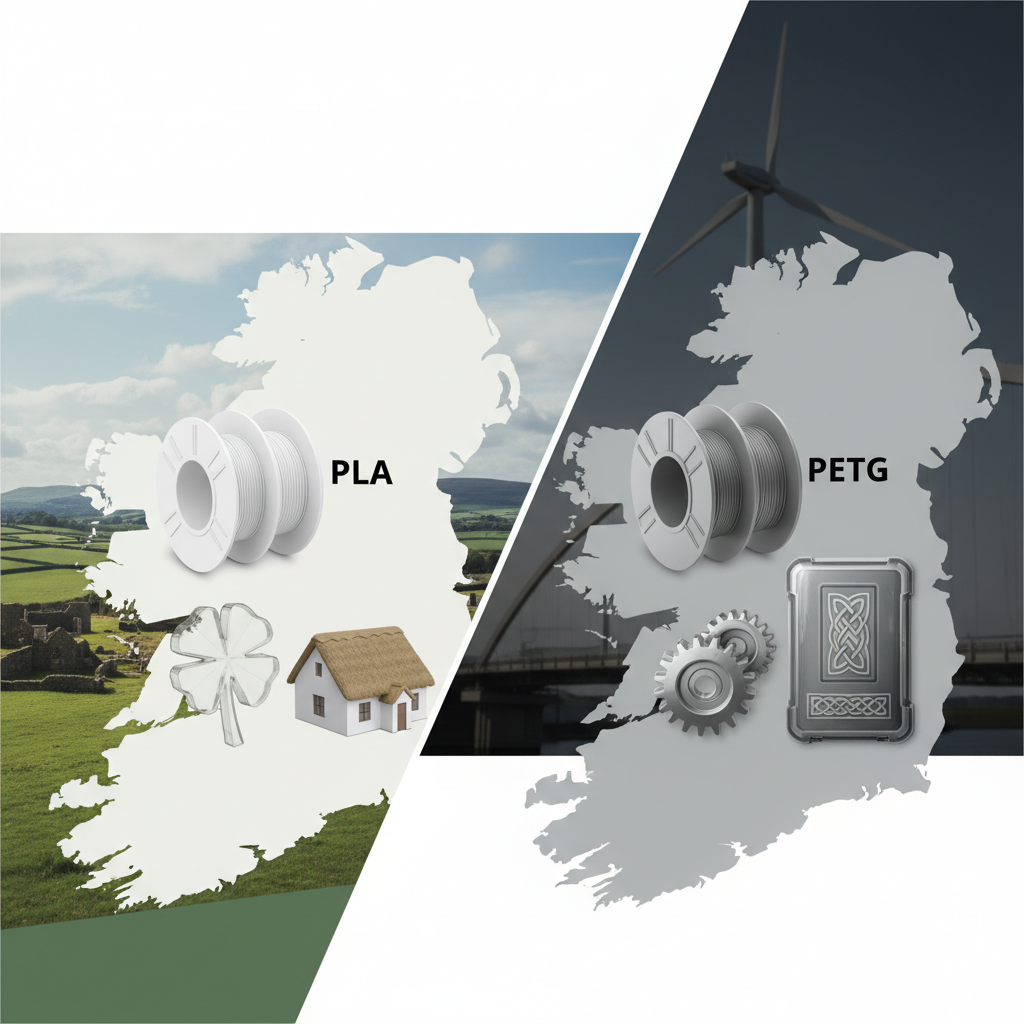
PLA (Polylactic Acid) is a thermoplastic polyester derived from renewable resources like corn starch or sugarcane, making it biodegradable under industrial composting conditions. It's renowned for its ease of use, lower printing temperatures, minimal warping, and lack of unpleasant fumes, which is why it's often recommended when considering which filament is best for beginners. PLA typically produces parts with a smooth, often shiny finish and is excellent for aesthetic models, prototypes, and low-stress applications.
PETG (Polyethylene Terephthalate Glycol) is a co-polyester that combines the ease of printing of PLA with the strength and durability of ABS, without many of ABS's downsides. It offers excellent layer adhesion, good impact resistance, and a higher temperature tolerance than PLA, making it suitable for functional parts that need to withstand more demanding conditions. While slightly more challenging to print than PLA due to its tendency to string, PETG provides a robust, often translucent finish that's ideal for mechanical components and outdoor applications.
Feature-by-Feature Comparison
Let's dive into a detailed comparison of PLA and PETG across several critical criteria that matter to Irish makers.
| Criterion | PLA (Polylactic Acid) | PETG (Polyethylene Terephthalate Glycol) |
|---|---|---|
| Ease of Printing | Generally considered the easiest filament to print. Requires lower temperatures (180-220°C nozzle, 0-60°C bed), minimal warping, and no enclosure needed. Excellent for beginners. | Slightly more challenging than PLA. Requires higher temperatures (220-250°C nozzle, 60-80°C bed) and can be prone to stringing. Good layer adhesion but requires careful retraction settings. |
| Strength & Durability | Rigid and brittle. Good tensile strength but low impact resistance. Parts can snap under stress. Best for non-load-bearing or aesthetic models. | Much stronger and more durable than PLA. High tensile strength, good impact resistance, and flexibility. Less brittle than ABS. Ideal for functional parts. |
| Temperature Resistance | Low heat resistance, softening point around 60°C. Not suitable for applications exposed to heat or direct sunlight. | Significantly better heat resistance than PLA, softening point around 80°C. Suitable for applications requiring moderate heat exposure. |
| Flexibility/Impact Resistance | Very low flexibility, prone to cracking or breaking on impact. | Good flexibility and high impact resistance. Parts can bend before breaking, making them resilient to drops and stress. |
| Post-Processing | Easy to sand, paint, and bond. Can be smoothed with specific chemical treatments (e.g., d-limonene, though less common than ABS smoothing). | Can be sanded and painted, but generally harder to work with than PLA. Chemical smoothing is difficult. Strong layer adhesion makes sanding more challenging. |
| Applications | Aesthetic models, prototypes, display pieces, low-stress jigs, educational prints, quick iterations. Great for art and decorative items. | Functional prototypes, mechanical parts, protective components, outdoor applications, liquid containers (some food-safe variants), RC parts, 3D printed replacement parts service. |
| Environmental Impact | Biodegradable under industrial composting conditions (not home composting), derived from renewable resources. More eco-friendly than most plastics. | Recyclable (though specific facilities are needed), but not biodegradable. Derived from petroleum. Considered a more sustainable alternative to ABS due to better recyclability. |
| Cost | Generally the most affordable and widely available 3D printing filament, making it very budget-friendly for hobbyists and businesses. | Slightly more expensive than standard PLA, but still very cost-effective given its enhanced mechanical properties. Our selection includes competitive options to buy Bambu Lab filament Ireland and buy PETG filament Ireland. |
Pros & Cons of PLA
Pros of PLA
- Ease of Printing: PLA is incredibly forgiving, making it ideal for beginners. It prints smoothly with minimal issues like warping or poor bed adhesion.
- No Fumes: It emits a slightly sweet, mild odour during printing, which is much less offensive than other filaments, making it suitable for home or office environments.
- Good for Aesthetics: PLA produces prints with a smooth, often glossy finish, excellent for models where visual appeal is paramount.
- Variety of Colours & Finishes: Available in a vast range of colours, including matte, silk, glitter, and glow-in-the-dark, offering immense creative freedom.
- Biodegradable: Made from renewable resources, PLA is a more environmentally conscious choice, breaking down under industrial composting.
Cons of PLA
- Low Durability: Prints can be brittle and prone to breaking under impact or stress, limiting its use for functional parts.
- Poor Heat Resistance: It has a low glass transition temperature, meaning prints can deform or soften in warm environments or direct sunlight.
- Limited Strength: Not suitable for high-stress applications or parts requiring significant structural integrity.
- Moisture Absorption: PLA can absorb moisture from the air, which can lead to printing issues if not properly stored.
Pros & Cons of PETG
Pros of PETG
- High Strength & Durability: PETG is much stronger and more durable than PLA, offering excellent impact resistance and tensile strength. This makes it perfect for 3d printed replacement parts service.
- Good Temperature Resistance: It can withstand higher temperatures without deforming, making it suitable for parts exposed to moderate heat.
- Flexibility: PETG parts have a degree of flexibility, allowing them to bend rather than snap, increasing their resilience.
- Chemical Resistance: It offers good resistance to various chemicals, oils, and greases, broadening its application range.
- Food-Safe Options: Some PETG variants are food-safe, making them suitable for containers or kitchen tools.
- Good Layer Adhesion: Excellent layer bonding contributes to strong, cohesive prints.
Cons of PETG
- Prone to Stringing: PETG has a tendency to string, requiring careful calibration of retraction settings and often slower print speeds.
- More Challenging to Print: While easier than ABS, it requires higher temperatures and can be more finicky to dial in compared to PLA.
- Surface Finish: Often produces a slightly less smooth or shiny finish than PLA, sometimes with a 'gumminess' if not properly tuned.
- Adhesion Issues: Can adhere too well to some print surfaces, potentially damaging the bed if not handled carefully (e.g., using a release agent or specific build surface).
Who Should Choose Each
Deciding between PLA and PETG ultimately comes down to your specific project needs and experience level. Here's a breakdown to help Irish makers pick their champion filament:
Choose PLA if you are:
- A Beginner to 3D Printing: If you're just starting your 3d printing journey, PLA is an ideal gateway material. Its ease of use minimises frustration and allows you to master the basics of your printer without battling complex material properties. It truly answers the question, "which filament is best for beginners?"
- Creating Aesthetic or Decorative Prints: For statues, figurines, cosplay props, display models, or any item where visual appeal is paramount, PLA's smooth finish and wide colour range excel. Think of intricate designs that don't need to withstand harsh conditions.
- Prototyping Rapidly: When you need to quickly iterate on designs, PLA's faster printing speeds and minimal post-processing make it perfect for rapid prototyping. If you're a startup looking for rapid prototyping and 3D design for Irish startups & SMEs, PLA can be your best friend.
- Working on Low-Stress Applications: For jigs, fixtures, or components that won't experience significant impact, heat, or mechanical stress, PLA is perfectly adequate and more cost-effective.
- Environmentally Conscious: If sustainability is a priority, PLA's biodegradable nature and derivation from renewable resources make it a more attractive option.
Choose PETG if you are:
- Creating Functional or Mechanical Parts: When your print needs to be strong, durable, and resilient to impact, PETG is the superior choice. This includes 3d printed replacement parts service for appliances, tools, protective cases, or drone components.
- Printing Items for Outdoor Use or Moderate Heat Exposure: If your part will be exposed to sunlight, higher temperatures (e.g., inside a car, near a window), or moisture, PETG's increased heat and UV resistance will ensure longevity.
- Seeking a Material Between PLA and ABS: PETG offers a fantastic middle ground, providing much of ABS's strength and temperature resistance without its difficult printing characteristics (like strong fumes or extreme warping). If you're thinking of buy ABS filament Ireland but are hesitant due to printing difficulties, PETG is a strong contender.
- Designing for Professional Applications: For projects requiring reliability and robustness, such as professional cad design for manufacturing, PETG provides the necessary mechanical properties for dependable end-use parts. If you have a precise CAD file and need a durable physical part, PETG is an excellent choice.
- Considering a Durable Everyday Item: From water bottle holders to durable phone cases, PETG's combination of strength and flexibility makes it suitable for items that will see regular handling and potential knocks.
For more complex requirements, such as precision components derived from a CAD file to 3d print service, or if you need expert assistance with professional cad design for manufacturing, PrintIn3D.ie offers comprehensive services to ensure your project's success. We also offer specialised services like 3d body scanning service and reverse engineering 3d scan service to help you turn any physical object into a print-ready design.
Verdict
The choice between PLA and PETG isn't about one being inherently "better" than the other; it's about selecting the right tool for the job. For Irish makers, PLA remains the champion for ease of use, aesthetic prints, and rapid prototyping, especially for those new to 3d printing. It's the go-to for hobbyists, educators, and anyone prioritising visual quality and printability. We stock high-quality PLA options, including Bambu Lab PLA filament Ireland, perfect for getting started.
However, when your projects demand resilience, strength, and better environmental resistance, PETG steps up as the clear winner. Its ability to produce durable, functional parts makes it indispensable for engineering applications, outdoor use, and anything that needs to withstand more than just visual inspection. While it presents a slightly steeper learning curve, the benefits in terms of mechanical performance are well worth the effort. For those looking to upgrade their material capabilities, our range of PETG filament in Ireland provides excellent options.
Ultimately, many experienced makers find themselves using both, leveraging PLA for initial concepts and decorative pieces, and transitioning to PETG when a design is finalised and needs to perform under real-world conditions. Don't be afraid to experiment, and remember that mastering your printer's settings for each material is part of the fun. If you're unsure or prefer to leave the printing to the experts, PrintIn3D.ie is here to help with our award-winning custom 3D printing services.
Ready to bring your ideas to life with the perfect filament? Explore our range of high-quality PLA and PETG filaments today at PrintIn3D.ie.