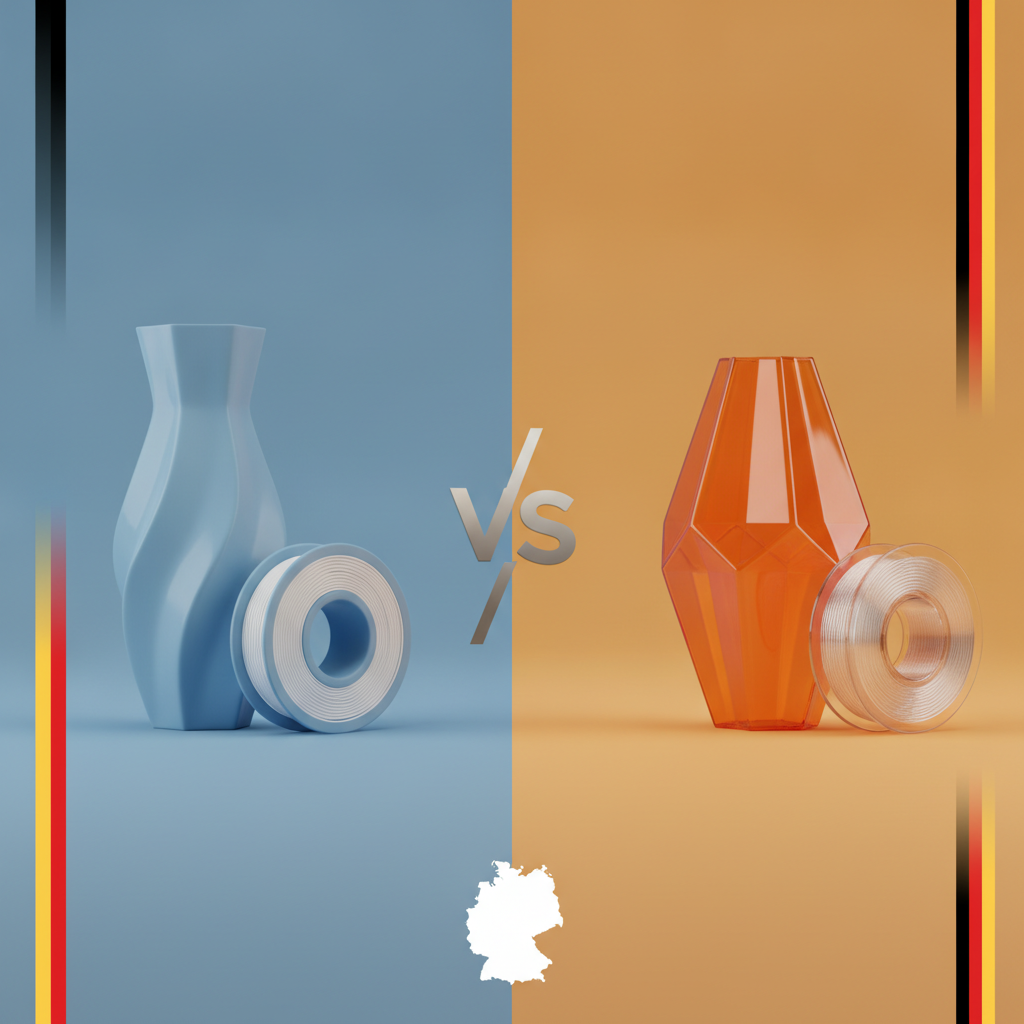
PLA vs. PETG Filament: Choose Your 3D Print Material in Germany
PLA vs. PETG Filament: Welches Material ist das Richtige für Ihr 3D-Druckprojekt in Deutschland?
Embarking on a 3D printing project in Germany, whether for a hobby or a professional application, often brings you to a crucial decision point: which filament should you choose? Among the most popular options, PLA (Polylactic Acid) and PETG (Polyethylene Terephthalate Glycol) stand out as go-to materials for countless makers. But how do you determine which one is the perfect fit for your specific needs? This comprehensive guide from PrintIn3D.ie, your trusted 3D printing partner in Europe, will walk you through the nuances of PLA and PETG, helping you make an informed decision for your next project, ensuring a hassle-free and successful 3D printing experience.
Understanding the fundamental differences between these two widely used filaments is essential for achieving optimal results. From ease of printing to final part durability and specific applications, PLA and PETG each offer distinct advantages. Here at PrintIn3D.ie, we're dedicated to helping you "Print Your 3D Dreams," whether you're looking to create personalisierte 3D-Druck Geschenke bestellen or industrial individuelle 3D-Druck Teile. Let's dive into the details to empower you with the knowledge to select the ideal 3d-druck-filament for your project in Germany.
Quick Overview: PLA & PETG Filament
PLA (Polylactic Acid) is often hailed as the king of beginner-friendly filaments. Derived from renewable resources like corn starch or sugarcane, it's biodegradable, making it a more environmentally conscious choice. PLA is incredibly easy to print, requiring lower temperatures and typically exhibiting minimal warping, which makes it a favourite for those new to 3D printing or for projects where intricate details and aesthetics are paramount. Its versatility, combined with a wide array of colours and finishes, makes it suitable for decorative items, prototypes, and educational models. If you’re just starting with 3D printing or need quick, reliable results, PLA is usually the first recommendation.
PETG (Polyethylene Terephthalate Glycol), on the other hand, bridges the gap between the ease of PLA and the strength of more technical filaments like ABS. It's a modified version of PET, the plastic commonly used in water bottles, with glycol added to prevent crystallization and make it clearer, less brittle, and easier to print. PETG offers a fantastic balance of strength, durability, flexibility, and temperature resistance. While slightly more challenging to print than PLA, it’s still manageable for most desktop 3D printers and provides significantly improved mechanical properties, making it ideal for functional parts, outdoor applications, and items that need to withstand a bit more wear and tear. For those in Germany seeking robust 3D-Druck Ersatzteile or components that need to last, PETG often hits the sweet spot.
Feature-by-Feature Comparison: PLA vs. PETG
| Criterion | PLA (Polylactic Acid) | PETG (Polyethylene Terephthalate Glycol) |
|---|---|---|
| Ease of Printing | Generally considered the easiest filament to print. It requires lower extruder and bed temperatures, experiences minimal warping, and offers excellent layer adhesion. This makes it ideal for beginners and for quickly iterating prototypes with high success rates. Users often find it more forgiving with calibration and settings. | Slightly more challenging than PLA but still very manageable for most desktop 3D printers. Requires higher extruder and bed temperatures, and can be prone to stringing if not properly calibrated. Adhesion to the print bed can be strong, sometimes too strong, necessitating careful removal strategies. |
| Strength & Durability | While rigid and offering good tensile strength, PLA is more brittle than PETG. It can snap under stress, especially in thinner sections, and is not ideal for parts that will experience repeated impact or bending. It's perfectly suitable for static, decorative, or low-stress functional parts. | Offers superior strength, toughness, and impact resistance compared to PLA. It's less brittle and can flex slightly before breaking, making it an excellent choice for functional parts, mechanical components, and items that need to withstand physical stress or drops. Ideal for individuelle 3D-Druck Teile that require robust performance. |
| Temperature Resistance | Has a relatively low glass transition temperature (Tg) of around 60°C. This means PLA prints can soften, deform, or even melt in hot environments, such as a car on a sunny day or near heat sources. Not suitable for applications requiring heat resistance. | Boasts significantly higher temperature resistance than PLA, with a Tg typically ranging from 80-85°C. This makes it much more suitable for parts that might encounter elevated temperatures without deforming, broadening its application range to automotive components or housings for electronics. |
| Flexibility | PLA is a rigid material with very little flexibility. Once printed, it maintains its shape firmly. This rigidity is advantageous for precise, dimensionally stable prints but limits its use in applications requiring any degree of give or elasticity. | Offers a good degree of flexibility compared to PLA. It's not as flexible as TPU, but it can bend and absorb impact without immediately breaking. This makes it excellent for parts that need to withstand some deformation, like clips, hinges, or protective casings. |
| Post-Processing | Relatively easy to sand, paint, and bond. It can also be smoothed using traditional methods. However, its low temperature resistance can make heat-based post-processing methods tricky without deformation. Chemical smoothing is generally not an option. | Can be sanded and painted, but its inherent toughness can make these processes more challenging than with PLA. Its layer adhesion can make seam removal more difficult. It can be vapor-smoothed with certain chemicals, but this is less common and more complex than with other filaments like ABS. |
| Environmental Impact | As a thermoplastic derived from renewable resources, PLA is biodegradable under industrial composting conditions, making it generally more environmentally friendly than petroleum-based plastics. It's a popular choice for sustainable printing practices. | While derived from petroleum, PETG is recyclable (though not always easily through standard municipal recycling streams). It is not biodegradable like PLA. However, its durability means parts often have a longer lifespan, reducing the need for frequent replacements. |
| Typical Applications | Excellent for prototypes, display models, decorative items, personalisierte 3D-Druck Geschenke bestellen, educational tools, and low-stress functional parts. Think figurines, architectural models, or quick design iterations. | Ideal for functional prototypes, durable mechanical parts, protective components, outdoor applications, liquid containers (food-safe grades available), and 3D-Druck Ersatzteile. Common for jigs, fixtures, and drone parts where toughness is key. |
Pros & Cons of PLA Filament
Pros of PLA
- Ease of Use: PLA is incredibly easy to print, offering good layer adhesion, minimal warping, and low stringing. It’s perfect for beginners and those seeking a straightforward printing experience.
- Aesthetic Quality: Known for producing prints with excellent surface finish and vibrant colours. Its rigidity allows for sharp details and clean lines, making it ideal for display pieces.
- Wide Availability & Cost-Effective: 3d-druck-filament für Bambu Lab and other PLA brands are widely available in our 3D-Druck online Shop and other suppliers, often at a lower price point than PETG.
- Biodegradable: Made from renewable resources, PLA is compostable under industrial conditions, offering a more eco-friendly option compared to most other plastics.
- Low Odour: Emits very little odour during printing, making it suitable for use in home or office environments without strong ventilation.
Cons of PLA
- Lower Strength & Brittleness: PLA is more brittle than PETG, making it prone to snapping under stress or impact. Not ideal for parts requiring high durability or flexibility.
- Low Temperature Resistance: Its low glass transition temperature means PLA prints can deform in warm environments, limiting its use for outdoor applications or parts exposed to heat.
- UV & Moisture Sensitivity: Over prolonged exposure, PLA can degrade when exposed to UV light and moisture, reducing its suitability for long-term outdoor use without protective coatings.
Pros & Cons of PETG Filament
Pros of PETG
- High Strength & Durability: Offers excellent tensile strength, toughness, and impact resistance, making it suitable for functional, load-bearing parts and individuelle 3D-Druck Teile.
- Good Temperature Resistance: Withstands higher temperatures than PLA without deforming, broadening its application range to more demanding environments.
- Chemical Resistance: Exhibits good resistance to a variety of chemicals, oils, and greases, which enhances its utility for industrial and mechanical applications.
- Flexibility: While not as flexible as TPU, PETG has a degree of flexibility that allows it to bend and absorb shock, reducing the likelihood of breakage compared to PLA.
- Food-Safe Options: Certain grades of PETG are considered food-safe, making them suitable for containers, kitchenware, or parts that come into contact with food (always check manufacturer specifications).
Cons of PETG
- More Challenging to Print: Requires higher printing temperatures and can be prone to stringing and oozing. Achieving optimal print quality often requires more fine-tuning of settings.
- Strong Bed Adhesion: While good for preventing warping, PETG can adhere very strongly to the print bed, sometimes making removal difficult and potentially damaging the print surface if not properly prepared.
- Less Detail Fidelity: Compared to PLA, PETG can sometimes be harder to print with very fine details due to its tendency to string, though this can be mitigated with proper retraction settings.
- Hydroscopic: PETG absorbs moisture from the air more readily than PLA, which can lead to poor print quality if the filament is not properly stored and dried before use.
Who Should Choose Each Filament?
Choosing the right filament comes down to understanding your project's specific requirements. PrintIn3D.ie is here to guide you, whether you’re exploring options for custom 3D printing service in Berlin or any other location in Germany, we ensure you select the best material.
Choose PLA if:
- You are new to 3D printing: Its ease of use, lower temperature requirements, and minimal warping make it the most forgiving material for beginners. It's a great starting point to learn the ropes.
- Your project is primarily aesthetic or decorative: For models, figurines, prototypes, or personalisierte 3D-Druck Geschenke bestellen where visual appeal and intricate details are more important than mechanical strength, PLA excels with its smooth finish and vibrant colours.
- You need quick and reliable prototypes: When iterating designs rapidly, PLA's fast printing and high success rate allow for efficient development cycles. It's perfect for quickly visualizing ideas before committing to more robust materials.
- Your prints won't be exposed to high temperatures or significant stress: If the final product will reside indoors, away from direct sunlight or heat sources, and won't undergo heavy use, PLA is a cost-effective and easy choice.
- Environmental impact is a concern: Its biodegradable nature makes PLA a more environmentally conscious choice for those looking to minimize their footprint.
- You require an efficient 3D-Druck online Shop experience for ready-to-print models: If you have an STL file and need it printed without complex material considerations, PLA is often the go-to.
Choose PETG if:
- You need strong, durable, and functional parts: For components that will experience impact, bending, or general wear and tear, such as 3D-Druck Ersatzteile, jigs, fixtures, or tool handles, PETG's toughness and flexibility are invaluable.
- Your prints will be exposed to higher temperatures or outdoor conditions: PETG's superior temperature and UV resistance make it suitable for outdoor applications, automotive parts, or enclosures for electronics where PLA would deform.
- You require chemical resistance: If your printed parts will come into contact with oils, solvents, or other chemicals, PETG offers better resistance than PLA, extending the lifespan and utility of the print.
- You are ready for a slightly more advanced printing challenge: While a step up from PLA, PETG is still very accessible for those with some 3D printing experience and a willingness to fine-tune settings for optimal results. Our 3D-Design Service and expert support can help you master PETG if you're feeling challenged.
- Your project involves individuelle 3D-Druck Teile that need to last: For custom parts designed for specific, demanding roles, PETG provides the robust performance needed for long-term reliability.
- You're considering prototyping functional items and need CAD design für 3D-Druck support: Our expert team can assist with 3D-Druck Design Service and material selection to ensure your functional prototypes are perfect.
Verdict: Making the Right Choice for Your 3D Printing in Germany
Ultimately, the "best" filament, whether PLA or PETG, isn't about one being inherently superior, but about which one is superior for your specific project. If you’re just starting your 3D printing journey in Germany, focused on aesthetics, rapid prototyping, or creating personalisierte 3D-Druck Geschenke bestellen, PLA is likely your ideal choice. Its ease of use, wide range of colours – including premium 3d-druck-filament für Bambu Lab options available in our 3D-Druck online Shop – and lower printing temperatures make it a fantastic, hassle-free material.
However, if your project demands strength, durability, flexibility, and resistance to higher temperatures or chemicals, then PETG steps up as the clear winner. It's the go-to material for functional individuelle 3D-Druck Teile, 3D-Druck Ersatzteile, or anything that needs to withstand real-world conditions. While it might require a little more tweaking in your printer settings, the results are well worth the effort for robust applications.
At PrintIn3D.ie, we understand that sometimes you need more than just filament. You might have an idea but no design, or a physical object you want to replicate. That’s where our comprehensive services come in. Our expert 3D-Design Service can transform your concepts into print-ready models, providing top-tier CAD design für 3D-Druck. If you have a physical item, our 3D-Objekt scannen lassen service can create a digital model, ready for reproduction. Whether you choose PLA or PETG, or need assistance with custom designs or scanning, we are your trusted partner for 3D printing in Germany and across the EU. We’re here to make your 3D printing journey seamless and successful, offering expert advice, fast turnaround times, and the premium filaments you need.
Ready to bring your ideas to life? Explore our custom 3D printing services and premium filaments today!