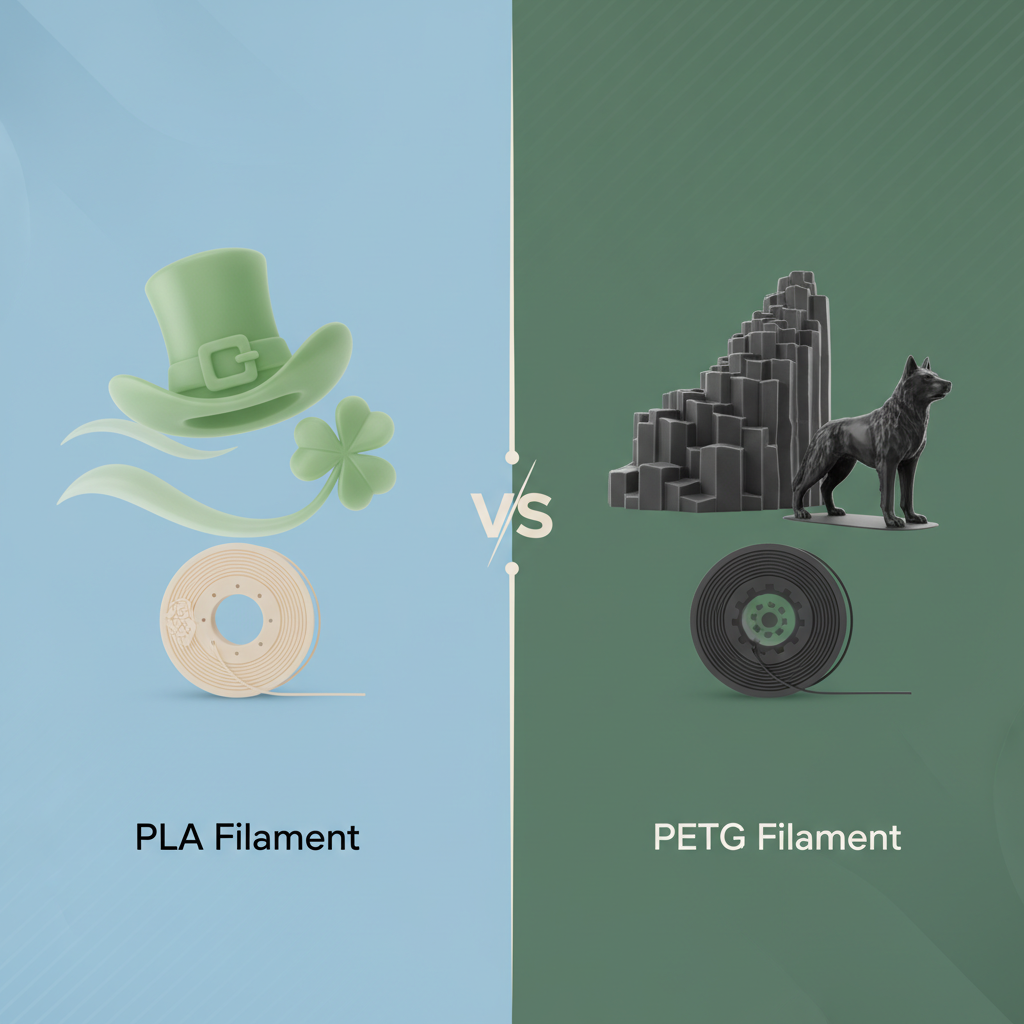
PLA vs. PETG Filament: Choosing for Your Irish 3D Printing Project
PLA Filament vs. PETG: Which is Best for Your Project in Ireland?
Embarking on a new 3D printing project in Ireland? One of the first and most crucial decisions you'll face is choosing the right filament. With a dazzling array of 3d printer filaments available, it can feel like navigating a maze. However, for most hobbyists, creators, and even businesses needing a rapid prototyping service Ireland, the choice often boils down to two titans: PLA and PETG. Both have their unique strengths and weaknesses, and understanding these differences is key to bringing your 3D dreams to life successfully.
At PrintIn3D.ie, your trusted 3D printing partner in Ireland, we're here to demystify this choice. We offer both custom 3D printing services and high-quality filaments like Bambu Lab PLA and SUNLU PETG, ready for fast delivery. This comprehensive comparison will help you understand whether PLA filament or PETG is the superior choice for your specific needs, ensuring your project achieves the perfect blend of aesthetics, functionality, and durability.
Quick Overview: PLA Filament
PLA, or Polylactic Acid, is arguably the most popular and widely used 3d printer filament globally, and certainly a go-to for many in Ireland. Derived from renewable resources like corn starch or sugarcane, it's celebrated for its ease of use, low warping, and excellent print quality. It's often recommended as which filament is best for beginners due to its forgiving nature and lack of unpleasant fumes during printing.
Quick Overview: PETG Filament
PETG, or Polyethylene Terephthalate Glycol-modified, is a fantastic hybrid material that combines the best aspects of PLA and ABS. It offers the ease of printing of PLA with the enhanced strength, durability, and temperature resistance of ABS. For those seeking functional parts that need to withstand more rigorous conditions, PETG is often the preferred choice, making it increasingly popular for demanding projects and as a common request for 3d printed replacement parts service.
Feature-by-Feature Comparison: PLA vs. PETG
Let's dive deeper into the key characteristics that differentiate these two popular 3d printer filaments:
| Criterion | PLA Filament | PETG Filament |
|---|---|---|
| Ease of Printing | Very Easy: Low melting point, minimal warping, no heated bed often required. Ideal for beginners. Less prone to stringing and blobbing. | Moderate: Higher melting point than PLA, requires a heated bed. Prone to stringing and oozing, requiring careful retraction settings. |
| Strength & Durability | Good, but Brittle: Relatively strong in compression but can be brittle, especially under sudden impact or bending. Low abrasion resistance. | Excellent: High tensile strength, very durable, and significantly more impact resistant than PLA. Good abrasion resistance. |
| Flexibility | Rigid: Not flexible. It will snap rather than bend under stress, making it unsuitable for parts requiring give. | Flexible/Tough: More flexible and less brittle than PLA, allowing it to absorb impact better and be suitable for parts that need some give. |
| Temperature Resistance | Low: Softens at around 50-60°C (122-140°F). Not suitable for outdoor use or parts exposed to heat (e.g., inside a car on a sunny day). | High: Withstands temperatures up to 80°C (176°F). Much better for applications requiring heat resistance. |
| Moisture Absorption | Moderate: Can absorb moisture from the air, which can lead to print quality issues if not stored properly. | High: More hygroscopic than PLA, meaning it absorbs moisture even more readily. Requires diligent dry storage to maintain print quality. |
| Post-Processing | Easy: Sands, paints, and glues well. Can be easily machined. Smooth surfaces are achievable with minimal effort. | Moderate: Can be challenging to sand due to its tough, slightly gummy nature. Painting and gluing require specific primers/adhesives. |
| Food Safety | Generally Not Recommended: While PLA itself can be food-safe, the printing process (layer lines, brass nozzles) can harbour bacteria. | Generally Food-Safe: Often used in food and beverage containers. However, the same caveats about the printing process apply. |
| Cost | Economical: Generally the most affordable 3d printer filament on the market, making it a cost-effective choice for many. | Mid-Range: Slightly more expensive than PLA, but offers superior properties for the price, making it excellent value for functional prints. |
Pros & Cons of PLA Filament
Pros of PLA Filament
- Extremely Easy to Print: PLA is renowned for its user-friendliness, making it the top choice for beginners and those looking for a hassle-free 3D printing experience. It adheres well to print beds, warps minimally, and doesn't require an enclosure.
- Low Odour: Unlike some other filaments, PLA produces a faint, sweet smell during printing, which is generally considered non-offensive and safe for use in home environments.
- Wide Range of Colours and Finishes: PLA boasts an incredible variety of colours, from vibrant solids to translucent, glitter, silk, and colour-changing options, perfect for aesthetic projects or educational models.
- Good Detail and Aesthetics: Its low printing temperature and viscosity allow for very fine details and smooth finishes, making it ideal for visual prototypes, figurines, and decorative items.
- Environmentally Friendlier: As it's derived from renewable plant-based sources, PLA is biodegradable under industrial composting conditions, making it a more eco-conscious choice among 3d printer filaments.
- Low Warping: Prints cool down and solidify with very little shrinkage, which means less risk of corners lifting off the print bed.
Cons of PLA Filament
- Brittle: While strong, PLA is quite rigid and can shatter or snap under impact, making it unsuitable for parts that require flexibility or high durability.
- Low Temperature Resistance: Its low glass transition temperature means PLA objects can soften, deform, or even melt in hot environments, such as a car on a sunny day or near a heat source.
- Not UV Resistant: Prolonged exposure to UV light (sunlight) can cause PLA to degrade and become even more brittle over time, limiting its outdoor applications.
- Limited Chemical Resistance: PLA is susceptible to degradation from various chemicals, making it less ideal for functional parts that might come into contact with solvents or oils.
- Mechanical Properties: Not the best choice for parts that will undergo significant mechanical stress or require load-bearing capabilities.
Pros & Cons of PETG Filament
Pros of PETG Filament
- High Strength and Durability: PETG is significantly stronger and tougher than PLA, offering excellent impact resistance and making it a superb choice for functional parts and prototypes. It excels where resilience is key.
- Good Flexibility: Unlike the brittle nature of PLA, PETG has a degree of flexibility, allowing it to bend slightly before breaking. This makes it ideal for parts that need to absorb shock or flex under pressure, such as clips or living hinges.
- Excellent Temperature Resistance: With a higher glass transition temperature (around 80°C), PETG objects can withstand hotter environments without deforming, broadening its range of applications considerably.
- Chemical Resistance: PETG exhibits good resistance to a variety of chemicals, oils, and solvents, enhancing its suitability for industrial applications or 3d printed replacement parts service in harsh environments.
- Food-Safe (Generally): Often used in food packaging, PETG is considered food-safe when manufactured and handled correctly. While direct 3D printing for food contact still has caveats due to layer lines and potential brass nozzle contaminants, PETG as a material is better suited than PLA.
- Good Layer Adhesion: PETG layers bond very well, resulting in strong, cohesive parts that are less likely to delaminate under stress.
- Transparency Options: PETG can be printed to be quite translucent or even transparent, which is useful for light pipes, protective covers, or aesthetic effects.
Cons of PETG Filament
- More Challenging to Print: PETG requires more fine-tuning of printer settings than PLA, particularly regarding retraction to minimise stringing and oozing. It also benefits from a heated bed.
- Prone to Stringing and Oozing: Its sticky nature when molten means PETG can leave fine strands of plastic (stringing) or blobs on prints, requiring careful calibration and potentially more post-processing.
- Highly Hygroscopic: PETG readily absorbs moisture from the air, which can severely impact print quality, causing bubbles, weak layers, and poor surface finish. It must be stored in a dry environment.
- Adherence Issues (Too Strong): While good layer adhesion is a pro, PETG can sometimes adhere *too* strongly to the print bed, especially glass, potentially damaging the surface if not released carefully or with an appropriate adhesive layer.
- Less Aesthetic Range: While available in many colours, the sheer variety and special finishes often seen with PLA are less common for PETG.
- Slightly Higher Cost: Generally, PETG costs a little more per kilogram than PLA, though still very affordable for the properties it offers. If you are looking to buy PETG filament Ireland, PrintIn3D.ie offers competitive pricing.
Who Should Choose Each Filament?
Choose PLA Filament if You Are:
- A Beginner to 3D Printing: If you're just starting your 3D printing journey, PLA is the ideal choice. Its ease of use will help you learn the ropes without the frustration of constant print failures. It answers the question, "which filament is best for beginners?" very clearly.
- Creating Decorative Items and Figurines: For models, toys, artistic pieces, or items where aesthetics are paramount and functional strength isn't a primary concern, PLA's print quality and vast colour range shine.
- Making Visual Prototypes: If you need to quickly iterate on a 3D design and visualise concepts, PLA offers fast, reliable prints for rapid prototyping service Ireland.
- Printing Non-Functional Parts: For items that won't be exposed to stress, heat, or outdoor elements, such as desk organizers (10 essential 3D printed solutions for your home) or display models, PLA is perfectly sufficient.
- Budget-Conscious: PLA is generally more affordable, making it a great choice for large prints or when you're experimenting and need to keep costs down.
Choose PETG Filament if You Are:
- Creating Functional Parts: When your project demands strength, durability, and a bit of flexibility, PETG is your go-to. Think jigs, fixtures, tool handles, or enclosures. This is especially true for 3d printed replacement parts service.
- Printing Items for Outdoor Use or High Temperatures: For components that will be exposed to sunlight, heat, or varying weather conditions (e.g., drone parts, garden accessories), PETG's resistance to UV and higher temperatures makes it superior.
- Manufacturing Mechanical Components: Its toughness and layer adhesion make it suitable for parts that will endure repeated stress or moderate impacts, bridging the gap between PLA and ABS filament (if you were thinking to buy ABS filament Ireland, PETG might be a good alternative).
- Working on Industrial Projects or Prototypes: For more demanding prototypes or even end-use parts in certain industrial 3D printing services, PETG offers the necessary mechanical properties. It's often chosen by a 3d design and prototyping company for robust models.
- Requiring Chemical Resistance: If your print needs to withstand exposure to water, oils, or mild chemicals, PETG will outperform PLA significantly.
Verdict: Your 3D Printing Partner's Recommendation
There's no single "best" filament; the ideal choice between PLA and PETG ultimately hinges on the specific requirements of your 3D printing project. If you're prioritising ease of use, aesthetic appeal, intricate details, and budget for non-functional items, PLA is your champion. It's truly which filament is best for beginners and fantastic for many everyday applications and visual prototypes.
However, if your project demands strength, durability, flexibility, temperature resistance, or if you're looking to create robust 3d printed replacement parts service or components for functional use, PETG steps up as the clear winner. While it requires a bit more finesse in printing, the resulting parts are significantly more resilient and versatile.
At PrintIn3D.ie, we understand these nuances intimately. Whether you need reliable, high-quality 3d printer filaments delivered fast to your door in Ireland, or prefer to take advantage of our award-winning custom 3D printing services, we're here to help. We stock premium options like Bambu Lab PLA and SUNLU PETG, ensuring you have the materials you need. And if you have a complex idea but no print-ready file, our expert 3d design team can transform your concept into a printable reality. We believe in providing hassle-free solutions, making us your ultimate 3D printing partner in Ireland.
Ready to Print Your 3D Dreams?
No matter which filament suits your project best, PrintIn3D.ie is ready to help you bring your ideas to life with our expert custom 3D printing service and premium filament selection.