PLA vs PETG Filament: Choosing for Your Irish 3D Printing Project
PLA vs PETG Filament: Which is Best for Your Irish 3D Printing Project?
Welcome to the exciting world of 3D printing! Whether you're a seasoned enthusiast or just starting your journey to bring digital ideas into physical reality, you've likely encountered a crucial decision: choosing the right filament. For many Irish makers and businesses, this choice often comes down to two popular contenders: PLA and PETG. But how do you know which is the best filament for 3d printing your specific project? That's what we're here to help you figure out!
At PrintIn3D.ie, we're your 3D printing partner, dedicated to making your creative process as hassle-free as possible. We understand that selecting the ideal material is paramount to achieving outstanding results, whether you're creating custom 3d printed parts ireland, developing a new product, or simply enjoying a hobby. This comprehensive guide will break down the characteristics of PLA and PETG, helping you make an informed decision for your next project.
Quick Overview: PLA vs PETG
Let's start with a brief introduction to our two stars:
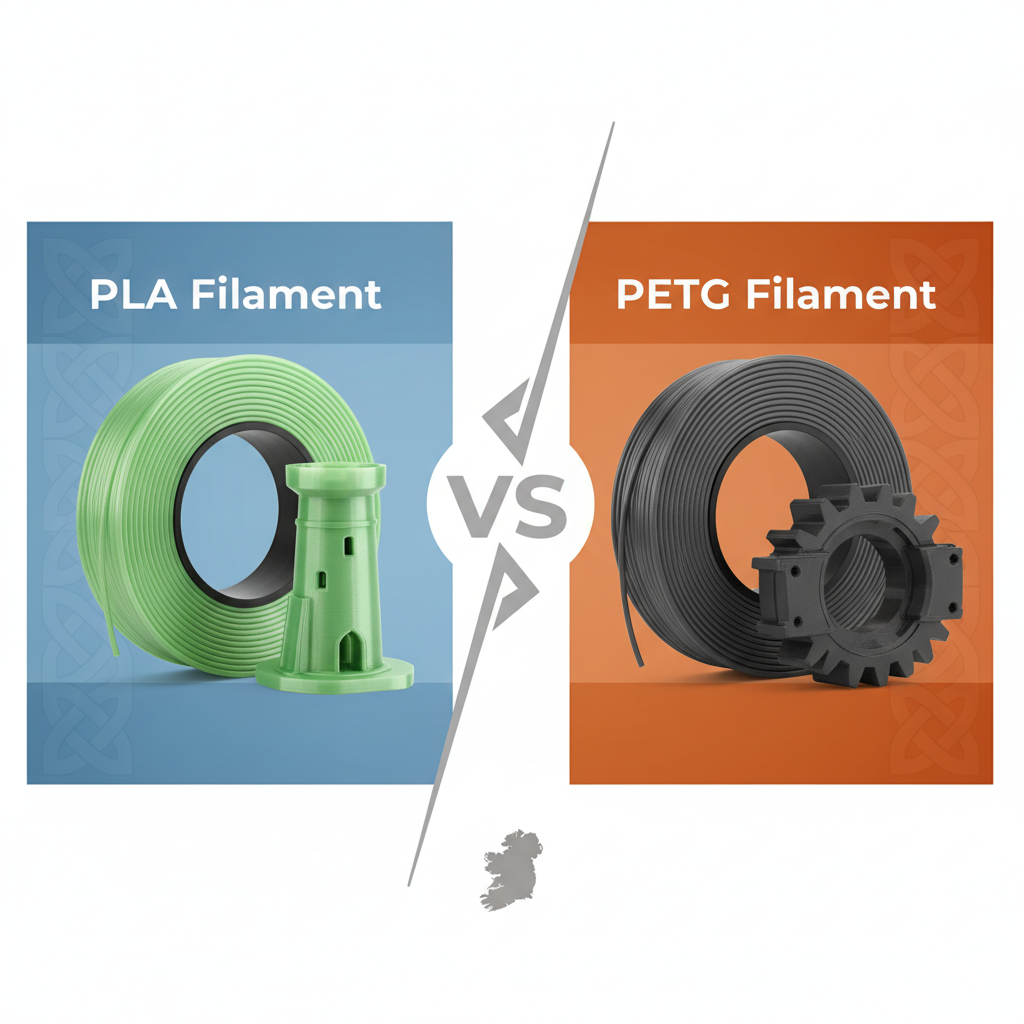
PLA (Polylactic Acid): Often the go-to choice for beginners and hobbyists, PLA is renowned for its ease of use. It's derived from renewable resources like corn starch, making it a more environmentally friendly option. Prints beautifully with minimal warping and doesn't require a heated bed for smaller models, though it's recommended for larger ones. It's great for aesthetic pieces, prototypes, and models that won't undergo significant stress or high temperatures.
PETG (Polyethylene Terephthalate Glycol-modified): Think of PETG as the best of both worlds – offering some of the ease of printing found in PLA, combined with enhanced durability and temperature resistance similar to ABS. It's a robust and versatile filament, ideal for functional parts that need to withstand more wear and tear, outdoor exposure, or moderate mechanical stress. If you're looking to buy abs filament ireland for its strength but are put off by its printing complexities, PETG might be your perfect compromise.
Feature-by-Feature Comparison
To truly understand which filament suits your needs, let's dive into a detailed comparison across key criteria:
| Criterion | PLA (Polylactic Acid) | PETG (Polyethylene Terephthalate Glycol-modified) |
|---|---|---|
| Ease of Printing | Generally considered the easiest filament to print. Low melting point, minimal warping, and no strong odours. Doesn't typically require an enclosed printer or heated bed, although a heated bed is beneficial for adhesion. Ideal for beginners. | Relatively easy to print, but requires slightly higher temperatures than PLA. Can be prone to stringing (fine strands of plastic) if retraction settings aren't dialled in correctly. Benefits greatly from a heated bed. More forgiving than ABS but less so than PLA. |
| Strength & Durability | Good stiffness and hardness, but brittle. Can snap under stress or impact. Not ideal for functional parts that need to endure mechanical loads or repeated impact. | Excellent strength, good impact resistance, and flexibility. Much less brittle than PLA, making it suitable for functional parts, tools, and components that need to withstand physical stress or drops. |
| Temperature Resistance | Low glass transition temperature (around 60°C). Softens and deforms easily in warm environments or direct sunlight. Not suitable for parts exposed to heat. | Higher glass transition temperature (around 80°C). Can withstand higher temperatures than PLA without deforming, making it suitable for parts that might be exposed to moderate heat or outdoor conditions. |
| Flexibility | Very rigid and brittle. Offers almost no flexibility before breaking. | Offers good flexibility, especially for a rigid filament. Can bend and deform slightly before breaking, providing more resilience than PLA. |
| Surface Finish & Aesthetics | Produces very clean, often glossy or matte finishes. Excellent for highly detailed models and aesthetic prints. Wide range of vibrant colours available. | Can produce a glossy finish, but can be prone to more visible layer lines or slight imperfections if not tuned correctly. Transparency is possible with specific settings and colours. |
| Adhesion & Warping | Excellent bed adhesion with minimal to no warping, even without an enclosure or heated bed. | Good bed adhesion, but can sometimes stick *too* well, potentially damaging the print surface if not properly prepared. Low to moderate warping, much less than ABS. |
| Water & Chemical Resistance | Poor resistance to moisture and many chemicals. Biodegradable over time, especially in compost environments. | Good resistance to water and many chemicals, making it more suitable for outdoor applications or parts that might come into contact with liquids. |
| Environmental Impact | Biodegradable and made from renewable resources, often considered the most eco-friendly standard filament option. | Recyclable (often bottle-grade plastic) but not biodegradable. Less eco-friendly than PLA but more so than many other plastics. |
Pros & Cons
Let's summarise the advantages and disadvantages of each filament:
PLA Filament
- Pros:
- Easy to Print: User-friendly, low warping, no strong fumes, making it ideal for home use.
- Good for Detail: Excels at printing intricate designs and models with fine features.
- Wide Colour Range: Available in a vast array of colours and finishes, including shiny, matte, and silk.
- Biodegradable: Made from renewable plant-based resources, making it a more sustainable choice.
- Affordable: Generally one of the most cost-effective filaments available.
- Perfect for Prototypes: Great for quick iterations and mock-ups, helping you visualise your 3d product design services ireland concepts rapidly.
- Cons:
- Brittle: Can break easily under impact or stress.
- Low Heat Resistance: Deforms at relatively low temperatures (around 60°C).
- Poor UV Resistance: Degrades and becomes brittle when exposed to sunlight over time, not suitable for outdoor use.
- Not Food Safe: Porous surface can harbour bacteria, making it unsuitable for direct food contact.
PETG Filament
- Pros:
- Strong and Durable: Offers excellent strength, impact resistance, and layer adhesion, making for robust parts.
- Temperature Resistant: Can withstand higher temperatures than PLA without deforming.
- Good Chemical Resistance: More resistant to water and chemicals, broadening its application range.
- Moderate Flexibility: Less brittle than PLA, allowing for some flex before breaking.
- Good Transparency: Certain PETG filaments can produce clear or translucent prints.
- Versatile Applications: Suitable for functional parts, mechanical components, and outdoor use.
- Alternative to ABS: Provides many of the benefits of ABS without the strong fumes or warping issues, which is great if you're exploring beyond traditional materials like if you currently buy abs filament ireland.
- Cons:
- Prone to Stringing: Can be tricky to dial in retraction settings to prevent fine strings of plastic between printed features.
- Surface Adhesion: Can sometimes stick too well to the print bed, potentially causing damage if not careful.
- Requires Higher Temperatures: Needs higher nozzle and bed temperatures than PLA, which some entry-level printers might struggle with.
- Less Aesthetic than PLA: While capable of good finishes, it can be harder to achieve the ultra-smooth, detailed look often seen with PLA.
- Not Biodegradable: While recyclable, it's not biodegradable like PLA.
Who Should Choose Each Filament?
The best choice truly depends on your specific project and priorities. Let's break down typical scenarios:
Choose PLA if:
- You're a Beginner: Its forgiving nature makes it the perfect starting point for learning the ropes of 3D printing.
- You Need Aesthetic Prints: For decorative items, intricate models, figurines, or art pieces where visual appeal is key.
- You're Prototyping Quickly: For initial design iterations or proof-of-concept models where speed and ease are more important than extreme durability. If you're an Irish startup needing rapid prototyping, PLA is an excellent choice for iterating your designs with an experienced 3d design and prototyping company like us.
- Your Prints Won't Experience Stress or Heat: Ideal for indoor use, low-stress applications, or parts that won't be exposed to high temperatures or direct sunlight.
- You Prioritise Environmental Friendliness: Its biodegradable nature makes it a more eco-conscious option.
- You're looking for an affordable 3d printing near me solution for simple parts: PLA helps keep costs down for straightforward jobs.
Choose PETG if:
- You Need Strong, Functional Parts: For components that require good mechanical strength, impact resistance, and durability, such as gears, brackets, tool handles, or drone parts.
- Your Prints Will Be Used Outdoors or in Warmer Environments: Its higher temperature and UV resistance make it suitable for outdoor applications or parts that might see moderate heat.
- You Require Some Flexibility: For parts that need to flex or absorb impact without immediately breaking.
- You're Making Enclosures or Covers: Its robust nature protects internal components effectively.
- You're Bridging the Gap from ABS: If you need strength approaching ABS but want an easier printing experience without the strong fumes, PETG is a fantastic alternative.
- You're Creating Durable Custom 3D Printed Parts Ireland: For businesses or individuals needing robust parts for various applications, PETG offers a reliable solution.
Verdict: Making the Right Choice for Your Project
Ultimately, there's no single "best" filament; there's only the best filament for *your* specific project. PLA shines for its ease of use, excellent aesthetics, and affordability, making it the champion for beginners, decorative prints, and quick prototyping. PETG, on the other hand, steps up when you need strength, durability, and temperature resistance, proving its worth for functional parts and more demanding applications.
For most Irish makers and businesses, a common strategy is to start with PLA for initial prototypes and aesthetic models. Once the design is validated, if the part requires greater resilience, heat resistance, or mechanical strength, then PETG becomes the natural upgrade. This approach allows for cost-effective development while ensuring the final product meets all necessary performance criteria.
Whether you need a quick prototype in PLA, robust custom 3d printed parts ireland in PETG, or expert 3d product design services ireland to bring your concept to life, PrintIn3D.ie is here to help. We offer both custom 3D printing services and a wide range of filaments. If you already own a printer, explore our 3d printer filament shop ireland for high-quality PLA and PETG from brands like Bambu Lab and SUNLU. With same day filament delivery ireland on many orders, you can get started on your projects without delay!
If you're unsure which material is best for your specific application, or if you need assistance with your model, our friendly team is always ready to offer expert advice. We can help you transition your ideas from concept to reality, even offering 3d design services if you don't have a print-ready file. For more insights on selecting the perfect material, check out our FAQ on choosing the best 3D printer filament for your project.
Ready to Bring Your 3D Dreams to Life?
Choose the right filament for your project or let PrintIn3D.ie print your custom parts with confidence!