PLA vs. PETG Filament: Choosing the Best for Your 3D Print Project in NL
PLA vs. PETG Filament: Choosing the Right Material for Your 3D Print Project in the Netherlands
Diving into the world of 3D printing opens up a universe of possibilities, from intricate models to functional prototypes. But before you can 'Print Your 3D Dreams', a crucial decision often looms: which filament material is best for your project? For enthusiasts and businesses engaged in 3d printen nederland, the choice often comes down to two titans of desktop 3D printing: PLA and PETG. Both are incredibly popular, yet they each possess unique properties that make them suitable for different applications.
At PrintIn3D, your award-winning 3D Printing Partner in Ireland and the EU/EEA, we understand that selecting the right material is paramount to achieving outstanding results. Whether you're a hobbyist looking to create beautiful display pieces or a business needing robust functional parts, understanding the nuances between PLA and PETG is key. This comprehensive comparison will help you navigate their strengths and weaknesses, ensuring your next custom 3d print service nederland project is a resounding success.
Quick Overview: PLA vs. PETG
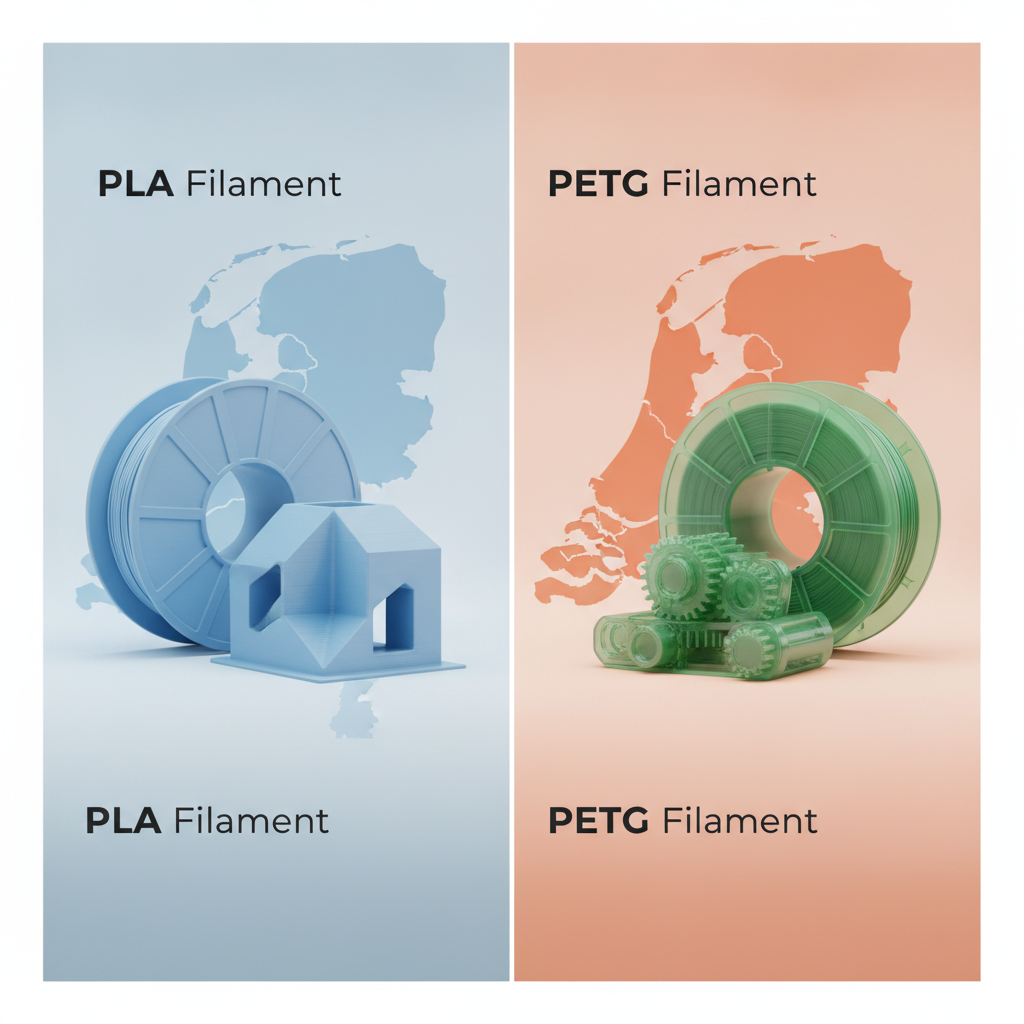
Before we delve into the specifics, let's get a quick snapshot of these two popular materials:
- PLA (Polylactic Acid): Widely regarded as the easiest 3D printing filament to work with, PLA is a biodegradable thermoplastic derived from renewable resources like corn starch. It's celebrated for its ease of printing, vibrant colour options, and minimal warping, making it a favourite for beginners and those creating aesthetic prints. If you're just starting your journey into 3d printen voor hobbyisten, PLA is often the recommended starting point.
- PETG (Polyethylene Terephthalate Glycol-modified): PETG offers a fantastic middle ground between the ease of PLA and the strength of more industrial filaments like ABS. It's known for its excellent durability, impact resistance, flexibility, and good temperature resistance. It's essentially a more robust version of the plastic used in water bottles, modified for 3D printing, making it ideal for functional parts that need to withstand a bit more stress and strain.
Feature-by-Feature Comparison: PLA vs. PETG
To help you make an informed decision for your next project, let's break down the key characteristics of PLA and PETG across several important criteria:
| Criterion | PLA (Polylactic Acid) | PETG (Polyethylene Terephthalate Glycol-modified) |
|---|---|---|
| Ease of Printing | Excellent. Easy to print with, requires lower temperatures (180-220°C nozzle, 0-60°C bed), minimal warping, and no strong odours. A top choice for beginners and reliable results. | Good. More challenging than PLA but easier than ABS. Requires higher temperatures (220-250°C nozzle, 60-80°C bed) and can be prone to stringing. Needs more tuning for optimal prints. |
| Strength & Durability | Good rigidity, but brittle. Strong for static loads but can snap under impact. Not ideal for parts requiring high mechanical stress or flexibility. | Excellent. High tensile strength, good impact resistance, and more flexible than PLA. Produces durable parts that can withstand more abuse, making it great for 3d print onderdelen kopen for functional applications. |
| Temperature Resistance | Low. Softens and deforms at relatively low temperatures (around 50-60°C). Not suitable for parts exposed to heat or direct sunlight. | High. Withstands temperatures up to 70-80°C without deforming. Much better for parts that might be exposed to warmer environments or mechanical stress. |
| Flexibility & Toughness | Low. Very rigid, almost glass-like, which contributes to its brittleness. Not suitable for parts that need to bend or flex. | Medium-High. Offers a good degree of flexibility and toughness, allowing parts to bend slightly before breaking. This makes it excellent for clips, hinges, and protective components. |
| Adhesion (Layer & Bed) | Excellent. Adheres well to print beds (glass, PEI) with minimal preparation. Good layer adhesion results in strong parts. | Very Good. Adheres strongly to the print bed, sometimes too strongly, potentially damaging surfaces without proper separation. Excellent layer adhesion, often stronger than PLA. |
| Post-Processing | Easy. Can be sanded, painted, and glued easily. Not chemical soluble, so no vapour smoothing. | Moderate. Can be sanded and painted, but is more resistant to sanding due to its toughness. Less common for chemical smoothing than ABS. |
| Environmental Impact | Biodegradable & Renewable. Made from plant-based resources, it's a more environmentally friendly option and will break down over time in commercial composting facilities. | Recyclable (limited). While technically recyclable, PETG recycling infrastructure for 3D prints is not as widespread as for bottles. Not biodegradable. |
| Applications | Prototypes, aesthetic models, educational aids, display items, architectural models, low-stress jigs, and fixtures. Perfect for when visual appeal and ease of printing are priorities. | Functional prototypes, mechanical parts, protective components, enclosures, outdoor parts, food-safe containers (check specific filament), medical devices. Ideal for durable and robust items. |
| Cost | Generally more affordable. Often the most cost-effective filament, making it ideal for large prints or numerous iterations. | Generally moderately priced. A good value for its superior mechanical properties, usually a bit more expensive than PLA but less than advanced engineering plastics. |
Pros & Cons of PLA
Pros:
- User-Friendly: Incredibly easy to print, with minimal warping and excellent bed adhesion. It's the go-to for anyone new to 3D printing.
- Aesthetic Appeal: Available in a vast array of vibrant colours, finishes (matte, silk, glitter), and even transparent options, making it perfect for visually appealing prints.
- Biodegradable: Derived from renewable resources, PLA is a more eco-conscious choice, breaking down under industrial composting conditions.
- Low Odour: Emits very little odour during printing, making it suitable for home or office environments without special ventilation.
- Versatile for Non-Functional Parts: Ideal for artistic pieces, detailed models, and prototypes where mechanical strength isn't critical.
Cons:
- Brittle: Prints can be prone to breaking or snapping under stress, limiting its use for functional or load-bearing parts.
- Low Heat Resistance: Will deform at relatively low temperatures (around 50-60°C), making it unsuitable for outdoor applications, car interiors, or anything exposed to heat.
- UV Degradation: Prolonged exposure to UV light can make PLA brittle and discoloured over time.
- Limited Chemical Resistance: Can be affected by certain solvents and chemicals.
Pros & Cons of PETG
Pros:
- High Durability: Offers excellent strength, impact resistance, and a degree of flexibility, making it perfect for functional parts that need to last.
- Good Temperature Resistance: Withstands higher temperatures than PLA, making it suitable for a wider range of applications, including those exposed to moderate heat.
- Chemical Resistance: Generally resistant to water, many acids, alkalis, and solvents, enhancing its utility for various environments.
- Food-Safe (for some variants): Certain types of PETG are approved for food contact, making them suitable for containers or kitchen tools, though always verify the specific filament's certification.
- Weather Resistance: Better suited for outdoor applications than PLA due to its higher temperature and UV resistance, though still not as robust as ASA or ABS.
- Strong Layer Adhesion: Excellent bonding between layers, contributing to the overall strength and integrity of the printed object.
Cons:
- Stringing & Oozing: PETG is notorious for stringing, where fine threads of plastic are left between print areas. This requires careful printer calibration and retraction settings.
- Adhesion Issues: While it adheres well to the print bed, it can sometimes adhere too strongly, potentially damaging print surfaces if not properly managed (e.g., using a release agent).
- Hygroscopic: PETG absorbs moisture from the air, which can lead to print quality issues like bubbling, stringing, and reduced strength. Proper storage in dry conditions is essential.
- More Challenging to Print: Requires higher print temperatures and more precise settings than PLA, making it a steeper learning curve for beginners.
- Less Post-Processing Friendly: Its toughness makes sanding and finishing more difficult than with PLA.
Who Should Choose Each Filament?
Choose PLA if:
- You are new to 3D printing and want an easy, forgiving material to learn with. PrintIn3D offers a variety of high-quality 3D printer filaments, including PLA, perfect for getting started.
- Your project is primarily aesthetic, like decorative items, figurines, cosplay props, or educational models.
- You need quick prototypes for visual inspection or fit testing, where mechanical strength isn't a major concern.
- You're creating gifts or items that won't be exposed to high temperatures, direct sunlight, or significant physical stress.
- You're working on indoor projects such as toy parts for children, display models, or intricate architectural designs.
- You are a hobbyist creating art pieces or functional objects that don't require extreme durability, perfect for 3d printen voor hobbyisten.
Choose PETG if:
- You require functional parts that need to be strong, durable, and impact-resistant, such as tool handles, machine parts, or drone components.
- Your prints will be exposed to moderate heat (e.g., electronic enclosures, car parts not in direct sun, items near heat sources).
- The parts need a degree of flexibility or toughness to avoid snapping under pressure, like clips, living hinges, or protective cases.
- You're looking for a material with good chemical resistance for specific applications.
- You're creating outdoor items that need to withstand varying weather conditions, such as garden accessories or outdoor sensor housings.
- You are a business or an individual looking for a reliable 3d print service voor bedrijven for robust prototypes or end-use parts. For those in the Netherlands needing advanced solutions, PrintIn3D is your partner for hassle-free 3D printing in the Netherlands.
- You need 3d print onderdelen kopen that combine strength and a sleek finish for mechanical applications.
Verdict: Your 3D Printing Partner in the Netherlands
Ultimately, there's no single "best" filament between PLA and PETG; the ideal choice hinges entirely on the specific requirements of your 3D print project. PLA shines for its ease of use, aesthetic quality, and environmental friendliness, making it perfect for beginners and non-functional items. PETG, on the other hand, excels in durability, flexibility, and temperature resistance, making it the go-to for functional parts that need to withstand real-world conditions.
For individuals and businesses in the Netherlands, understanding these differences allows you to leverage the full potential of 3D printing. If you have an idea for a product, a custom part, or need to transform a cad ontwerp 3d printen into a tangible object, PrintIn3D is here to help. We offer award-winning expertise and a seamless experience, whether you're looking to 3d printen kunststof nederland for a prototype or an end-use product. Our services include not only custom 3D printing service online with both PLA and PETG but also 3d ontwerp service nederland to bring your concepts to life. We specialize in providing a custom 3d print service nederland that eliminates the hassle for you.
As a 'Rising Star' at the Irish Print Awards 2026, PrintIn3D is committed to providing expert, friendly support and fast turnaround times. We understand the specific needs of the Dutch market, offering solutions for everything from one-off bespoke items to larger batches for businesses requiring 3d printen op maat nederland. Our 30-Day Risk-Free Return policy, including shipping, underscores our confidence in our quality and commitment to your satisfaction. So, whether you choose PLA or PETG, you can trust us to deliver exceptional results for your 3d printen nederland needs.
Ready to Print Your 3D Dreams?
Don't let material choices hold you back. Request a 3d print offerte aanvragen today and let PrintIn3D be your partner in bringing your ideas to life with hassle-free 3D printing!