PLA vs. PETG Filament for Irish 3D Printing: Choosing Your Material
PLA vs. PETG Filament for Irish Makers and Businesses: Choosing the Right Material
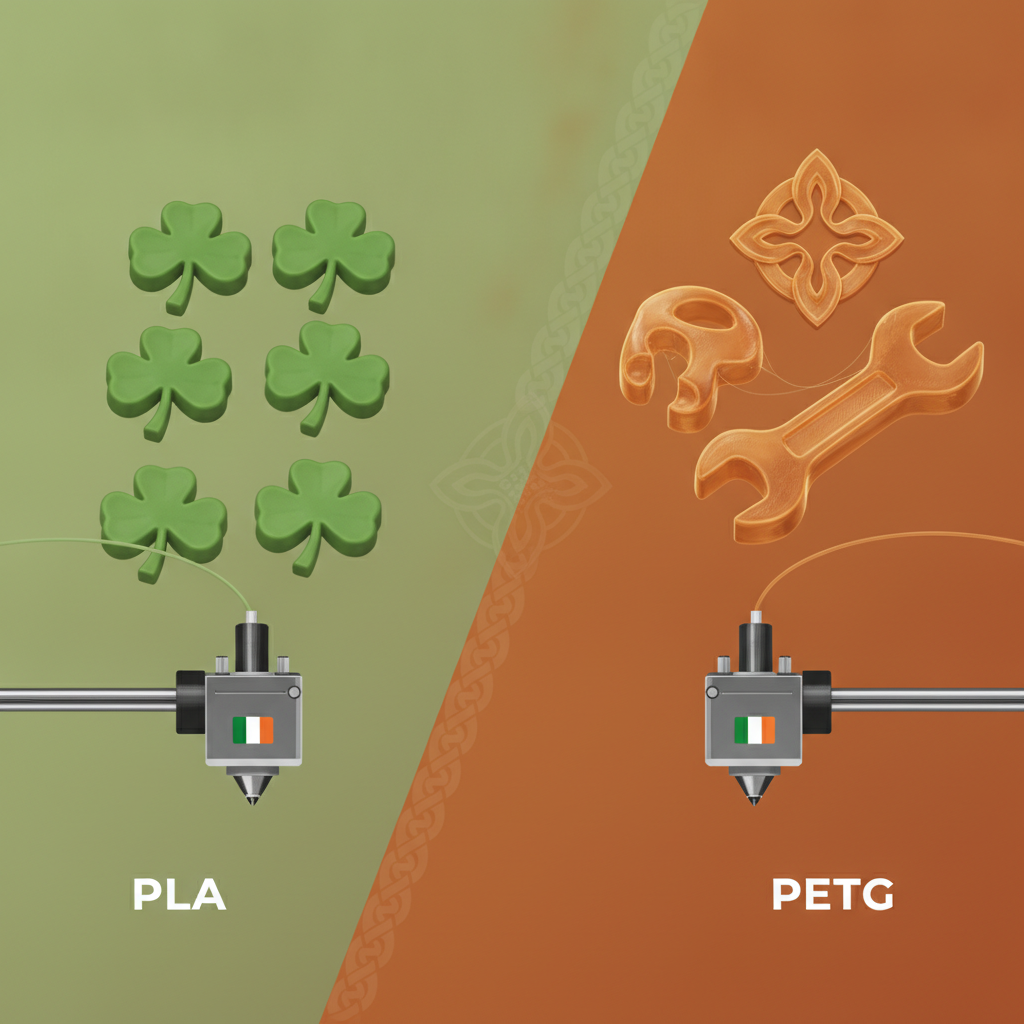
As Ireland's vibrant 3D printing community continues to grow, so does the array of choices for bringing your ideas to life. At PrintIn3D.ie, your trusted 3D printing partner, we often see customers weighing up the two most popular FDM 3d printer filaments: PLA and PETG. Both materials have carved out essential niches in the world of additive manufacturing, but understanding their unique strengths and weaknesses is key to selecting the perfect one for your specific project.
Choosing the right material isn't just about aesthetics; it impacts the functionality, durability, and overall success of your 3D printed parts. Whether you're a hobbyist creating intricate models, a designer prototyping a new product, or a business needing robust custom 3d printed parts Ireland, knowing which filament to reach for can save you time, money, and frustration. We're here to help you navigate this choice with our friendly, expert advice, ensuring your 3D dreams become a tangible reality.
Quick Overview: PLA and PETG 3d Printer Filaments
Let's start with a brief introduction to these two foundational 3d printer filaments:
PLA (Polylactic Acid)
PLA is often hailed as the "king of accessibility" in the 3D printing world. Derived from renewable resources like corn starch or sugarcane, it's biodegradable and non-toxic, making it a popular choice for environmentally conscious projects and general home use. Its ease of use is unparalleled, boasting excellent print quality with minimal warping or bed adhesion issues. For those wondering which filament is best for beginners, PLA is almost always the answer. It prints at lower temperatures and requires less finesse, making it ideal for prototypes, decorative items, and educational projects. However, its lower melting point and inherent brittleness mean it's not the go-to for parts requiring high strength, impact resistance, or exposure to elevated temperatures or direct sunlight.
PETG (Polyethylene Terephthalate Glycol)
PETG is the workhorse filament, striking a fantastic balance between PLA's ease of use and ABS's strength. It's a modified version of PET, the plastic commonly used in water bottles, with glycol added to prevent crystallisation and make it clearer, less brittle, and easier to 3D print. PETG offers superior strength, durability, and flexibility compared to PLA, alongside good heat and chemical resistance. This makes it an excellent candidate for functional parts, mechanical components, and items that need to withstand more rigorous conditions, such as 3d printed replacement parts service or outdoor applications. While slightly more challenging to print than PLA due to its tendency to string and require specific retraction settings, its robust properties make the extra effort worthwhile for many practical applications.
Feature-by-Feature Comparison
To truly understand the nuances between PLA and PETG, let's dive into a detailed comparison across key criteria that matter to Irish makers and businesses.
| Criterion | PLA (Polylactic Acid) | PETG (Polyethylene Terephthalate Glycol) |
|---|---|---|
| Ease of Printing | Generally considered the easiest filament to print. Low warping, excellent bed adhesion, and requires minimal tuning. Perfect for beginners and high-volume prototyping where speed and reliability are paramount. | Slightly more challenging than PLA. Prone to stringing and oozing, which requires careful calibration of retraction settings. Good bed adhesion, but can sometimes stick too strongly. Requires a heated bed. |
| Strength & Durability | Moderate strength, but known for its brittleness. Not ideal for parts that will undergo stress, impact, or bending. Layer adhesion is good for most aesthetic prints but can delaminate under pressure. | High strength, much more durable and flexible than PLA. Excellent impact resistance and good layer adhesion, resulting in tough, functional parts. Ideal for custom 3d printed parts Ireland that need to withstand wear and tear. |
| Temperature Resistance | Low heat deflection temperature (around 50-60°C). Parts can soften and deform in direct sunlight or hot environments (e.g., inside a car on a sunny day). Not suitable for high-temperature applications. | Good heat resistance (around 80-90°C), making it suitable for applications where moderate temperatures are a factor. Can be used for outdoor parts, but prolonged direct UV exposure can degrade the material over time. |
| Surface Finish & Aesthetics | Produces smooth, often glossy prints with sharp details. Wide range of vibrant colours and special finishes (e.g., silk, matte, wood-filled). Easy to post-process with sanding and painting. | Can produce a glossy, somewhat translucent finish. Due to stringing, post-processing might be needed to remove wispy strands. Less prone to showing layer lines than some other strong materials. |
| Applications & Use Cases | Ideal for aesthetic models, figurines, prototypes, low-stress jigs, educational models, and decorative items. Great for rapid prototyping where form is more critical than extreme function. Often the choice for affordable 3d printing near me when quick iterations are needed. | Perfect for functional prototypes, mechanical parts, containers, protective components, outdoor parts, and items requiring food contact (uncoloured, virgin PETG). Excellent for 3d scanning for product development into robust functional items. |
| Environmental Impact | Biodegradable under industrial composting conditions. Derived from renewable resources, making it a more environmentally friendly option compared to petroleum-based plastics. | Not biodegradable, but widely recyclable. Many municipal recycling programs accept PETG, especially if it's clear. Virgin PETG is food-safe. A good option for sustainability through recycling. |
| Cost | Generally the most affordable 3d printer filaments available, making it cost-effective for large projects or frequent printing. Its ease of use also reduces failed prints, further lowering costs. | Typically slightly more expensive than PLA, but still very reasonably priced for its performance characteristics. Represents excellent value for money given its superior mechanical properties. |
| Chemical Resistance | Poor chemical resistance. Can degrade or dissolve when exposed to many common solvents, acids, or bases. Not suitable for parts that will come into contact with harsh chemicals. | Good chemical resistance to water, dilute acids, and some alcohols. This property makes it suitable for containers, laboratory equipment, or parts that might be exposed to various cleaning agents. |
Pros & Cons of PLA
Pros of PLA
- User-Friendly: Incredibly easy to print with minimal warping, making it ideal for those new to 3D printing. If you're wondering which filament is best for beginners, PLA is consistently recommended.
- Excellent Aesthetics: Produces smooth, high-detail prints with a wide variety of colours and finishes, from matte to glossy.
- Low Odour: Emits very little smell during printing, making it suitable for use in home or office environments.
- Biodegradable: Derived from renewable plant-based resources and can biodegrade under industrial composting conditions, appealing to eco-conscious users.
- Cost-Effective: Generally the most affordable filament on the market, reducing the barrier to entry for many projects.
Cons of PLA
- Brittle: Prints can be prone to snapping or breaking under stress or impact.
- Low Heat Resistance: Easily deforms at temperatures above 60°C, limiting its use for functional parts in warm environments.
- Poor UV Resistance: Degrades over time when exposed to direct sunlight, making it unsuitable for long-term outdoor applications.
- Limited Flexibility: Offers very little flexibility, making it less suitable for parts that require any degree of bending or springiness.
- Chemical Sensitivity: Susceptible to degradation by various chemicals, which restricts its use in certain industrial or scientific applications.
Pros & Cons of PETG
Pros of PETG
- High Strength & Durability: Offers significantly better strength, impact resistance, and durability compared to PLA, making it perfect for custom 3d printed parts Ireland that need to last.
- Good Temperature Resistance: Can withstand temperatures up to 80-90°C without deforming, broadening its application range to more demanding environments.
- Flexibility: Has a degree of flexibility, which allows it to absorb impacts better than brittle PLA and resist breaking.
- Chemical Resistance: Resistant to a variety of chemicals, oils, and solvents, enhancing its utility for functional enclosures or prototypes.
- Recyclable: Widely accepted in recycling streams, offering an environmentally responsible disposal option (check local guidelines).
- Food Safe (Virgin): Virgin, uncoloured PETG is often deemed food-safe, making it suitable for certain food-contact applications.
Cons of PETG
- Prone to Stringing: Has a notorious tendency to string and ooze, requiring careful retraction settings and printer calibration.
- Hygroscopic: Absorbs moisture from the air, which can negatively affect print quality and strength if not properly stored (requires drying before use if exposed).
- Bed Adhesion: Can sometimes adhere too strongly to print beds, potentially damaging the surface if not handled carefully.
- Less Detail: While good, the finished print quality might not be as aesthetically pleasing as PLA due to potential stringing and slightly less sharp edges.
- Slightly More Expensive: Marginally pricier than PLA, though still very affordable for its superior performance.
Who Should Choose Each Filament
Choose PLA if...
- You're a beginner to 3D printing and want a hassle-free experience. PLA is often considered which filament is best for beginners due to its ease of use.
- Your project is primarily aesthetic, decorative, or for prototyping where final strength isn't critical. Think figurines, display models, or home decor items.
- You need quick iterations and rapid prototyping for form and fit checks, needing an affordable 3d printing near me solution.
- The printed object will not be exposed to high temperatures, direct sunlight, or significant physical stress.
- Environmental considerations are a top priority due to its biodegradability.
Choose PETG if...
- You need a strong, durable, and somewhat flexible part that can withstand impact and stress, such as 3d printed replacement parts service for appliances or tools.
- Your project requires good temperature resistance, like parts for electronics enclosures, automotive components, or outdoor fixtures.
- The object needs to be food-safe (using virgin, uncoloured PETG) or resistant to various chemicals.
- You are prototyping functional parts for 3d scanning for product development, where the final product needs to be robust.
- You're looking for a balance between ease of printing and material properties that approach those of more advanced engineering plastics, ideal for custom 3d printed parts Ireland.
Verdict: Your 3D Printing Partner in Ireland
Ultimately, the choice between PLA and PETG comes down to your project's specific requirements. If you're just starting out, prioritising aesthetics, or creating non-functional prototypes and decorative pieces, PLA is your friendly and forgiving companion. Its ease of printing and affordability make it an excellent choice for iterating designs or simply enjoying the creative process.
However, if your designs demand strength, durability, heat resistance, or chemical resilience for custom 3d printing services Ireland, then PETG steps up as the clear winner. It's the robust workhorse for functional parts, mechanical components, and items that need to endure the real world. While it demands a little more attention during printing, the superior properties it offers are well worth the investment in time and effort.
At PrintIn3D.ie, we understand these considerations. That's why we offer a wide range of both PLA and PETG 3d printer filaments from top brands like Bambu Lab and SUNLU, ensuring you have access to the best materials for your needs. Whether you have a simple CAD file to 3d print service requirement or need expert guidance on material selection, we're here to help.
We also cater to businesses and educational institutions looking for a bulk filament supplier Ireland, ensuring you always have the right materials on hand. And if you're looking for something beyond PLA and PETG, remember we can also buy flexible tpu filament Ireland, expanding your possibilities even further. With our fast turnaround times and same day filament delivery Ireland on many orders, we make getting your materials and prints hassle-free.
Print Your 3D Dreams with PrintIn3D.ie
Ready to bring your 3D ideas to life with the perfect material? Explore our custom 3D printing services Ireland or browse our range of high-quality 3d printer filaments today and experience the PrintIn3D.ie difference!