PLA vs. PETG Filament: Your Guide to 3D Printing in Ireland
Introduction: PLA vs. PETG – Choosing the Right Material for Your Irish 3D Prints
In the vibrant world of 3D printing, selecting the right filament is just as crucial as the design itself. For hobbyists, engineers, and businesses across Ireland looking to bring their ideas to life, two materials frequently stand out: PLA (Polylactic Acid) and PETG (Polyethylene Terephthalate Glycol-modified). Each offers a unique set of properties, making them suitable for different applications.
At PrintIn3D.ie, your trusted 3D printing partner in Ireland, we understand that navigating the material landscape can be a bit overwhelming. That's why we've put together this comprehensive guide to help you decide between PLA and PETG. Whether you're creating a simple prototype, a functional part for custom prototype manufacturing Ireland, or beautiful etsy 3d printed products Ireland, understanding the strengths and weaknesses of each will empower you to achieve the best results.
Let's dive into the details and find out which filament is your perfect match for your next 3D printing project.
Quick Overview
PLA (Polylactic Acid)
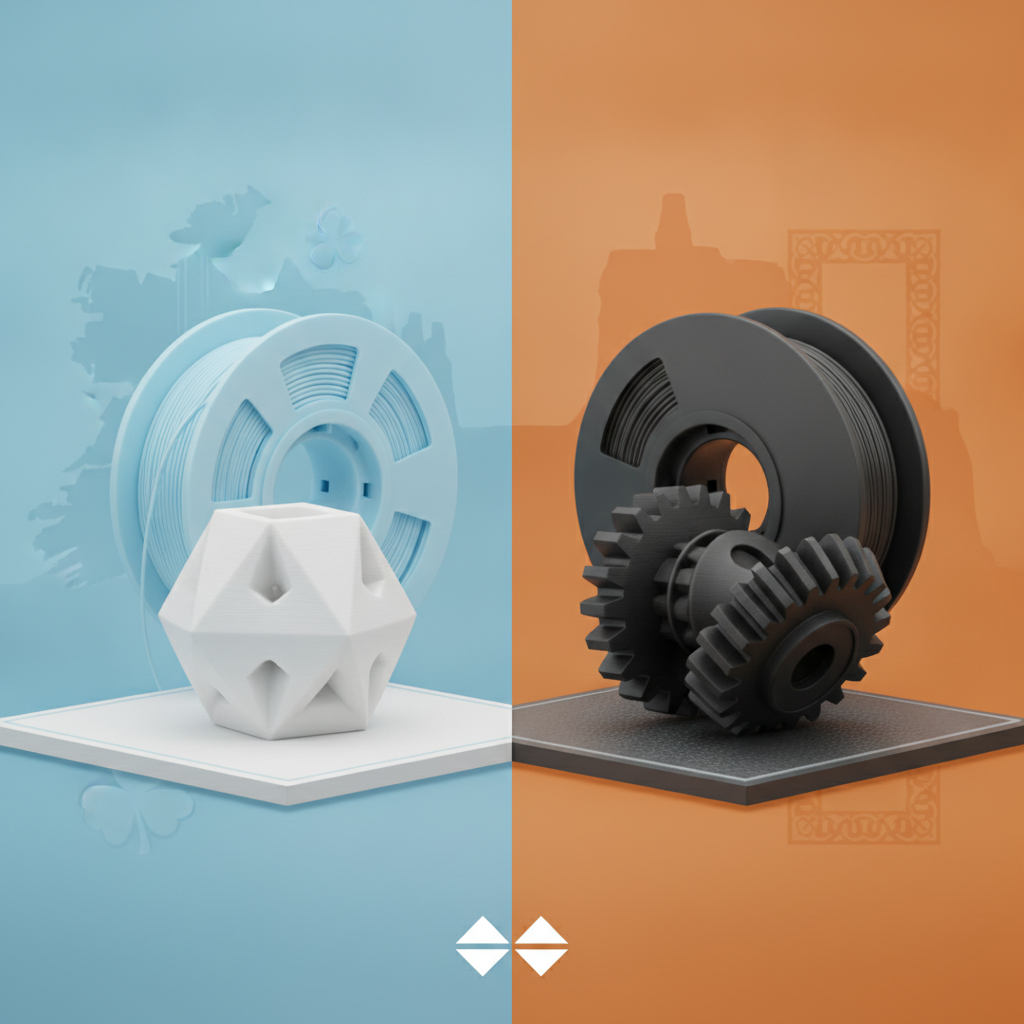
PLA is a biodegradable thermoplastic derived from renewable resources like corn starch or sugarcane. It's renowned for its ease of use, making it a favourite among beginners and for general-purpose printing. PLA prints at lower temperatures, produces minimal odour, and exhibits excellent aesthetic qualities, making it ideal for decorative items, prototypes, and models where high mechanical strength or temperature resistance isn't the primary concern.
PETG (Polyethylene Terephthalate Glycol-modified)
PETG is a durable, versatile thermoplastic that combines the best characteristics of both ABS and PLA. It offers superior strength, flexibility, and temperature resistance compared to PLA, while being easier to print than ABS. PETG is known for its excellent layer adhesion, chemical resistance, and food-safe properties (for virgin filament), making it a popular choice for functional parts, mechanical components, and items requiring robustness.
Feature-by-Feature Comparison
| Criterion | PLA (Polylactic Acid) | PETG (Polyethylene Terephthalate Glycol-modified) |
|---|---|---|
| Ease of Printing | Generally considered the easiest filament to print. It requires lower extruder and bed temperatures, has minimal warping, and offers excellent bed adhesion with common surfaces like blue tape or glue stick. Tolerant to less precise printer calibration, it's a dream for beginners and quick prototypes. | Slightly more challenging than PLA but easier than ABS. Requires higher extruder temperatures (around 220-250°C) and a heated bed (60-80°C). Prone to stringing due to its sticky nature, requiring careful retraction settings and often direct drive extruders. Warping is less of an issue than ABS but more than PLA. |
| Strength & Durability | Offers good stiffness and moderate strength. It's quite rigid but can be brittle under stress, especially in thinner sections. Not ideal for parts that will endure repeated impacts or significant mechanical loads. Good for static models and prototypes. | Excellent strength, good impact resistance, and much more flexible than PLA. It can withstand significant stress before breaking, making it suitable for functional parts, tools, and enclosures. Its inherent toughness provides superior durability for everyday use. |
| Temperature Resistance | Low heat resistance, with a glass transition temperature (Tg) around 60-65°C. Parts can deform or soften when exposed to direct sunlight or hot environments, such as inside a car on a sunny day. Not suitable for outdoor or high-temperature applications. | Significantly higher temperature resistance than PLA, with a Tg around 80-85°C. This makes it much better suited for applications where the part might be exposed to elevated temperatures or direct sunlight, offering greater stability and longevity. |
| Flexibility / Brittleness | Relatively brittle and rigid. While it can hold its shape well, it tends to snap rather than bend when overstressed. This characteristic is why it's less preferred for interlocking parts or components requiring some give. | More flexible and less brittle than PLA, offering a degree of elasticity. This property makes PETG excellent for parts that need to absorb shock, bend without breaking, or have some spring-like action. It's a key advantage for functional components. |
| Post-Processing | Relatively easy to sand, paint, and glue. Its rigidity allows for clean finishing with standard tools. However, care must be taken during sanding as it can soften with friction-induced heat. Solvent smoothing is generally not effective. | More challenging to sand due to its ductility and tendency to gum up sandpaper. Painting and gluing can also be more difficult due to its smooth, less porous surface. It responds well to chemical smoothing with solvents like ethyl acetate, though this requires caution. |
| Environmental Impact | Biodegradable and compostable under commercial composting conditions, as it's derived from renewable resources. Considered more environmentally friendly than most other petroleum-based plastics. | Recyclable (often categorised as Type 1 plastic, like PET bottles) but not biodegradable. While it can be repurposed, it's not considered as "green" as PLA from a biodegradability standpoint. It's a petroleum-based plastic. |
| Surface Finish & Aesthetics | Often produces a smooth, matte to semi-gloss finish. Available in a vast array of colours and special effects (silks, glitters, translucents). Great for highly aesthetic models and prototypes. | Typically produces a high-gloss, sometimes translucent finish, depending on the colour and brand. Can show some stringing or "cobwebbing" if not properly dialled in, which can affect aesthetic appeal, but when perfected, it looks sleek and professional. |
| Food Safety | Generally considered food-safe in its raw material form, but 3D printed parts are rarely food-safe due to porous surfaces where bacteria can grow and potential contamination from brass nozzles or other printer components. | Virgin PETG filament is often food-safe, making it a popular choice for containers and kitchen gadgets. Similar to PLA, the 3D printing process itself can introduce issues, so for true food safety, additional post-processing (e.g., food-safe coating) or specific certification is required. |
Pros & Cons of PLA Filament
Pros of PLA
- User-Friendly: Incredibly easy to print, making it perfect for beginners and educational settings.
- Low Warping: Minimal shrinkage and warping issues, leading to successful prints even without an enclosed printer.
- No Odour: Emits very little to no unpleasant fumes during printing, making it suitable for home or office use.
- Good Aesthetics: Produces visually appealing prints with a wide range of colours and finishes. Great for decorative items or models destined for etsy 3d printed products Ireland.
- Biodegradable: Derived from renewable resources and is industrially compostable, offering a more eco-conscious choice.
- Low Cost: Generally more affordable than PETG, reducing the barrier to entry for many users.
Cons of PLA
- Low Temperature Resistance: Softens and deforms at relatively low temperatures, limiting its use for functional parts in warm environments.
- Brittle: Less durable and prone to snapping under stress or impact, unsuitable for high-stress applications.
- UV Degradation: Can become brittle and discolour over time with prolonged exposure to UV light, making it less ideal for outdoor use.
- Limited Chemical Resistance: Susceptible to degradation by some common solvents.
Pros & Cons of PETG Filament
Pros of PETG
- High Strength & Durability: Offers excellent mechanical strength, impact resistance, and durability, making it ideal for functional parts.
- Good Flexibility: More flexible than PLA, allowing it to withstand bending and stress without breaking.
- Higher Temperature Resistance: Can endure higher temperatures before deforming, broadening its application range.
- Water & Chemical Resistance: Resists moisture and many chemicals, enhancing its suitability for a variety of environments.
- Good Layer Adhesion: Bonds well between layers, creating strong, monolithic parts.
- Transparency: Can be printed to achieve a high level of transparency, useful for specific aesthetic or functional needs.
Cons of PETG
- More Challenging to Print: Requires higher temperatures and more careful tuning of retraction settings to avoid stringing.
- "Sticky" Nature: Can stick very aggressively to print beds, potentially damaging the surface if not properly prepared (e.g., using a release agent or specific build surface).
- Less Aesthetic Control: While it can look great, achieving a perfect, string-free finish requires more effort than with PLA.
- Not Biodegradable: While recyclable, it's a petroleum-based plastic and does not biodegrade.
- Can Scratch Easily: The surface can be prone to scratching compared to some other engineering plastics.
Who Should Choose Each
Choose PLA if you are:
- A Beginner in 3D Printing: Its ease of use and forgiving nature make it the perfect starting point for learning the ropes of 3D printing.
- Creating Decorative Objects or Models: Ideal for figures, display pieces, architectural models, and prototypes where visual appeal is paramount and mechanical stress is low. If you're looking to create beautiful etsy 3d printed products Ireland, PLA is often the go-to.
- Making Quick Prototypes or Concept Models: For rapid prototyping service Ireland where you need to quickly iterate on a design and test its form, PLA's print speed and low cost are invaluable.
- Printing Indoors or in Controlled Environments: Best for items that won't be exposed to high temperatures or direct sunlight.
- Environmentally Conscious: Preferring a material derived from renewable resources that is industrially compostable.
- On a Budget: PLA generally offers a more economical option for your filament needs, especially when you buy 3d printer filaments in bulk.
Choose PETG if you are:
- Creating Functional Parts or Mechanical Components: Its strength, flexibility, and impact resistance make it excellent for gears, brackets, enclosures, and tools that need to withstand real-world forces. This is crucial for custom prototype manufacturing Ireland.
- Making Items for Outdoor Use or High-Temperature Environments: Ideal for car parts, garden accessories, or components exposed to direct sunlight, thanks to its superior temperature and UV resistance.
- Printing Parts Requiring Water or Chemical Resistance: Suitable for containers, laboratory equipment, or parts that will come into contact with liquids or chemicals.
- Looking for a Balance of Strength and Ease of Printing: If ABS is too challenging but PLA isn't strong enough, PETG strikes a great balance.
- Working with professional cad design for manufacturing: For engineers and designers who require robust, reliable parts directly from their cad file to 3d print service, PETG provides the necessary performance. If you need 3d product design services Ireland that translate into durable products, PETG is often recommended.
- Utilising 3d scanning service ireland for Reverse Engineering: When replicating existing parts for repair or improvement, PETG's properties often closely match original components, ensuring functional replacements.
Verdict: Your 3D Printing Partner's Recommendation
Both PLA and PETG are fantastic 3D printer filaments, each with distinct advantages. There isn't a single "best" material; the ideal choice depends entirely on your project's specific requirements. Think about what your 3D print needs to do: Is it purely decorative, or does it need to withstand impact? Will it be exposed to heat, or does it need flexibility? Do you prioritise ease of printing or ultimate durability?
For most everyday prints, learning and decorative items, or initial prototypes, PLA remains an unbeatable choice due to its simplicity and aesthetic appeal. It's fantastic for hobbyists and designers creating models that don't need to endure harsh conditions. We offer premium PLA filaments from leading brands like Bambu Lab and SUNLU, perfect for bringing your initial concepts to life. You can check out our range, including Bambu Lab PLA Pure Refill 1kg 1.75mm, for vibrant and smooth prints.
However, when your project demands greater strength, higher temperature resistance, and more flexibility – think functional parts, outdoor components, or mechanical prototypes – PETG truly shines. It’s the workhorse material that bridges the gap between easy-to-print PLA and more challenging engineering filaments like ABS. For businesses and innovators seeking reliable materials for rapid prototyping service Ireland or final production, PETG is an excellent investment. We also stock high-quality PETG, such as SUNLU PETG Filament 1kg 1.75mm, for all your robust printing needs.
Ultimately, if you're undertaking complex projects that require specific material properties, or if you're looking for professional 3D printing in Dublin or anywhere else in Ireland without the hassle of owning a printer, PrintIn3D.ie is here to help. Our award-winning custom 3D printing services ensure your chosen material is printed to the highest standards, delivering precision and quality every time. We make sure your cad file to 3d print service experience is seamless.
Print Your 3D Dreams with PrintIn3D.ie
Ready to bring your ideas to life with the perfect filament? Upload your design today and let PrintIn3D.ie handle all your custom 3D printing needs, from filament supply to expert design and rapid production across Ireland and beyond.