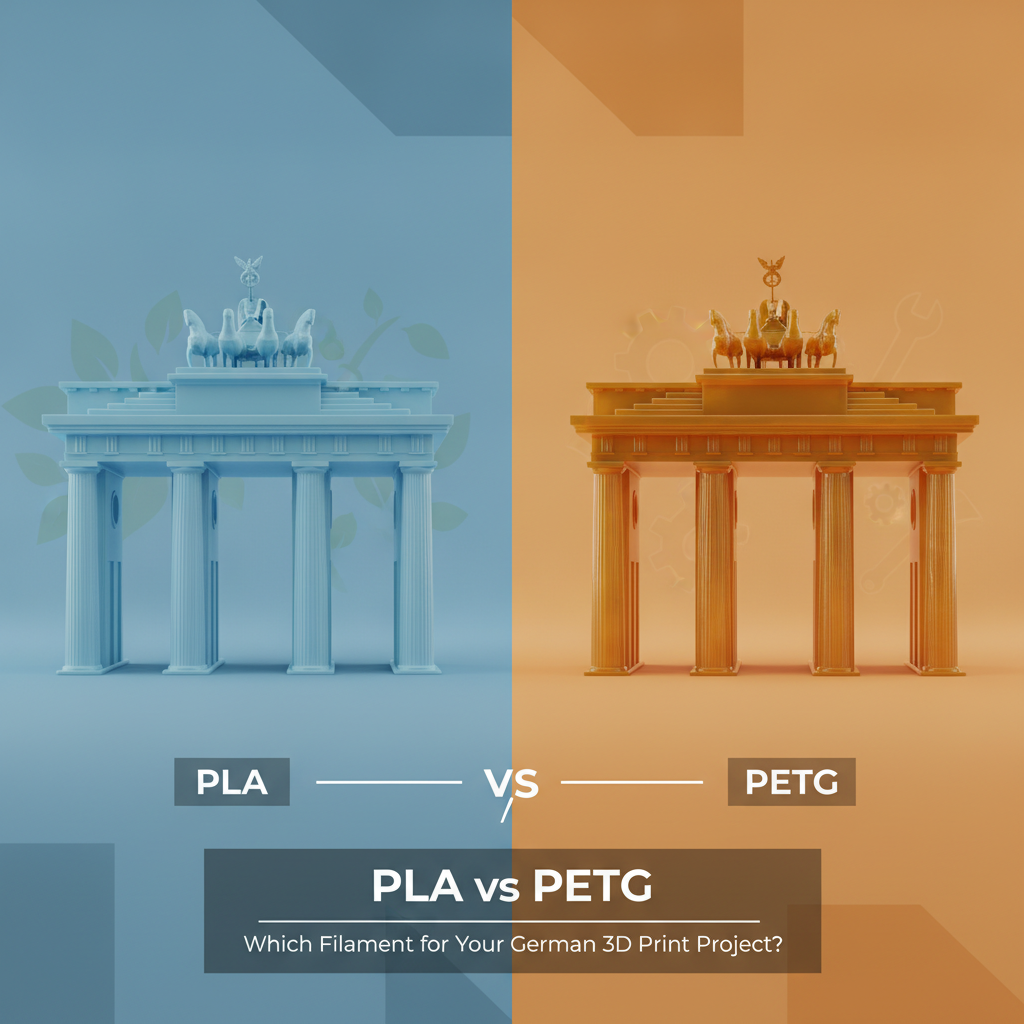
PLA vs PETG: Which Filament for Your German 3D Print Project?
PLA vs PETG: Which Filament for Your 3D Print Project in Germany?
Are you embarking on a 3D printing project in Germany and wondering which filament to choose? The decision between PLA and PETG is one of the most common dilemmas for both beginners and experienced makers. Each material offers distinct properties that make it suitable for different applications. Understanding these differences is crucial for ensuring your printed parts meet your expectations in terms of strength, finish, and functionality.
At PrintIn3D.ie, your trusted partner for custom 3D printing, 3D design, and 3D scanning services across the EU/EEA, we frequently guide our customers through this choice. Whether you're looking to create intricate prototypes, durable functional parts, or even unique 3d-druck geschenke personalisiert, the right filament is key. We offer a wide range of high-quality 3d-drucker filament from brands like Bambu Lab and SUNLU, and our goal is to help you achieve your 3D printing dreams with hassle-free solutions.
Quick Overview: PLA and PETG
PLA (Polylactic Acid) is perhaps the most popular and user-friendly 3D printing filament, especially favoured by hobbyists and for educational purposes. Derived from renewable resources like corn starch or sugar cane, it's biodegradable, making it an environmentally friendlier choice. PLA is known for its ease of printing, minimal warping, and excellent detail reproduction, making it ideal for aesthetic models and non-functional prototypes.
PETG (Polyethylene Terephthalate Glycol), on the other hand, is a versatile thermoplastic that combines many of the advantages of both PLA and ABS. It's renowned for its excellent strength, durability, and chemical resistance, while still being relatively easy to print compared to more demanding materials. PETG is a fantastic choice for functional parts that require resilience and a degree of flexibility, without the common issues associated with ABS filament, such as strong fumes or significant warping.
Feature-by-Feature Comparison
Let's dive deeper into the key characteristics of PLA and PETG to help you decide which is the better fit for your specific 3D printing needs in Germany.
| Criterion | PLA (Polylactic Acid) | PETG (Polyethylene Terephthalate Glycol) |
|---|---|---|
| Ease of Use | Generally considered the easiest filament to print. Requires lower printing temperatures, minimal to no heated bed, and produces very little warping. Perfect for beginners and quick projects. | Relatively easy to print, but more challenging than PLA. Requires higher extrusion and bed temperatures, and can be prone to stringing if not properly dialled in. Generally less warping than ABS. |
| Strength & Durability | Good tensile strength, but can be brittle and prone to breaking under stress or impact. Not ideal for parts that need to withstand significant force or repeated use. | Excellent strength, much more durable and impact-resistant than PLA. Offers good layer adhesion, resulting in strong, resilient parts. A great alternative if you need something stronger than PLA but want to avoid the difficulties of ABS filament kaufen. |
| Temperature Resistance | Low heat resistance, typically deforming at temperatures around 50-60°C. Not suitable for outdoor use or parts exposed to heat, like automotive components. | Significantly better temperature resistance than PLA, handling temperatures up to 80°C or even higher, depending on the specific blend. Ideal for parts that might experience moderate heat. |
| Flexibility | Very rigid and stiff. Not flexible at all, which contributes to its brittleness under certain loads. | Offers a good balance of rigidity and flexibility. It has a slight give, making it less brittle than PLA and more suitable for parts that need to absorb some shock or flex a little. For true flexibility, consider TPU filament kaufen Deutschland. |
| Post-Processing | Easy to sand, paint, and glue. Can be annealed for increased heat resistance, though this is less common. Takes well to various finishing techniques. | More challenging to sand due to its ductility and stickiness, which can gum up sandpaper. Painting and gluing are possible but require specific primers/adhesives. Its inherent durability often reduces the need for extensive post-processing. |
| Environmental Impact | Biodegradable and derived from renewable resources. Considered more environmentally friendly, especially compared to petroleum-based plastics. | Recyclable (often bottle-to-bottle), but not biodegradable. While not from renewable sources, its recyclability is a significant environmental advantage over other plastics like ABS. Germany leads the way in sustainable 3D printing initiatives, making this an important consideration. |
| Moisture Absorption | Relatively low moisture absorption, but prolonged exposure to humidity can still degrade print quality and filament performance. Store in a dry place. | Higher moisture absorption than PLA. PETG needs to be kept dry, as absorbed moisture can lead to bubbling, stringing, and weakened prints. Proper storage in dry boxes is highly recommended. |
| Adhesion (Bed & Layer) | Excellent bed adhesion, often requiring little more than a clean print surface. Good layer adhesion results in aesthetically pleasing, smooth prints. | Strong bed adhesion, sometimes too strong, potentially damaging print surfaces. Excellent layer adhesion, contributing to the material's overall strength and durability, making it perfect for robust functional 3D printing services. |
Pros & Cons of PLA
Pros:
- User-Friendly: Extremely easy to print, with minimal warping and no strong odours. This makes it ideal for home use or in a 3D printing service in Berlin for rapid prototyping.
- Good Detail: Excellent for capturing fine details and smooth finishes, perfect for aesthetic models and figures.
- Variety of Colours: Available in a vast array of colours and finishes, including shiny, matte, transparent, and even wood-filled options.
- Biodegradable: Made from renewable resources and breaks down under industrial composting conditions, appealing to environmentally conscious users.
- Affordable: Generally offers a 3d-drucker filament günstiger preis compared to many other materials, making it cost-effective for everyday printing.
Cons:
- Low Temperature Resistance: Parts can deform easily under moderate heat, limiting outdoor or high-temperature applications.
- Brittle: Can be rigid and brittle, breaking rather than bending under stress, which is not ideal for functional parts.
- UV Sensitive: Prolonged exposure to UV light can weaken and degrade the material over time.
Pros & Cons of PETG
Pros:
- Durability: Offers excellent strength, impact resistance, and flexibility, making it suitable for functional parts and enclosures.
- Temperature Resistance: Higher heat resistance than PLA, expanding its application range to parts that may experience warmth.
- Chemical Resistance: Resistant to many chemicals, oils, and greases, which is beneficial for industrial or mechanical components.
- Food Safe: Certain PETG grades are food-safe, making it suitable for containers or kitchen items (always verify with manufacturer specs).
- Good Layer Adhesion: Results in very strong, robust prints with good structural integrity.
Cons:
- Stringing: Can be prone to stringing and oozing if print settings are not perfectly tuned.
- Hygroscopic: Absorbs moisture from the air, which can negatively impact print quality and strength if not stored properly.
- Bed Adhesion Issues: Can sometimes adhere too strongly to print beds, potentially causing damage if not handled carefully. Use a release agent like glue stick if necessary.
- More Challenging to Print: Requires higher temperatures and more precise calibration than PLA, posing a slight learning curve for new users.
Who Should Choose Each?
Choose PLA if:
- You are new to 3D printing and want an easy, forgiving material to learn with.
- Your project involves intricate models, artistic sculptures, or prototypes where aesthetics and fine details are paramount.
- You are making 3d-druck geschenke personalisiert, display pieces, or educational models that won't experience high temperatures or significant physical stress.
- You prioritize environmental considerations due to its biodegradability and renewable origins.
- You need to iterate quickly and affordably, as PLA generally has a 3d-drucker filament günstiger preis.
Choose PETG if:
- Your project requires durable, functional parts that can withstand impact, moderate heat, or chemicals. Think mechanical components, protective casings, or outdoor fixtures.
- You need parts with some flexibility and less brittleness than PLA, such as living hinges or components that need to absorb shock.
- You are looking for a material that offers a good balance between ease of printing (compared to ABS or Nylon) and superior mechanical properties.
- You are creating items for the home or workshop that need to last and resist wear and tear.
- You plan to use the printed object in environments where PLA would deform, such as inside a car on a hot day.
Verdict: Making Your Informed Choice for Germany
Ultimately, the best filament for your 3D printing project in Germany depends entirely on the specific requirements of your part. If you're looking for an effortless printing experience for aesthetic models, teaching aids, or personal gifts, PLA is your champion. Its ease of use and crisp detail make it a superb starting point and a go-to for many general-purpose prints.
However, if your designs demand greater strength, impact resistance, flexibility, and a higher tolerance for heat, then PETG is the clear winner. While it presents a slightly steeper learning curve in terms of print settings, the robust and reliable parts it produces are well worth the effort. It's an excellent all-rounder for functional prototypes and end-use parts, serving as a powerful bridge between the simplicity of PLA and the industrial strength of materials like ASA (which you might consider if you need to asa filament für 3d-druck kaufen for extreme weather resistance).
For those in Germany seeking high-quality 3D printing services without the hassle of owning and maintaining a printer, PrintIn3D.ie is your ideal partner. We understand the nuances of each filament and material, including how to expertly stl datei erstellen lassen or optimize your 3d-druck dateien downloaden for the best results. Whether you provide your own files or need our 3D design service to turn a concept into a print-ready model, or even an objekte 3d scannen lassen (3d scanner service) for reverse engineering, we're here to help. Our award-winning service and 30-day risk-free return policy ensure you get exactly what you need.
Explore our range of filaments, including Bambu Lab and SUNLU PLA and PETG, or let our experts handle your custom printing needs by visiting our 3d-druck online shop today!