PLA vs. PETG: Your Luxembourg 3D Printing Filament Guide
PLA vs. PETG: Choosing the Right Filament for Your 3D Print Project in Luxembourg
Embarking on a 3D printing project in Luxembourg? One of the most critical decisions you'll make is selecting the right filament. With a plethora of options available, Polylactic Acid (PLA) and Polyethylene Terephthalate Glycol (PETG) stand out as two of the most popular and versatile choices. Understanding their unique characteristics is essential for ensuring your printed parts meet your specific needs for durability, aesthetics, and functionality. Whether you're creating intricate prototypes, functional parts, or artistic models, your filament choice will significantly impact the success of your 3D print. At PrintIn3D.ie, your trusted entreprise impression 3d luxembourg, we're here to guide you through this decision, ensuring your ideas come to life exactly as you envision them.
Quick Overview: PLA and PETG Filaments
PLA (Polylactic Acid) is an incredibly popular choice, especially among beginners, due to its ease of use and environmental friendliness. Derived from renewable resources like corn starch, PLA is biodegradable, making it a more sustainable option. It prints at lower temperatures, has minimal warping, and emits a slightly sweet smell during printing, making it a comfortable material to work with in home or office settings. It's fantastic for detailed models and aesthetic prints where high strength or temperature resistance isn't the primary concern.
PETG (Polyethylene Terephthalate Glycol) is a robust and versatile thermoplastic that combines the best properties of PLA and ABS. It offers excellent strength, durability, chemical resistance, and is more flexible than PLA, making it ideal for functional parts that need to withstand impact or stress. While slightly more challenging to print than PLA due to higher temperature requirements and potential stringing, its superior mechanical properties make it a favourite for engineering applications and parts that will be exposed to more demanding conditions. If you're looking for filament petg luxembourg prix, you'll find it's often a worthwhile investment for its performance.
Feature-by-Feature Comparison
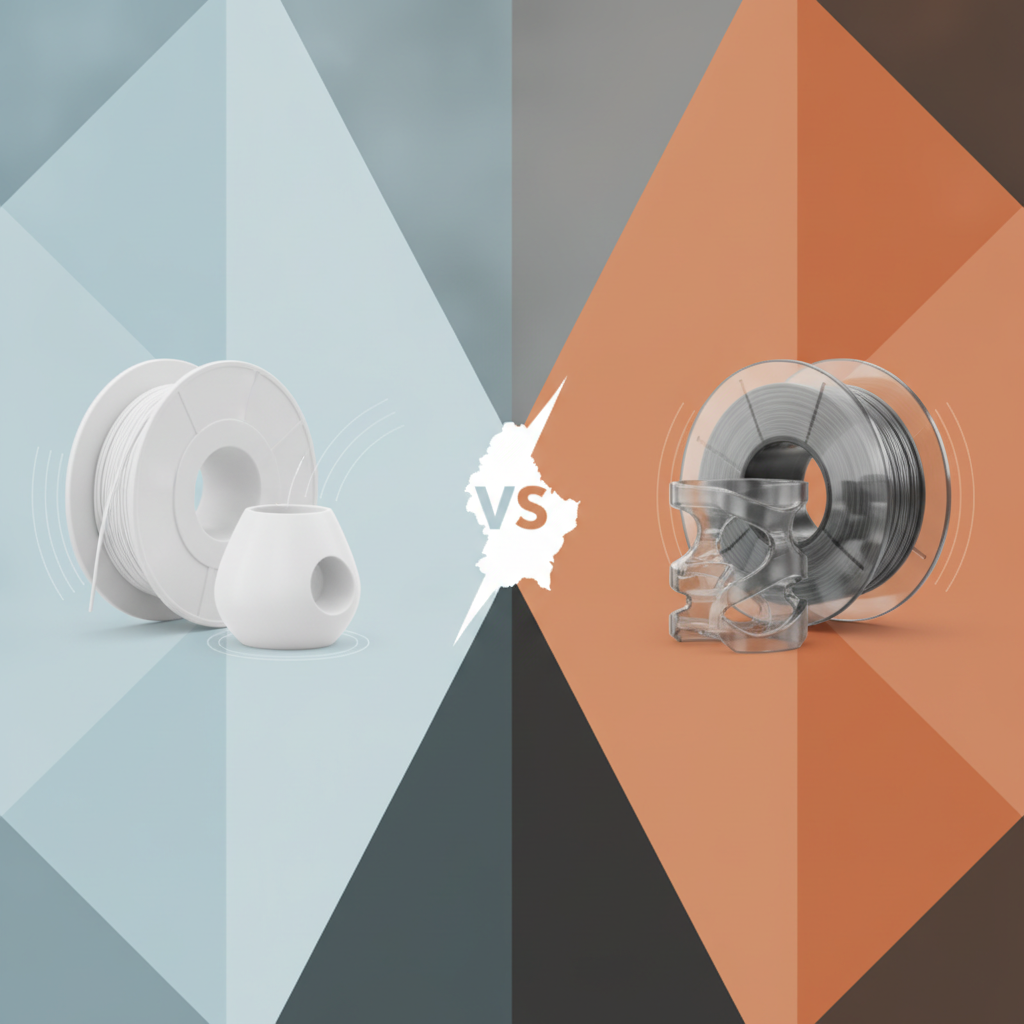
To help you make an informed decision for your next project, let's dive into a detailed comparison of PLA and PETG across several key criteria:
| Criterion | PLA (Polylactic Acid) | PETG (Polyethylene Terephthalate Glycol) |
|---|---|---|
| Ease of Printing | Generally considered the easiest filament to print. Low print temperatures (180-220°C), minimal warping, and doesn't require an enclosure or heated bed (though a heated bed helps). Great for beginners. | Slightly more challenging than PLA. Higher print temperatures (220-250°C), more prone to stringing, and benefits from a heated bed (70-90°C). Requires some fine-tuning for optimal results. |
| Strength & Durability | Good stiffness and reasonable strength for non-load-bearing applications. More brittle than PETG, prone to breaking under stress or impact. Excellent for display models and prototypes. | Excellent strength, impact resistance, and flexibility. Much less brittle than PLA, making it suitable for functional parts, mechanical components, and items that need to withstand bending or force. |
| Heat Resistance | Low heat resistance, softening around 60°C. Not suitable for parts exposed to high temperatures or direct sunlight, as it can deform easily. | Good heat resistance, with a glass transition temperature around 80-85°C. Better suited for outdoor applications or parts that will be in warmer environments than PLA. |
| Adhesion (Layer & Bed) | Excellent layer adhesion, resulting in smooth finishes. Good bed adhesion, often prints well on various surfaces with minimal preparation. | Very strong layer adhesion, which contributes to its overall strength but can make supports harder to remove. Good bed adhesion, sometimes too good, requiring care when removing prints. |
| Post-Processing | Easily sanded, painted, and glued. Can be smoothed with solvents like acetone, but not as effectively as ABS. Easier to remove supports from. | More difficult to sand due to its flexibility and toughness. Resistant to many common solvents, making chemical smoothing less straightforward. Supports can be challenging to remove cleanly. |
| Aesthetics & Finish | Often produces very smooth, glossy, or matte finishes depending on the type (e.g., silk PLA). Excellent for aesthetic models and parts where appearance is key. | Typically produces a slightly more translucent and glossy finish than standard PLA. Can be prone to stringing, which affects surface quality if not properly tuned. |
| Environmental Impact | Biodegradable and made from renewable resources, making it a more environmentally friendly choice. Compostable under industrial conditions. | Recyclable (often categorised as PET, which is widely recycled) but not biodegradable. Made from petroleum-based plastics, but is food-safe in its pure form. |
| Food Safety & Medical Use | Generally considered food-safe in its pure form, but 3D printed objects can have microscopic pores where bacteria can grow. Not recommended for long-term food contact without sealing. | Pure PETG is often used in food and medical containers (e.g., water bottles). Like PLA, 3D printed items should be sealed for long-term food contact due to potential bacterial growth in layer lines. |
Pros & Cons of PLA
Pros of PLA
- User-Friendly: Incredibly easy to print with, low warping, and no strong odours, making it ideal for beginners and home use.
- Good Detail & Finish: Produces high-quality prints with excellent detail and a smooth surface finish, perfect for aesthetic models.
- Environmentally Conscious: Derived from renewable resources and biodegradable, offering a more sustainable choice.
- Wide Colour Range: Available in an extensive array of colours and special finishes (e.g., silk, glitter, wood-filled). For a wide selection, explore Bambu Lab PLA Pure Refill and other options for achat filament 3d luxembourg.
Cons of PLA
- Low Heat Resistance: Deforms at relatively low temperatures (around 60°C), limiting its use for outdoor or high-temperature applications.
- Brittle: More prone to breaking under impact or stress compared to other engineering plastics.
- UV Sensitive: Can degrade and become even more brittle when exposed to UV light over prolonged periods.
Pros & Cons of PETG
Pros of PETG
- High Strength & Durability: Offers excellent impact resistance and flexibility, making it suitable for functional and robust parts.
- Good Heat Resistance: Withstands higher temperatures than PLA, making it better for parts exposed to warmth or sunlight.
- Chemical Resistance: Resists many chemicals, oils, and greases, increasing its versatility for various applications.
- Food & Medical Grade: Pure PETG is food-safe and widely used in packaging and medical devices, though 3D printed parts need careful consideration for direct food contact. You can find quality SUNLU PETG Filament for your projects.
Cons of PETG
- Prone to Stringing: Can be more challenging to print cleanly due to its tendency to string, requiring careful retraction settings.
- Humidity Sensitive: PETG absorbs moisture, which can lead to poor print quality if not stored properly.
- Harder Support Removal: Strong layer adhesion can make removing support structures more difficult and leave marks.
- Higher Printing Temperatures: Requires a heated bed and higher nozzle temperatures, consuming slightly more energy.
Who Should Choose Each Filament?
Choose PLA if:
- You are new to 3D printing and want an easy-to-use filament.
- Your project prioritises aesthetic appeal, fine detail, and ease of post-processing (sanding, painting).
- You are printing display models, prototypes, miniatures, cosplay props, or educational tools.
- The printed part will not be exposed to high temperatures, direct sunlight, or significant mechanical stress.
- You are looking for a more environmentally friendly option for your projects in Luxembourg.
- You need an affordable and readily available filament.
Choose PETG if:
- Your project requires parts with high strength, impact resistance, and a degree of flexibility.
- The printed part will be used in functional applications, mechanical assemblies, or outdoor environments where it might experience wear and tear, or moderate heat.
- You need chemical resistance for your parts, such as for containers or components that might come into contact with various substances.
- You are creating protective cases, mechanical parts, printer components, or items requiring semi-transparent finishes.
- You are an experienced printer comfortable with fine-tuning print settings to mitigate stringing and optimise layer adhesion.
- You are operating an entreprise impression 3d luxembourg that caters to industrial or demanding consumer applications.
For those in Luxembourg needing a reliable source for materials or custom printing, whether it's filament 3d composites luxembourg or standard PLA/PETG, PrintIn3D.ie offers competitive solutions and fast delivery.
Verdict: Making Your Choice in Luxembourg
The choice between PLA and PETG ultimately depends on the specific requirements of your 3D printing project. There isn't a universally "better" filament; rather, there's the right filament for the right job.
For hobbyists, beginners, or anyone focused on visually appealing, intricate models that don't need to withstand harsh conditions, PLA is your champion. Its ease of use, excellent surface finish, and wide colour availability make it a delightful material to work with. If you're looking to create beautiful display pieces or quick prototypes, PLA offers a hassle-free experience.
However, if your designs demand strength, durability, flexibility, and resistance to heat or chemicals, then PETG steps up as the clear winner. It's the go-to material for functional parts, mechanical components, and items intended for more rigorous use. While it may require a bit more patience and calibration during printing, the robust properties of PETG often justify the extra effort, delivering truly resilient parts.
For businesses and individuals in Luxembourg, understanding this distinction is crucial. Whether you're a startup looking for usinage rapide 3d luxembourg for prototypes, or an established company needing robust functional parts, selecting the correct filament will save you time, money, and frustration. If you're pondering a complex design and need expert advice on material selection, our 3d design service luxembourg can help translate your concept into a print-ready file, ensuring the right filament is chosen from the outset.
At PrintIn3D.ie, we're more than just a supplier; we're your 3D printing partner. We offer a curated selection of high-quality filaments, including PLA and PETG, from leading brands like Bambu Lab and SUNLU, with fast delivery across Ireland and the wider EU/EEA, including Luxembourg. If you prefer to skip the hassle of owning a printer or need professional-grade results, our award-winning custom 3D printing services can bring your designs to life with precision and efficiency. We are recognized as a 'Rising Star' at the Irish Print Awards, demonstrating our commitment to quality and customer satisfaction. With our 30-Day Risk-Free Return policy and friendly WhatsApp support, you can trust us to deliver exceptional service and results for your 3D printing services needs.
Don't let the technicalities hold you back. If you have a concept and need a professional to handle the material selection and printing, consider PrintIn3D.ie. We provide a complete solution from 3D design services to the final printed product, making your additive manufacturing journey smooth and successful.
Ready to bring your 3D print project to life in Luxembourg with the perfect filament? Explore our filament options and custom 3D printing services today!