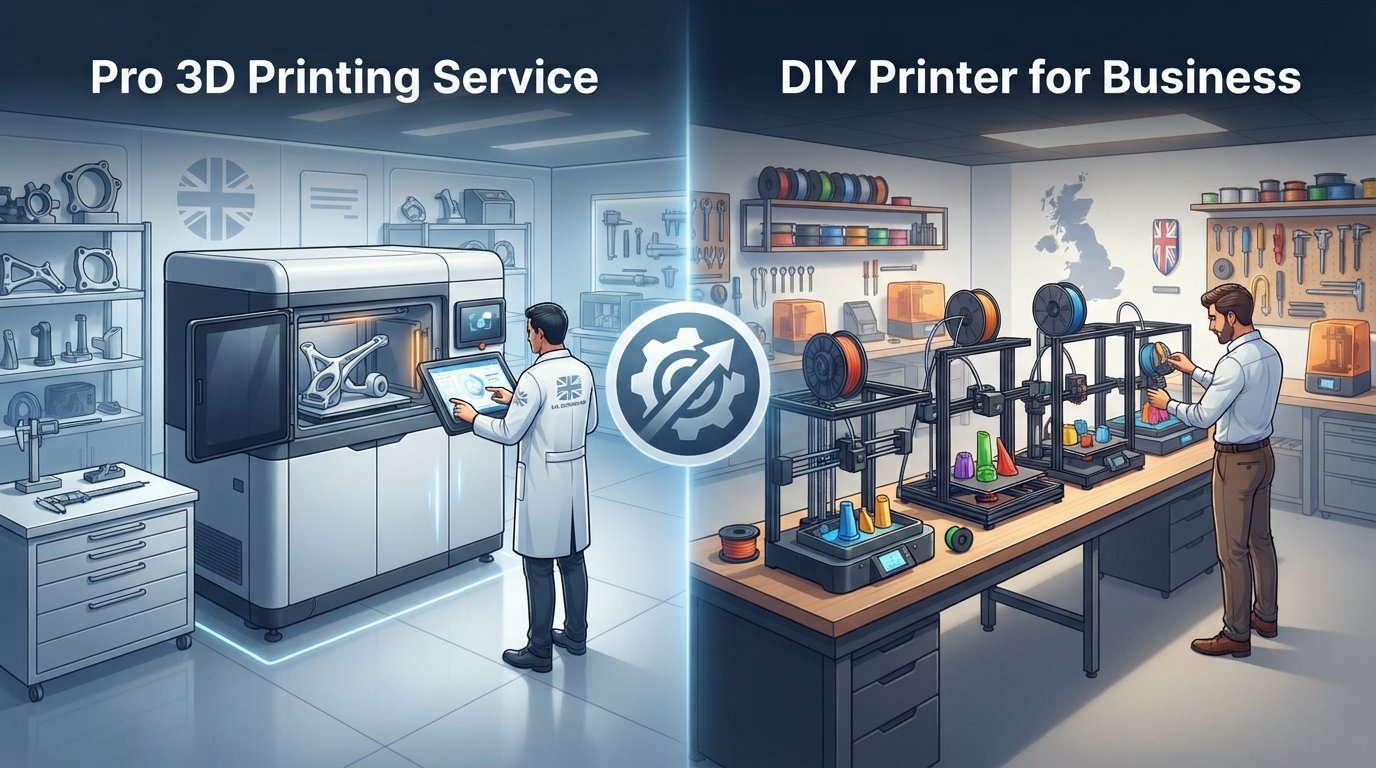
Pro 3D Printing vs. DIY Printer for UK Businesses
Professional 3D Printing Service vs DIY Home 3D Printer: Which is Best for UK Businesses?
In today's fast-paced business world, innovation is key. For UK businesses, 3D printing offers an incredible avenue for prototyping, creating custom parts, and even manufacturing on a small scale. But a crucial decision often arises: should you invest in a DIY home 3D printer, or is a professional 3D printing service the smarter choice? This isn't just about owning a piece of tech; it's about efficiency, quality, cost-effectiveness, and ultimately, what best serves your business goals.
Whether you're looking to create robust 3d printing replacement parts UK, develop new product prototypes, or require a specialised custom 3D printing service UK for intricate components, understanding the differences between these two options is vital. From a startup in a bustling hub like a 3d printing service London UK to an established manufacturer in a scenic area benefiting from a 3d printing service Scotland UK, this guide will help you navigate the landscape of additive manufacturing in Great Britain.
Quick Overview
Professional 3D Printing Service: Opting for a professional service means partnering with experts who handle everything from file preparation to post-processing. You simply upload your design (or engage their 3D modelling service), specify your requirements, and receive high-quality, finished parts. This hassle-free approach provides access to industrial-grade technology, a vast array of materials, and specialised expertise without the upfront investment or ongoing maintenance.
DIY Home 3D Printer: Investing in a DIY home 3D printer brings the printing process in-house. It offers direct control over every print, a steep learning curve, and the satisfaction of creating objects yourself. While appealing for hobbyists and those with frequent, basic printing needs, it demands significant time, technical knowledge, and a willingness to manage equipment, troubleshoot issues, and invest in materials and maintenance.
Feature-by-Feature Comparison
To help UK businesses make an informed decision, let's compare key aspects of professional 3D printing services and DIY home 3D printers:
| Criterion | Professional 3D Printing Service | DIY Home 3D Printer |
|---|---|---|
| Initial Investment & Running Costs | No upfront hardware cost. You pay per project or part, which includes materials, labour, machine time, and expertise. This makes it highly cost-effective for prototyping, custom parts, and small-batch production, especially for complex designs or infrequent needs. A clear 3d printing quote UK simplifies budgeting. | Significant upfront cost for the printer itself (ranging from a few hundred to several thousand pounds). Ongoing costs include filament, software, replacement parts, maintenance, electricity, and most critically, the time spent operating and troubleshooting the machine. Can be cost-effective per part only after a very high volume of simple prints. |
| Quality & Accuracy | Utilises industrial-grade 3D printers and advanced technologies (SLA, SLS, FDM with high-end machines) to deliver superior print quality, exceptional detail, and high dimensional accuracy. Parts often require minimal post-processing, resulting in a professional finish suitable for end-use products or detailed prototypes. | Quality varies greatly depending on the printer model, calibration, and user expertise. Consumer-grade FDM printers often produce visible layer lines, require significant post-processing (sanding, painting), and may have less consistent accuracy. Fine details can be challenging to achieve, and failures are common during the learning phase. |
| Material Variety & Properties | Access to a vast range of engineering-grade materials, including robust plastics (ABS, Nylon, Polycarbonate, TPU), resins (SLA for fine detail), and even metals. These materials come with diverse properties like high strength, flexibility, heat resistance, and chemical inertness, allowing for specialised applications and performance requirements. | Typically limited to common consumer-grade filaments like PLA and PETG, with some printers supporting ABS or flexible filaments like TPU. The material options are restricted by the printer's capabilities (e.g., enclosure for high-temperature materials) and are less diverse in their engineering properties. |
| Speed & Turnaround | Professional services are optimised for speed and efficiency. With multiple industrial machines and skilled operators, they can offer rapid prototyping, quick turnarounds (e.g., PrintIn3D's 8-hour, 12-hour, or 24-hour custom printing services), and often provide same-day dispatch for filament orders. Ideal for tight deadlines. | Printing speed is limited by the single machine's capabilities and the complexity of the part. Preparation, slicing, print time, and potential troubleshooting can lead to significant delays. For urgent needs, a DIY printer can be a bottleneck rather than a solution, eating into valuable business time. |
| Technical Expertise & Support | Requires no 3D printing expertise from your side. The service handles all technical aspects, from optimising your upload STL for 3d printing to machine operation and post-processing. Many services also offer expert 3d modelling service GB and 3d scanning to CAD service UK, providing end-to-end support. Friendly WhatsApp support is a common feature. | Demands considerable technical knowledge and a steep learning curve. Users must understand 3D design software (CAD), slicing programs, printer calibration, material properties, and troubleshooting common issues (clogged nozzles, bed adhesion, failed prints). This requires a dedicated resource or significant time investment from existing staff. |
| Scalability & Volume | Easily scales from a single prototype to small-to-medium batch production. Professional services have multiple machines and a robust workflow to handle increased demand without compromising quality or speed. This makes them ideal for businesses growing their product lines or needing consistent output. | Limited by the capacity of a single machine. Scaling up requires purchasing more printers, managing more maintenance, and dedicating more staff, quickly eroding any perceived cost savings. Not suitable for even modest production runs without significant additional investment and infrastructure. |
| Design & Post-Processing Services | Often includes comprehensive design support, from refining existing files to full 3d printing service GB design UK from concept. Post-processing like sanding, painting, assembly, and quality control are part of the service, delivering a ready-to-use part. | You're responsible for the design (either doing it yourself or outsourcing separately) and all post-processing. This can be very time-consuming and requires additional tools and skills to achieve a polished finish. |
Pros & Cons
Let's summarise the advantages and disadvantages of each option:
Professional 3D Printing Service
- Pros:
- Superior Quality & Accuracy: Industrial-grade printers ensure high-resolution, precise parts.
- Wide Material Selection: Access to advanced and specialty materials with diverse properties.
- Expertise & Support: Benefit from professional knowledge in design, printing, and troubleshooting. Includes 3d modelling service GB and 3d scanning to CAD service UK.
- No Upfront Investment: Avoid the capital expenditure of purchasing and maintaining a printer.
- Fast Turnaround: Optimised workflows and multiple machines mean quicker delivery, often with options for expedited orders.
- Scalability: Easily handle varying volumes from single prototypes to batch production.
- Hassle-Free: Your 3D printing partner manages the entire process, allowing you to focus on your core business.
- Reliability: Consistent results and professional quality control.
- Risk-Free Guarantee: Many services offer robust return policies, like PrintIn3D's 30-Day Risk-Free Return.
- Confidentiality: Often provides Non-Disclosure Agreements (NDAs) for sensitive projects.
- Cons:
- Per-Part Cost: For very high volumes of simple, low-detail parts, the per-unit cost might eventually exceed that of a fully utilised DIY printer (after significant initial investment and time spent).
- Less Direct Control: You're relying on the service provider's schedule and processes, though reputable services offer transparent communication.
DIY Home 3D Printer
- Pros:
- Direct Control: Full oversight of the printing process from start to finish.
- Potential for Low Per-Part Cost: Once the initial investment is recouped and assuming high usage with minimal failures, the cost per basic part can be very low.
- Educational Value: Great for learning the intricacies of 3D printing and design.
- Immediate Access: Print on demand for very small, non-critical items without waiting for delivery.
- Cons:
- High Initial & Ongoing Costs: Significant capital outlay plus continuous spending on filament, maintenance, and upgrades.
- Steep Learning Curve: Requires considerable time and effort to master operation, software, and troubleshooting.
- Limited Quality & Materials: Generally lower print quality and a smaller range of material options compared to industrial machines.
- Slow & Time-Consuming: Prints take a long time, and constant monitoring and intervention are often needed.
- Maintenance Headaches: Printers require regular calibration, cleaning, and part replacement.
- Not Scalable: One printer can only do one job at a time, making scaling production difficult and expensive.
- No Expert Support: You're on your own for design, troubleshooting, and material selection (unless you hire dedicated staff).
- Inconsistent Results: Quality can vary wildly due to environmental factors, calibration issues, and user error.
Who Should Choose Each
Understanding your specific business needs is crucial to making the right choice:
Who Should Choose a Professional 3D Printing Service?
- Businesses Needing High-Quality & Precision: If your applications require strong, accurate, or aesthetically pleasing parts (e.g., functional prototypes, jigs, fixtures, 3d printing replacement parts UK, architectural models, or complex visualisations).
- Those Requiring Advanced Materials: If your project demands specific material properties like high strength, flexibility, chemical resistance, or unique finishes.
- Companies with Tight Deadlines: When you need prototypes or small batches quickly, leveraging a service's fast turnaround times is invaluable.
- Businesses Lacking In-House Expertise: If you don't have a dedicated team with 3D printing skills, a service provides the expertise without the training costs. This is perfect if you need a 3d printing service GB custom parts UK without the overhead.
- Startups & SMEs: Ideal for product development, testing, and small-scale manufacturing without large capital investment.
- Organisations Needing Design & Scanning Support: If you have a concept that needs to be converted into a print-ready file (3d modelling service GB) or a physical object that needs to be replicated (3d scanning to CAD service UK).
- Any Business Seeking a Hassle-Free, Reliable Solution: If you value your time and want a partner who can deliver consistent results with minimal fuss. This applies whether you're looking for a 3d printing service London UK or a 3d printing service Scotland UK, or anywhere across the UK.
Who Should Choose a DIY Home 3D Printer?
- Hobbyists & Educators: Individuals or institutions primarily interested in personal projects, learning, or teaching the basics of 3D printing.
- Businesses with Very Basic, Non-Critical Needs: If you only need to print very simple, non-functional, conceptual models occasionally, and quality/accuracy are not paramount.
- Organisations with Ample Time & In-House Expertise: If you have dedicated staff willing to invest significant time in learning, operating, and maintaining the printer.
- Budget-Constrained Projects (after initial investment): For very high volumes of truly simple parts, *and if* the printer is flawlessly maintained and operated, the per-part cost might become lower over time. However, this often overlooks the cost of labour and potential print failures.
Verdict
For the vast majority of UK businesses, from ambitious startups to established enterprises, choosing a professional 3D printing service offers a clear advantage over investing in and operating a DIY home 3D printer. While the allure of having a 3D printer in your office might seem appealing, the reality of high upfront costs, a steep learning curve, ongoing maintenance, material limitations, and inconsistent quality quickly reveals the benefits of outsourcing.
A professional service, like PrintIn3D.ie, acts as your reliable 3D printing service GB partner. We bring award-winning expertise (Silver Rising Star at the Irish Print Awards 2026), industrial-grade equipment, and a vast selection of high-quality materials directly to your project. This means you can focus on your core business, confident that your prototypes, 3d printing replacement parts UK, or custom components will be produced with precision and delivered swiftly.
With services ranging from converting concepts into print-ready models through our 3d modelling service GB, to offering upload STL for 3d printing directly onto our platform for an instant 3d printing quote UK, PrintIn3D.ie provides a seamless experience. Our fast turnaround times, same-day dispatch for filament orders, and friendly WhatsApp support ensure your projects stay on track. Plus, with our 30-Day Risk-Free Return policy, you can experience our quality and reliability with complete peace of mind. Choosing a professional 3d printing online UK service is not just about saving money on hardware; it's about investing in efficiency, quality, and peace of mind for your business's innovation journey.
Ready to print your 3D dreams?
Get your instant 3D printing quote UK today and experience the PrintIn3D difference with our hassle-free, expert service.