TPU Filament for 3D Printers: Your Ultimate Comparison Guide
TPU Filament for 3D Printers: Your Ultimate Comparison Guide
In the vibrant world of 3D printing, few materials spark as much excitement and possibility as TPU filament. Standing for Thermoplastic Polyurethane, TPU is a game-changer for anyone looking to create parts that are not just strong and durable, but also wonderfully flexible and elastic. Imagine printing phone cases that absorb impacts, custom grips that mold to your hand, or functional parts that can bend and compress without breaking. That's the magic of using a tpu filament for 3d printer projects.
But with varying types and characteristics, choosing the right TPU can feel a bit daunting. This comprehensive guide is designed to be your expert companion, helping you navigate the options and understand the nuances between different TPU filaments. As an award-winning service recognized as a 'Rising Star' at the Irish Print Awards, and your dedicated 3D printing partner, PrintIn3D is here to ensure you make an informed decision, whether you're looking to buy 3D printer filament online or seeking professional 3D printing services to bring your flexible designs to life.
We'll delve into the key differences between common TPU variants, highlighting their flexibility, printability, and best-suited applications. By the end, you'll have a clear understanding of which TPU is best for your specific needs, helping you unlock new levels of creativity and functionality in your 3D printing journey. Let's explore how to choose the ideal premium 3d printer filament for your next flexible masterpiece!
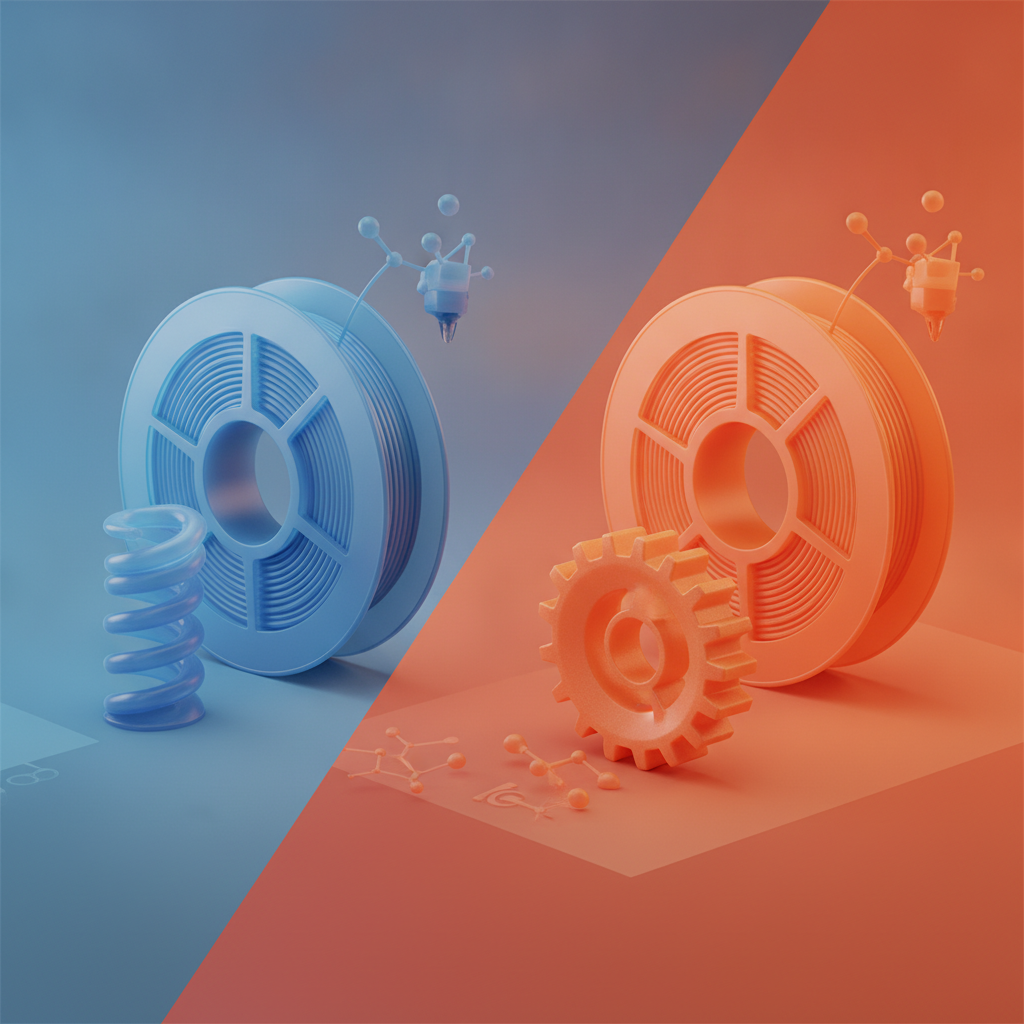
Quick Overview: Standard (Shore 95A) TPU vs. Highly Flexible (Shore 85A) TPU
While many types of TPU exist, a common way to differentiate them is by their Shore hardness rating, which measures a material's resistance to indentation. For 3D printing, you'll often encounter TPUs ranging from Shore 60A (very soft) to Shore 98A (quite stiff). For this comparison, we'll focus on two widely representative categories to give you a clear understanding:
Standard (Shore 95A) TPU
This type of TPU offers a fantastic balance of flexibility and ease of printing. With a Shore hardness of approximately 95A, it's firm enough to maintain its shape under moderate stress but still pliable and elastic, making it incredibly versatile. It's often the go-to choice for those new to flexible filaments or for applications requiring good impact resistance without extreme floppiness. It's generally more forgiving to print, allowing for wider compatibility with various 3D printer setups.
Highly Flexible (Shore 85A) TPU
Stepping down to a Shore hardness of around 85A, this TPU variant truly embraces flexibility. It's significantly softer and more elastic than 95A TPU, offering superior shock absorption and a rubber-like feel. While its extreme pliability opens up a world of unique applications, it also introduces more challenges during the printing process. Achieving clean, successful prints with highly flexible TPU often requires a more finely tuned printer and some experience with flexible materials.
Feature-by-Feature Comparison
| Criterion | Standard (Shore 95A) TPU | Highly Flexible (Shore 85A) TPU |
|---|---|---|
| Flexibility (Shore Hardness) | Moderate flexibility, akin to a hard rubber eraser. Holds shape well but can bend and compress. Shore 95A. | High flexibility, very rubbery and elastic. Can be stretched considerably and return to original shape. Shore 85A. |
| Printability | Easier to print; good flow, less prone to tangling in Bowden systems. Moderate print speeds possible. Requires careful retraction settings. | Challenging to print; very soft and can stretch in Bowden tubes, leading to clogs. Best with direct drive extruders. Requires slow print speeds, no or minimal retraction. |
| Durability & Abrasion Resistance | Excellent durability and very good abrasion resistance. Resists wear, tearing, and impacts effectively. Ideal for protective parts. | Exceptional durability and outstanding abrasion resistance. Absorbs impacts very well and is highly resistant to surface wear. |
| Layer Adhesion & Part Strength | Strong layer adhesion results in robust, functional parts. Good tensile strength and tear resistance. | Very strong layer adhesion, creating highly cohesive and resilient parts. Excellent elongation at break and tear strength. |
| Applications | Phone cases, protective covers, footwear components, seals, gaskets, drone parts, flexible tooling, vibration dampeners. | Soft grippers, custom medical models, highly compliant gaskets, soft robotic components, wearable items, flexible hinges, extreme shock absorbers. |
| Chemical & Temperature Resistance | Good resistance to oils, greases, and many chemicals. Stable across a decent temperature range (-30°C to 100°C). | Similar good chemical resistance to oils and greases. Generally maintains flexibility well across a similar temperature range, though extreme cold can stiffen it slightly. |
| Moisture Sensitivity | Moderately hygroscopic; can absorb moisture, leading to print quality issues (stringing, bubbles) if not dried properly. | Slightly more hygroscopic than 95A; proper drying is crucial for successful printing and optimal part properties. |
| Post-Processing | Can be challenging to sand due to flexibility. Gluing is possible with specific adhesives. Can be painted, but flexibility might cause cracking. | Very difficult to sand. Best left as-is or using specific flexible glues. Painting is generally not recommended if flexibility is to be maintained. |
Pros & Cons
Standard (Shore 95A) TPU
- Pros:
- Easier to Print: More forgiving than softer TPUs, making it a good entry point for users new to flexible filaments. It often performs well even with Bowden extruder setups, though direct drive is always preferred.
- Versatile Balance: Offers a great mix of flexibility and stiffness, suitable for a wide array of functional parts that need to be resilient but not overly floppy.
- Good Detail Retention: Its relative stiffness allows for better detail and bridging compared to softer variants, resulting in cleaner prints.
- Wide Application Range: Excellent for protective gear, robust seals, and components that need some give without losing structural integrity.
- Readily Available: Many brands offer high-quality 95A TPU, making it easy to buy TPU filament online.
- Cons:
- Less Flexible: For applications requiring extreme elasticity or a very soft, squishy feel, 95A TPU might not be flexible enough.
- Still Requires Care: While easier than 85A, it's still more challenging to print than rigid filaments like PLA or PETG, demanding proper calibration and settings.
- Not for Extreme Dampening: If you need maximum vibration absorption or a very soft buffer, a stiffer TPU might not provide enough give.
Highly Flexible (Shore 85A) TPU
- Pros:
- Extreme Elasticity: Offers unparalleled flexibility and stretchiness, perfect for parts that need to deform significantly and return to shape.
- Superior Shock Absorption: Its softness makes it excellent for dampening vibrations and absorbing impacts, protecting sensitive components.
- Unique Tactile Feel: Provides a very soft, rubbery touch, ideal for ergonomic grips, custom insoles, or wearable items.
- Excellent for Sealing: Creates highly compliant seals and gaskets that can conform to irregular surfaces.
- Unmatched Durability: Despite its softness, it boasts incredible tear and abrasion resistance, standing up to rigorous use.
- Cons:
- Difficult to Print: This is its biggest drawback. It's highly prone to tangling, stretching, and jamming, especially in Bowden setups. Requires a direct drive extruder, very slow print speeds, and precise temperature control.
- Stringing and Blobs: Its soft, sticky nature often leads to more stringing and blobbing, requiring careful retraction tuning (or disabling it entirely).
- Post-Processing Challenges: Almost impossible to sand or effectively post-process for a smooth finish, limiting aesthetic options.
- Less Detail Resolution: The extreme flexibility can make it harder to print very fine details or sharp corners accurately.
Who Should Choose Each
Choose Standard (Shore 95A) TPU If:
- You're new to flexible filaments: Its easier printability makes it a great starting point for beginners to get comfortable with TPU.
- You need functional parts with a balance of stiffness and flexibility: Ideal for items like rugged phone cases, flexible tool handles, drone frames, or automotive gaskets that need to resist wear and tear while offering some give.
- Your printer has a Bowden extruder: While direct drive is always best for TPU, 95A often performs acceptably on well-tuned Bowden systems.
- You're creating prototypes for products that will eventually be manufactured with a similar Shore hardness rubber or plastic. This makes it excellent for rapid prototyping 3d printing.
- You require good abrasion resistance and impact absorption without extreme floppiness. Think protective caps, cable management, or vibration dampeners.
- You're a small business or an individual looking for an affordable 3d printing service USA to create functional parts without investing in a specialized printer. Many online 3d printing services in the US or a local 3d printing shop can handle these projects with ease.
Choose Highly Flexible (Shore 85A) TPU If:
- You need extreme elasticity and a very soft, rubbery feel: Perfect for custom insoles, soft robotic actuators, medical models requiring high compliance, or squishy toys.
- Your application demands superior shock absorption: For instance, delicate electronic enclosures that need ultimate protection against drops, or highly effective vibration dampeners.
- You have a direct drive extruder and experience with flexible materials: This filament is best tackled by advanced users with optimized printer setups.
- You're a designer or engineer developing innovative products requiring unique haptics or extreme deformation. This might include working with a 3D printing service in Los Angeles or exploring custom 3D printing service in Austin.
- You require highly compliant seals or custom gaskets for irregular surfaces.
- You're a 3d printed parts manufacturer looking to offer specialized, soft components to your clients, and you're prepared for the printing challenges. If you're looking to buy filament in bulk for such projects, consider your printer setup.
Verdict: Making Your Choice for the Best TPU Filament
The "best" tpu filament for 3d printer applications isn't a one-size-fits-all answer; it entirely depends on your project's specific requirements. If you're seeking a balance of good flexibility, durability, and relatively easy printability, Standard (Shore 95A) TPU is likely your ideal choice. It's a fantastic all-rounder for most functional flexible parts and an excellent entry point into the world of flexible filaments. This is often the type of durable, flexible TPU you'll find from reliable suppliers like PrintIn3D, ensuring quality and consistent performance for your projects.
However, if your design calls for extreme elasticity, superior shock absorption, or a very soft, rubber-like feel, and you have the technical expertise (or a professional 3d printing service in the US to handle it), then Highly Flexible (Shore 85A) TPU is unmatched. Just be prepared for a more demanding printing process, or consider outsourcing to an expert. For instance, if you're exploring 3d printing services by state or specifically 3d printing services in California, ensure they have experience with these more challenging flexible materials.
No matter which TPU you choose, always prioritize quality. A premium 3d printer filament will make a significant difference in print success and the final part's performance. PrintIn3D offers high-quality filament options for your needs. We understand the intricacies of 3D printing and are here to help you achieve your goals, whether you need to buy filament in bulk or require a custom printed part. If you're unsure, our friendly WhatsApp support is always ready to guide you.
Remember that moisture management is critical for all TPU types. Always store your filament in a dry environment, and consider drying it before printing, especially softer variants, to avoid common print issues like stringing or weak layers. For complex designs or if you're working with an existing physical object that needs a flexible reproduction, don't forget that a professional 3d scanning service USA can convert it into a printable 3D model with precision.
Ready to bring your flexible ideas to life with high-quality TPU?
Explore PrintIn3D's range of premium 3D printer filaments and custom 3D printing services to start your next flexible project hassle-free.