Leverage Custom 3D Printing for US Small Business Prototypes & Products
How to Leverage Custom 3D Printing Services for Your US Small Business Prototypes and Products
In today's fast-paced market, small businesses in the US are constantly seeking innovative ways to accelerate product development, reduce costs, and stay competitive. Enter custom 3D printing services – a game-changer that empowers entrepreneurs and businesses to transform ideas into tangible prototypes and market-ready products with unprecedented speed and flexibility. Gone are the days when bringing a new product to life meant massive upfront investments in tooling and long lead times. With accessible custom 3d printing for US small businesses, you can iterate designs, test functionalities, and even produce short-run batches of products without ever owning a 3D printer.
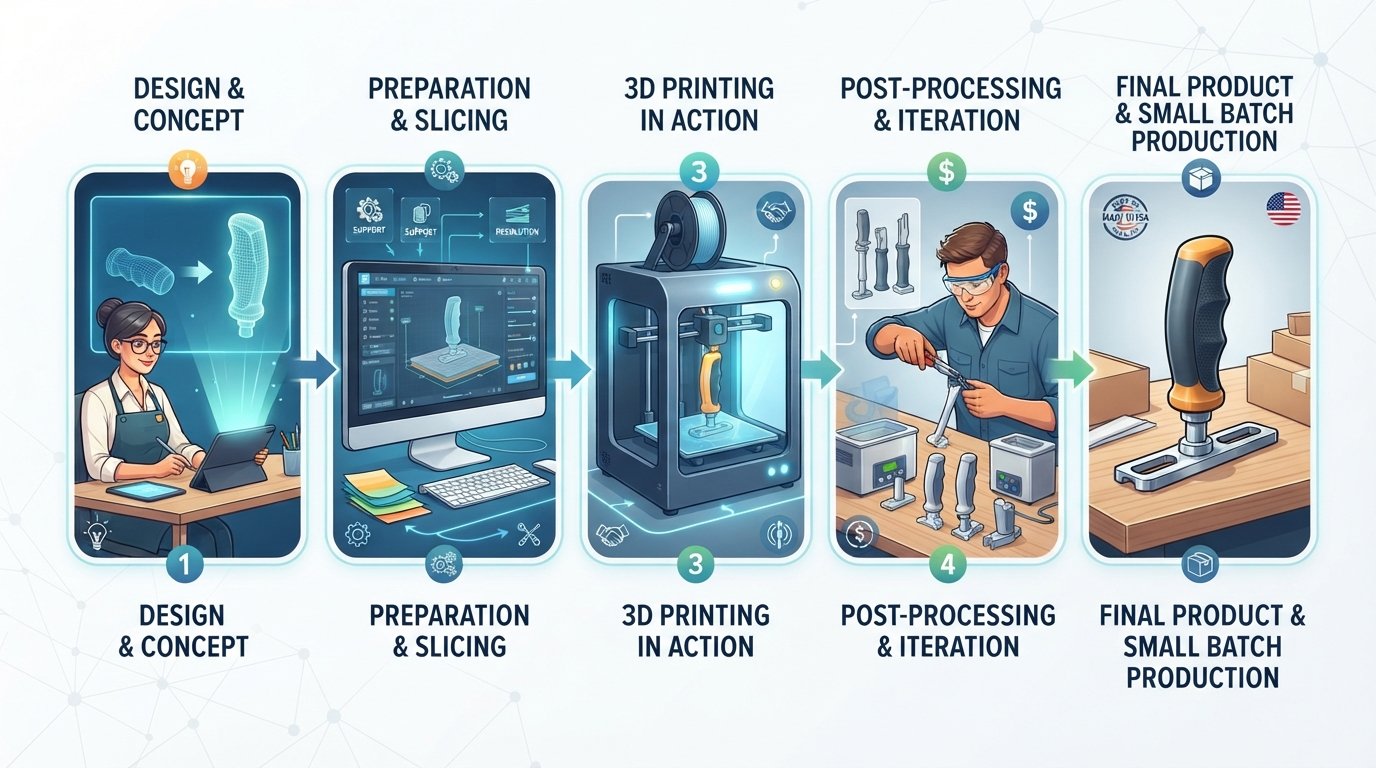
This comprehensive guide will walk you through everything you need to know about leveraging custom 3D printing services for your US-based small business. We'll cover the journey from concept to final product, explaining how to choose the right service, prepare your designs, and effectively utilize the technology to gain a significant edge. Whether you're looking to create functional prototypes, custom components, or unique consumer goods, understanding this technology is crucial for your business's success. We aim to make this complex process hassle-free, helping you unlock your creative potential and bring your 3D dreams to life.
Who This Is For
- US-based small business owners and entrepreneurs looking to innovate.
- Product developers and engineers seeking rapid prototyping solutions.
- Designers who need physical models of their digital creations.
- Businesses aiming for cost-effective, low-volume manufacturing.
- Anyone without a personal 3D printer who needs custom 3D printed parts.
Step 1: Define Your Project Needs and Goals
Before diving into the world of 3D printing, the first crucial step for any US small business is to clearly define what you want to achieve. What is the purpose of your 3D printed part? Is it a concept model, a functional prototype, an end-use product, or a tool? Understanding your end goal will dictate the choice of materials, print quality, and the type of 3D printing service you'll need. This initial clarity saves time and resources down the line.
Consider the functional requirements of your part. Will it bear weight, endure specific temperatures, or come into contact with certain chemicals? These details are vital for selecting the appropriate materials. For instance, a simple display model might be fine with basic PLA filament, but a part exposed to heat would require a high temperature 3d printer filament like PETG or even ABS, or specialized engineering plastics. Also, consider the desired quantity – are you looking for a single prototype or considering a bulk 3d printing service for a small production run?
- Identify the Part's Purpose: Is it for visualization, fit-testing, functional testing, or final product?
- Determine Functional Requirements: Think about strength, flexibility, heat resistance, chemical resistance, and environmental exposure.
- Estimate Quantity: Decide if you need one prototype, a small batch, or larger-scale production.
- Set a Budget and Timeline: Realistic expectations for cost and turnaround time are essential for planning.
Tip: Document your project needs thoroughly. Create a brief that outlines the part's function, desired dimensions, material properties, and any specific aesthetic requirements. This will be invaluable when communicating with online 3d printing service providers.
Step 2: Design or Acquire Your 3D Model
A 3D printing service can only print what you provide. The foundation of any successful 3D print is a well-designed 3D model. If you already have an existing digital file, ensure it's in a suitable format (typically STL, OBJ, or 3MF). If your idea is still a sketch or a physical object, you'll need to create a digital model or have one created for you.
For those without in-house CAD expertise, many 3D printing services also offer CAD design services for 3d printing. You can provide sketches, technical drawings, or even physical objects, and their designers can convert them into print-ready 3D files. Alternatively, if you have a physical object you wish to replicate or modify, 3D scanning services can capture its geometry and create a digital model. This is especially useful for reverse engineering or creating custom fits for existing parts.
- Review Existing 3D Files: Check if your current CAD files are suitable for 3D printing (e.g., watertight, correct scale).
- Sketch Your Idea: If starting from scratch, create detailed sketches with dimensions and annotations.
- Utilize 3D Design Software: Learn basic CAD tools (e.g., Tinkercad, Fusion 360) or hire a professional designer.
- Consider 3D Scanning: For existing physical objects, explore 3D scanning services in the USA to create a digital replica.
Warning: Poorly designed or non-manifold 3D models can lead to print failures, wasted time, and additional costs. Always ensure your design is optimized for 3D printing, with adequate wall thickness and minimal overhangs, or rely on a professional design service.
Step 3: Select the Right 3D Printing Service Provider
Choosing the right partner is paramount for US small businesses. While searching for "3d printing service near me" might yield local options, an online 3d printing service like PrintIn3D.ie often offers broader material selections, competitive pricing, and efficient workflows, regardless of your physical location in the USA. Look for providers that offer a combination of reliability, material variety, fast turnaround, and excellent customer support.
Consider the types of 3D printing technologies offered. FDM (Fused Deposition Modeling) is excellent for functional prototypes and larger parts, often using materials like PLA or PETG. SLA (Stereolithography) provides high detail and smooth finishes, ideal for aesthetic prototypes. SLS (Selective Laser Sintering) is perfect for complex geometries and strong, functional parts. The right technology choice depends heavily on your project's specific requirements identified in Step 1.
- Evaluate Online vs. Local: Weigh the benefits of convenience, material range, and price from online 3d printing service providers against local options, even if you're looking for "3d printing services in new york."
- Check Material Selection: Ensure the service offers the materials suitable for your application (e.g., PLA, PETG, ABS, Nylon, specialty filaments).
- Assess Turnaround Times: If you need rapid prototyping, inquire about same day 3d printing service or express shipping options.
- Read Reviews and Testimonials: Look for evidence of quality, reliability, and customer satisfaction. PrintIn3D.ie, for example, is an award-winning service recognized as a 'Rising Star' at the Irish Print Awards 2026.
- Inquire about Support: Friendly and knowledgeable customer support is essential, especially if you have complex requirements or need guidance.
Tip: Don't hesitate to contact multiple services for quotes and to discuss your project. This will give you a better understanding of pricing, capabilities, and the level of service you can expect. PrintIn3D.ie offers friendly WhatsApp support for quick queries.
Step 4: Prepare Your 3D Model File for Printing
Once you have your 3D model and have chosen your service, the next step is to prepare your file for submission. Most online 3d printing services prefer STL (STereoLithography) files, though OBJ and 3MF are also common. It's crucial that your model is "watertight," meaning it has no holes or gaps in its surface, which would confuse the slicer software used by the printer.
Before uploading, double-check the scale and orientation of your model. Many software programs use different unit systems (millimeters vs. inches), and a simple oversight can lead to a print that's too small or too large. Consider the orientation on the print bed; this can affect print quality, strength, and the need for support structures. While the service provider's experts will usually optimize this, a good starting point from your end can streamline the process. If your model is complex, a simple visual inspection in a 3D viewer can catch glaring issues.
- Export to Preferred Format: Convert your CAD model to an STL, OBJ, or 3MF file.
- Check for Watertightness: Use mesh repair tools if necessary to ensure a solid, enclosed volume.
- Verify Scale and Units: Confirm your model is in the correct dimensions (e.g., millimeters or inches).
- Consider Print Orientation: Think about how the part will be printed to minimize supports and maximize strength.
- Compress Files: For very large files, consider zipping them before uploading to save time.
Warning: Ignoring file preparation can result in costly reprints or even a non-printable model. Many services offer file repair, but it's often an additional charge. Doing your due diligence upfront saves money and speeds up delivery.
Step 5: Get a Quote and Place Your Order
With your file ready, it's time to submit it for a quote. Most online 3d printing services have an intuitive upload system where you can select your desired material, color, and finish, and instantly receive a price estimate. The cost of custom 3d printing services is typically influenced by factors like material volume, print time, complexity, and the chosen finish. For bulk 3d printing service orders, expect volume discounts.
Carefully review the quote for details like material specifications, estimated lead time (e.g., 24 hours custom printing service, 48 hours), and shipping costs to your US location. Don't hesitate to ask questions if anything is unclear. Once you're satisfied, proceed with placing your order. Many services offer various payment options and secure transactions. For sensitive projects, ensure the service provides confidentiality options, such as an NDA, which PrintIn3D.ie offers.
- Upload Your File: Use the service provider's online platform to upload your 3D model.
- Select Options: Choose your material (e.g., PLA, PETG), color, infill density, and desired finish.
- Review the Quote: Check pricing, lead time, and shipping costs carefully.
- Ask Questions: Clarify any doubts before confirming your order.
- Place Your Order: Complete the payment process and await confirmation.
Tip: For larger or recurring orders, inquire about setting up a business account or preferred client status. This can sometimes unlock better pricing or dedicated support for your bulk 3d printing service needs.
Step 6: Review Prototypes and Iterate Designs
One of the greatest advantages of custom 3d printing services for small business is the ability to rapidly prototype and iterate. Once you receive your initial print, thoroughly inspect it. Does it meet your aesthetic expectations? Does it fit correctly with other components? Does it perform its intended function?
Gather feedback from your team, potential customers, or test users. Identify any areas for improvement, no matter how small. Then, go back to your 3D design software (or your 3D design service provider) and make the necessary adjustments. With online 3d printing service, you can quickly order a revised version, often with a fast turnaround. This iterative process is crucial for refining your product, catching flaws early, and ensuring the final design is robust and market-ready. This approach significantly reduces the risk associated with traditional manufacturing methods.
- Thoroughly Inspect the Print: Check dimensions, aesthetics, fit, and functionality.
- Gather Feedback: Involve stakeholders and target users in the review process.
- Identify Areas for Improvement: Document all necessary changes to the design.
- Revise Your 3D Model: Make adjustments based on feedback and re-export the file.
- Order a New Prototype: Repeat the printing process with the updated design.
Warning: Skipping or rushing the iteration phase can lead to costly mistakes down the line, especially if you move to mass production with an unoptimized design. Embrace the iterative nature of 3D printing.
Step 7: Scaling for Production (Small Batch & Beyond)
Once your prototype is perfect, custom 3d printing services for small business can also facilitate small-batch production. For many US small businesses, producing dozens or even hundreds of parts via 3D printing is a viable and cost-effective alternative to injection molding, especially for niche products or early market testing. This is where bulk 3d printing service options become highly beneficial.
If you anticipate needing a continuous supply of parts, you might also consider sourcing your own 3d printer filament in larger quantities. While PrintIn3D.ie primarily offers custom printing, they also sell high-quality filaments from brands like Bambu Lab and SUNLU. If you eventually decide to buy a 3d printer filament yourself, knowing where to buy pla filament online or find bulk pla filament USA can be valuable. However, for most small businesses, leveraging a professional service for production remains the most hassle-free solution, avoiding the complexities of printer maintenance and operation.
- Discuss Bulk Pricing: Contact your chosen service provider about discounts for larger quantities.
- Consider Material Consistency: Ensure the material and quality remain consistent across all units.
- Plan Logistics: Coordinate production schedules and shipping to align with your market launch.
- Evaluate Long-Term Production: Assess if 3D printing remains cost-effective for growing volumes or if traditional manufacturing is needed.
Tip: For ongoing production, maintain open communication with your custom 3d printing service provider. Building a strong relationship can lead to better service, faster turnarounds, and potentially more favorable terms for your online 3d printing service needs.
Common Mistakes to Avoid When Using Custom 3D Printing Services
While custom 3D printing offers immense advantages, there are common pitfalls that US small businesses should be aware of. Avoiding these can save you time, money, and frustration:
- Underestimating Material Selection: Not all filaments are created equal. Choosing the wrong material (e.g., using PLA for a high-heat application instead of high temperature 3d printer filament like PETG) can lead to product failure and wasted resources. Always match the material properties to your part's functional requirements.
- Poor File Quality: Uploading non-watertight, incorrectly scaled, or excessively complex models without optimization can lead to print failures, extended lead times, or additional design fees. Invest time in file preparation or utilize cad design services for 3d printing.
- Skipping the Iteration Phase: Rushing from a first prototype straight to production is risky. The beauty of 3D printing is rapid iteration. Use it to refine your design, test functionalities, and gather feedback before committing to larger orders.
- Lack of Clear Communication: Vague instructions or an incomplete project brief can result in prints that don't meet your expectations. Provide as much detail as possible to your online 3d printing service provider.
- Ignoring Post-Processing Needs: Some 3D prints may require sanding, painting, or assembly. Factor in these post-processing steps and costs, both in terms of time and budget, especially for aesthetic parts or prototypes.
- Overlooking Service Provider Expertise: Not all 3d printing services are equal. Look for providers with a strong track record, a wide range of materials, and robust customer support, like PrintIn3D.ie, which has received industry recognition.
- Focusing Only on Cost: While budget is important, choosing the cheapest option can sometimes compromise quality, material choice, or turnaround time. Balance cost with the provider's reputation, capabilities, and customer service.
- Not Considering Volume Discounts: For multiple parts or future production, always inquire about bulk 3d printing service pricing. This can significantly reduce your per-unit cost.
Frequently Asked Questions About Custom 3D Printing for US Small Businesses
What are the typical costs for custom 3D printing services for small businesses?
The cost varies significantly based on several factors: the complexity and size of your part, the type of material chosen (e.g., standard PLA filament vs. high temperature 3d printer filament), the print resolution, and the quantity. Simple prototypes in basic materials can be quite affordable, often starting from a few dollars. Complex designs or those requiring advanced materials and finishes will naturally cost more. Many online 3d printing services offer instant quotes based on your uploaded 3D file, allowing you to easily compare options and scale your order. For bulk 3d printing service, per-unit costs decrease substantially.
How quickly can I get a custom 3D printed part?
Turnaround times depend on the service provider, the complexity of your model, and their current workload. Many online 3d printing services, including PrintIn3D.ie, offer expedited options. You can often get a prototype or small batch within a few days, with options for same day 3d printing service or 24-hour custom printing service for urgent projects. Shipping to the US will add additional time, but efficient logistics can minimize this. Always check the estimated lead time during the quoting process.
What file formats are accepted by custom 3D printing services?
The most common and widely accepted file format is STL (STereoLithography), which defines the geometry of your 3D model using a mesh of triangles. Other popular formats include OBJ (Object File) and 3MF (3D Manufacturing Format), which can carry more information like color and material properties. Most professional 3d printing services will specify their preferred formats and often provide tools or guidance for converting your native CAD files.
Can custom 3D printing services help with product design if I only have an idea or sketch?
Absolutely! Many custom 3d printing services, including PrintIn3D.ie, offer comprehensive 3d design services. If you have a concept, sketch, technical drawing, or even a physical object that needs replication or modification, their expert designers can transform it into a print-ready 3D model using professional CAD design services for 3d printing. This is an invaluable service for small businesses that lack in-house design capabilities, streamlining the journey from idea to prototype.
What types of materials are available for custom 3D printing?
The range of materials is vast and constantly expanding. For FDM (Fused Deposition Modeling) printing, common materials include:
- PLA (Polylactic Acid): Easy to print, biodegradable, and ideal for prototypes, display models, and non-functional parts. You can buy PLA filament online readily.
- PETG (Polyethylene Terephthalate Glycol): Stronger and more durable than PLA, with good temperature and chemical resistance, suitable for functional parts and enclosures. Considered a high temperature 3d printer filament option.
- ABS (Acrylonitrile Butadiene Styrene): Known for its strength, impact resistance, and suitability for engineering applications, though trickier to print.
- Nylon: Offers excellent strength, flexibility, and abrasion resistance.
- TPU (Thermoplastic Polyurethane): A flexible, rubber-like material perfect for gaskets, phone cases, and soft components.
For other technologies like SLA or SLS, materials like resins (for high detail) and nylons (for strength and complexity) are common. Always discuss your specific application with the service provider to ensure you select the optimal material. For those looking to buy 3d printer filament for their own machines, sources for bulk pla filament USA and other materials are plentiful.
Next Steps: Bring Your Vision to Life with PrintIn3D.ie
Ready to transform your US small business ideas into reality? Leveraging custom 3D printing services is your strategic advantage for rapid prototyping and efficient product development. Let PrintIn3D.ie be your trusted online 3d printing service partner, offering hassle-free solutions, expert 3D design services, and high-quality prints shipped directly to you in the USA. Visit PrintIn3D.ie today to get an instant quote and start printing your 3D dreams.