DIY 3D Printing vs. Professional Services: US Small Business Guide
Introduction
For US small businesses and ambitious entrepreneurs, the world of 3D printing offers incredible opportunities, from rapid prototyping to creating unique end-use products. But a crucial decision often looms: should you invest in your own 3D printer for a DIY approach, or leverage the power and expertise of professional 3D printing services? This isn't just a technical question; it's a strategic business decision that impacts your budget, time, quality, and overall project success.
Understanding the nuances between DIY 3D printing vs. professional 3D printing services is key to making an informed choice. Each path has its own set of advantages and challenges, and what works best depends entirely on your specific needs, resources, and long-term goals. We're here to help you navigate this decision with a friendly, expert perspective, ensuring you choose the solution that helps your 3D dreams come to life.
Quick Overview
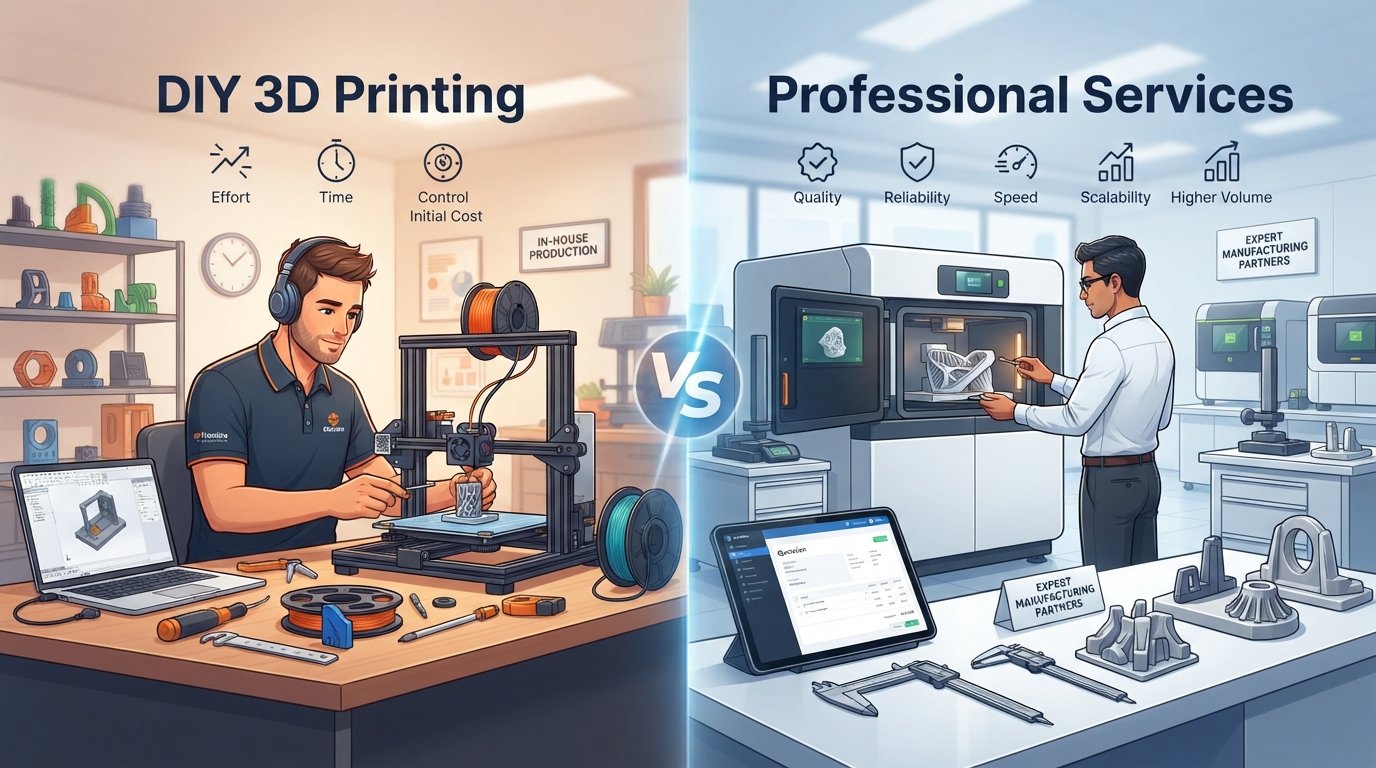
DIY 3D Printing involves purchasing, setting up, and operating your own 3D printer. This approach grants you immediate access and control over the printing process, allowing for on-the-fly adjustments and experimentation. It's often seen as a cost-effective solution for those with a consistent, low-volume need for 3D printed parts and the time to dedicate to learning and maintaining the equipment.
Professional 3D Printing Services, on the other hand, means outsourcing your 3D printing needs to a specialized provider. These services offer access to industrial-grade machines, a wider range of materials, and expert knowledge, often resulting in higher quality, more complex parts with faster turnaround times. They handle everything from file preparation to post-processing, providing a hassle-free solution for businesses seeking precision, scalability, and efficiency without the upfront investment or operational burden.
Feature-by-Feature Comparison
| Criterion | DIY 3D Printing | Professional 3D Printing Services |
|---|---|---|
| Initial Investment | Requires significant upfront capital for the 3D printer itself (ranging from a few hundred to several thousand dollars), software licenses, essential tools, and an initial stock of various 3D printing supplies online like filaments. | Virtually no upfront investment in equipment. You only pay for the specific prints you need, making it a highly accessible option for businesses of all sizes, especially those seeking custom 3D printing for US small businesses without capital expenditure. |
| Operating Costs | Ongoing expenses include electricity, maintenance (replacement nozzles, print beds, spare parts), software subscriptions, and continuous purchase of various filaments such as 1.75 mm PLA filament USA, PETG, ABS, or even specialized options like carbon fiber filament supplier. | Costs are transparently quoted per project, covering materials, labor, machine time, and post-processing. This allows for predictable budgeting without hidden maintenance or utility costs, making it simple to get online 3D printing quotes USA. |
| Skill & Time Required | Demands a steep learning curve for machine operation, troubleshooting, slicing software, and post-processing techniques. Significant time commitment for setup, calibration, print monitoring, and maintenance. | Requires minimal technical expertise beyond submitting a well-prepared 3D model. The service provider handles all the complex aspects, freeing up your team's time for core business activities. This makes it ideal for businesses without in-house 3D printing specialists. |
| Quality & Precision | Quality can vary widely depending on the printer's cost, technology, and user expertise. Entry-level printers may struggle with fine details, complex geometries, or consistent part accuracy. Professional finishing is often challenging. | Offers access to industrial-grade 3D printers that deliver superior resolution, dimensional accuracy, and surface finish. Expert technicians ensure optimal print settings and post-processing for high-quality 3D printed parts, suitable for demanding applications like prototype 3D printing service. |
| Material Variety & Strength | Limited by the capabilities of your chosen printer. Most consumer FDM printers primarily use PLA and PETG. Access to advanced, engineering-grade materials like nylon, composites, or specialized resins requires more expensive, higher-end machines. | Provides a vast selection of materials, including robust plastics, metals, resins, and composites, often unavailable to hobbyist printers. This ensures you can select the perfect material properties (strength, flexibility, heat resistance) for your specific application. Many offer to buy PLA filament online or other specialized options. |
| Scalability & Turnaround | Limited by the single machine's capacity and speed. Scaling up means buying more printers, which multiplies costs and management complexity. Turnaround can be slow due to print times and potential failures. | Highly scalable, as providers have multiple machines and optimized workflows to handle small batches or large production runs efficiently. They often offer expedited options for fast turnaround, crucial for meeting tight deadlines or managing fluctuating demand. This makes on-demand 3D printing services very attractive. |
| Support & Expertise | Relies on community forums, online tutorials, and self-learning for troubleshooting. Limited access to professional guidance for complex design challenges or material selection. | Offers direct access to a team of 3D printing experts who can provide guidance on design optimization, material selection, and process choice. Many also offer additional services like 3D design assistance or 3D scanning near me capabilities. |
Pros & Cons of DIY 3D Printing
Pros of DIY 3D Printing
- Immediate Access & Control: Once set up, you have instant access to your printer, allowing for rapid iterations and hands-on experimentation without waiting for external services. This can be great for quick, in-house design validation.
- Educational Value: Operating your own printer provides a deep understanding of the 3D printing process, from CAD to print. This knowledge can be valuable for internal R&D teams and fostering innovation within your small business.
- Cost-Effective for Very Low Volume: For infrequent, small-scale projects where precision isn't critical, the per-part cost can eventually become lower than outsourcing, especially once the initial investment is amortized.
- Privacy & Security: For highly sensitive prototypes or proprietary designs, keeping production in-house offers maximum control over intellectual property, though reputable services also offer NDAs.
Cons of DIY 3D Printing
- High Upfront & Ongoing Costs: The initial investment in a reliable printer, software, and 3D printing supplies online can be substantial. Add to this the cost of various filaments (e.g., PLA filament, PETG), maintenance, and potential upgrades, and costs quickly add up.
- Steep Learning Curve & Time Sink: Mastering 3D printing requires significant time and effort. From understanding slicing software and material properties to troubleshooting common print failures, it can divert valuable resources and personnel hours away from core business activities.
- Quality & Reliability Issues: Consumer-grade printers often lack the precision, speed, and material capabilities of industrial machines. Achieving consistent, high-quality results can be challenging, leading to failed prints, wasted material, and frustration.
- Limited Material & Technology Options: Most DIY setups are confined to FDM technology and a limited range of plastics. If your project requires advanced materials like metal, high-performance composites, or intricate details possible with SLA/DLP, a DIY setup will fall short.
- Scalability Challenges: Scaling production means investing in more printers, increasing maintenance, and dedicating more floor space and staff time, quickly eroding the perceived cost savings.
Pros & Cons of Professional 3D Printing Services
Pros of Professional 3D Printing Services
- No Upfront Investment: Avoids the significant capital outlay for equipment, software, and extensive 3D printing supplies online. You pay only for the services you use, making it an operational expense rather than a capital one.
- Superior Quality & Precision: Access to industrial-grade machines (FDM, SLA, SLS, DMLS) and expert operators ensures consistent, high-quality 3D printed parts with excellent surface finish, accuracy, and mechanical properties, perfect for everything from prototype 3D printing service to end-use components.
- Broad Material Selection: Unrestricted access to a vast array of materials, including engineering plastics, resins, metals, and composites (e.g., carbon fiber filament supplier), allows you to choose the optimal material for your application's specific requirements.
- Expertise & Support: Leverage the knowledge of experienced professionals who can guide you on design optimization, material selection, and process choice. Many services also offer 3D design or 3D scanning near me to help bring your ideas to life.
- Scalability & Speed: Easily scale production up or down based on demand, from a single prototype to thousands of parts. Professional services are optimized for efficiency, offering fast turnaround times, crucial for product development cycles.
- Reduced Risk & Hassle: Minimize the risks of equipment failure, maintenance, and learning curve associated with DIY printing. The service provider handles all technical challenges, offering a truly hassle-free experience.
- Focus on Core Business: By outsourcing 3D printing, your team can concentrate on what they do best – innovation, development, and growing your business – rather than managing machinery.
Cons of Professional 3D Printing Services
- Per-Part Cost for Low Volume: For very small, simple parts, the per-part cost might be higher than if you printed it yourself after the initial DIY investment is recouped. However, this often balances out when considering total cost of ownership for DIY.
- Less Immediate Iteration: While professional services offer fast turnarounds, there's still a lead time involved in submitting files, getting quotes, and receiving parts, which can be less instantaneous than an in-house machine.
- Dependency on Provider: Your project timeline and quality are tied to the service provider's capabilities and schedule. Choosing a reliable partner like PrintIn3D is crucial to mitigate this.
- Potential IP Concerns: While reputable services offer NDAs, sharing sensitive designs externally always carries a small inherent risk, though this is carefully managed by trusted providers.
Who Should Choose Each
Who Should Choose DIY 3D Printing?
- Hobbyists and Enthusiasts: Individuals or small teams primarily interested in learning about 3D printing, creating personal projects, or experimenting for educational purposes.
- Businesses with Very Low, Infrequent Needs: Companies that only need a few simple, non-critical parts occasionally and have dedicated staff willing to learn and operate the equipment.
- Tightest Budgets (with high time investment): For those where the absolute lowest long-term per-part cost for simple items is the only driving factor, and they are prepared to invest significant time and effort upfront and ongoing.
- Internal R&D for Basic Prototyping: Small R&D departments needing to quickly produce very rough, early-stage visual prototypes where precision and material strength are not primary concerns.
Who Should Choose Professional 3D Printing Services?
- Small Businesses Needing High-Quality Prototypes or Production Parts: If your business requires accurate, functional prototypes or end-use 3D printed parts with specific material properties and a professional finish, a service is indispensable. This is true whether you're looking for 3D printing service USA or services across different regions.
- Companies Focused on Efficiency and Core Competencies: Businesses that want to avoid the complexities of machine operation and maintenance, preferring to focus their resources on design, marketing, and sales.
- Businesses with Varied Material & Technology Needs: If your projects require more than basic plastics, such as engineering-grade materials, precise resin prints, or metal components, a service offers the necessary technology.
- Those Requiring Scalability: For fluctuating demands, from single items to batch production, professional services provide the flexibility to scale without additional capital investment.
- Anyone Valuing Speed and Reliability: When deadlines are tight and consistent, high-quality output is critical, professional services with optimized workflows and expert support are the superior choice. This is especially true for companies seeking an on-demand 3D printing service USA.
- Businesses Needing Expertise & Support: If you value professional advice on design optimization, material selection, and process recommendations, leveraging a service's expertise can be invaluable. This can also include services like 3D scanning near me for reverse engineering or digital archiving.
Verdict
For most US small businesses, the choice between DIY 3D printing and professional 3D printing services leans heavily towards outsourcing. While the idea of owning your own machine can seem appealing for control and perceived cost savings, the reality often involves significant hidden costs in time, maintenance, learning, and inconsistent quality.
Professional services offer unparalleled advantages in terms of quality, material variety, expert support, and scalability, all without the heavy upfront investment and operational headaches. They allow you to access industrial-grade 3D printing service USA, ensuring your prototype 3D printing service needs, or even full production runs, are handled with precision and efficiency. Whether you need a simple part in 1.75 mm PLA filament USA or a complex component from a specialized carbon fiber filament supplier, a professional provider can deliver.
By partnering with a trusted service, you gain access to a reliable 3D printed parts manufacturer, comprehensive 3D printing supplies online, and hassle-free solutions, allowing you to focus on your core business and innovation. This approach provides the flexibility to get online 3D printing quotes USA, leverage 3D scanning near me, and find the right 3D printing services by state, ensuring your projects are completed to the highest standards, on time and within budget.
CTA
Ready to bring your ideas to life with professional, high-quality 3D printing services? Get an instant quote and start your project today!