FDM vs. SLA 3D Printing: Your Guide for Projects in Germany
FDM vs. SLA 3D Printing: Which Method is Right for Your Project in Germany?
Venturing into the world of 3D printing can be incredibly exciting, whether you're a hobbyist, a small business, or a large enterprise looking for innovative manufacturing solutions. For those seeking 3d-druck online bestellen deutschland, understanding the core technologies is crucial. Two of the most common and accessible 3D printing methods are Fused Deposition Modeling (FDM) and Stereolithography (SLA). Each offers distinct advantages and caters to different project requirements.
At PrintIn3D.ie, your trusted 3D printing partner, we understand that choosing the right technology can be daunting. We're here to help you navigate these options, ensuring your vision comes to life with precision and efficiency. This comprehensive guide will break down FDM and SLA, helping you decide which method is the perfect fit for your specific project needs in Germany.
Quick Overview: FDM vs. SLA
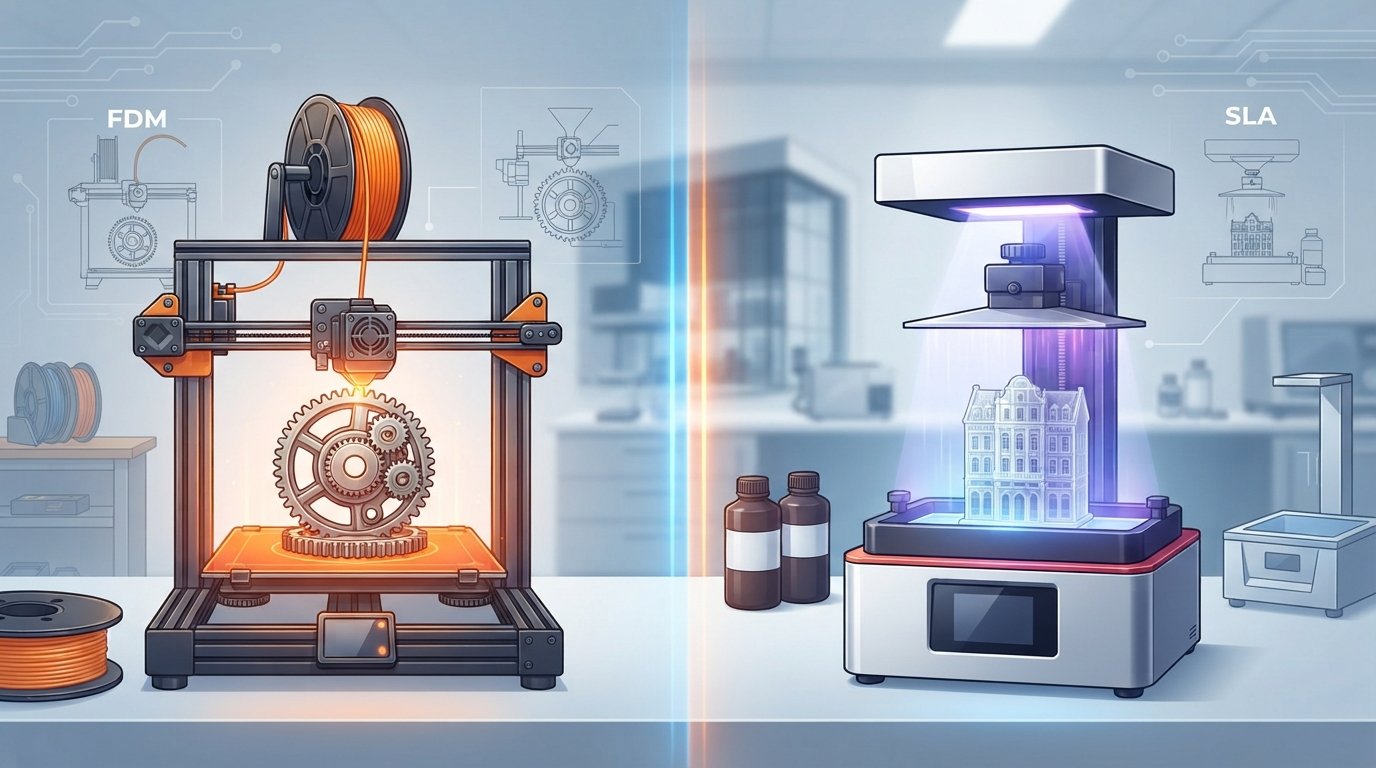
FDM (Fused Deposition Modeling) is an additive manufacturing technology that builds objects layer by layer by melting and extruding thermoplastic filament. Think of it like a hot glue gun that precisely traces out your design, one thin layer at a time, to create a solid object. It's renowned for its versatility and cost-effectiveness, making it a popular choice for functional prototypes, jigs, fixtures, and end-use parts where strength and material variety are key.
SLA (Stereolithography) is another additive manufacturing process, but instead of melting plastic, it uses a UV laser to cure liquid resin into hardened plastic, layer by layer. This process is known for producing incredibly high-resolution parts with smooth surface finishes and intricate details. SLA is often preferred for intricate models, visual prototypes, master patterns for molding, and applications requiring high aesthetic quality.
Feature-by-Feature Comparison
Let's dive into a detailed comparison to highlight the differences and strengths of each technology.
| Criterion | FDM (Fused Deposition Modeling) | SLA (Stereolithography) |
|---|---|---|
| Working Principle | Melts and extrudes thermoplastic filament (e.g., PLA, PETG) through a nozzle, building layers on a heated bed. | Uses a UV laser to selectively cure liquid photopolymer resin in a vat, hardening it layer by layer. |
| Accuracy & Resolution | Good for functional prototypes and larger parts. Layer lines are typically visible. Dimensional accuracy ±0.1mm - ±0.5mm. | Excellent for fine details and intricate geometries. Very smooth surface finish with minimal visible layer lines. Dimensional accuracy ±0.05mm - ±0.15mm. |
| Surface Finish | Characterized by visible layer lines, requiring sanding or post-processing for smooth surfaces. | Very smooth, almost injection-molded quality straight off the printer, ideal for aesthetic models. |
| Material Options | Wide range of thermoplastics like PLA (pla filament kaufen), PETG (petg filament kaufen), ABS, Nylon, ASA, TPU (tpu filament kaufen deutschland), and composites. Ideal for various functional requirements. We also offer Bambu Lab PLA filament, perfect for popular printers like the Ender 3. | Limited to photopolymer resins with varying properties (standard, tough, flexible, castable, dental, high-temp). Colour options are also generally less diverse than FDM. |
| Mechanical Properties | Parts are generally strong and durable, especially with engineering-grade filaments. Anisotropic properties (weaker along layer lines) are a consideration. | Resin parts are typically more brittle than FDM thermoplastics, though new resins offer improved toughness and flexibility. Generally isotropic (uniform strength in all directions). |
| Print Speed | Generally faster for larger, less intricate parts. Print speed can vary significantly based on nozzle size and layer height. | Often slower for large parts due to the precise laser curing process. However, faster for batches of small, detailed parts on some machines. |
| Post-Processing | Support removal (often break-away), sanding, painting, acetone smoothing. Relatively straightforward. | Requires washing in isopropyl alcohol, UV curing (post-curing) to achieve full mechanical properties, and support removal (often fine supports). More steps involved. |
| Cost (Service) | Generally more cost-effective for larger, less detailed parts and functional prototypes. Excellent value for small series in Germany. | Higher cost per part due to more expensive resin materials and extensive post-processing requirements, especially for highly detailed or specialized prints. |
Pros & Cons of FDM
Pros of FDM:
- Cost-Effective: Both the printers and the 3d-druck zubehör kaufen (3D printing accessories) like filament are generally more affordable than SLA equivalents, making it accessible for a wide range of users, including those looking for 3d-filament versand deutschland.
- Wide Material Selection: Offers a vast array of thermoplastic filaments (PLA, PETG, ABS, Nylon, ASA, TPU, etc.) with diverse mechanical and thermal properties. This allows for excellent flexibility in choosing the right material for specific applications, from strong engineering parts to flexible prototypes. You can easily find PLA filament kaufen or PETG filament kaufen for various needs.
- Durability & Strength: FDM parts, especially when printed with robust filaments, are often very durable and suitable for functional applications, jigs, fixtures, and end-use parts. Filaments like Bambu Lab PLA are known for their reliability.
- Larger Build Volumes: FDM printers commonly offer larger build volumes compared to SLA printers in similar price ranges, allowing for printing bigger objects in one piece.
- Ease of Use & Maintenance: Generally, FDM printers are simpler to operate and maintain, with fewer messy chemicals involved than SLA.
Cons of FDM:
- Lower Detail Resolution: Layer lines are almost always visible, leading to a less smooth surface finish. This can be a drawback for aesthetic models or parts requiring very fine details.
- Anisotropy: Parts can be weaker along the Z-axis (layer lines) due to the way layers adhere to each other. This needs to be considered in design and printing orientation for functional parts.
- Slower for Intricate Parts: Printing complex geometries with many small features or overhangs can require extensive support structures, potentially increasing print time and post-processing.
- Warping: Some filaments, particularly ABS, are prone to warping and shrinking, especially on larger prints, which can lead to print failures if not properly managed.
Pros & Cons of SLA
Pros of SLA:
- Exceptional Detail & Smoothness: Produces incredibly high-resolution parts with extremely fine features and smooth, almost invisible layer lines, making it ideal for visual prototypes, intricate jewelry, and art pieces.
- High Accuracy: Delivers superior dimensional accuracy compared to FDM, making it suitable for tight tolerances and precise fits.
- Water-tight & Isotropic: SLA parts are often water-tight and exhibit more isotropic (uniform) mechanical properties compared to FDM, as the resin cures consistently throughout the part.
- Variety of Resins: While fewer than FDM filaments, there's a growing range of specialty resins (flexible, tough, rigid, clear, castable) for specific applications.
Cons of SLA:
- Higher Material Cost: Photopolymer resins are significantly more expensive than FDM filaments, increasing the overall cost per print, especially for larger parts.
- Brittle Parts: Standard resins tend to be more brittle than FDM thermoplastics, which may not be suitable for highly functional or impact-resistant parts. Although, engineered resins are improving.
- Extensive Post-Processing: Requires multiple steps: washing in isopropyl alcohol to remove uncured resin, followed by UV post-curing to achieve optimal strength and hardness. This adds time and complexity.
- Smaller Build Volume: SLA printers typically have smaller build volumes compared to FDM printers, limiting the size of objects that can be printed in a single run.
- Messy & Hazardous Materials: Resins are liquid chemicals that require careful handling, ventilation, and proper disposal. They can be skin irritants.
- Limited Colour Options: Resins come in fewer standard colours compared to the vast spectrum of FDM filaments.
Who Should Choose Each?
The best choice largely depends on your project's specific requirements, budget, and desired outcome.
Choose FDM if:
- You need functional prototypes, jigs, fixtures, or end-use parts where strength, durability, and cost-effectiveness are paramount.
- Your project involves larger parts or components where slight visible layer lines are acceptable.
- You require a wide range of material properties, such as high impact resistance, flexibility, or heat resistance (e.g., using PETG, Nylon, or Bambu Lab PLA Basic).
- Budget is a significant concern, and you're looking for the most economical option for custom 3D printing service in Berlin or across Germany.
- You need parts quickly and are less concerned with ultra-fine details.
Choose SLA if:
- Your project demands exceptional detail, smooth surface finishes, and aesthetic quality (e.g., figurines, jewelry, highly detailed miniatures, display models).
- You require tight tolerances and high dimensional accuracy for precise fitting parts.
- You are creating master patterns for molding and casting, where surface quality is critical for the final product.
- You need water-tight components for specific applications.
- Your design involves intricate geometries, thin walls, or delicate features that FDM might struggle to reproduce without extensive support or compromise.
- You need to create a 3D model from a 3D scan, and the scanned object has fine details you want to replicate with high fidelity.
Verdict: Your 3D Printing Partner in Germany
There's no single "better" technology; only the right one for your specific project. For many functional and cost-sensitive applications in Germany, FDM remains an incredibly versatile and powerful choice, offering robust parts with a vast material selection. If you prioritise intricate details, smooth finishes, and high aesthetic value, then SLA is often the superior option, despite its higher cost and more involved post-processing.
At PrintIn3D.ie, we simplify this decision-making process for you. We offer comprehensive 3D printing services utilizing both FDM and other advanced technologies to match your exact needs. Whether you have a precise CAD file ready for printing, need expert cad modellierung für 3d-druck services to bring a concept to life, or even require 3d-scanning von objekten to replicate an existing part, our team is here to assist. We pride ourselves on offering a hassle-free experience with friendly WhatsApp support, fast turnaround times, and award-winning service.
Don't have a 3D printer? No problem! We are your reliable partner for 3d-druck online bestellen deutschland, delivering high-quality custom 3D prints directly to your door. We also stock a wide range of 3D printing filaments, including PLA filament kaufen and PETG filament kaufen, with fast 3d-filament versand deutschland for those who do print themselves, even specialized TPU filament kaufen deutschland. Let PrintIn3D.ie handle the complexities, so you can focus on your innovation.
Ready to bring your 3D dreams to life? Contact us today to get a quote for your custom 3D printing project in Germany!