FDM vs SLA 3D Printing: Choosing the Right Tech for Your Ireland Project
FDM vs SLA 3D Printing: Which is Best for Your Project in Ireland?
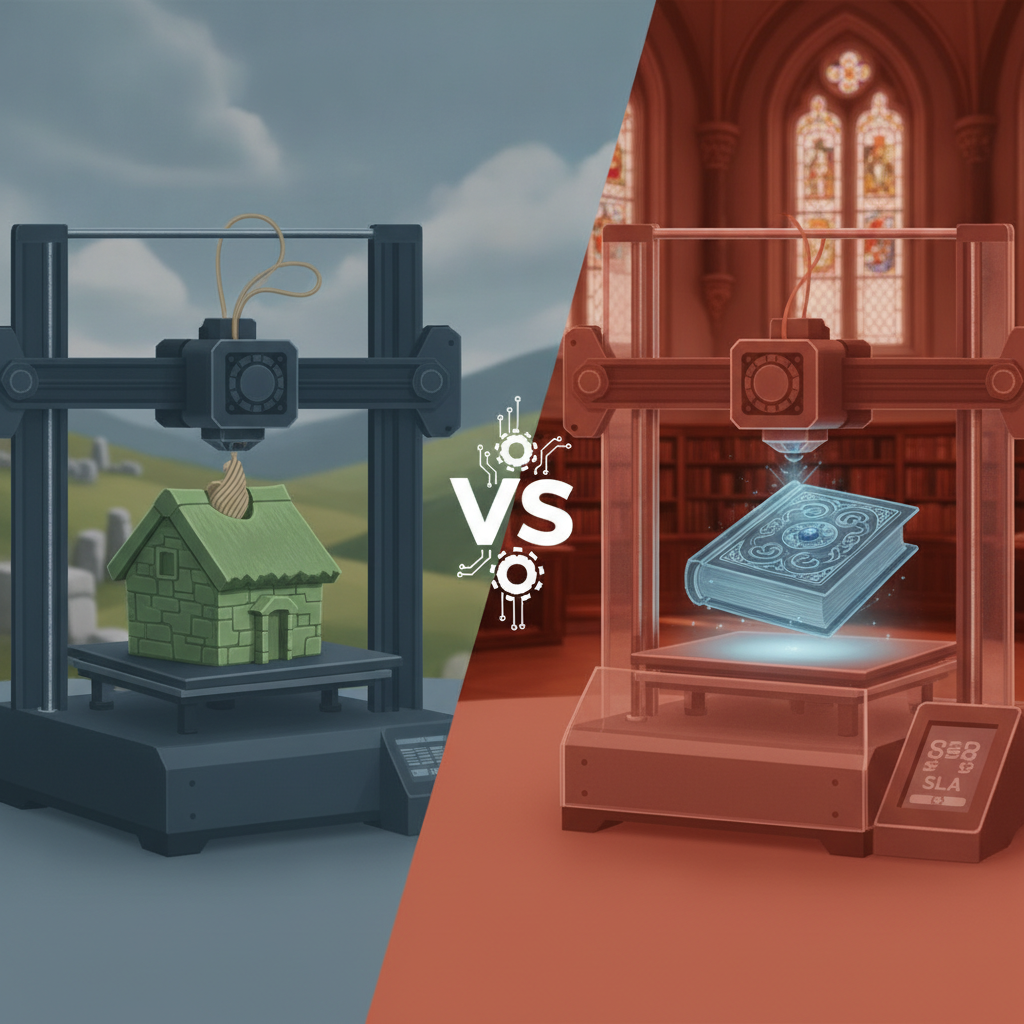
Welcome to the exciting world of 3D printing! As your trusted 3d design and prototyping company, we at PrintIn3D.ie understand that navigating the various technologies can feel a bit overwhelming. Two of the most common and accessible 3D printing methods are FDM (Fused Deposition Modelling) and SLA (Stereolithography). Choosing between them is crucial, as each offers unique advantages suited to different types of projects here in Ireland, whether you're creating intricate models, durable prototypes, or stunning display pieces.
This comprehensive guide is designed to help you understand the core differences between FDM and SLA 3D printing, so you can confidently decide which technology aligns best with your specific needs. From material properties and print resolution to cost and applications, we'll break down everything you need to know to bring your 3D dreams to life, hassle-free.
Quick Overview: FDM vs. SLA
Before we dive into the nitty-gritty, let's get a brief introduction to each technology.
Fused Deposition Modelling (FDM)
FDM, often referred to as FFF (Fused Filament Fabrication), is the most common and widely recognised form of 3D printing. It works by extruding a thermoplastic filament, such as PLA or PETG, through a heated nozzle. This molten material is then deposited layer by layer onto a build plate, where it cools and solidifies to form the desired object. Think of it like a highly precise robotic hot glue gun building up an object from the ground up. FDM is known for its versatility, affordability, and ability to produce strong, functional parts.
Stereolithography (SLA)
SLA is a resin-based 3D printing technology that uses a liquid photopolymer resin and an ultraviolet (UV) laser or projector to cure and solidify the resin layer by layer. The laser draws out each cross-section of the object in the resin vat, causing it to harden. Once a layer is complete, the build plate moves slightly, and the process repeats until the entire object is formed. SLA is renowned for its exceptional detail, smooth surface finish, and ability to create intricate designs with high accuracy.
Feature-by-Feature Comparison
To help you compare FDM and SLA more easily, let's look at their key characteristics side-by-side.
| Criterion | FDM 3D Printing | SLA 3D Printing |
|---|---|---|
| Printing Method | Extrudes melted thermoplastic filament layer by layer from a nozzle onto a build plate. | Uses a UV laser or projector to selectively cure liquid photopolymer resin in a vat, solidifying it layer by layer. |
| Materials Used | A wide variety of thermoplastics like PLA, PETG, ABS, Nylon, TPU, and exotic blends. These are available as Bambu Lab filament Ireland options and other brands. | Liquid photopolymer resins (thermosets) with various properties: standard, tough, flexible, castable, clear, dental, biocompatible, etc. |
| Print Resolution & Detail | Typically good, but visible layer lines are common. Best for larger, less intricate parts. Layer heights generally range from 0.1mm to 0.4mm. | Excellent, with very fine details and intricate features. Minimal to invisible layer lines. Layer heights can be as fine as 0.025mm. |
| Surface Finish | Matte to slightly glossy, often requires post-processing (sanding, painting, acetone smoothing) for a smoother finish. | Very smooth, often glassy or shiny straight off the printer, resembling injection-moulded parts. Minimal post-processing usually needed. |
| Strength & Durability | Generally strong and durable, especially with materials like PETG or ABS. Parts can be anisotropic (weaker along layer lines). Suitable for functional prototypes and end-use parts. | Often more brittle than FDM thermoplastics in their standard form, though engineered resins offer improved toughness and flexibility. Isotropic properties (uniform strength in all directions). |
| Cost (Materials) | Generally more affordable per kilogram. 3D printer filaments are widely available and cost-effective. | Resins are typically more expensive per litre than FDM filaments. Specialized resins can significantly increase costs. |
| Speed | Generally faster for larger, less detailed parts. Print speed depends on layer height and infill. | Print speed can vary. For very detailed prints, SLA can be slower per layer, but the process of curing an entire layer at once (DLP/LCD) can make it faster for some geometries. |
| Post-Processing | Support removal (often simple snap-off), potential sanding, painting, or solvent smoothing. | Support removal (can be delicate), washing in isopropyl alcohol, and mandatory UV post-curing to achieve full material properties. |
Pros & Cons of FDM 3D Printing
Pros of FDM:
- Cost-Effective: Both FDM printers and their filaments are generally more affordable, making it a budget-friendly option for many projects.
- Wide Material Choice: Access to a vast range of 3D printer filaments, including PLA, PETG filament Ireland, ABS filament Ireland, and flexible TPU, each offering different properties like strength, flexibility, or heat resistance. You can easily buy Bambu Lab filament Ireland through us.
- Strong & Functional Parts: FDM is excellent for producing strong, durable functional prototypes, jigs, fixtures, and end-use parts.
- Large Build Volumes: FDM printers often have larger build volumes, allowing for bigger prints or multiple smaller parts in one go.
- Easier Post-Processing: For many applications, FDM parts require minimal post-processing beyond support removal.
- Environmentally Friendlier Options: Many FDM filaments, especially PLA, are derived from renewable resources and can be more easily recycled than resin.
Cons of FDM:
- Lower Detail & Surface Finish: Visible layer lines are inherent to the process, leading to less smooth surfaces compared to SLA. Fine details can be challenging.
- Anisotropy: Parts tend to be weaker along the Z-axis (layer adhesion) due to the nature of layer-by-layer deposition.
- Tolerances: Dimensional accuracy can be less precise than SLA, especially for very small features.
- Supports Can Leave Marks: While generally easy to remove, supports can sometimes leave minor blemishes on the surface.
Pros & Cons of SLA 3D Printing
Pros of SLA:
- Exceptional Detail & Accuracy: SLA is unparalleled for producing highly detailed, intricate models with smooth surfaces and tight tolerances.
- Smooth Surface Finish: Prints often have a glossy, injection-moulded look directly off the printer, reducing the need for extensive sanding.
- Isotropic Properties: SLA parts have uniform strength in all directions, as the entire layer is cured at once.
- Variety of Specialty Resins: A growing range of resins offers specific properties such as flexibility, rigidity, heat resistance, castability, and even biocompatibility for dental or medical applications.
- Ideal for Visual Prototypes & Artistic Models: Perfect for creating realistic visual prototypes, models for display, jewellery moulds, and dental models. Many custom 3D printed gifts Ireland can benefit from SLA's detail.
Cons of SLA:
- Higher Cost: SLA printers and especially the resins are typically more expensive than FDM counterparts.
- Brittle Parts: Standard resins can produce brittle parts, though advanced resins are improving durability.
- Messier Post-Processing: Requires washing parts in isopropyl alcohol and mandatory UV post-curing, which can be a bit messier and adds an extra step to the workflow.
- Smaller Build Volumes: SLA printers generally have smaller build volumes than FDM printers, limiting the size of objects that can be printed.
- Material Handling: Liquid resins require careful handling, storage, and disposal due to their chemical nature.
- Limited Material Strength for Some Applications: While strong for detail, certain engineering applications may still prefer the robust nature of FDM thermoplastics.
Who Should Choose Each
Understanding the strengths and weaknesses of FDM and SLA is key to making the right choice for your project. Here’s a breakdown of who each technology is best suited for:
Choose FDM if:
- You need functional prototypes or end-use parts: FDM's strength and material variety make it ideal for parts that need to withstand stress or be used in real-world applications. This is excellent for custom prototype manufacturing Ireland for initial testing.
- Cost-efficiency is a top priority: If you're on a budget for materials or multiple iterations, FDM is generally more economical.
- You require large parts or objects: FDM printers often have larger build volumes, suitable for bigger components or batch production.
- Durability and a variety of material properties are important: Whether you need stiff, flexible, or impact-resistant parts, FDM has a filament for it.
- Speed is essential for larger models: For less intricate objects, FDM can often produce parts faster.
- You're looking for common household items or tool parts: From home organisation solutions to simple replacement parts, FDM shines.
Choose SLA if:
- You need high detail and a smooth surface finish: For intricate designs, figurines, jewellery, or models where aesthetics are paramount, SLA is the clear winner.
- Precision and tight tolerances are critical: If your project involves very small features or requires high dimensional accuracy, SLA delivers.
- You're creating visual prototypes or master patterns: For presentations, moulds for casting, or architectural models, SLA provides the polished look you need.
- You require specialised resin properties: Specific applications like dental models, hearing aids, or parts needing transparency can leverage SLA's unique resins.
- You're developing products that require intricate 3d product design services Ireland: When detail is integral to the product's function or aesthetic, SLA will bring your complex designs to life beautifully. If you're wondering how to get a 3d model made with exceptional fidelity, SLA is often the answer.
- You have 3d scanning data that needs to be reproduced with accuracy: For reverse engineering or replicating complex organic shapes from a scan, SLA maintains fidelity.
Verdict: Making the Best Choice for Your Irish Project
Ultimately, the "best" 3D printing technology for your project in Ireland isn't about one being inherently superior, but about which one better suits your specific requirements. Think about what truly matters for your project: Is it the absolute finest detail and surface finish, or is it strength, durability, and cost-effectiveness?
- For functional prototypes, robust mechanical parts, jigs, fixtures, and everyday utility prints where strength and material variety are key, and a slightly rougher finish is acceptable, FDM is often the preferred choice. It's a fantastic solution for rapid prototyping for startups and businesses seeking efficient, budget-friendly manufacturing.
- For highly detailed aesthetic models, intricate jewellery, precise visual prototypes, or medical/dental applications where a smooth surface and accuracy are paramount, SLA excels. If your project demands museum-quality finishes and minute features, SLA is the way to go.
At PrintIn3D.ie, we're proud to be an award-winning service, recognised as a 'Rising Star' at the Irish Print Awards 2026. We offer both FDM and SLA custom 3D printing services, ensuring you always have access to the right technology for your needs. Whether you're in need of a reliable 3d printing service Dublin or anywhere across Ireland, we're your partner in bringing ideas to life.
Our friendly experts are always here to help you weigh the options, discuss your project's unique demands, and guide you towards the perfect solution. With our hassle-free process, fast turnaround times, and 30-Day Risk-Free Return policy, you can explore the possibilities of FDM and SLA with complete confidence.
Ready to start printing your 3D dreams? Upload your design today and let PrintIn3D.ie be your trusted 3D printing partner!